 Sialkot, Pakistan
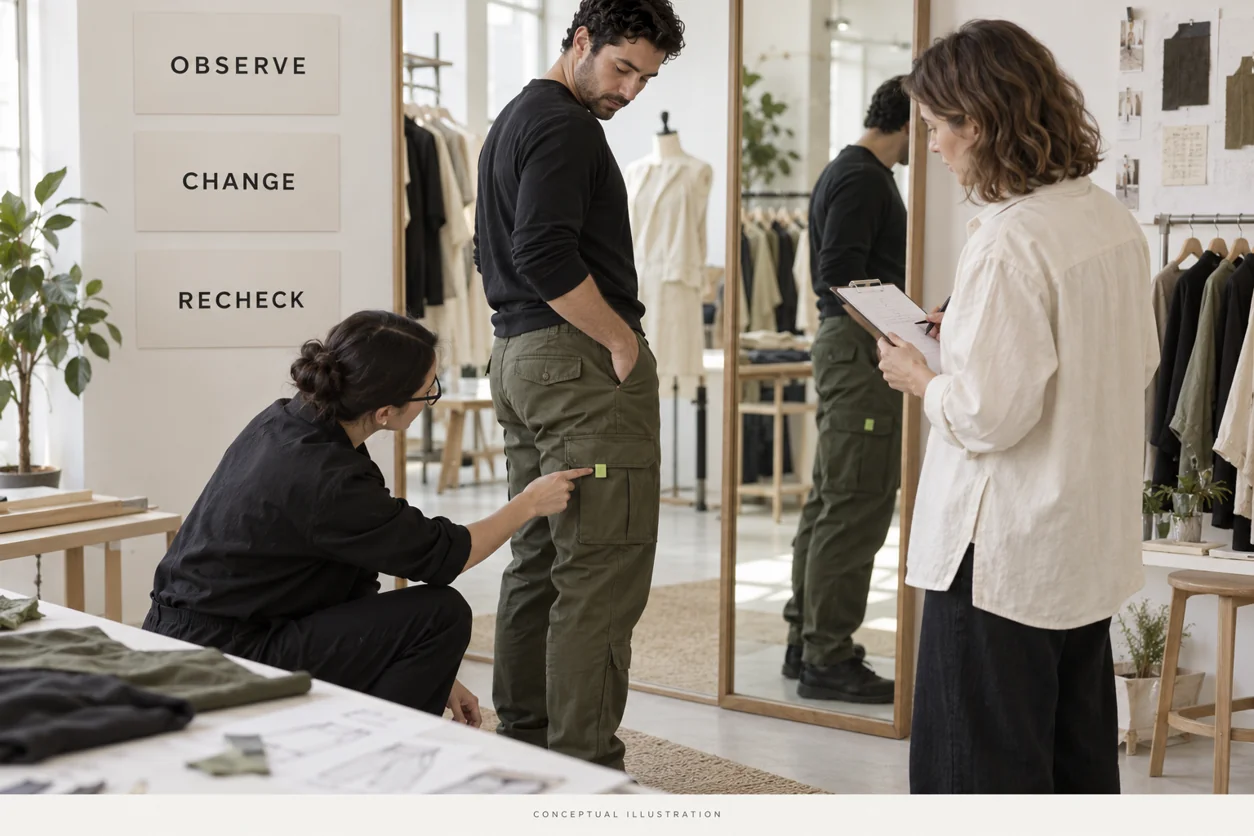
Place cargo pockets on the complete worn trouser, then define their edges against named garment reference points. Approve the position together with the opening, pocket shape and closure: a pocket can look balanced in a flat photograph yet be awkward to reach or uncomfortable when the wearer sits. There is no single pocket height or size that suits every cargo silhouette.
For a clothing brand, the useful decision is what this pocket should do in this particular pair of cargos. A clean wide-leg streetwear trouser, a relaxed everyday cargo and a more detailed utility design can need different pocket proposals. This guide shows how to turn that decision into a clear placement drawing and a practical sample review.
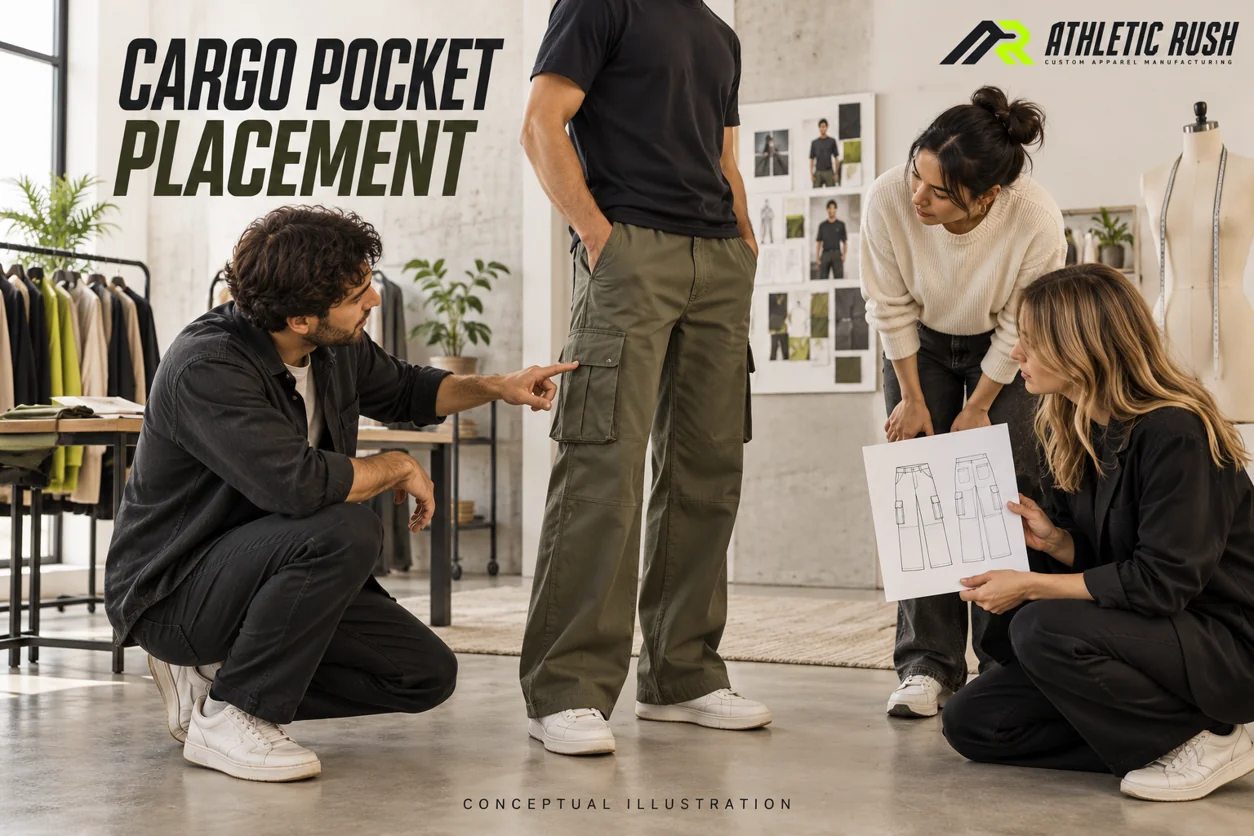
The six original images in this guide are conceptual illustrations. They explain design choices and inspection steps; they are not photographs of available inventory, customer orders or measured test results.
Decide the pocket's job before drawing its outline
Start with the intended wearer and wearing routine. Is the thigh pocket mostly a visual feature, intended to hold a named everyday item, or part of a more specific functional brief? Write that down before requesting a larger pocket or a more complicated flap. An impressive pocket outline does not establish useful storage.
Consider these three illustrative design briefs:
- Clean wide-leg cargo: the pocket supports the leg's visual shape, with restrained projection when empty. Decide whether it needs functional storage or simply a defined, usable opening without a particular carrying claim.
- Relaxed everyday cargo: the wearer should be able to reach an agreed everyday object during ordinary use. Bring that object or an identified size reference to the sample review; do not rely on an unspecified “phone pocket.”
- Layered utility cargo: multiple pockets create a deliberate visual arrangement. Assign each pocket a role, and review access with the intended top and outer layer so that one opening does not interfere with another.
These are development directions, not universal product categories or performance ratings. Explore Athletic Rush's cargo pants development page, then describe which visible features matter to your own range.
Separate the pocket's external outline from its usable interior. A flap can extend beyond the opening. Folded edges, internal divisions and the closure can also make the space different from the shape seen in a photograph. Ask the supplier to show both the exterior and the actual opening of the proposed sample.
If carrying an item is part of the brief, identify the item, its orientation and the review conditions. For example, “check the supplied phone-size reference upright while standing and seated” is more useful than “fits all phones.” A successful fit check with one object does not establish capacity for other objects or a load rating.
Build a placement map that another person can repeat
A reference photograph communicates appearance, but it often hides waistband position, body proportions and perspective. Translate the image into a garment drawing with named points. Agree whether the drawing shows the garment flat, worn, or both; these views answer different questions.
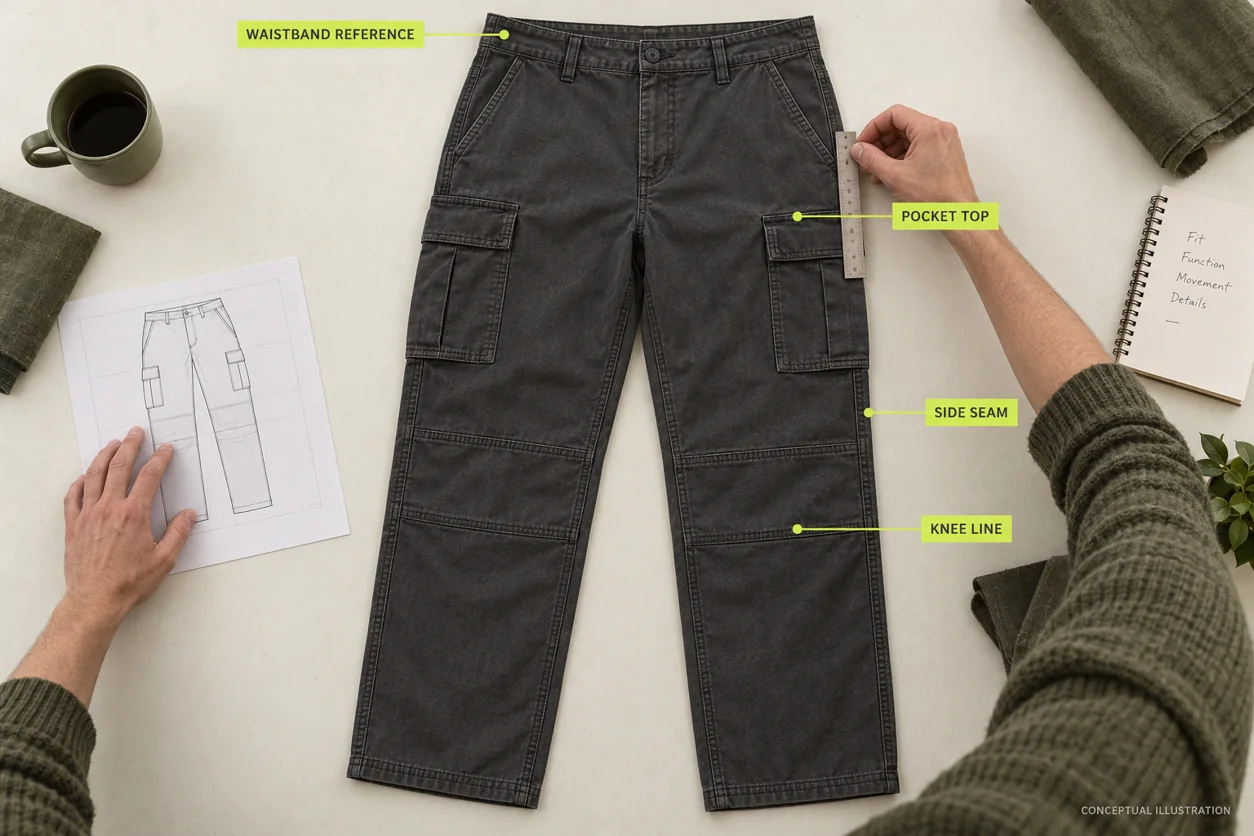
For the flat specification, define the relevant references before entering values. Useful points can include the chosen waistband edge, the side seam or another identified seam, the pocket's top edge, and a knee reference established for that pattern. The knee line is a design reference to agree, not a universal mark that can be copied from any trouser.
State where each measurement begins and ends. “Pocket top below waistband” is incomplete if one person measures from the upper edge and another from the waistband seam. A small annotated drawing is often clearer than a longer description. For an angled or shaped pocket, specify the relevant corners rather than treating it as a simple rectangle.
Use one stated unit system throughout the drawing and chart, such as centimetres or inches. A notation template could read: “Pocket top: A centimetres below the upper waistband edge on the identified base size; outside pocket edge: B centimetres from the named side seam.” Replace A and B with the agreed sample measurements, define the measuring direction on the drawing, and agree the permitted variation. This template illustrates how to write a specification; it does not recommend a placement value.
Record these elements as separate decisions:
- Vertical position: the agreed reference and the exact pocket point being located.
- Side-to-front position: whether the pocket sits around the side seam, more toward the front, or in another defined location.
- Pocket outline: width, depth, corner shape and any angle, with a drawing that identifies the measured points.
- Opening and flap: opening length and direction, flap coverage and closure positions.
- Size-range treatment: which details remain fixed and which change across sizes, with the supplier's proposal recorded.
Approve garment measurements and worn appearance separately. Two trousers can have the same pocket measurement from a waistband edge yet place the pocket differently on the wearer because the rise or worn waistband position differs. Record the intended waist position and reference wearer when comparing sample photographs.
Ask how the pocket is treated across the size range. Keeping the same pocket for every size and changing pocket dimensions by size are different design proposals; neither should be assumed from one approved middle-size sample. Check selected sizes that reveal the important proportion differences in your intended range.
Use clear front, side and rear views with a consistent stance and camera position. A pocket that looks balanced from the front may project differently from the side. If you revise the rise or thigh width after approving placement, review the pocket again on the revised garment rather than assuming the earlier approval still describes it.
Choose the pocket shape and opening together
A flat patch pocket is a piece attached to the garment with a usable opening. A bellows pocket includes folded sections or gussets that allow the pocket shape to project. These descriptions identify construction ideas; the exact shape, usable space and appearance depend on the supplied sample.
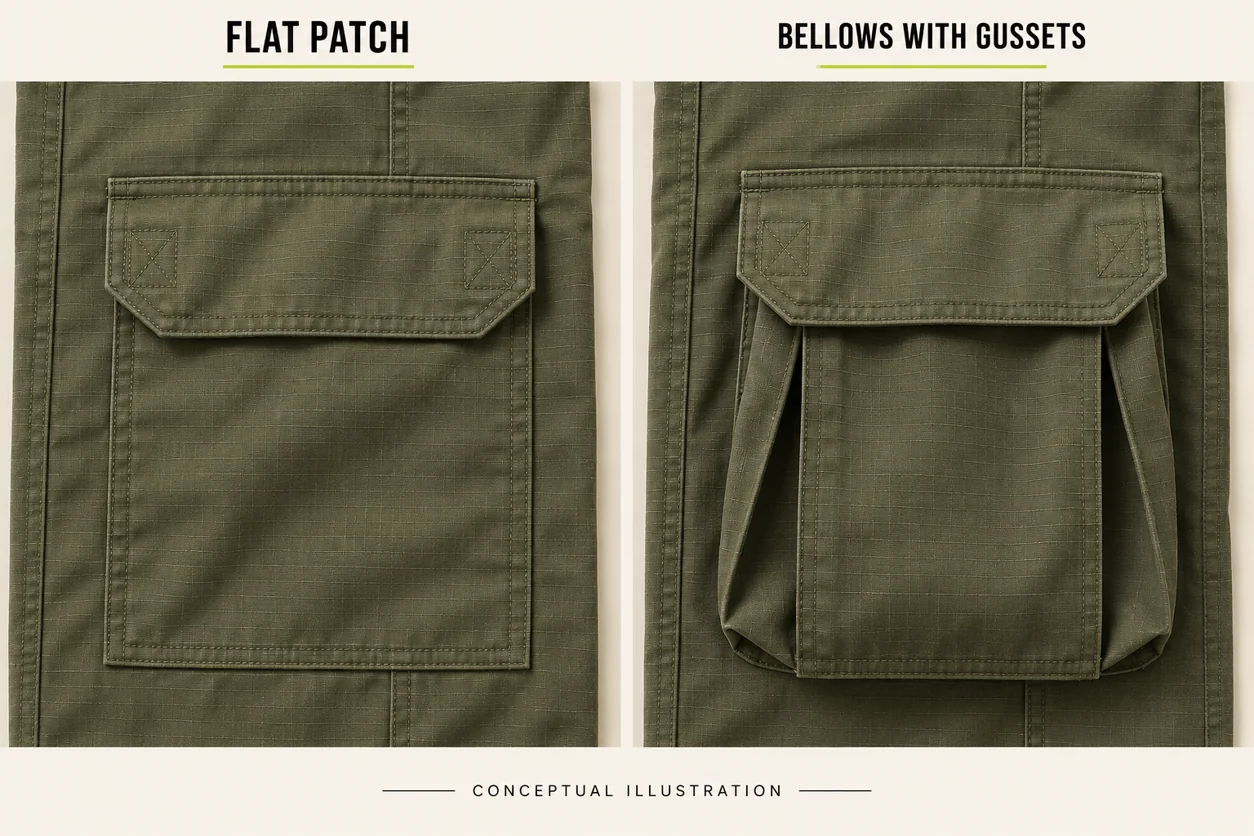
For a restrained cargo, compare how a flat patch sits when empty and with the agreed reference item. If you want a more pronounced utility shape, inspect the bellows proposal in both states. Do not choose a gusset solely from an empty studio image and then overlook the appearance when it is in use.
Pocket depth, opening access and external width are separate variables. Making the outline wider may not solve an opening that is hard to operate. Making the pocket deeper may change where an object rests, but it does not automatically make retrieval easier. Diagnose the observed problem before changing dimensions.
| Pocket proposal | Buyer decision | Useful sample check |
|---|---|---|
| Flat patch with an open top | Is the restrained outline suitable, and is the opening appropriate for the intended use? | Review empty appearance and access with the agreed item; examine what happens when sitting |
| Flat patch with a flap | Does the flap give the desired coverage without awkward operation? | Lift and close the flap on the worn garment; check coverage and hand access |
| Bellows pocket | Is the visible projection part of the desired silhouette? | Compare the folded form empty and in the intended use state; view the leg from the side |
| Pocket with an internal division | Does the division organize the named item usefully? | Show the actual interior and try the intended orientation without assuming the outer outline defines usable space |
| Pocket with a zip opening | Is the opening direction and operation suitable for this location? | Operate it on the worn sample and inspect the surrounding fabric and inside finish |
This is a design comparison, not a ranking of security, strength or carrying capacity. If a particular functional claim matters, define it and agree the evidence needed before using it in product copy.
The body fabric also affects the proposal you are reviewing. Keep the intended material and finish linked to the pocket sample. Our cargo pant fabric guide explains how to compare identified materials without attributing every garment difference to a fabric name.
Review reach and sitting on the complete garment
An access review should use the waistband position, wearer and intended use agreed in the brief. First inspect the empty garment. Then, where carrying is intended, introduce the identified reference item and record the condition. Keep those two observations separate so a supplier understands what changes when the pocket is used.

Try the actions that matter to the design: reaching the opening while standing, sitting normally and taking a step or bend relevant to the wearing routine. Observe where the hand approaches, whether the flap must be held out of the way, and whether the wearer needs to twist into an awkward position. Ask about pressure or restriction rather than inferring comfort from a still image.
Check the pocket in relation to the knee and seat as the leg bends. Record any unwanted contact, pulling, opening or projection. The useful comment is specific: “with the agreed reference item, the lower pocket area presses against the thigh while seated.” That identifies a condition to investigate without assuming that moving the pocket, changing its shape or changing the fit is the only solution.
If the trouser has several pockets, review their interaction. Can the wearer use the upper hand pocket without disturbing the thigh flap? Does a longer overshirt cover the intended access point? Is the object being carried visible in the outline in a way the brand accepts? These are questions for the complete outfit and wearer, not just the drawing.
Avoid changing several variables in a single unexplained revision. If the first sample has awkward access, ask the supplier to identify the proposed change: position, opening angle, flap, internal depth, or garment fit. Review that change under the same relevant conditions. Consistent photographs help show whether the original concern was addressed.
A practical wear review supplies design feedback. It is not a standardized load test, a long-term durability result or evidence that valuables will stay secure in every situation. Keep the claims you plan to make separate from the informal observations you have collected.
Specify the closure and inspect the attached detail
Name the closure operation you want. A button, a snap and a zipper require different actions, and their appearance can also differ. Decide whether hardware should be visible, concealed by the flap or restrained in colour. Then review the actual attached component instead of approving it solely from a trim photograph.
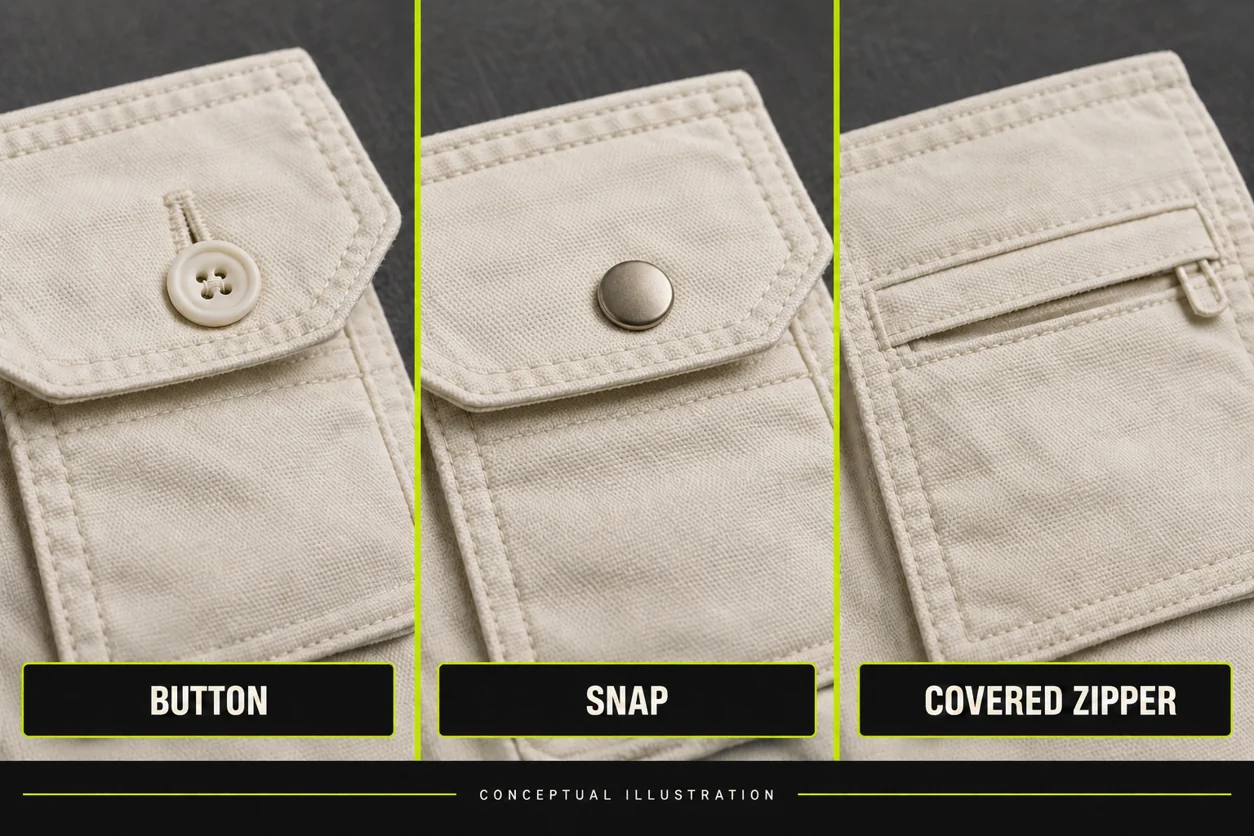
For a button, operate it through the actual buttonhole and inspect the inside finish. For a snap, open and close the attached pair while supporting the garment normally, and note any visible distortion or difficult operation. For a zipper, review the opening direction, access to the puller and the fabric around the opening. Record the exact component reference and proposed attachment where these details matter.
Inspect the pocket edges, corners, reverse and attachment points. Look for the agreed finish, unobstructed opening and a consistent construction proposal. If a corner looks uneven or a closure pulls the fabric out of shape, identify the location and sample condition in your correction. A photograph of dense stitching or a bar tack alone does not establish the strength of the assembled pocket.
For a woven garment, formal seam evidence is a separate discussion. The public scope of ASTM D1683/D1683M concerns sewn seam strength and failure under specified testing; it also states that the method does not predict actual seam wear performance. It is not a complete-pocket carrying test. Ask a qualified supplier or laboratory which assessment is relevant to your particular requirement rather than treating any seam result as proof of every pocket claim.
If care is part of the review, document the garment revision and procedure, then repeat the relevant opening and appearance checks after the agreed care. Compare the same reference points and note any change. AATCC TM150's public summary addresses garment length and width changes after home laundering, with limitations for certain stretch fabrics. Those dimensional observations do not, by themselves, establish closure reliability or pocket strength.
Write a correction that leads to a useful next sample
Keep an observed issue separate from a proposed solution. The buyer can describe the desired result while asking the supplier to explain the construction or placement change. That leaves room for a technically appropriate revision and creates a traceable decision.
| Observation on the sample | Clear revision instruction |
|---|---|
| The empty pocket projects farther than the approved visual reference | Identify a revised pocket shape or construction proposal that reduces the unwanted projection; retain the agreed material for comparison |
| The wearer can reach the opening standing but struggles while seated | Show the proposed access change and repeat the seated review with the same waistband position and reference item |
| The reference item fits inside but is awkward to retrieve | Review the opening and interior separately; do not enlarge the whole pocket without explaining the reason |
| The flap appears balanced on one size but disproportionate on another | Propose and document the size-range treatment, then show the affected sizes in comparable views |
| The snap operation visibly distorts the surrounding fabric | Review the exact attached component and local construction; provide a revised garment detail for operation checks |
For example, an illustrative brief might say: “We want an olive wide-leg cargo with a restrained thigh pocket when empty. Identify the pocket position from the agreed waistband edge and side seam. Review access to the supplied item reference standing and seated. If access is awkward, explain the proposed change before revising the pocket dimensions.” This is a fictional development request, not a customer order or an agreed product specification.
Before approving the version for production, retain the placement drawing, identified garment sample, material and closure references, relevant review photographs, size-range decision and resolved corrections. State exactly which revision is accepted. A new pocket component or revised trouser pattern should be reviewed for the differences relevant to the earlier approval.
Questions clothing brands ask about cargo pockets
How high should a cargo thigh pocket sit?
Set the position for the intended silhouette and wearer, then document it from named garment points. There is no universal height to copy into every cargo. Check the worn appearance, reach and bent-leg condition before approving the drawing and sample together.
Should every size use the same cargo pocket?
Agree the size-range proposal explicitly. A fixed pocket and a pocket adjusted across sizes are different choices. Inspect the proportions and function in selected relevant sizes; an approval of one sample size does not settle the whole range.
Does a bigger bellows pocket automatically hold more comfortably?
The outer appearance does not answer that question. Review the actual interior, opening and identified item in the complete trouser. Observe the worn outline and seated condition, then decide whether the proposal meets your brief.
Can I approve the pocket from a flat drawing only?
Use the drawing to define the repeatable specification. Also review the physical garment for operation, inside finish, hand access and worn behavior. Keep those observations linked to the same revision so the supplier knows what was accepted.
Discuss a cargo pocket proposal for your range
A useful pocket brief connects three things: its intended job, its repeatable placement and its behavior on the actual trouser. Choose the relevant checks before sampling and use precise observations to guide the revision.
Athletic Rush develops custom apparel from Sialkot, Pakistan. Send your cargo reference, silhouette, pocket-use priorities and any identified item reference to kamran@athleticrush.co or WhatsApp +923279008337 to discuss a development sample. Start with the cargo pants page if you are comparing design directions.