 Sialkot, Pakistan
Choose overshirt fabric by matching an identified material to the intended silhouette, underlayer and finished construction. A swatch helps you shortlist the surface and feel. A built collar, placket and cuff show how the material works in the design. The complete sample shows whether the chosen combination meets your brief.
For a clothing-brand buyer, the useful question is: which material gives this overshirt the appearance and wearing result I want, and what evidence should I request before ordering? Cotton plain wovens, twills and canvas proposals are starting directions. Their names, colour or GSM alone do not answer the whole question.
This guide focuses on unlined, woven streetwear overshirts. Treat “overshirt” or “shacket” as a starting product description, then define the actual garment. Lined, insulated or specialist protective styles need a different construction and evidence brief.
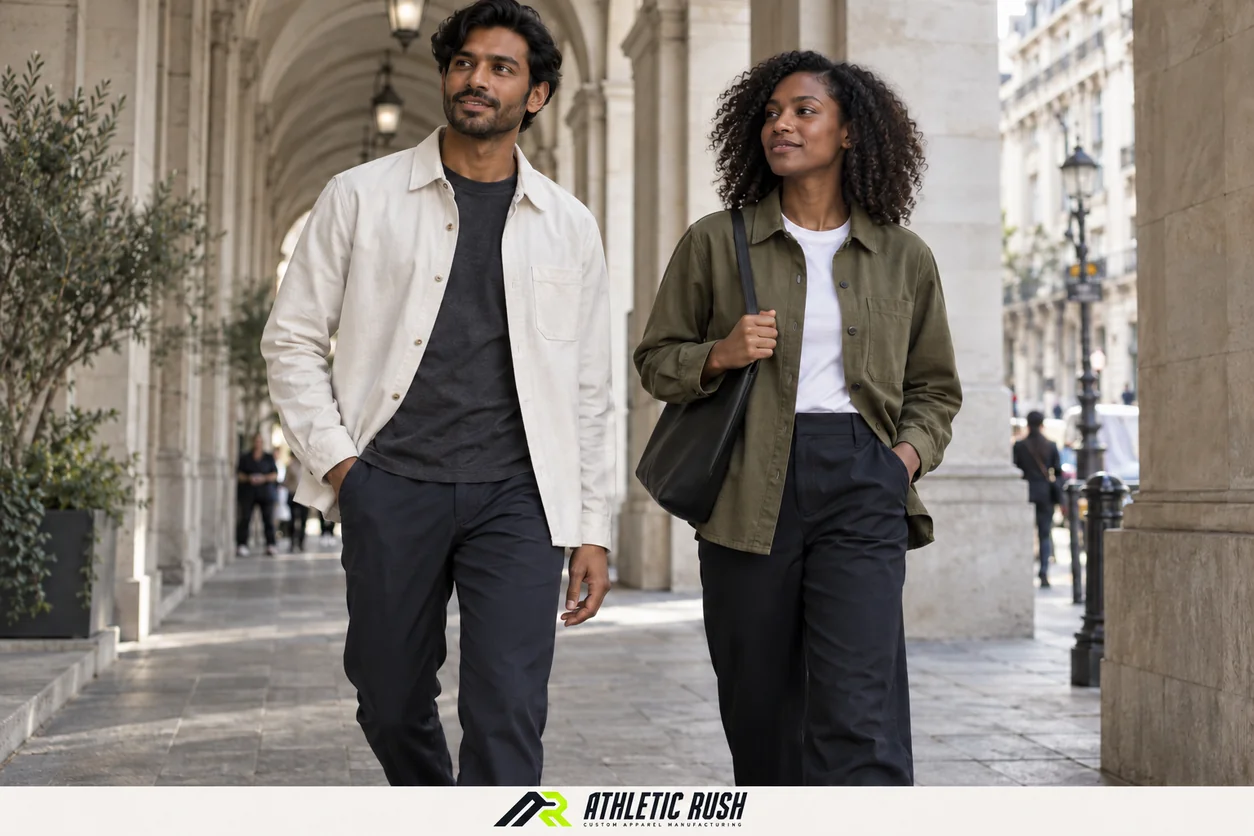
All six images are original conceptual illustrations. They explain material and review choices; they are not photographs of Athletic Rush inventory, customer orders or measured test results.
Start with the overshirt's job in the outfit
Decide what the customer will wear underneath, how the front will usually be worn, and how much visual structure you want. A relaxed overshirt worn open over a tee and a boxy outer layer worn closed over a hoodie can call for different development decisions, even when both are described as cotton overshirts.
Write the intended result in observable terms. “The hem should hang close to the body” is more useful than “premium drape.” “The collar should retain the approved outline without feeling bulky at the neck” tells the maker more than “strong fabric.” Identify the reference garment or image, then distinguish the features to keep from those still open for development.
Use named proposals to make the discussion concrete. The examples below are hypothetical buyer briefs, not tested material recommendations or stock specifications.
| Illustrative overshirt brief | Material direction to investigate | What the sample needs to show |
|---|---|---|
| Ivory shirt-like layer, usually open over a charcoal tee | A fine plain-woven cotton proposal with the desired surface and fold | Open-front hanging shape, visibility of the underlayer and collar appearance |
| Navy everyday layer, worn both open and closed | An identified cotton twill proposal | The diagonal surface, body and sleeve outline, and comfortable access to the intended underlayer |
| Olive boxy workwear-inspired layer with prominent pockets | An identified cotton canvas proposal | The intended body shape, folded-detail bulk and pocket appearance in the complete garment |
These are three different garment proposals. If their patterns, finishes and underlayers also differ, do not attribute the result to the fabric name alone.
For a small collection, decide whether you need three distinct roles or one overshirt offered in several colours. The same material reference in a new colour still needs the relevant shade and garment checks. A different material is a development change, not simply another colour option.
Read a fabric proposal as several separate facts
Fibre composition and weave answer different questions
“Cotton” describes fibre content. “Twill” describes a weave direction. Neither word supplies a complete material identity. Ask for the composition, construction, supplier reference, colour reference and stated finish of each candidate.
CottonWorks' basic woven fabric guide explains plain weave as alternating yarn interlacing and twill as a construction with a diagonal line. It lists canvas among common plain-weave fabrics. That means canvas and plain weave are not competing basic-weave categories. A fine plain-woven sample and a canvas proposal can share a broad construction family while remaining quite different material proposals.
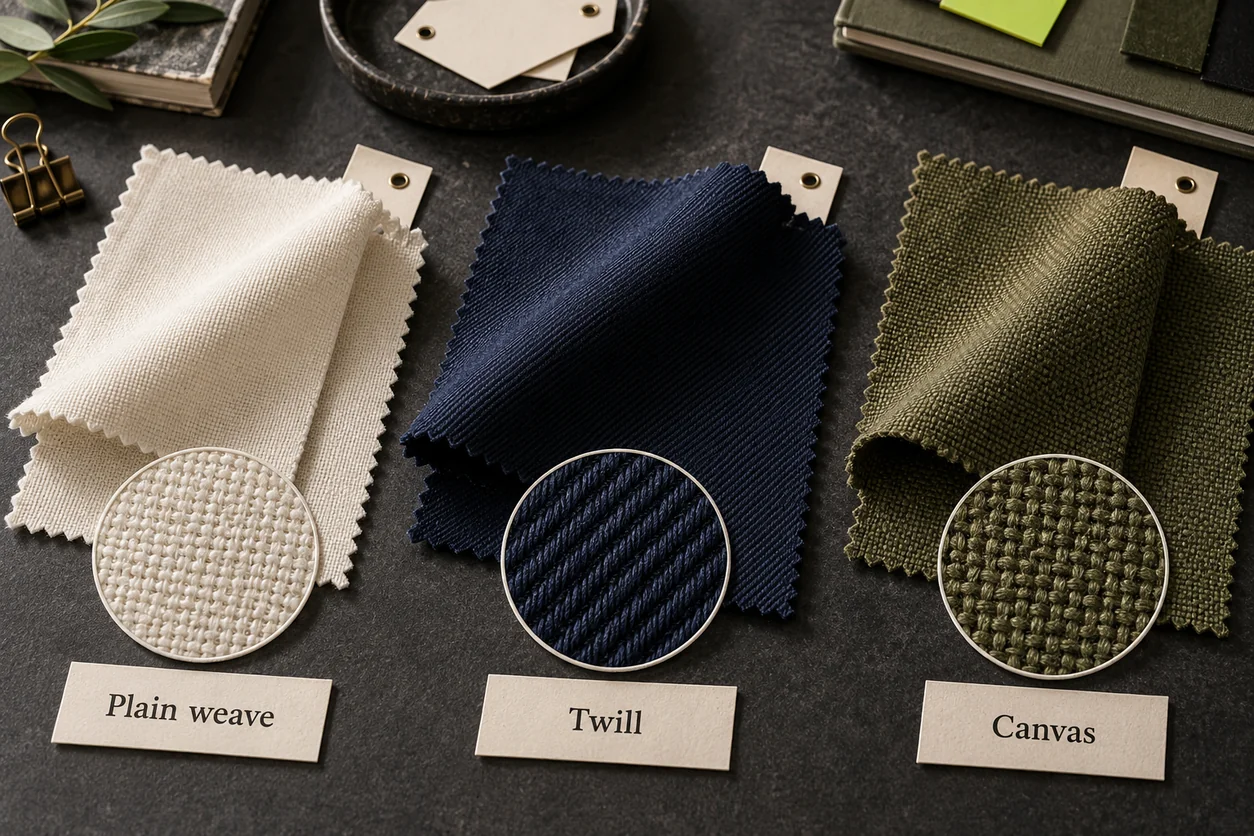
For the buyer, the next step is to examine the actual sample rather than assign a universal property to the label. Look at the face and reverse, the visible texture, the fold and the way the fabric feels against the planned underlayer. Ask the supplier to clarify an ambiguous trade name.
Do not infer fibre composition, stretch content or a performance finish from the photograph. If a particular composition or functional claim is essential, agree what supporting documentation or testing is needed. Keep a supplier statement clearly identified as a statement until the required evidence has been reviewed.
GSM is a mass reference, not the complete garment result
When expressed in grams per square metre, GSM records fabric mass per unit area. It does not directly specify thickness, stiffness, warmth or the total weight of a finished overshirt. Use it to identify and compare the proposed materials, alongside the other recorded details.
ASTM D3776/D3776M's public scope covers fabric mass per unit area using different specimen options. Its small-swatch result applies to the sample and does not necessarily establish the whole lot. If measured mass matters to acceptance, ask how the value was obtained, which specimen it represents and how production material will be checked.
Avoid asking only for “the best overshirt GSM.” Explain the silhouette, wearing layer and construction first. Ask for a justified shortlist with identified samples. There is no universal weight prescribed in this guide, and increasing the number is not a substitute for reviewing the garment.
Record whether a value is the supplier's nominal specification or a measured result. Keep the method, units and sample condition with any measurement. A loose swatch and a garment with pockets, facing, trims and folded assemblies are different objects.
Finish and sample condition belong in the identity
Ask what treatment or finishing is included in the proposed material and whether the submitted swatch represents the intended production condition. If the finished garment will receive an additional process, identify that separately.
A finish name is not a complete recipe or evidence of a particular outcome. Request the supplier's description and the corresponding sample. Keep an initial reference so that later changes in surface, fold or appearance can be discussed against something identifiable.
For example, if the navy swatch is accepted for its surface but the next garment uses a revised finishing route, record the change. Do not carry the old material approval forward without reviewing the relevant result.
This distinction is useful when comparing quotations too. Two proposals called “cotton twill overshirts” may still differ in material identity and finished construction. Settle those differences before treating the offers as equivalent.
Compare the loose cloth before building the whole garment
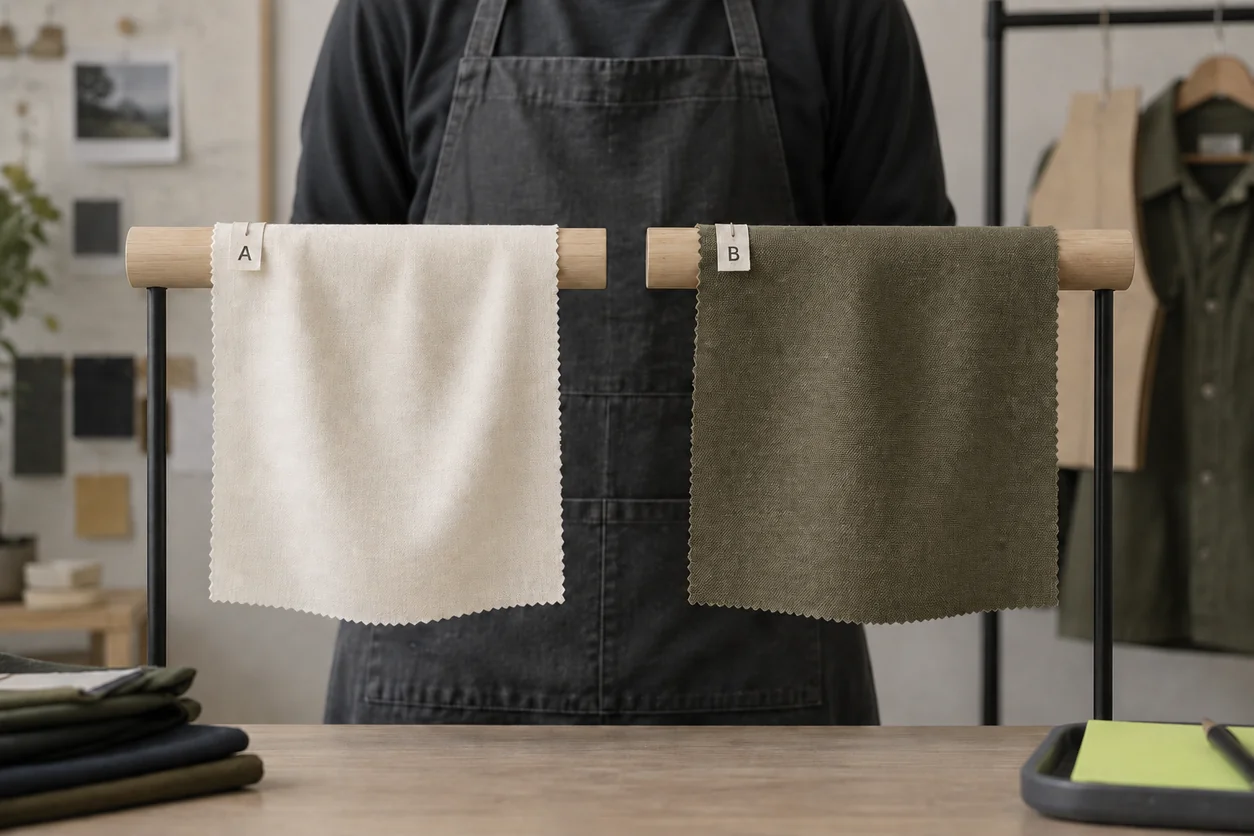
Give shortlisted samples references such as Material A and Material B. Keep their identity cards attached through the review. Compare them in the same relevant condition and lighting.
Fold each sample, hold it in the same orientation and let it hang over the same support without pulling it taut. Note the fold and hanging outline. Use comparable sample dimensions when the purpose is a practical comparison. These observations help shortlist appearance; they are not a standardized stiffness or drape test.
Then look at the intended colour over the planned underlayer. For an ivory overshirt, view the selected tee beneath it in the situations that matter to the brief. Record whether the amount of show-through is acceptable. A favourable close-up of fabric on a table does not establish the worn appearance over a dark top.
Feel the face and reverse and ask the wearer about contact at the neck and wrist. Keep this feedback as practical wearer feedback. Do not convert it into a general claim about comfort, skin suitability or cooling.
If you want to investigate one material change, keep the pattern and relevant construction references consistent in the next comparison where practical. If each material needs its own construction adjustment, ask the maker to explain it and review two complete garment proposals. Either approach can be useful; the record should say which comparison you actually made.
Our cargo pant fabric guide discusses material identity in a different garment role. A material accepted for trousers still needs an overshirt review, particularly at the neck, front opening and sleeves.
Build the collar, placket and cuff before choosing from feel alone
An overshirt contains folded and joined details. Ask for construction specimens in the shortlisted material when those details are central to the brief. Keep their fabric reference and construction revision visible.
Start with the collar. Review its outline relaxed, worn and with the front in the intended position. Check the edge appearance, the fold and the feel at the neck. If supporting material is included, identify it separately and ask for the intended assembly to be shown.
Next, inspect the front placket: the strip or folded arrangement carrying the front closure. Look at how it lies, whether its outline matches the design, and how the folded assembly feels when handled. A loose piece of cloth does not show this finished stack of material.
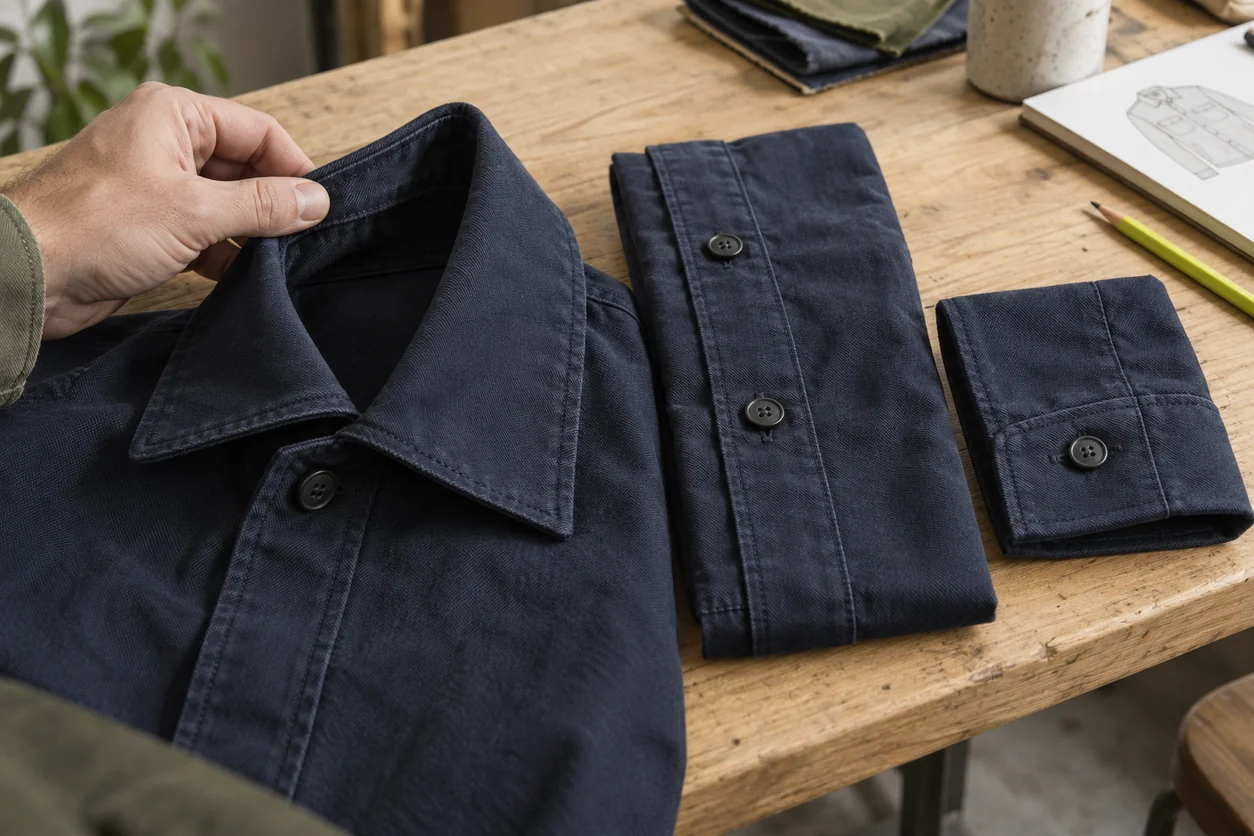
Review the cuff in the same way. Open and close it as intended, turn the edge and inspect the inside. Note unintended bulk, an uneven edge or a feel that differs from the accepted example. Record where the issue occurs rather than rejecting the entire fabric without explanation.
The construction proposal matters alongside the body material. If the collar feels too bulky, ask the supplier to review the material and assembly combination. Changing the fabric, the supporting material and the construction at once may solve the garment problem, but the resulting sample needs its own identified approval.
Inspect a pocket and representative seam as well. Look for the desired appearance on the actual body fabric, including the reverse. If embroidery or another decoration is planned, request its sample on that material before approving the decorated garment. A plain material approval does not cover a later decoration automatically.
These are visual and handling checks. They do not establish seam strength, abrasion resistance or closure durability. When the buyer brief requires formal evidence, agree the applicable method and acceptance criteria with a competent testing provider instead of substituting a tidy-looking detail.
Wear the sample with the layer specified in the brief
Keep the sample size, revision, material and underlayer identifiable. Review it open and closed if both uses are intended. Photograph the front, side and back in a relaxed standing position, then perform the relevant reaching or sitting actions.
Check the upper back, sleeve and front together. Can the wearer use the overshirt in the intended way? Does the hem and front outline remain acceptable? Record the wearer's comments and the situation in which any restriction appears.
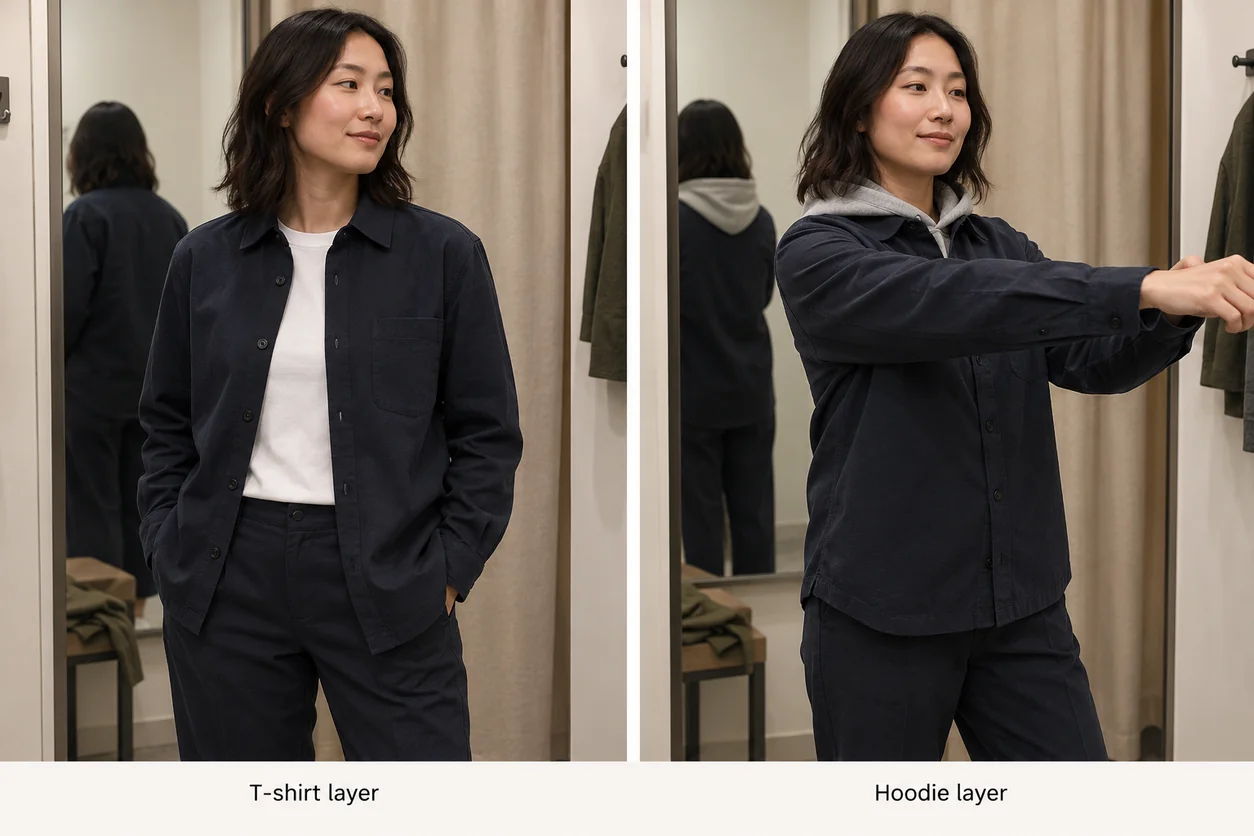
Do not diagnose a tight-looking back as a fabric problem from one photograph. The pattern, underlayer and construction may need investigation. Ask for a proposed revision that preserves the accepted parts of the design.
For the navy example, the buyer might accept the material surface and open-front appearance over the tee but still need a closed-front review over the chosen hoodie. That is a limited approval. It is not evidence that the same sample works for every underlayer or customer size.
Confirm which further sizes or wearers must be reviewed before the range is approved. Record the actual reference underlayer, not just “hoodie,” because different garments with that name are not identical.
If the customer will usually wear the overshirt only over a tee, do not add unnecessary volume solely to accommodate an unrelated bulky layer. Decide the intended use first, then assess the sample against that use.
Close the decision with traceable care and revision records
Agree the relevant care route for the proposed complete garment. Keep initial and after-care records tied to the same sample identity, with defined garment measuring points where dimensional change is being reviewed.
AATCC TM150's public summary concerns garment length and width changes after home laundering and notes limits for some stretch fabrics. Dimensional evidence alone does not establish appearance, colourfastness, seam durability or every other care outcome. Agree separate evidence when those requirements matter.
Review the collar, placket, cuffs, pockets and overall hanging shape in the relevant condition. Note what changed without guessing the cause. Do not report an initial and after-care illustration as an actual test: the images in this guide are concepts.
Keep three linked decisions visible: material identity, built construction and complete garment result. A swatch can be accepted for colour and surface while the construction is still under development. A collar specimen can be accepted while the whole overshirt still needs a layer or care review.
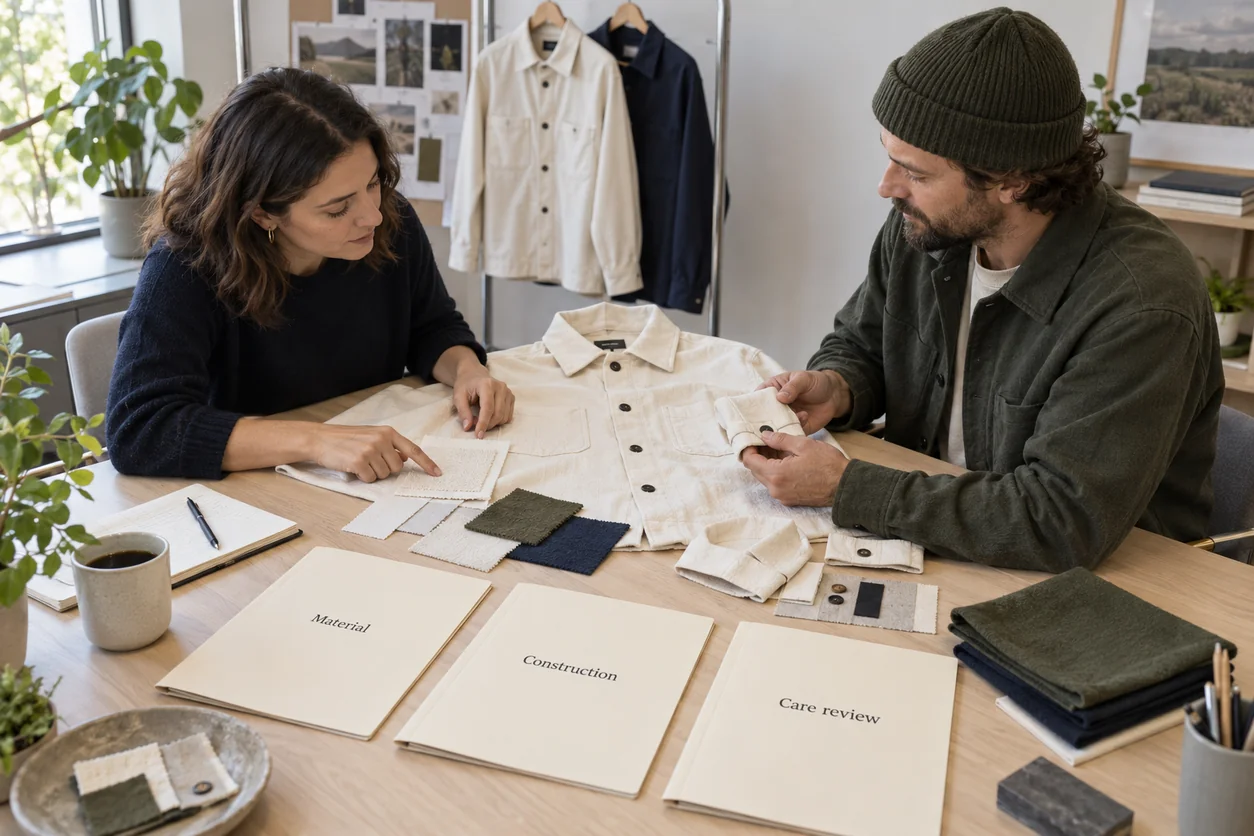
Use focused feedback that preserves what already works:
| Observation on the identified proposal | Useful revision request | What to review next |
|---|---|---|
| Material A's surface is accepted, but the folded collar feels bulkier than the reference | Review the collar material and assembly; retain the accepted body appearance where practical | Identified revised collar and complete sample |
| The ivory cloth looks acceptable on the table but shows more of the dark tee than intended | Propose a material or garment adjustment for the stated underlayer; explain the change | Comparable worn views with that tee |
| The navy overshirt works open over a tee but restricts the agreed reach when closed over the hoodie | Investigate the fit and construction for that use before attributing the issue to the fabric | Revised sample with the same underlayer and movement record |
| The placket no longer lies as approved after the agreed care review | Investigate the complete material and assembly combination | Traceable initial and after-care records for the revision |
An illustrative brief could read: “Develop an unlined navy twill overshirt for open and closed wear over our identified tee and hoodie. Material A's colour and diagonal surface are accepted. Please retain its reference, show the collar, placket and cuff assemblies, and review the closed garment with the hoodie. The current upper-back reach needs investigation. Keep proposed changes and the initial and after-care records separate.”
Before production approval, retain the chosen material identity, accepted colour reference, nominal or measured mass information, finish condition, construction references, underlayer and size review, required test evidence and final sample revision. Ask how the approved development material will be linked to the production material; an approved small swatch is not the complete incoming-material control plan.
Overshirt fabric questions buyers ask
Is twill always better than canvas for an overshirt?
No. Twill identifies a weave direction; canvas is a fabric description commonly associated with plain weave. Compare the actual proposals in the silhouette, folded details and wearing conditions you want. The name does not establish which complete garment meets your brief.
Can a heavier fabric replace supporting material in the collar?
Do not make that decision from GSM alone. Ask the maker to show the proposed collar assembly, identify any supporting material and review the finished outline and feel. Approval belongs to that complete construction.
Can I select overshirt fabric from an online photograph?
A photograph can help shortlist colour and surface direction. It cannot supply every material fact or show the full handling and wearing result. Request identified swatches, relevant built details and a complete sample before final approval.
Does a fabric swatch approval cover the finished overshirt?
Only to the extent explicitly recorded. Separate accepted material features from outstanding construction, fit, care or testing requirements. Link the final garment approval to its actual material and revision.
Take a complete material brief into sampling
Begin with the overshirt's role and underlayer. Shortlist identified cloth, compare it under repeatable conditions, then build the collar, placket and cuff. Choose the final combination through the complete sample and the evidence your brief requires.
Athletic Rush develops custom apparel from Sialkot, Pakistan. Explore our material development page and streetwear jacket development page. Send your overshirt reference, intended layer and material questions to kamran@athleticrush.co or WhatsApp +923279008337.