 Sialkot, Pakistan
 Worldwide enquiries

A successful custom soccer kit order starts with one controlled specification covering the jersey, shorts, goalkeeper products, player groups, fabric, decoration, size chart, roster, labels and packaging. Approve the actual material, colour, fit and complete sample before bulk production; a digital mockup alone cannot prove how the finished kit will perform or look.
Start your enquiry: Email kamran@athleticrush.co or message Athletic Rush on WhatsApp. WhatsApp: +92 327 9008337. Include the product list, quantities, delivery destination and the questions you need answered.
Define the Complete Soccer Kit Program
Buyer checkpoint: Separate home, away, goalkeeper and training requirements in the enquiry.
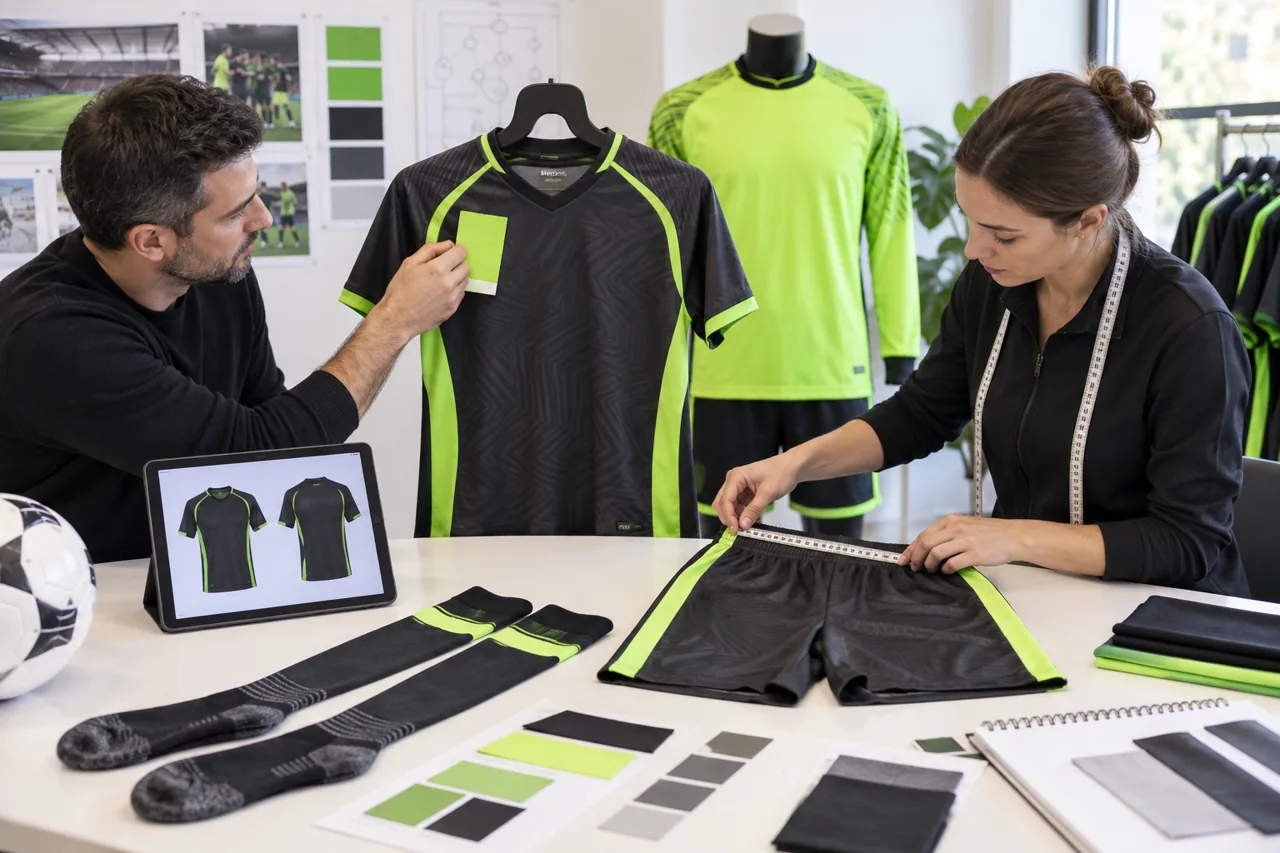
Review field-player and goalkeeper products as one clearly specified kit programme. AI-generated educational illustration; not a photograph of actual staff or an approved production sample.
Do not request a quotation for “soccer uniforms” without listing every product. A club, academy, school, distributor or sportswear brand may need several connected ranges.
Match products
- Home and away jerseys
- Match shorts
- Goalkeeper jerseys and shorts
- Socks or coordinated sock specifications
- Women’s and youth fits where required
Training and sideline products
- Training jerseys and shorts
- Bibs or pinnies
- Tracksuits and warm-up tops
- Polos and presentation wear
- Rain jackets or sideline outerwear
- Hoodies, bags and supporter products
State the quantity per garment, design, colourway and player group. A field-player jersey, goalkeeper jersey and training top may use different patterns, fabrics and decoration routes even when they share one visual identity.
Select Fabric by Garment Function
Buyer checkpoint: Choose by performance and garment function, not a fabric name alone.
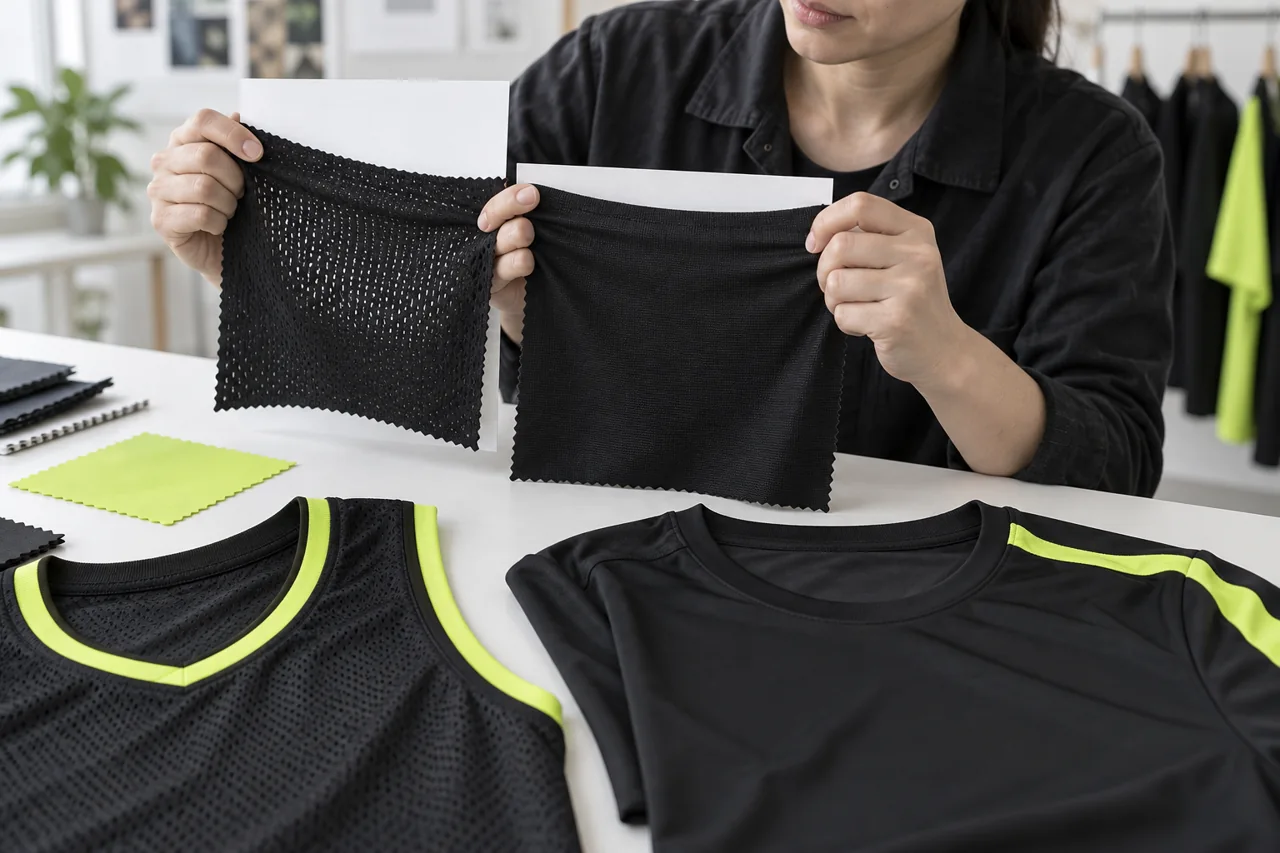
Compare fabric construction, coverage and stretch for the intended garment function. AI-generated educational illustration; not a photograph of actual staff or an approved production sample.
“Polyester” is not a complete fabric specification. Soccer fabrics can differ in knit structure, weight, stretch, recovery, opacity, ventilation, snag resistance, surface texture and print behaviour.
| Fabric direction | Common evaluation use | Buyer checks |
|---|---|---|
| Polyester interlock | Jersey or short panels needing a smooth, stable surface | Opacity, hand feel, print clarity and snag risk |
| Bird-eye or performance mesh | Breathable bodies or mapped ventilation panels | Hole size, transparency, seam stability and colour result |
| Micro mesh | Lightweight training wear and selected ventilation zones | Opacity, strength and decoration compatibility |
| Polyester-spandex knit | Stretch panels, compression layers or close-fitting products | Stretch recovery, heat response and dimensional stability |
| Brushed polyester or tricot | Tracksuits and warm-up garments | Surface finish, pilling risk and embroidery support |
| Rib or engineered trim | Collars, cuffs and selected detail areas | Recovery, colour match and attachment quality |
Ask the manufacturer to provide the exact proposed composition and construction, a swatch and verified fabric weight where weight is part of the specification. GSM describes weight; it does not alone prove quality or suitability.
Plan the Jersey and Shorts as One System
The jersey and shorts should be reviewed together for colour, fit, movement and artwork.
Confirm:
- Jersey body and sleeve pattern
- Raglan, set-in or other approved sleeve construction
- Neckline shape and finish
- Side, shoulder and ventilation panels
- Short length and leg opening
- Waistband construction and drawcord
- Inner brief or liner if required
- Reinforcement at stress points
- Crest, sponsor, name and number locations
- Relationship between jersey and short graphics
If graphics continue from the jersey into the shorts, approve the visual relationship on a worn or dressed sample—not only on separate flat drawings.
Use Sublimation Correctly
Buyer checkpoint: Approve the actual print on the intended fabric, not only the screen artwork.
Dye sublimation is often evaluated for detailed, full-colour soccer kits made from compatible polyester. In a cut-and-sew route, artwork is applied to garment panels before assembly.
Where sublimation helps
- All-over graphics and gradients
- Multiple sponsor marks
- Player names and numbers
- Home, away and goalkeeper colourways
- Designs requiring little added surface layer
- Variable data built into individual panels
Important limitations
Sublimation dye is transparent. It does not lay an opaque white ink layer over black fabric. Bright kits normally begin with white or light-compatible polyester; intended white areas remain unprinted while darker colours are created through the artwork.
The final result depends on the fabric, colour profile, transfer settings, heat, pressure and artwork preparation. Approve colour on the actual proposed material.
Sublimation approval evidence
Request:
- A colour strike-off
- Fabric identification for the strike-off
- Artwork shown on the production pattern
- Sponsor, crest, name and number proofs
- Seam and panel-crossing review
- White-area and contamination check
- A complete sewn sample
A screen image is not a reliable colour standard.
Decide When Another Decoration Method Is Better
Not every soccer product or placement needs sublimation.
| Method | Possible use | Key controls |
|---|---|---|
| Screen printing | Bold graphics on suitable training or supporter garments | Ink compatibility, opacity, curing and hand feel |
| Heat transfer | Names, numbers, sponsor marks or crests on compatible products | Adhesion, stretch, edge quality and heat sensitivity |
| Embroidery | Polos, jackets, tracksuits and selected stable jersey areas | Digitizing, stitch density, backing and puckering |
| Woven or embroidered badge | Club identity requiring a separate badge construction | Edge finish, attachment, weight and wash behaviour |
A lightweight jersey crest may need a different solution from the same crest on a structured jacket. Approve each method on its intended fabric and location.
Prepare Soccer Artwork for Production
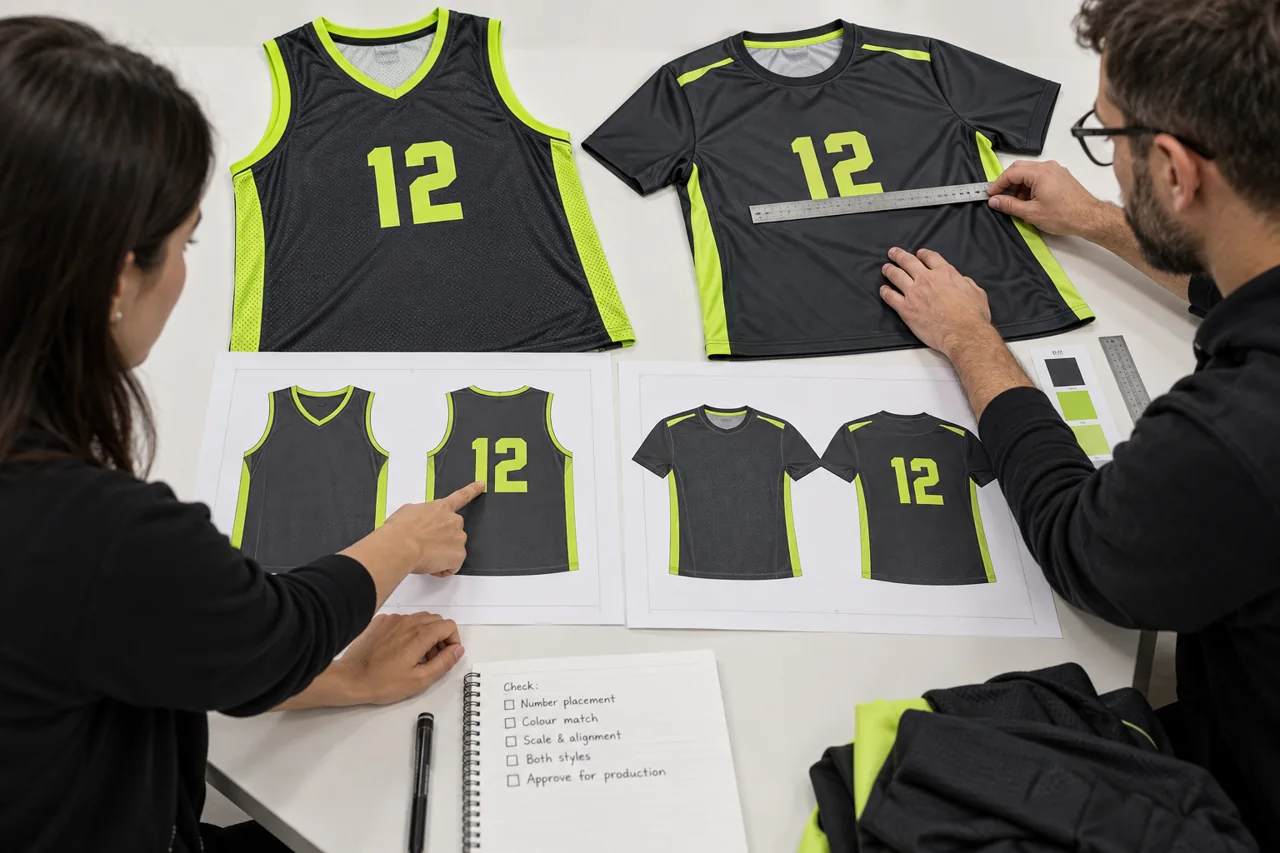
Compare full-size artwork with the garment and its placement references. AI-generated educational illustration; not a photograph of actual staff or an approved production sample.
A front-and-back mockup communicates design direction, but production files need more control.
Supply:
- Vector club crest and sponsor logos
- Approved fonts or outlined text
- Colour references
- Front, back, sleeve and short views
- Name and number style
- Placement dimensions
- Safe distance from seams, necklines and hems
- Home, away, training and goalkeeper file separation
- Current version number and approval date
The supplier may need to adapt artwork to the exact garment pattern. If a stripe or graphic crosses a seam, agree on a realistic alignment tolerance and review it on the sample.
Verify Competition and Sponsor Requirements
Soccer uniform rules can differ by federation, league, tournament, age group and season. Before approving artwork, the buyer should verify:
- Required player-number positions
- Number and name legibility
- Colour contrast between competing teams
- Goalkeeper colour requirements
- Sponsor count, size and placement
- Club crest and manufacturer-mark rules
- Sleeve or competition badge requirements
- Youth, school or tournament restrictions
Send the applicable rule document to the manufacturer. The buyer or club should confirm eligibility with the relevant competition authority rather than relying on a general uniform assumption.
Build Separate Fit Routes Where Needed
A single unisex pattern may not serve every soccer program.
Define the intended fit for:
- Men’s or adult field players
- Women’s teams
- Youth age groups
- Goalkeepers
- Referees or staff where included
- Training and supporter products
Fit decisions should address chest ease, body length, shoulder or sleeve movement, short rise, leg opening and waistband comfort. Test the complete kit during running, kicking, bending and layering.
A goalkeeper jersey may need different sleeve, body or protective-equipment clearance. Do not assume that choosing a larger field-player size creates the correct goalkeeper proportions.
Create a Clear Size Chart
Buyer checkpoint: Specify measurement method, fit group and tolerance together.
State whether the chart uses body measurements or finished-garment measurements. Do not mix the two.
| Size-chart control | What to define |
|---|---|
| Measurement basis | Body or finished garment |
| Fit group | Adult, women, youth, goalkeeper or training |
| Key jersey points | Chest, body length, shoulder, sleeve and other pattern-specific points |
| Key short points | Waist, hip, rise, inseam, outseam and leg opening as applicable |
| Tolerance | Agreed production tolerance by measurement |
| Reference size | Base pattern used for grading |
| Version | Date or revision number |
| Approval | Buyer and manufacturer confirmation |
If the buyer uses a retail size label such as Small or Medium, the finished measurements must still be defined. Size names are not universal.
Lock the Player Roster
Buyer checkpoint: Reconcile every kit and spare before the roster is released.
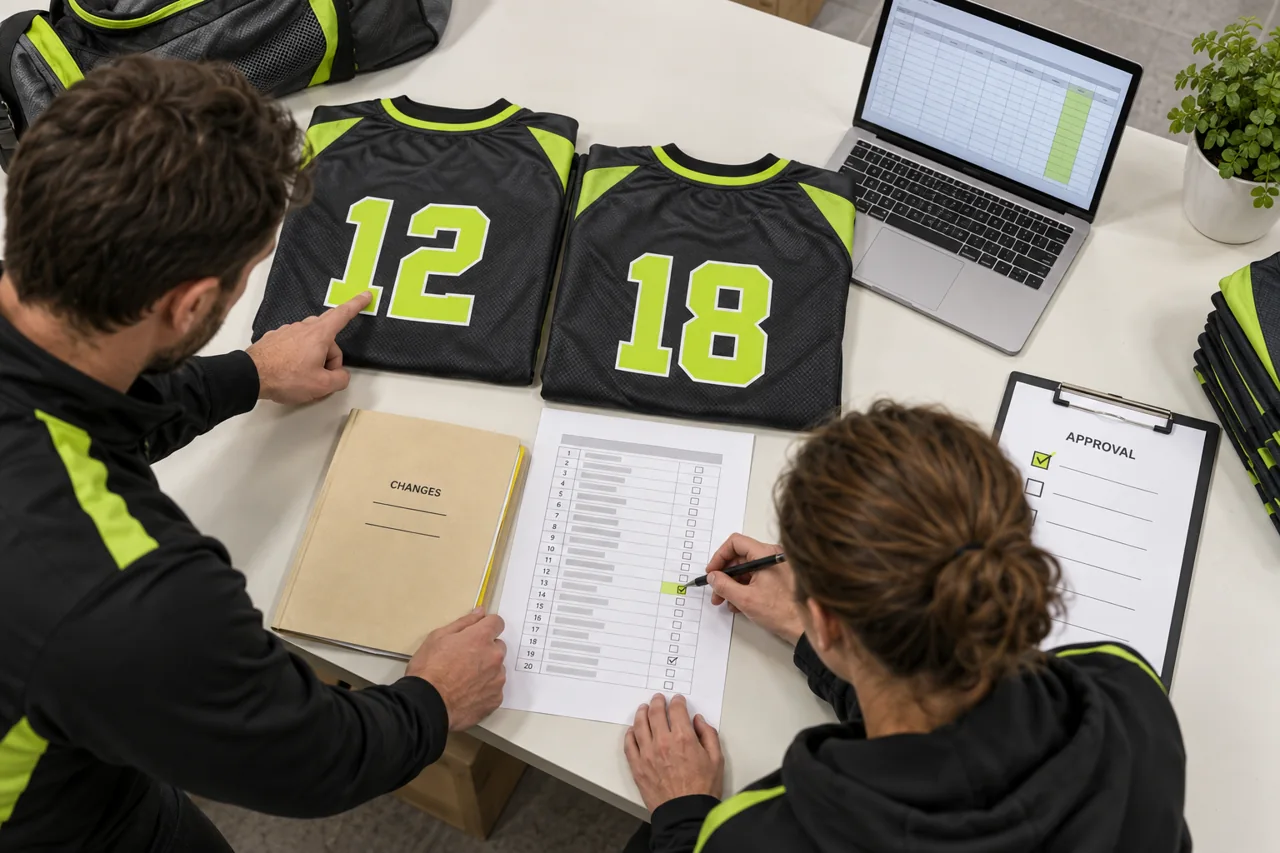
Reconcile player numbers, garment sizes and colourways before personalization. AI-generated educational illustration; not a photograph of actual staff or an approved production sample.
Use one controlled roster with a row for every player and garment.
Include:
- Player name exactly as printed
- Number
- Jersey size
- Short size
- Goalkeeper or field-player status
- Home and away quantity
- Training products
- Special notes
- Buyer approval status
Check spelling, duplicate numbers, size allocation and totals before personalization begins. If jersey and short sizes can differ, keep them in separate columns.
Late changes can affect artwork, printing, sorting, inspection and packing. Confirm the cutoff and change process in writing.
Approve a Complete Soccer Kit Sample
Buyer checkpoint: Approve the complete sewn kit, including the short and goalkeeper requirements.
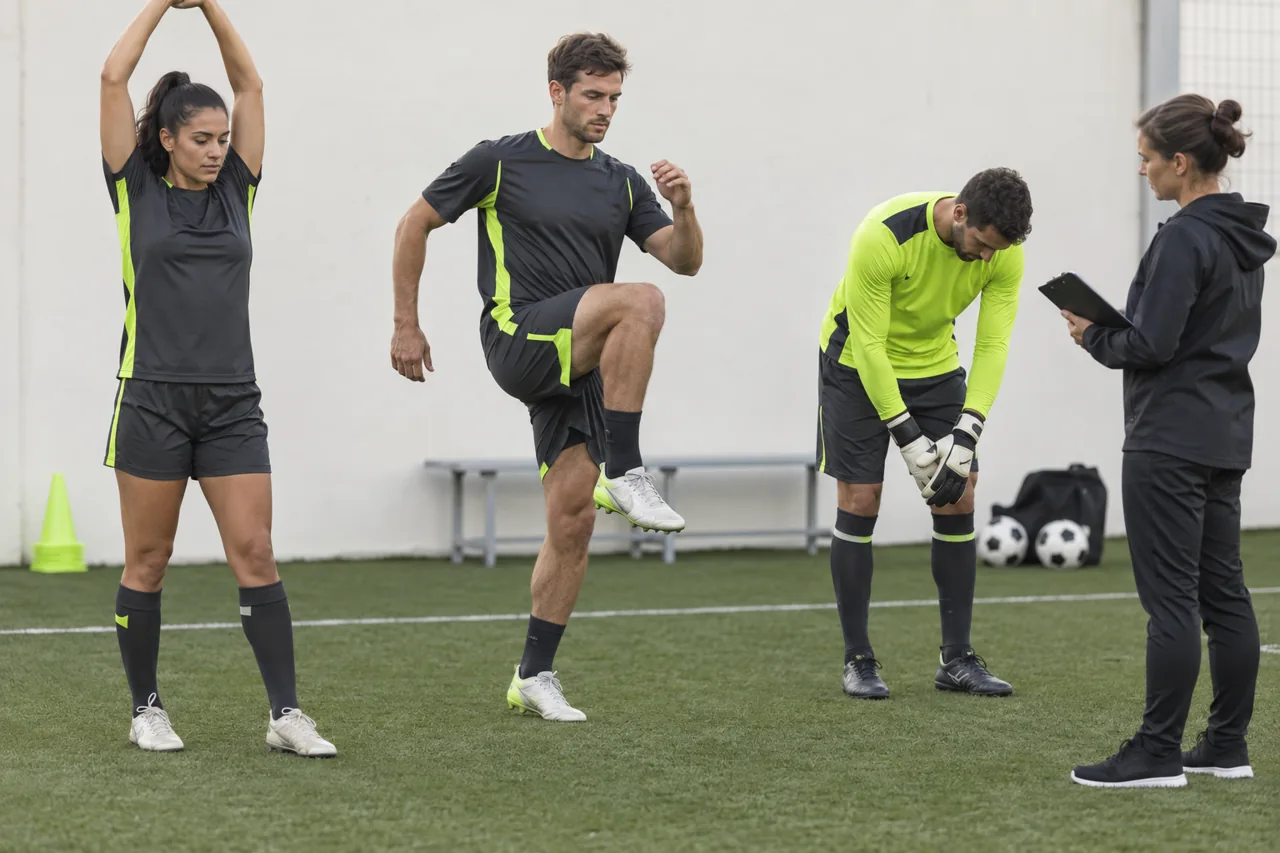
Use movement checks to assess field-player and goalkeeper fit. AI-generated educational illustration; not a photograph of actual staff or an approved production sample.
A complete sample should test more than appearance.
Fit and movement
- Jersey and short measurements
- Arm and shoulder movement
- Body length during play
- Waistband security
- Goalkeeper clearance where applicable
- Women’s and youth fit accuracy
Fabric and colour
- Composition and construction
- Opacity under stretch
- Ventilation and hand feel
- Shade across jersey and shorts
- Sublimation result
- Colour under agreed lighting
Construction
- Neckline, hems and seams
- Waistband and drawcord
- Panel joins
- Reinforcement
- Inside finish
- Labels and trims
Decoration and roster
- Crest and sponsor dimensions
- Name and number style
- Player-specific data
- Placement from fixed reference points
- Graphics at seams
- Badge or transfer attachment
Record corrections in one annotated approval document. Identify the final sample and file versions that become the bulk-production reference.
Understand the Bulk Manufacturing Workflow
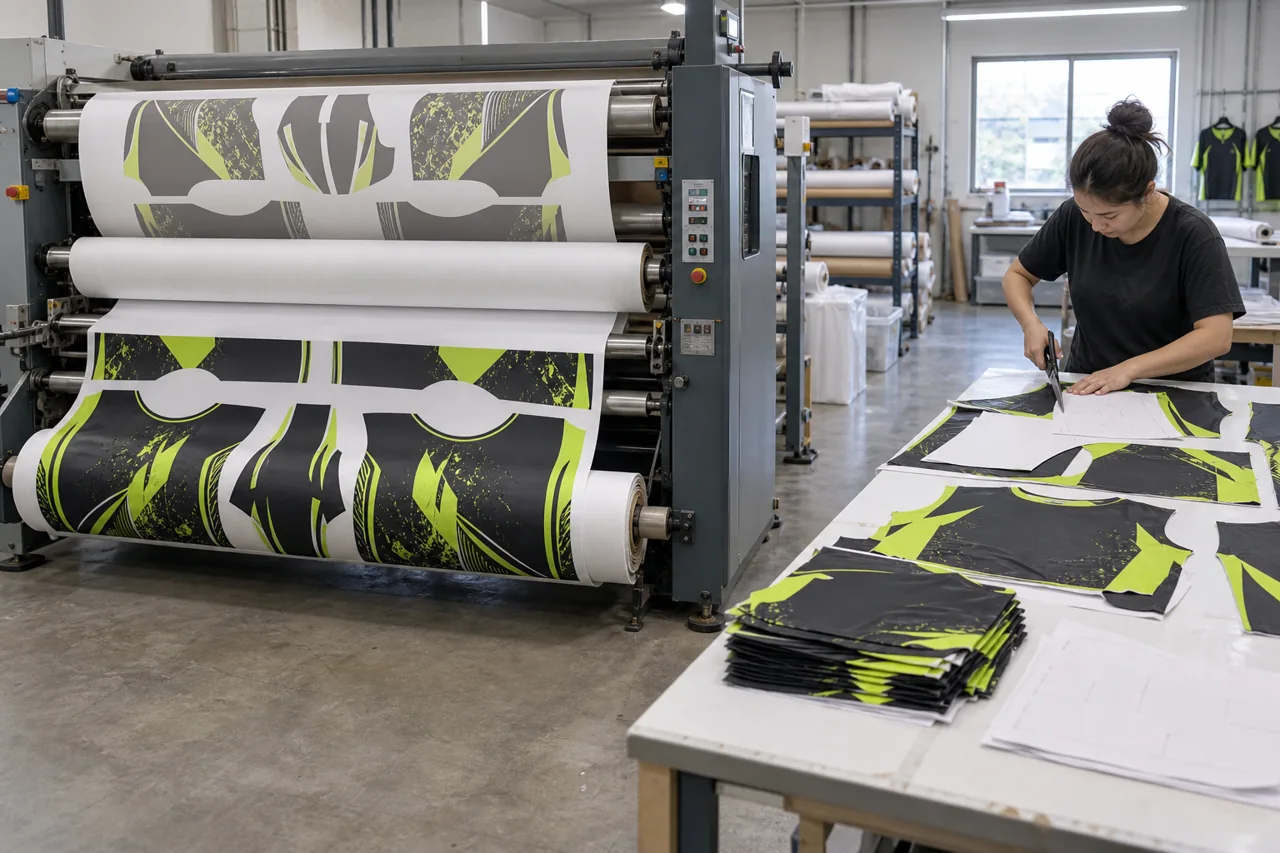
For the illustrated cut-and-sew route, transfer the approved design to compatible fabric before cutting the printed panels. AI-generated educational illustration; not a photograph of actual staff or an approved production sample.
A custom soccer kit can move through these stages:
| Stage | Main control |
|---|---|
| Requirement review | Complete product, quantity and deadline brief |
| Pattern and fit | Approved construction and measurement chart |
| Fabric | Swatch, specification and colour approval |
| Artwork | Pattern-mapped files and player data |
| Decoration test | Strike-off, print sample, sew-out or transfer |
| Sample | Complete kit review and corrections |
| Material preparation | Approved bulk fabric and trims |
| Cutting and printing | Panel orientation, colour and quantities |
| Sewing | Seams, measurements and reinforcement |
| Personalization audit | Every name, number, size and colourway |
| Final inspection | Appearance, measurement and quantity checks |
| Packing | Player, size or team-based sorting |
| Dispatch | Agreed documents and shipping responsibility |
Athletic Rush’s how orders move forward and quality-control information can help buyers specify the checkpoints they want included in a quotation.
Define Quality Control for Bulk Soccer Kits
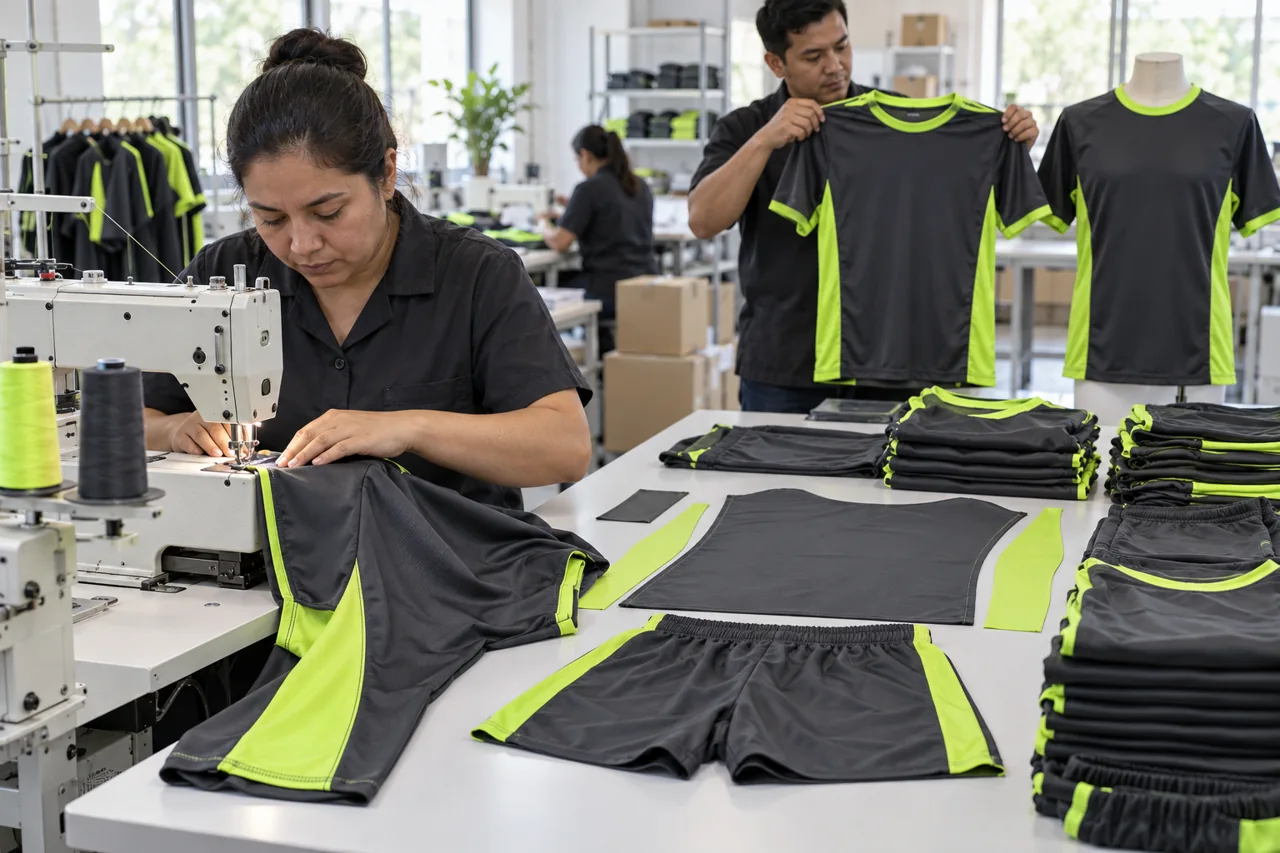
Inspect the sewn kit and compare it with the approved production sample. AI-generated educational illustration; not a photograph of actual staff or an approved production sample.
Ask how the manufacturer verifies:
- Fabric identity and shade
- Sublimation colour consistency
- Print defects and white marks
- Cutting accuracy
- Panel and seam alignment
- Stitch security and seam finish
- Finished measurements and tolerances
- Crest and sponsor placement
- Every player name, number and size
- Pairing of jerseys and shorts
- Labels, folding and packaging
- Final unit and carton totals
Personalized kits should be inspected against the locked roster, not only against a generic sample.
Compare Soccer Kit Quotations Correctly
Buyer checkpoint: Compare equivalent specifications and included services.
| Quote area | Confirm |
|---|---|
| Unit | Jersey, shorts, pair, set or complete kit |
| Designs | Home, away, goalkeeper and training colourways |
| Fit | Adult, women, youth and goalkeeper patterns |
| Fabric | Composition, construction, colour and verified weight |
| Decoration | Sublimation, transfer, embroidery, badge or print |
| Personalization | Names, numbers and roster processing |
| Sample | Development, revisions, tests and courier |
| Private label | Neck label, care label, hangtag and packaging |
| Bulk order | Quantity basis and colourway rules |
| Freight | Method, destination and responsibility split |
| Import | Duties, taxes and clearance responsibility |
| Changes | Cost and schedule impact after approval |
MOQ, sampling cost and production time vary with product structure, quantity, fabric sourcing, colourways and decoration. Obtain written order-specific terms rather than relying on a general claim.
Plan Reorders and Player Additions
For repeat consistency, retain:
- Product and style code
- Pattern and size-chart version
- Fabric and colour reference
- Sublimation artwork
- Crest and sponsor files
- Name and number style
- Label and packaging specification
- Approved sample photos
- Inspection record
- Original order date
Reconfirm material availability, colour, MOQ, price and schedule for each reorder. Do not assume all original conditions remain unchanged.
Soccer Kit Buyer Checklist
Before placing the bulk order, confirm:
- Every product and colourway is listed
- Field-player and goalkeeper requirements are separate
- Adult, women’s and youth fits are defined
- Fabric and decoration are compatible
- Competition rules have been checked
- Production artwork is approved
- Size charts identify the measurement basis
- The roster is checked and locked
- A complete kit sample is approved
- Quality tolerances are written
- Labels and packaging are defined
- Freight and import responsibilities are clear
- Reorder records will be retained
Frequently Asked Questions
What fabric is best for custom soccer jerseys?
There is no universal best fabric. Polyester interlock, performance mesh and related constructions are common directions, but the right choice depends on fit, opacity, ventilation, stretch, print method and intended use. Review the actual swatch and sample.
Is sublimation suitable for soccer kits?
Sublimation can be suitable for detailed full-colour designs on compatible polyester. Approve the colour, fabric, panel artwork, names, numbers and complete sewn sample before bulk production.
Can white be sublimated onto black fabric?
Sublimation dye does not print an opaque white layer over black fabric. Cut-and-sew sublimated kits commonly begin with white or light-compatible polyester, with white areas left unprinted.
Can jersey and short sizes be different for one player?
They can be recorded separately when the manufacturer and order structure allow it. Use distinct jersey-size and short-size columns in the locked roster.
Should goalkeeper kits use a separate pattern?
Goalkeeper fit and equipment clearance should be specified and tested. Simply enlarging a field-player jersey may not create the correct body and sleeve proportions.
What files are required for a soccer kit quotation?
Send the product list, quantities, player groups, size range, fabric and fit requirements, vector artwork, decoration, roster format, labels, packaging, destination and required date.
How should home and away kits be quoted?
List each colourway, garment, player group and quantity separately. Confirm whether the supplier applies minimums, setup or sampling requirements per design.
Request a Custom Soccer Kit RFQ
Send Athletic Rush your match, goalkeeper and training product list; quantities by design; size range; fabric and fit requirements; artwork; roster needs; labels; packaging; destination; and required date. The specification can then be reviewed for missing information before a product-specific quotation is prepared.
Explore manufacturing services, review minimums and pricing information, or request a production quote.
Email kamran@athleticrush.co or message Athletic Rush on WhatsApp. WhatsApp: +92 327 9008337. Include the product list, quantities, delivery destination and the questions you need answered.
Use the team uniform size chart and player roster guide when preparing your order files.