 Sialkot, Pakistan
You have agreed to order 60 T-shirts, but the supplier still cannot tell which colors and sizes to make. A total is not a production breakdown. Create one size-by-color matrix for each confirmed design, enter a piece quantity in every offered combination, and check both the color totals and the complete design total before approval. Base the split on your own evidence where available; a generic “U.S. size ratio” is not a substitute for knowing your product and customers.
This guide helps a new U.S. clothing brand or a creator developing a first streetwear drop turn an order quantity into a clear manufacturing instruction. It covers the allocation itself, the evidence behind it, and the checks that keep a revised spreadsheet from becoming the wrong order.
Start on AthleticRush.co: Explore Athletic Rush's streetwear development and manufacturing pages to identify your garment direction. Then use the actual design reference, size-chart guidance and quotation links beside the relevant steps below to build your enquiry.
The examples use a fictional North Tee and Arc Hoodie. They are teaching references, not actual Athletic Rush inventory, customer orders or tested demand. All six illustrations are original AI concepts rather than photographs of an actual production order.
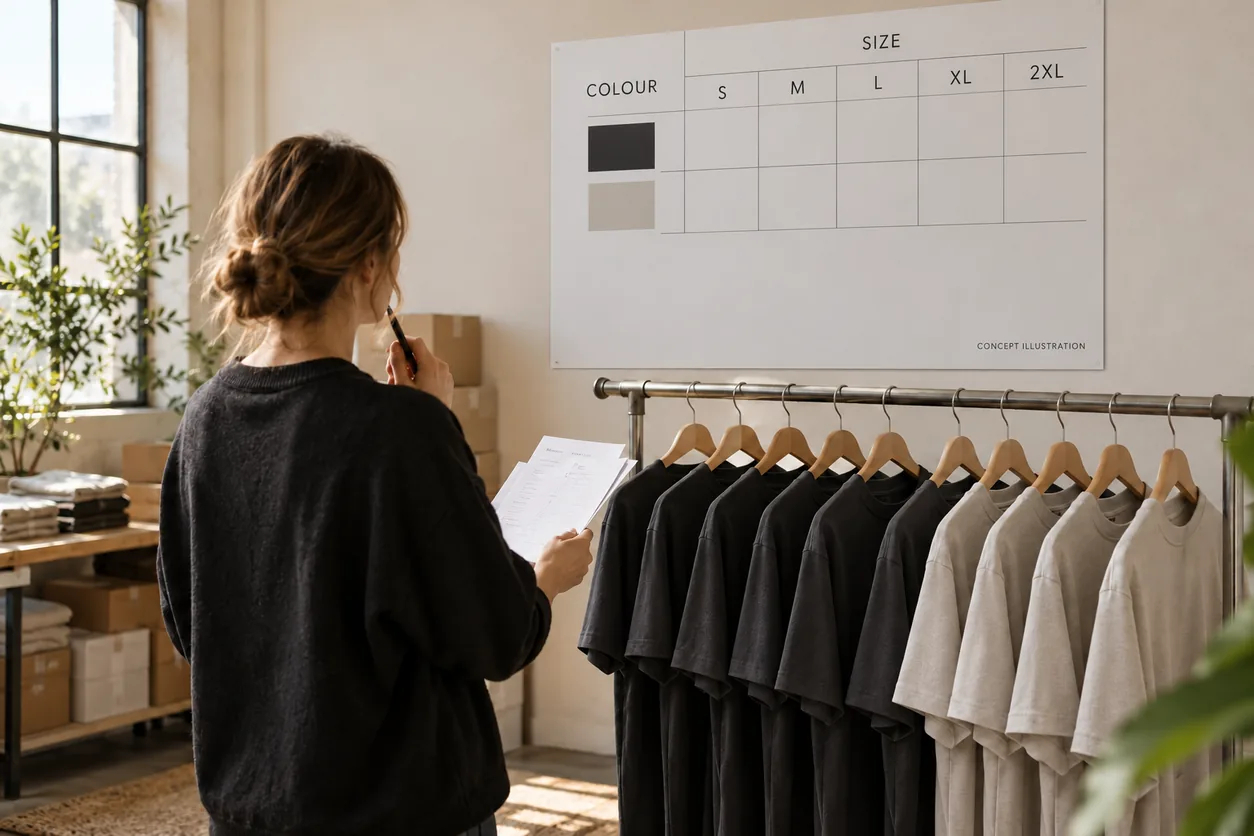
Concept illustration: a garment total needs an identified color-and-size breakdown before it can guide production. The scene does not document an actual order.
Set the boundaries before dividing the pieces
Put the design reference, revision, intended fit, fabric, color references, size-chart version and total quantity at the top of the sheet. The matrix should allocate an identified product; it should not quietly decide what that product is.
For example, “North Tee, revision B, relaxed fit, two approved color references, size chart NT-B” is more useful than “60 oversized tees.” If one color uses different artwork or a different material proposal, identify that difference and ask the supplier to confirm its effect on the quotation and approval scope.
Athletic Rush's owner-confirmed minimum is 30 pieces per design, with one to three colors and mixed sizes within that same design. Each additional design requires its own 30 pieces. This is a per-design rule, not an instruction to order 30 of every color or size. Confirm the actual grouping using Athletic Rush's guide to counting designs before a quotation; do not pool separate designs into one qualifying total.
Then distinguish the product's purchasable combinations from the number of physical pieces. Shopify's variant guidance describes combinations of options such as size and color. Two colors offered in five sizes create ten combinations when all are offered. That says nothing about how many pieces belong in each combination.
Apply the brief to an actual Athletic Rush design reference
Athletic Rush website reference: View the Relaxed Midweight T-Shirt — True Black Tonal Mineral Wash. The live page presents a relaxed tee direction with a tonal mineral-wash appearance and front-and-back views. Use that specific page to identify the visual starting point in your enquiry, rather than asking for an unspecified “black oversized tee.” The presentation does not establish stock availability, measured finished dimensions or an approved physical sample.
For example, a new U.S. brand could write: “Our starting reference is the linked Athletic Rush Relaxed Midweight T-Shirt in True Black. Please review our attached intended measurements, artwork and proposed color-size matrix. Confirm the final garment reference, finish and design grouping before quoting the allocation.” If a second color or a changed fit is proposed, identify it separately and ask what needs development or sample review; do not assume the displayed design already includes that variation.
Compare garment directions: Browse Athletic Rush's streetwear T-shirt collection before choosing the reference for your own brief. North Tee remains a separate fictional teaching example for the arithmetic below. If you are allocating hoodies as well, keep that garment's fit, size chart and matrix separate.
Use evidence that actually describes the proposed product
There is no defensible universal size split for every U.S. streetwear launch. A cropped boxy tee, a long relaxed tee and a roomy hoodie can attract different fit choices, even when their labels all run from S to 2XL. The decision also changes when a buyer is serving an established customer base, a new audience, a wholesale account or a specific preorder group.
Start with the closest evidence you have, and write down its limitations beside the proposed allocation. A number without its source looks more certain than it is.
| Evidence available | Useful question to ask | Limitation to record |
|---|---|---|
| Previous sales of a comparable garment | Which exact color-size combinations sold during the same selling window? | A different fit, price, audience or promotion may make the comparison weak. |
| Dated preorder commitments | Which garment reference, color, size and quantity did each commitment identify? | A casual preference or waitlist entry is not automatically a paid or confirmed order. |
| Size-related exchanges and returns | Were customers changing size, changing fit preference, or reporting a garment problem? | A larger replacement size does not by itself prove demand for more large sizes next time. |
| Wholesale allocation request | Has the account confirmed its exact size-color breakdown? | A requested assortment is not the same as general consumer demand. |
| First launch with no comparable records | Which assumptions can be made visible and reviewed before ordering? | The initial split is a documented planning judgment, not a forecast established by sales data. |
When reviewing sales, check what was available to buy. If medium sold out early and large remained available all month, a simple comparison of units sold hides the unequal opportunity to purchase. Likewise, low sales of a stone color do not tell you much if key sizes in that color were unavailable for much of the launch.
Separate saleable stock from other stock states. Shopify's inventory-state documentation distinguishes available, committed, unavailable and incoming inventory. Use the definitions in your own store or system; do not treat a quantity reserved for another order or set aside for a problem as freely available launch stock.
These checks improve the interpretation of your own records. They do not turn a small sample of sales into a reliable prediction. Keep the source dates, product revision and known stock gaps visible, and explain why the chosen comparison is relevant.
If this is your first creator-led clothing drop
Keep audience interest, product preference and actual order commitments in separate columns. A follower who likes a hoodie post has not necessarily selected a size, accepted the price or committed to a purchase. If you collect preferences, show the exact garment and intended fit, ask for color and size choices separately, and distinguish U.S. delivery requirements from responses elsewhere. Do not convert a follower count into a production quantity.
With no comparable sales, write the allocation as a proposal and name the uncertainty. For example: “We have color preferences for North Tee, but no completed sales of this fit. The size split is provisional; please confirm the sample and size-chart questions before we finalize the matrix.” That gives the manufacturer a usable next question without presenting an influencer poll as a demand forecast.
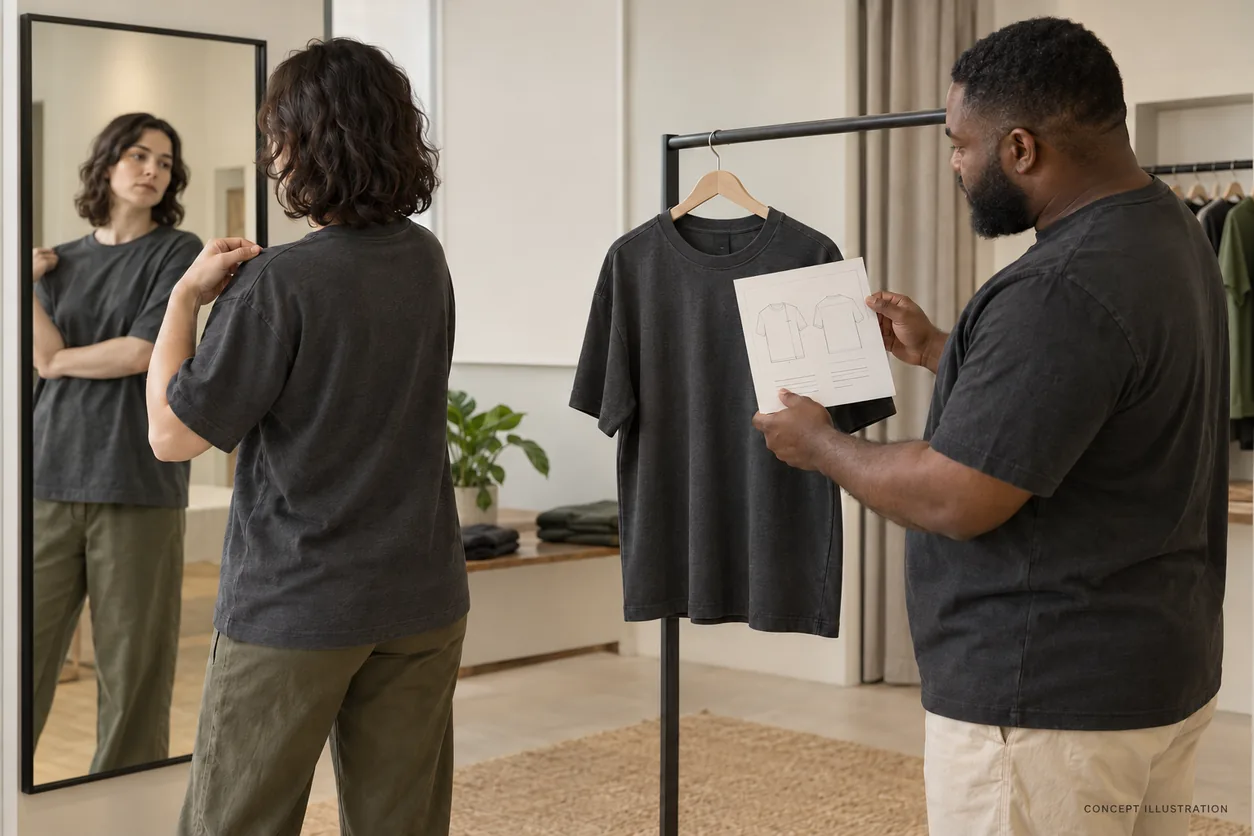
Concept illustration: review the actual fit and size-chart reference before borrowing an old size allocation. Bodies and garment examples do not establish a recommended ratio.
Build one complete matrix, then prove its totals
Here is an illustrative allocation only for 60 North Tees. It is not a recommended size curve or a claim about U.S. demand. Assume the supplier has confirmed these two colors belong to one design and the buyer has chosen five sizes for this example.
| North Tee color | S | M | L | XL | 2XL | Color total |
|---|---|---|---|---|---|---|
| Charcoal | 4 | 10 | 14 | 9 | 3 | 40 |
| Stone | 2 | 5 | 7 | 4 | 2 | 20 |
| Size total | 6 | 15 | 21 | 13 | 5 | 60 |
Check the sheet in two directions. Charcoal sums to 40 and stone to 20, so the color totals give 60. The size totals also give 60. Both routes must agree with the confirmed design quantity. A correct grand total alone can hide a wrong cell: adding one medium and removing one XL preserves 60 while changing what gets made.
Give every offered combination an explicit integer quantity. Use 0 when you intentionally order none; define a separate mark for a combination that is not offered. A blank must not mean “supplier decides.” If your ordering system does not permit zero entries, document the excluded combinations in the accompanying brief and confirm how they appear on the supplier's version.
Keep physical units unambiguous. “Six medium charcoal tees” means six garments in that exact combination. For a hoodie-and-jogger bundle, specify the quantities and sizes of the top and bottom separately and ask how the quotation counts pieces and designs. Do not replace a garment count with a bundle count halfway through the sheet.
For a second, separately confirmed Arc Hoodie design, an illustrative 30-piece olive allocation could be S 3, M 6, L 9, XL 8 and 2XL 4. That is a separate 30-piece matrix. The combined purchase is 90 physical garments: 60 tees plus 30 hoodies. The tee matrix does not cover a missing hoodie minimum, and the hoodie sizes need not follow the tee proportions.
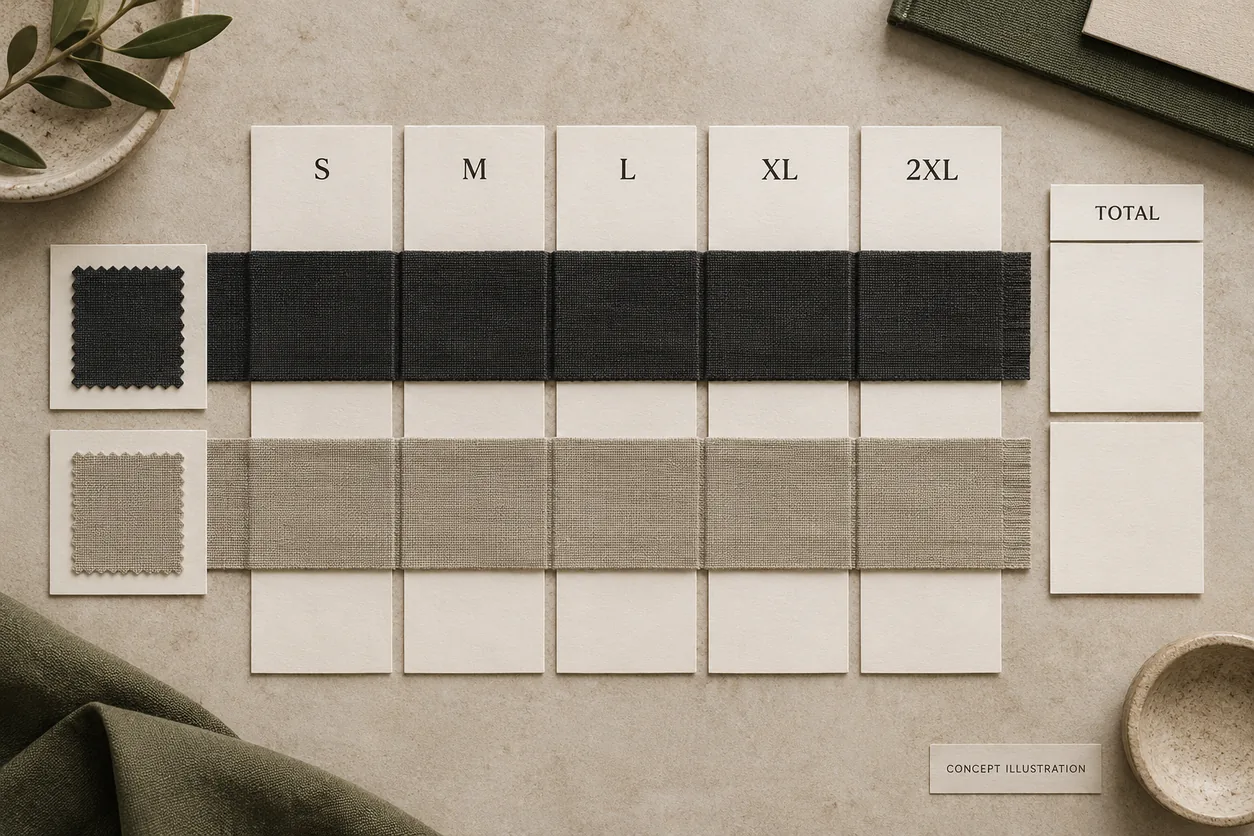
Concept illustration: the matrix has independent color rows and size columns. The accurate worked quantities are in the table above; the image is not a filled production sheet.
Choose the allocation method deliberately
An equal split is easy to explain, but it is still an assumption. Sixty pieces divided equally across two colors and five sizes would be six per combination. That creates a tidy matrix; it does not demonstrate equal demand. It can be a transparent starting proposal when evidence is absent, provided the buyer understands the exposure in each combination and the supplier confirms feasibility.
A split based on past comparable sales uses observed information, but it can inherit old constraints. Check stock gaps, fit changes, returns, selling periods and channel differences. A color that sold well in one garment should not automatically receive the same share in another design.
A commitment-led split follows identified requests more directly, but needs a clear commitment definition. Keep confirmed orders separate from unpaid expressions of interest, and account for the actual terms under which those commitments were collected. Keep interest-poll results separate from completed purchases.
You can use different methods within one collection. For example, the tee might have relevant sales history while the new hoodie does not. Record that distinction rather than assigning the same “proven ratio” to both.
If you begin with percentages, convert them into whole pieces before approval and reconcile rounding within each color's intended total. Do not independently round every cell and assume the final sum survives. Any discretionary extra piece should be visible in the sheet and its reasoning, rather than hidden as a spreadsheet adjustment.
Avoid adding colors simply to make the collection look larger. With a fixed piece total, adding offered combinations spreads those pieces across more cells. That is arithmetic, not evidence that fewer colors will sell better. Choose the offered range intentionally, then confirm its quantities and production constraints.
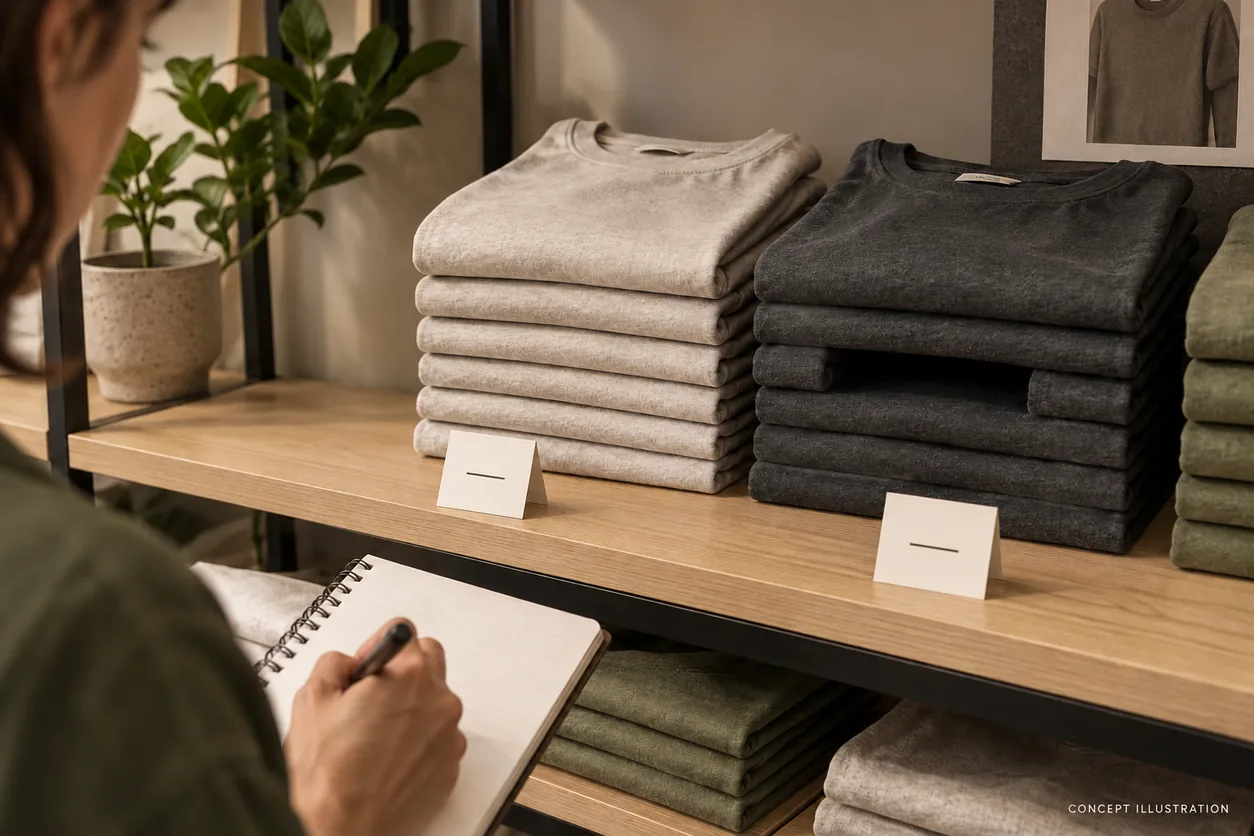
Concept illustration: inspect availability dates alongside sales records. This display does not document an actual stock gap, sales result or inventory count.
Test the breakdown against the garment, not just the spreadsheet
Before releasing quantities, make sure a size label refers to the intended finished garment. For measurement references, read Athletic Rush's T-shirt size-chart guide. A size chart describes the product; an allocation says how many of each identified size you want. One cannot replace the other.
For the North Tee, review the sample against its identified chart and intended fit. If you decide to widen the body or shorten the hem, record the revised specification and review whether the original customer evidence still applies. You may keep the same allocation, but it should be an explicit decision after the fit change.
Check the color reference and artwork version attached to each row. “Stone” in a spreadsheet can be mistaken for another beige proposal if no physical or approved reference identifies it. If the decoration color changes between charcoal and stone garments, link each row to the correct artwork or decoration reference. This does not mean every cell requires an identical sample program; ask which combinations need their own evidence and record the agreed scope.
For the Arc Hoodie, examine its own fit, materials and color proposal. Explore Athletic Rush's streetwear hoodie development page to begin the product discussion, then attach the specific hoodie chart and revision to its separate matrix. Do not label a tee-based size split as a confirmed hoodie fit decision.
If a requested combination cannot be supplied as proposed, ask for a written alternative and its effect on the complete matrix. A shift from two stone smalls to two charcoal mediums changes both the color and size exposure even though the total remains 60. Confirm the replacement, revised totals and associated artwork before accepting it.
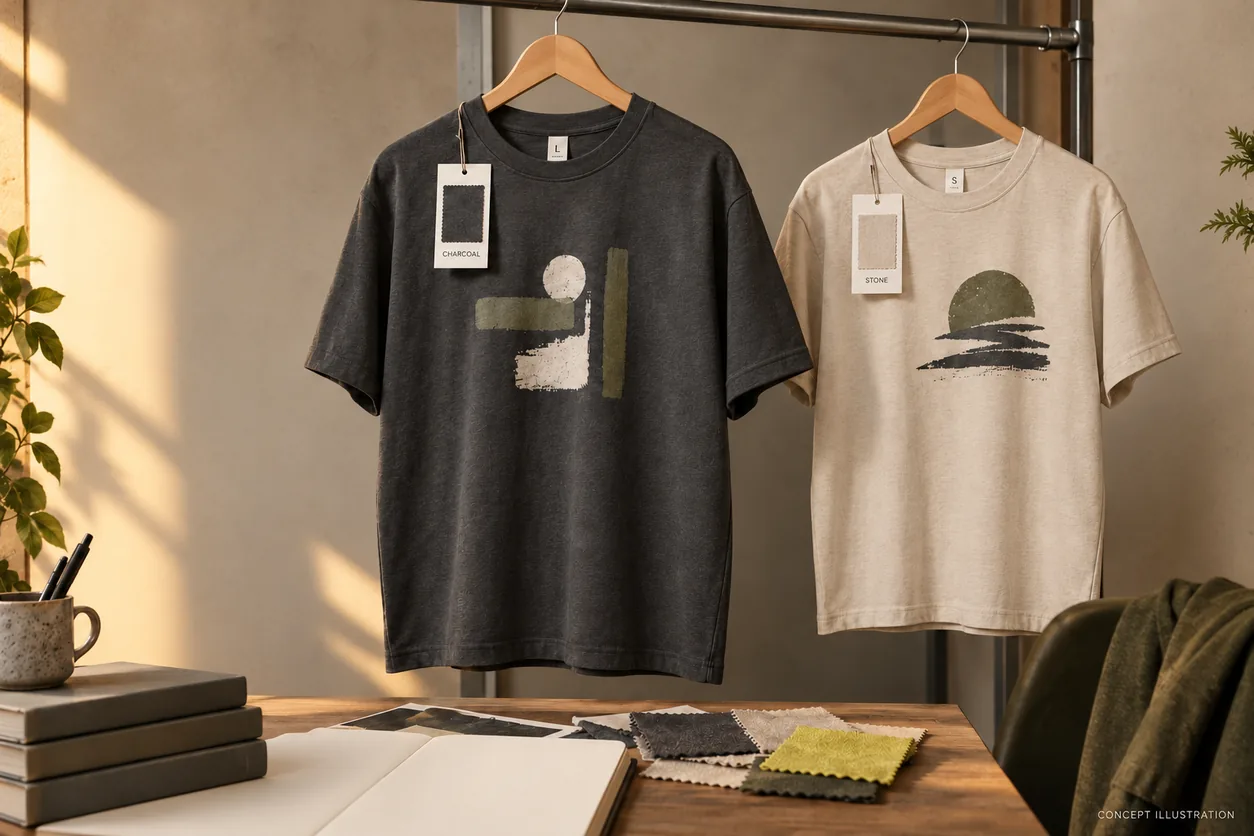
Concept illustration: keep color, size and artwork identity attached to the intended garment. The garments and cards are not approved production samples.
Send a controlled allocation brief and reconcile the reply
Use a dated version that a supplier can return with a clear confirmation. A useful brief contains:
- Design identity: buyer reference, supplier-confirmed design reference and specification revision.
- Fit identity: size-chart version, size labels, units and the finished-garment condition to which measurements refer.
- Color and decoration identity: approved or proposed color reference, artwork version and any row-specific differences.
- Quantity matrix: every offered color-size combination, explicit exclusions, row totals, column totals and design total.
- Decision status: proposed, awaiting confirmation or approved, with unresolved items named.
- Commercial and delivery questions: minimums, quantity-dependent constraints, production timing, shipping and required approvals to confirm in the quotation.
For example: “Please review North Tee allocation NT-B-03, 60 pieces across charcoal and stone. Confirm the design grouping, exact color and artwork references, all cell quantities, and any material or decoration constraints. Do not replace colors or sizes without our written confirmation. Return the confirmed matrix with the quotation and identify any difference from our version.”
When the reply arrives, compare the cells, not just the subject line or grand total. Check that the supplier used the same size order, especially when a form abbreviates or rearranges labels. Keep the original and returned versions so a changed quantity can be traced. Ask which version governs the order before production begins.
After approval, record a revision as a change from the previous version: which cell changed, by how many pieces, why, and whether the design total changed. A corrected screenshot with no date or revision can leave both parties using different instructions.
Finally, define how the finished order will be counted and identified. Ask for packing information that lets you reconcile garment labels and quantities against the approved matrix. Counting two cartons or 60 garments is not enough to establish that the correct color-size mix arrived. Agree the packing service and its scope in the quotation; this example describes a proposed inspection instruction.
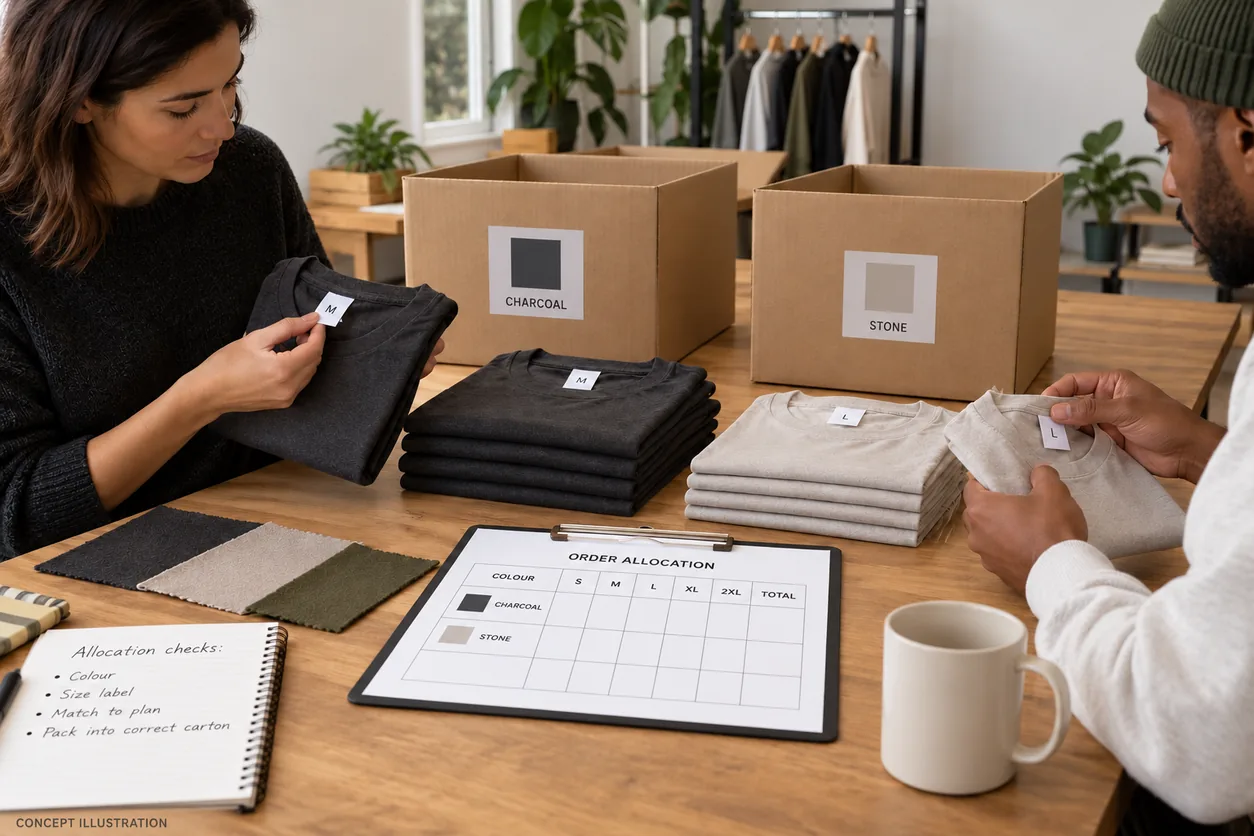
Concept illustration: reconcile individual garment identities and quantities with the approved breakdown. The cartons do not show an actual shipment.
Questions buyers ask before approving the split
Does 30 pieces per design mean 30 of every size or color?
Athletic Rush's confirmed minimum is 30 pieces per design, allowing one to three colors and mixed sizes within that same design. Each different design needs its own 30 pieces. Confirm the particular design grouping and any material, trim or decoration constraints in the actual quotation; do not invent a separate minimum for every matrix cell.
Which sizes should receive the largest quantities for a U.S. streetwear drop?
There is no universal answer established for your proposed garment. Use relevant sales, availability, return and commitment evidence when you have it. Identify the fit and audience, show uncertainty, and keep the first allocation separate from a claim of proven demand. The worked table here is an arithmetic example only.
Can each color have a different size split?
Show that proposal explicitly in the matrix and ask the supplier to confirm feasibility and quotation implications. Equal size shares across colors are not a logical requirement of a matrix. Neither is an unequal split automatically supported by evidence.
What should happen if the supplier proposes a substitution?
Require the affected cells, color or size references, artwork implications and revised totals in writing. Review the revised mix before confirmation. The same grand total does not mean the same order.
Turn your proposed breakdown into a quotation discussion
Send one identified matrix per proposed design, your relevant tech pack or garment references, and the evidence or assumptions behind the split. If the range itself still needs development, review Athletic Rush's collection-development service to connect the garment proposals before treating the quantities as final.
Athletic Rush manufactures in Sialkot, Pakistan, and welcomes U.S. clothing-brand enquiries. Owner-confirmed sample production is 4–6 working days. Bulk production is 8–10 working days for orders up to 100 pieces; larger orders depend on quantity. Shipping time is separate. Ask when the quoted production period starts, which approvals are needed and how revisions affect the schedule. Confirm shipping and arrival expectations separately.
Ready to discuss your first U.S. streetwear drop? Request an Athletic Rush manufacturing quotation. Include the Athletic Rush product-reference link or your own design reference, your proposed color-size matrix, intended fit, artwork and U.S. delivery destination. For a direct discussion, email kamran@athleticrush.co or send the allocation brief to Athletic Rush on WhatsApp. Ask for the returned, confirmed matrix before authorizing the order.