 Sialkot, Pakistan
How do you design a track jacket and trouser set that looks coordinated without compromising either garment's fit? Define the jacket silhouette, trouser silhouette and shared design language separately, then approve their relationship on a wearer. Check the jacket zipped and open, the waist and hem together, and the intended top-and-bottom size combinations. A matching colour or side stripe is only one part of the decision.
For a clothing brand developing a streetwear tracksuit, the useful question is not simply, “Do the pieces match?” It is, “Does this pairing create the intended outfit when someone actually wears it?” A jacket can look balanced on its own yet overwhelm the trousers. A trouser stripe can be correctly positioned on a flat garment yet appear disconnected from the jacket when the wearer turns.
This guide focuses on track jacket and trouser set design: proportion, visual continuity, openings and whole-outfit review. It does not establish sports-performance specifications. The named designs below are hypothetical development examples, not Athletic Rush stock or tested products.
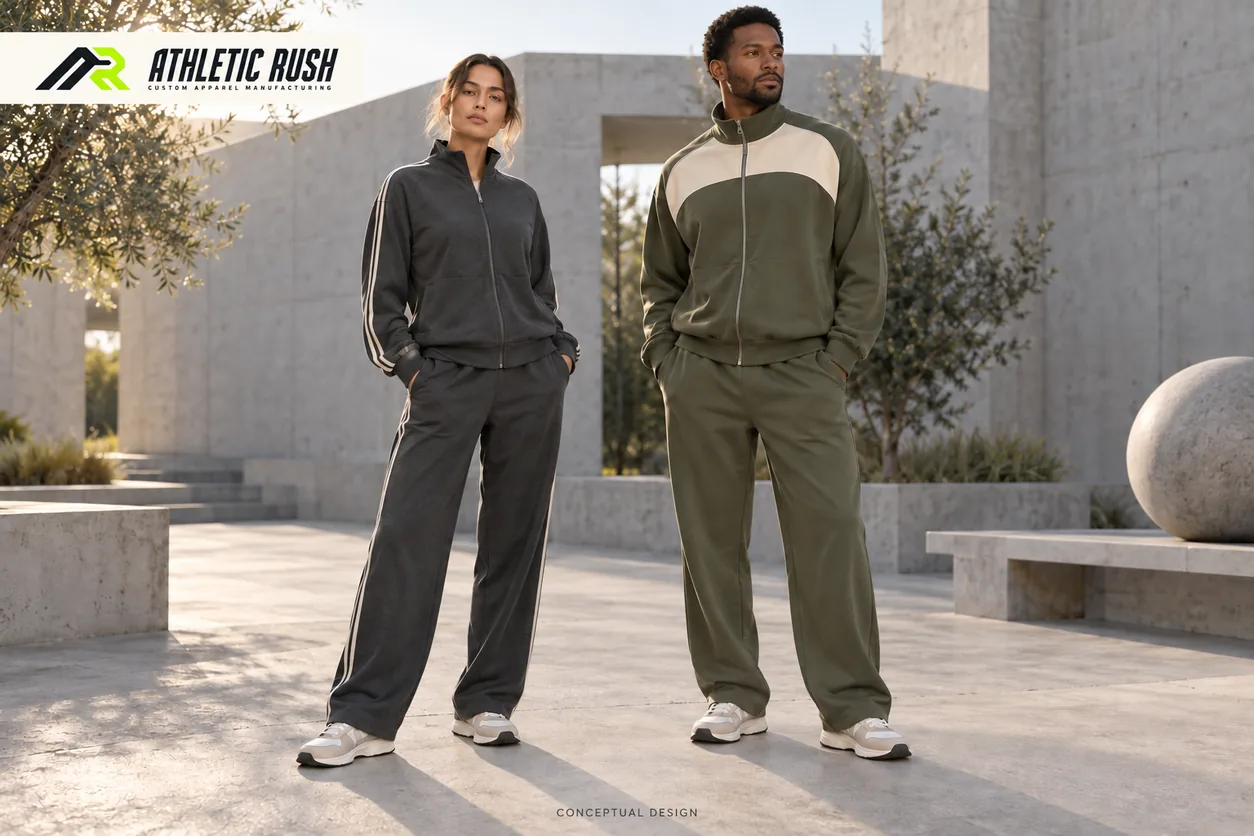
Original conceptual illustration. The garments, wearers and details demonstrate design choices; they are not photographs of available inventory.
Start with a set relationship, not two matching drawings
Choose what makes the outfit recognisable before adding several competing details. It might be a narrow tape repeated on sleeves and legs, a curved yoke echoed by a trouser panel, or a restrained colour arrangement with different jacket and trouser shapes.
Then describe the relationship in a sentence a pattern maker can use. “Charcoal zip jacket and straight trousers, with a narrow ivory line on each outer sleeve and outer leg” gives a clearer starting point than “premium retro tracksuit.” The second phrase describes a mood; it does not identify the garments or placement.
Consider three possible directions:
| Hypothetical set | Main design relationship | Decision to resolve on the sample |
|---|---|---|
| Line Set — stand-collar zip jacket and relaxed straight trousers | Narrow ivory tape repeats on the sleeves and outer legs | Whether the line reads coherently from front, side and back without requiring the jacket and trousers to physically connect |
| Arc Set — shorter boxy zip jacket and wide straight trousers | Curved jacket yoke and a quieter trouser panel share a visual rhythm | Whether jacket length and upper-leg volume leave the waist relationship clear |
| Quiet Set — longer track jacket and tapered trousers | Tonal materials, repeated zipper finish and minimal graphics | Whether the longer top hides an intended waistband or pocket detail, and whether the lower silhouette still looks deliberate |
None is a universal fit recommendation. A brand may prefer a different waist position, hem length or balance. The point is to choose a direction that can be assessed rather than combining every detail from several references.
For Line Set, sleeve and leg tape could be the leading feature, with the chest mark kept quiet. For Arc Set, the shape of the yoke may lead, so adding a large chest graphic and several trouser stripes could dilute the idea. Decide which feature the viewer should notice first.
Athletic Rush's streetwear tracksuit development page provides a place to start a set enquiry. Treat any base design as a reference to discuss and specify; confirm the exact materials, construction and requested changes for your project.
Map the lines to each garment's own reference points
A set drawing needs more than a front view with attractive stripes. Make separate jacket and trouser drawings, including back views, and identify where each design line starts, changes direction and ends.
For the jacket, useful references may include a named shoulder seam, sleeve seam, centre front or finished hem. For the trousers, they may include the finished waistband edge, side seam, pocket opening or leg hem. State how a placement is measured. “Tape starts below the shoulder seam” remains incomplete until the particular seam, distance and measuring route are defined.
Specify whether the detail is applied tape, piping, a sewn panel or another agreed construction. An illustrated pale line does not tell the manufacturer which method to use. Ask for the chosen construction to be demonstrated on the actual sample, especially at intersections and terminations.
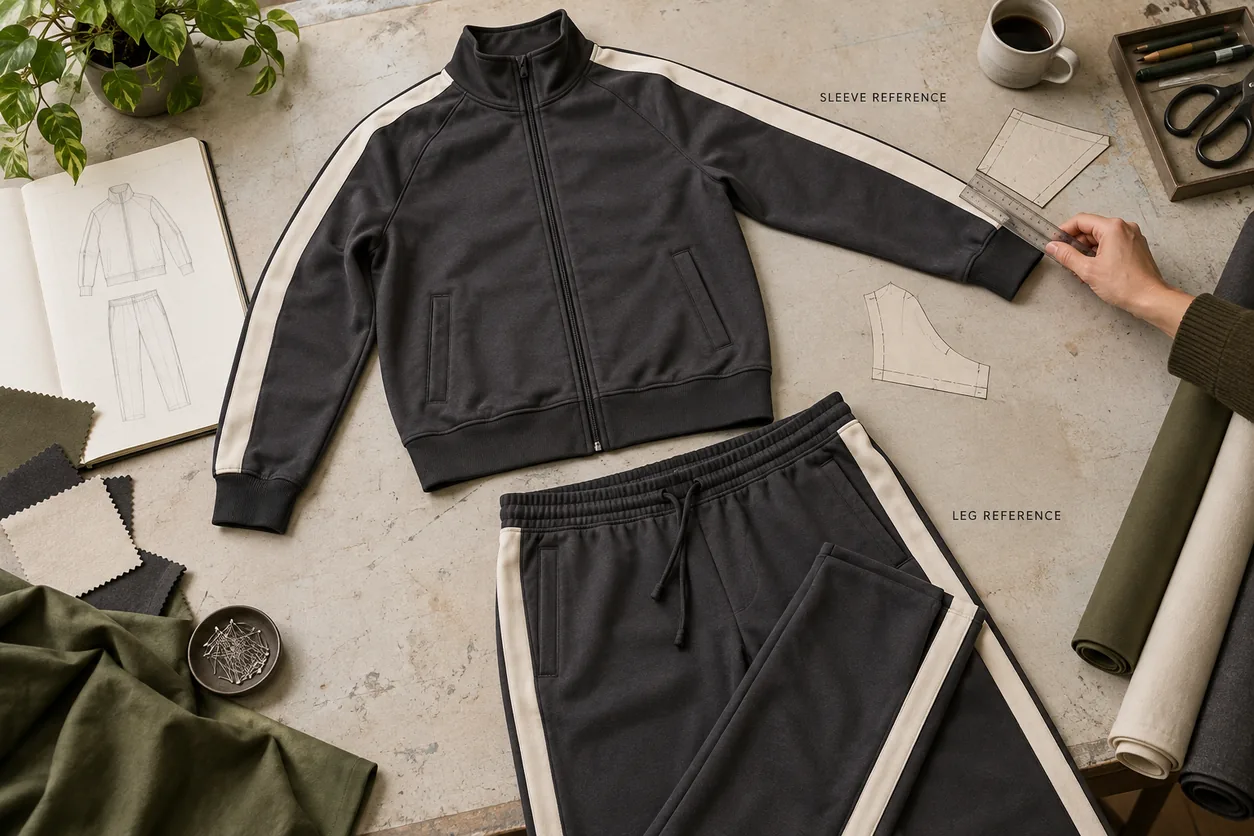
Conceptual placement scene. The unmarked ruler illustrates a review step; no dimensions are supplied or recommended by the image.
Repetition is different from a continuous line
Sleeve tape and trouser tape can repeat the same visual language without forming one straight line across the waist. They are on different garments and different parts of the body. A sleeve moves when the wearer raises an arm; the jacket hem moves relative to the trouser waistband.
If your concept depends on a line appearing to continue from the jacket body to the trousers, write down the intended viewing condition: jacket zipped, a particular waist position, wearer standing naturally, and a specified size pairing. Review it in that condition, then inspect what happens when the wearer sits or opens the jacket.
Do not approve only a carefully posed photograph that holds the two pieces in an artificial relationship. If continuity is essential but works only in one pose, reconsider the line arrangement. A repeated colour or shape may communicate the set more reliably for your intended wearing routine.
Resolve the interruptions deliberately
Look at the places where decoration meets a zipper, pocket, cuff or hem. Decide whether the line should stop, continue over a component, or turn along a seam. Confirm the left and right treatment rather than assuming symmetry from one sketch.
For Line Set, a trouser pocket may interrupt the outer-leg tape. One option is to keep the tape independent of the pocket opening; another is to integrate the pocket into the panel arrangement. Review access and appearance in the actual construction before choosing. The supplier should show a workable proposal, not infer a hidden construction from artwork.
Keep material-to-material engineering for a separate discussion if you introduce different fabrics. This article's decision is the set's design relationship; a coordinated drawing does not by itself approve a mixed-fabric assembly.
Review the jacket hem and trouser waist as a shared zone
The jacket hem and trouser waistband sit near each other, so review them together. Do not use jacket body length alone to decide whether the outfit is balanced.
Record the intended trouser waist position, jacket hem shape, underlayer and footwear. Then inspect a wearer with those choices. A jacket that looks short over a high waist may create a different relationship over a lower waist. A gathered jacket hem may rest differently from a straight hem of the same nominal length. These are reasons to inspect the actual outfit, not reasons to apply a fixed proportion formula.
For Arc Set, ask whether the shorter boxy jacket gives the intended balance above the wide trousers. If the jacket hem rests heavily over the waistband, identify whether you want the top to sit above it, overlap it, or leave it visible only when open. Each is a design choice; write the intended result.
For Quiet Set, a longer jacket may deliberately cover the waistband. In that case, do not also make waistband graphics a central feature of the complete outfit without reviewing their visibility.

Conceptual wearing views. The positions suggest a review sequence, not measured fit or movement results.
Use three views before commenting on length
- Standing, jacket zipped: inspect the relaxed hem, waist overlap, sleeve balance and trouser line. Avoid pulling the jacket into position for the photograph.
- Sitting, jacket zipped: observe where the jacket gathers, whether the front opening feels restrictive, and whether the waistband or pocket entrance becomes difficult to use.
- Standing and reaching, jacket open: inspect the intended underlayer, front edges and balance when the central block of colour is interrupted.
Record what happened before naming a correction. “The jacket front gathers over the trouser waistband while seated” describes an observation. “Remove body length” proposes one possible response, but it may not address the whole issue. Ask for a revised proposal, then reassess the affected garment and the pairing.
For a deeper review of the lower garment, use the trouser length and leg-opening guide. Set design still needs a clear decision about the footwear and intended hem position.
Build the openings around the wearing routine
A zip-front track jacket and a drawcord trouser do not automatically create a convenient outfit. Review the openings with the intended underlayer, shoes and ordinary use in mind.
At the jacket front, operate the zipper in the complete sample. Check whether surrounding fabric catches, whether the pull is easy to reach and whether the front sits as intended when closed. A zipper that functions on the desk still needs a worn-garment review. Define the opening configuration and complete component proposal rather than choosing from the appearance of a puller alone.
At the collar, inspect the jacket fully closed and partly open. Look at how the stand collar sits, whether the edge contacts the wearer's chin, and how the collar changes the intended profile. Record the observed fit with the wearer and size; do not extrapolate one person's comfort to the whole range.
At the trousers, check waistband adjustment, drawcord access and pocket entry while the jacket is worn. If the jacket hem covers the pocket entrance, is that acceptable for the planned use? If a side-pocket zipper sits under a jacket edge, review how the wearer finds and operates it.
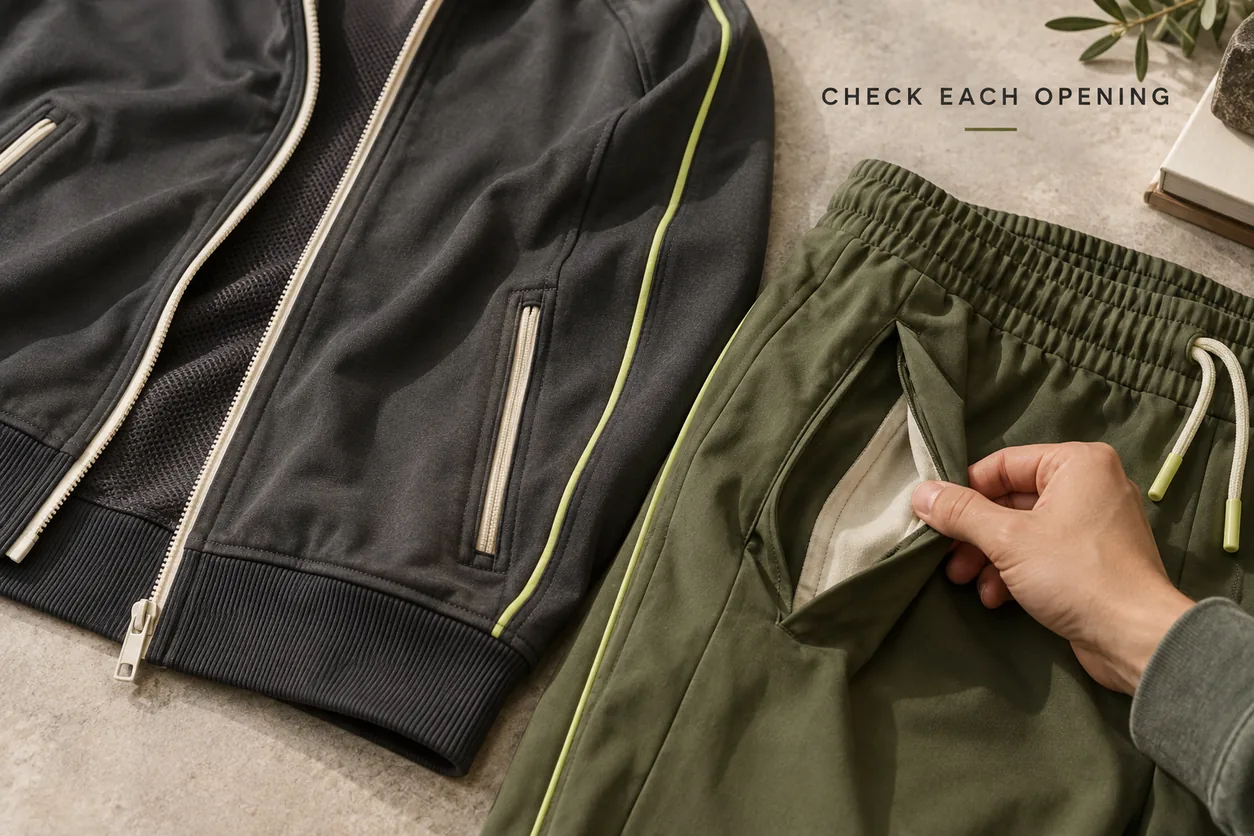
Conceptual construction illustration. Confirm the chosen components and attachment details on a physical sample.
Decide what a pocket is intended to hold before discussing its usable space. A phone-sized object and a bulky key bundle create different review questions. Use representative items agreed for the sample check and document the result. Do not convert a casual pocket trial into an unverified security or durability claim.
For waistband detail, the jogger waistband and drawcord guide explains how to review the complete assembly. The track-set question adds another layer: can the waistband and pockets still be used comfortably beneath this jacket?
Choose the actual materials before judging the outfit
A material description should identify more than fibre or a fashionable family name. Record the supplier's material reference, stated composition, fabric construction, mass with units and agreed finish. Identify the lining, rib, tape and pocket materials separately where used.
A woven route and a knit route can be distinct design proposals, but do not assign a universal level of comfort, stretch, ventilation or weather protection to either name. Review the identified fabrics and built garments for the result your brand wants.
Cotton Incorporated's Textile Weaving booklet explains woven construction through interlaced yarn systems. That describes construction; it does not establish a particular track set's wearing performance. Fibre, construction and a finished garment claim are separate pieces of information.
To compare two material proposals fairly, keep the pattern and main construction consistent where practical. If the supplier changes the pattern, lining or hem assembly to suit a different material, record that you are comparing two complete garment proposals. Otherwise, you may attribute a difference in silhouette to the fabric when several things changed.
Examine the top and bottom together under the same viewing conditions. Ask whether their surface appearance, drape and contrast details produce the intended relationship. A brand may deliberately choose contrasting materials; the important point is to approve that contrast rather than discovering it at the final set review.
Preserve the relationship after the agreed care review
Record the jacket and trouser measurements separately before and after the agreed care process. Then inspect the outfit again. Look at sleeve and leg length, hem-to-waist overlap, front-opening appearance, panel lines and visible material differences.
AATCC TM150's public scope addresses garment length and width changes after home laundering and notes that the method may not apply to some stretch fabrics. Ask the supplier or qualified laboratory to confirm the suitable method and conditions for your garments. The public summary does not provide the full procedure.
Dimensional-change evidence does not also establish colourfastness, zipper life, elastic recovery or sports performance. Request relevant evidence for any additional claim you intend to make. Keep observations from your own sample review clearly separate from formal test reports.
Approve top and bottom sizes independently, then inspect the pairings
A jacket labelled M and trousers labelled M are two labelled garments, not proof of a suitable outfit for a particular wearer. Use the actual measurement charts, reference-body information and the brand's intended fit for each piece.
Decide whether the collection will be sold as fixed-size sets, mixed-size sets or separate pieces with coordinated styling. Resolve that choice before finalising size-pairing instructions. It affects what combinations must be sampled or reviewed and what information packing staff need.
For a fixed pairing, record both garment identifiers and their sizes. For a mixed-size offer, identify the combinations your order actually requires. Do not assume that reviewing one same-letter combination approves every permitted top-and-bottom pairing.
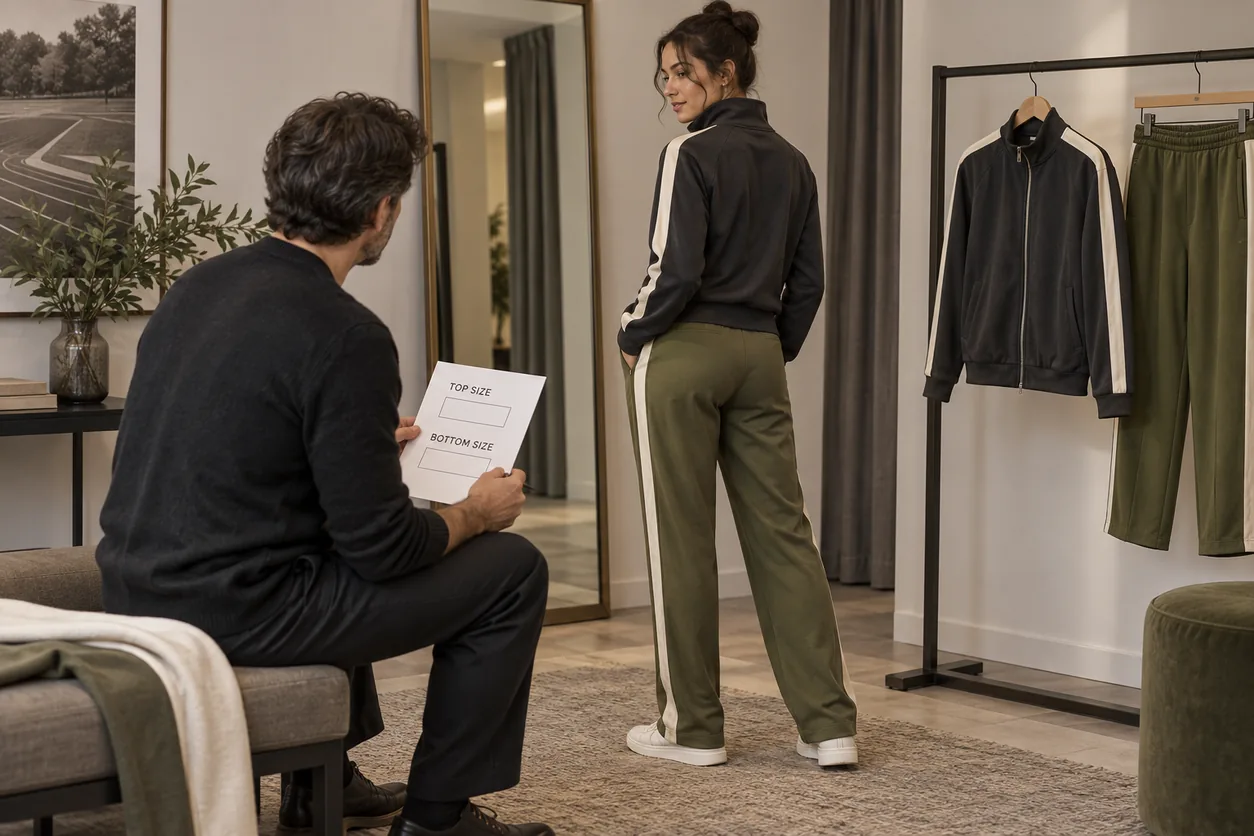
Conceptual fitting consultation. Blank size fields illustrate independent decisions; the image establishes no size recommendation.
For example, if your offer includes a larger jacket with a smaller trouser, review the intended volume relationship rather than treating that pairing as an exception to be ignored. The jacket may cover more of the waistband or dominate the lower silhouette. Decide whether that remains consistent with the collection's design intent.
Use a traceable review record: wearer/reference information agreed for the project, jacket revision and size, trouser revision and size, underlayer, footwear and views. Keep personal identities private when sharing content beyond the development team.
If a jacket revision changes its hem length or panel position, identify which pairings need to be checked again. A fit change to one garment can affect the visual relationship even when the other garment has not changed.
Turn observations into a controlled revision
The useful approval record has three parts: what you saw, what result you want, and what must be checked on the revision. Avoid comments such as “make more premium” or “match better” without a named area and intended outcome.
| Observation on an identified sample | Useful revision request | Check before accepting the revision |
|---|---|---|
| Jacket hem covers the intended trouser pocket entry | Propose a hem/pocket relationship that leaves the required access usable; identify which component changes | Worn pocket access, standing and seated, plus the intended jacket silhouette |
| Sleeve and leg tape feel visually unrelated in side view | Show their separate placement references and a revised side-view relationship | Both flat placements and relaxed worn views; do not require artificial pose alignment |
| The jacket looks balanced zipped but too dominant open | Propose a change to the front/hem or outfit styling around the agreed underlayer | Zipped and open views with the same trousers and footwear |
| The revised trouser volume changes the balance of Arc Set | Review the lower silhouette alongside the approved jacket before changing either again | Whole outfit front, side and back, plus independent trouser fit |
| Care review changes the jacket-to-waist relationship | Provide the recorded dimensional observations and a suitable corrective proposal | Identified revised garments, repeated agreed care review and complete-outfit comparison |
These are hypothetical comments, not diagnoses of actual samples. The manufacturer should evaluate a suitable construction or pattern response. Do not prescribe a technical fix solely from an illustrative image.
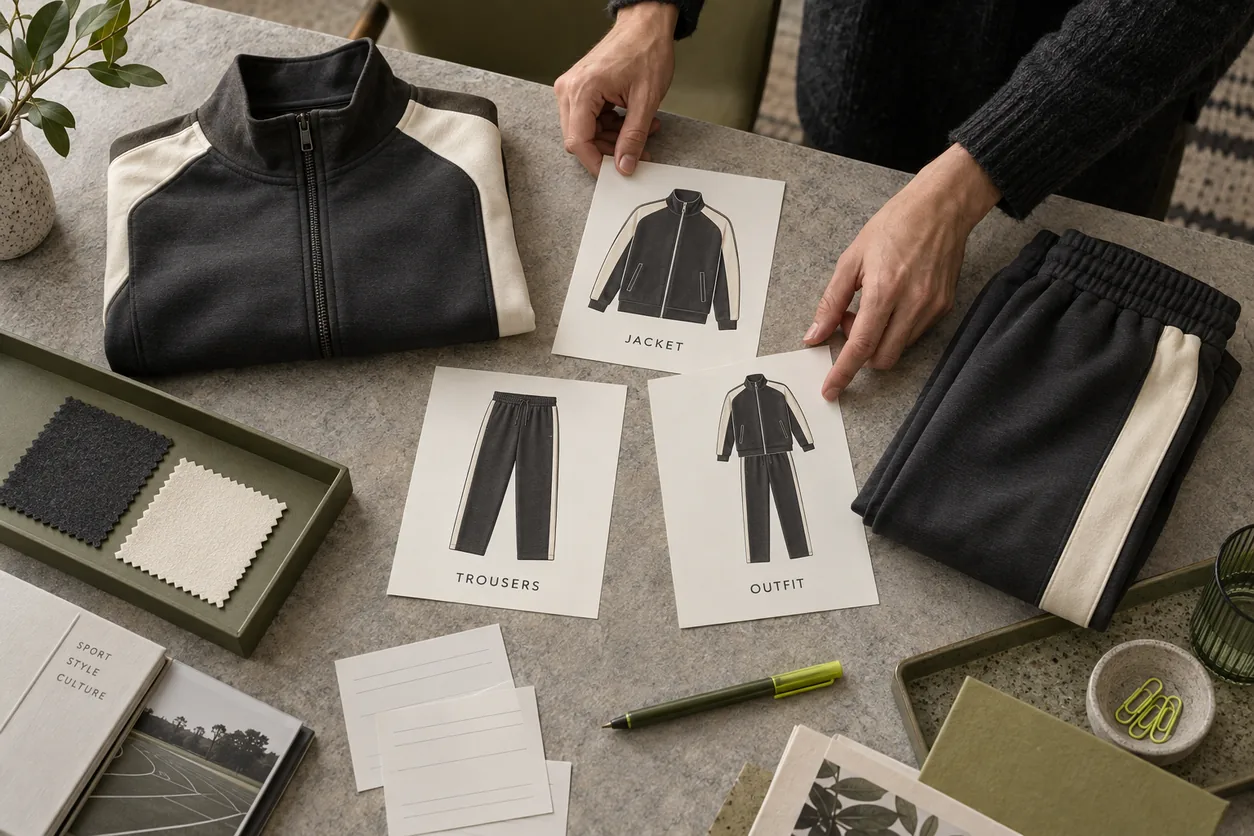
Original conceptual approval scene. The cards demonstrate separate component records and one complete-outfit decision.
What belongs in the final set brief?
Keep the jacket, trousers and relationship sheet together. A useful brief contains:
- The named design direction and intended wearing routine.
- Separate front/back garment drawings and a whole-outfit view.
- Jacket and trouser measurement charts, measuring methods and project-agreed tolerances.
- Panel, tape and artwork references, including start/stop points and construction choices.
- Identified body fabrics, lining, trims and complete opening components.
- Approved top/bottom size-pairing rules, underlayer and footwear used for review.
- Traceable sample revisions, care observations and any relevant test reports.
- Clear packing identification for each component and the ordered pairing.
Approve the two garments individually and the relationship between them. If only the jacket is approved, say so; do not describe the whole set as approved. If a new revision is still required, keep that condition attached to the affected component and pairing.
Buyer FAQs
Must the jacket and trousers use exactly the same fabric?
No. They may use one material or an intentional combination. Identify each proposal and approve the resulting appearance, fit, care relationship and any required evidence. Matching fibre names or colour labels alone do not establish that the two materials behave or look alike.
Should a jacket stripe line up with the trouser stripe?
Only if that continuity is part of your defined design intent. Sleeve and leg details can repeat a visual language without physically connecting. If a body-to-trouser line is intended, define the viewing condition and size pairing, then review ordinary movement as well as the standing view.
Can I approve the set from flat photographs?
Flat views help document placement and construction, but they do not show the full worn relationship. Combine them with physical sample review and consistent worn views: jacket closed and open, standing and seated, with the intended trousers, underlayer and footwear.
Is one approved size enough for a mixed-size set offer?
One pairing does not demonstrate every combination. Define the intended offer and agree a review plan that covers the relevant size range and top/bottom pairings. Keep each garment's fit approval separate from the complete-outfit decision.
Discuss your track set with Athletic Rush
Bring a named silhouette direction, separate jacket and trouser references, and the details you want the outfit to communicate. Include the questions still unresolved: hem-to-waist balance, line placement, pocket access, material proposals or size pairings.
Explore Athletic Rush tracksuits, email kamran@athleticrush.co, or message on WhatsApp. A clear brief makes the next sampling decision easier to assess.