 Sialkot, Pakistan
How should a clothing brand approve a colour sample?
Approve an identified physical sample against an agreed physical colour reference, on the specified material and under agreed viewing conditions. Record which sample revision passed, what the approval covers and what still needs review. A message saying “the clay looks good” leaves the supplier guessing whether you approved a laboratory dye sample, a larger finished fabric or the complete hoodie.
For a streetwear buyer, the useful decision has three parts: establish the target and material, compare the sample consistently, and carry the decision into the next development stage without losing its identity. This guide explains that route through a clay hoodie and an olive overshirt. Both are hypothetical examples, not Athletic Rush inventory or reported customer orders.
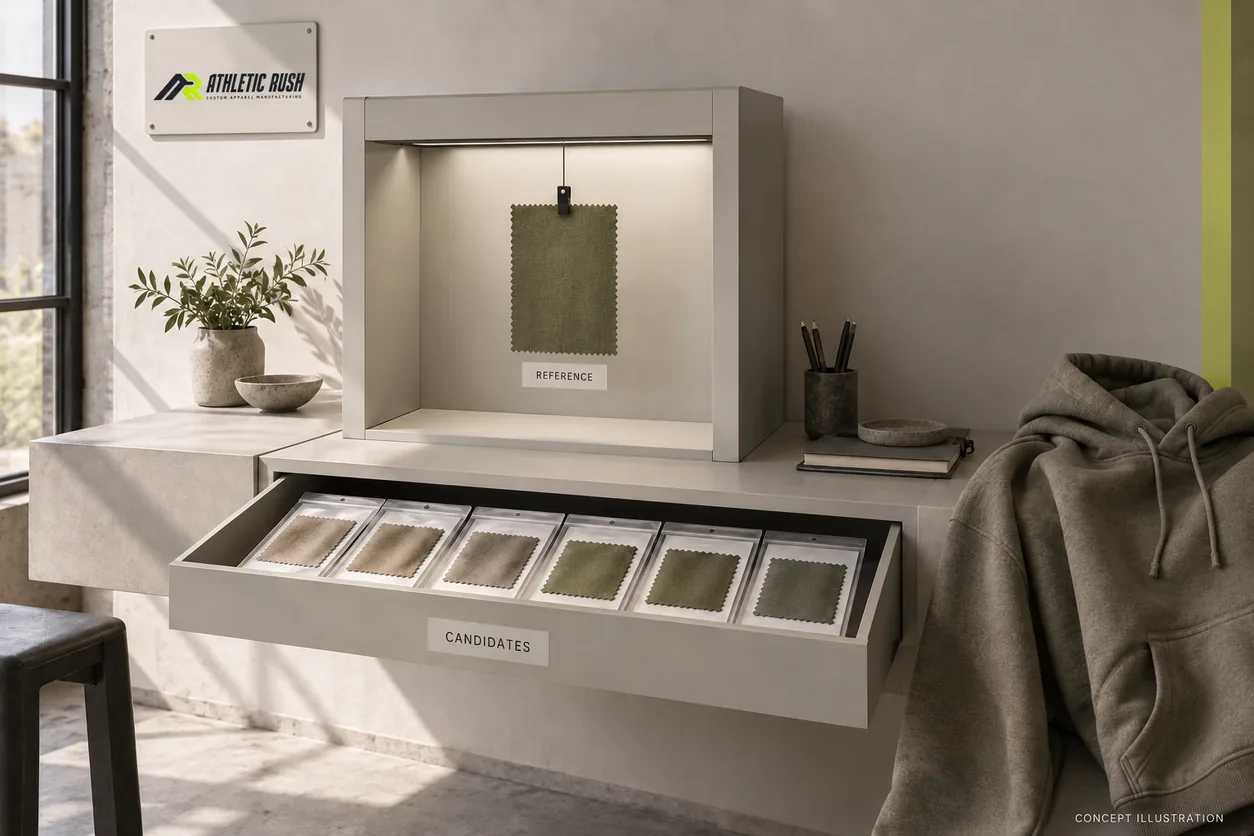
Concept illustration: the cabinet shows a reference-and-candidate workflow. It does not show measured colour results or an actual production approval.
If you are still deciding which shades belong in the range, start with our streetwear collection colour planning guide. The decision here begins after a target shade has been selected: does this particular physical submission represent that target well enough for its stated purpose?
Start with one target that both sides can identify
A colour name is a useful label, but it is a weak approval reference. “Clay” might describe a muted brown, a pinker terracotta or a pale warm neutral. Two people can agree with the name while imagining different fabrics.
Give the project a reference record. Include the colour name, an unambiguous reference identifier, the physical reference supplied, the garment or material it applies to, and the revision date. When using a commercial colour system, identify the actual system and reference format. Do not combine a code from one format with an unrelated image and expect the supplier to infer which one controls.
If a previously approved garment is your reference, identify the specific retained piece and the area to compare. State whether its visible face, a particular panel or another nominated specimen is the target. A vague instruction to match “our old hoodie” is difficult to repeat if the buyer and supplier hold different examples.
Distinguish the reference from the candidate
In the hypothetical Clay Hoodie project, the buyer supplies a retained physical target labelled Clay Reference R1. The supplier returns candidates A, B and C on the proposed hoodie fabric. R1 stays the target while the candidates are evaluated.
Do not quietly promote candidate B into the new target because it is the most attractive of the three. If B is deliberately chosen as a new colour direction, make that a recorded design change. Otherwise, the supplier may continue trying to match R1 while the buyer has begun expecting B.
This distinction also makes rejection clearer. You can request a revision towards R1 without dismissing the material or changing the palette. If the original target cannot be achieved on the proposed material, ask for that limitation and the alternatives to be explained before authorising a new direction.
Ask what material and state the sample represents
A sample should arrive with enough information to identify its substrate: the fabric or component, relevant material specification, intended visible face and finishing stage. Ask whether it represents the proposed production material or a temporary development substitute.
CottonWorks describes lab dipping as colour development on a specified substrate, followed by evaluation and possible revisions before scale-up. Its demonstration uses cotton interlock and a particular dye route; that example is not a universal recipe for fleece, woven overshirts or trims. The useful buyer lesson is to identify the material as well as the shade. CottonWorks lab dip process.
A Clay Hoodie sample on a different temporary fabric may help explore colour direction. Record that limited purpose. It should not silently become approval of the final hoodie fabric, construction or finished appearance.
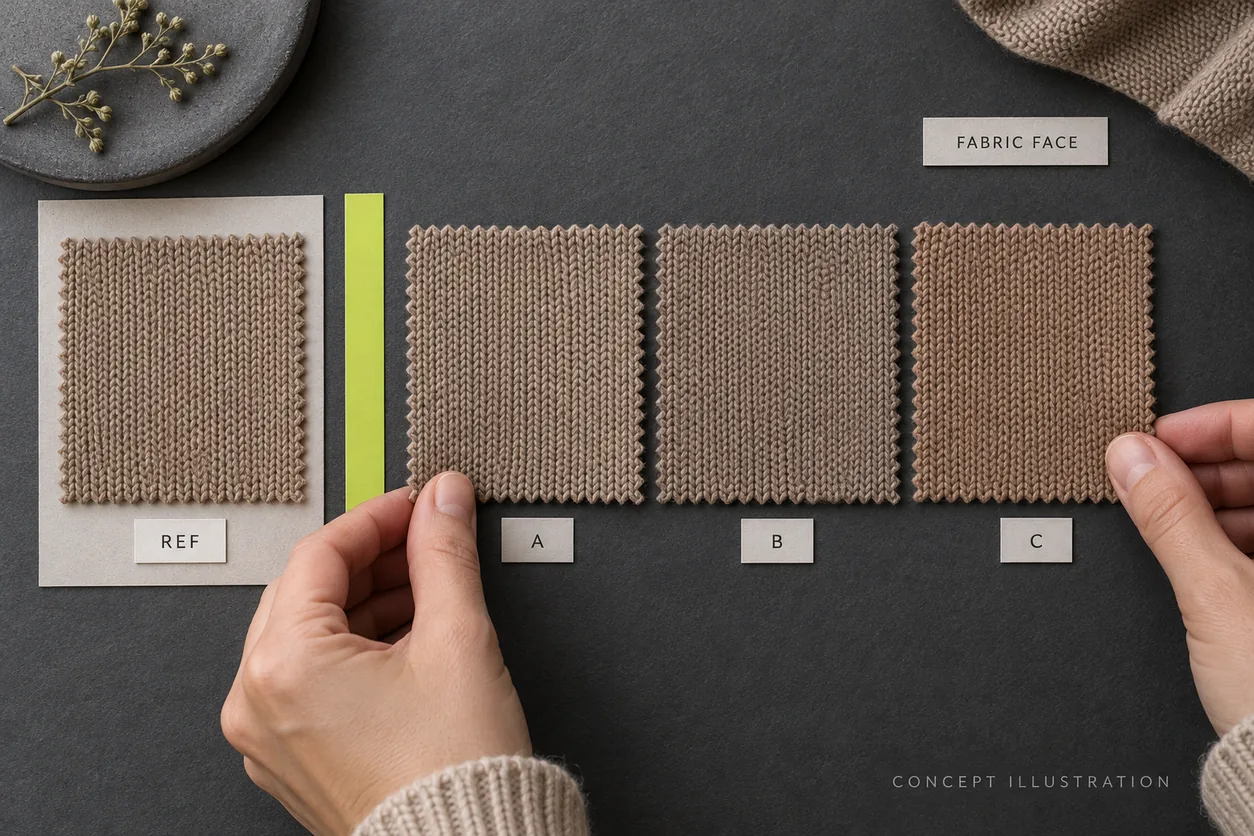
Concept illustration: reference and candidate labels make the comparison traceable. The pictured knit textures and shade differences are illustrative, not laboratory readings or a recommended winning candidate.
Compare the submission, not the photograph
Before judging the shade, check that you are reviewing the intended revision. Match the specimen labels to the supplier's submission record. Keep the reference and candidate identifiers visible throughout the discussion.
Use a repeatable comparison arrangement agreed with the supplier or colour specialist. Compare the nominated fabric faces, keep orientation consistent, and use the agreed background, specimen presentation and lighting. If a specimen is folded, stretched or viewed through a sleeve, confirm how the actual comparison should be prepared. An archive sleeve can protect a sample, but its surface should not become an unexplained part of the colour judgement.
AATCC EP9's public scope concerns visual comparison of textile specimens against a standard, with the aim of making colour-difference evaluation consistent. A formal evaluation should use the applicable procedure and competent personnel. This article offers buyer communication guidance; it does not reproduce that paid procedure or report a laboratory test. AATCC EP9 public scope.
Agree the lights before choosing the sample
Define the primary evaluation source and any additional relevant sources with the supplier. Record their identities, not just “bright light” or “the office.” If neither side has suitable evaluation facilities, agree how a qualified colour team or laboratory will handle the decision.
Datacolor explains two related effects. A single material's appearance can change when the lighting changes. Metamerism concerns two materials that appear to match under one source and separate under another. A phone image cannot establish either condition reliably. Use the agreed controlled comparison to investigate a suspected difference. Datacolor light sources and colour evaluation.
For the hypothetical Olive Overshirt, suppose candidate B appears close to the target under the first agreed source but appears redder relative to it under a second. Record that particular observation and request a review. Do not approve it on the first view while leaving the second result unaddressed.
Conversely, if both pieces look warmer under the second source while retaining the agreed relationship, that is a different observation. Avoid calling every change “metamerism.” Describe what you actually see, under which source, and against which reference.
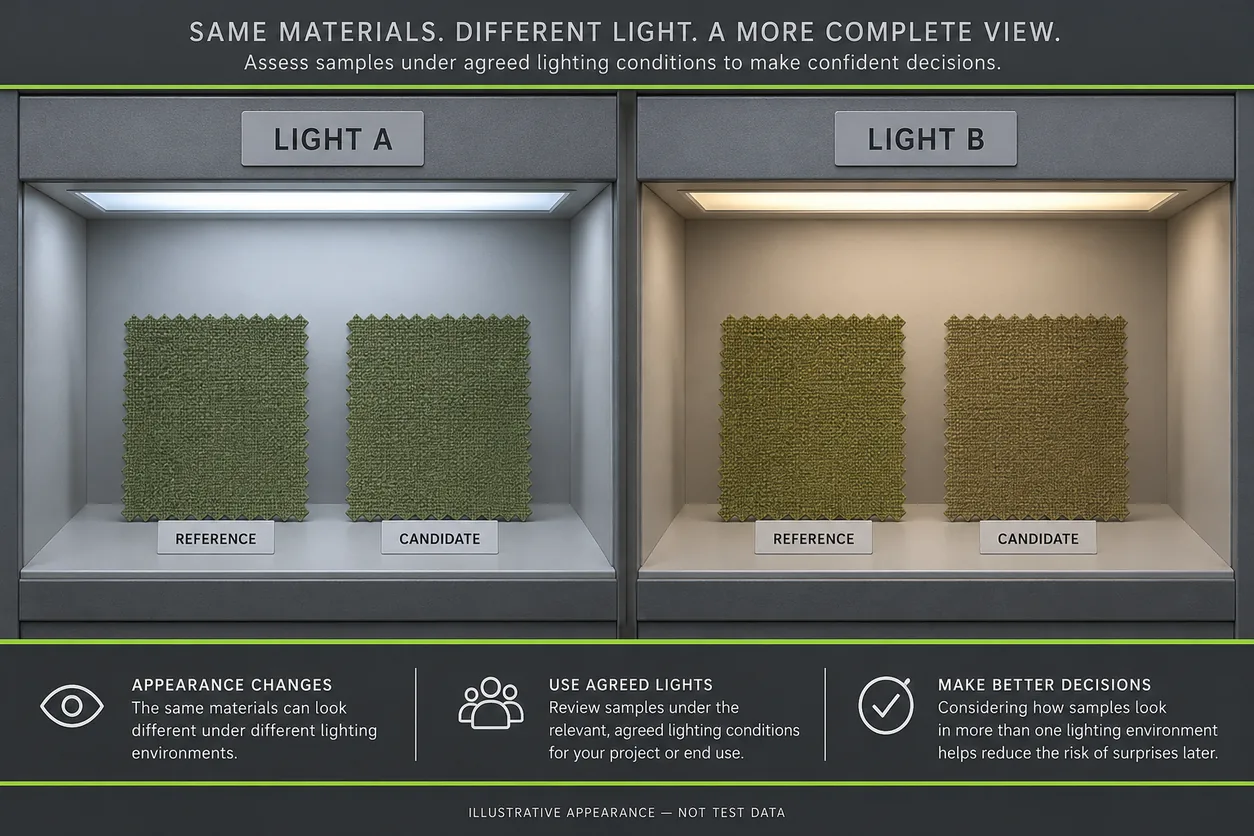
Concept illustration: Light A and Light B demonstrate why viewing conditions matter. These rendered colours are not measurements, named standard illuminants or proof of metamerism in an actual fabric.
What if the buyer and supplier disagree?
First compare the review conditions and sample identities. Are both people using R1? Is one reviewing candidate B while the other has an earlier submission? Are the same face and specified light being used? Resolve those differences before requesting another dye adjustment.
If disagreement remains, retain the disputed specimens and ask the agreed evaluator to review them. Record the unresolved issue rather than replacing the original reference with a screenshot of whichever person feels most confident.
This route helps separate a colour problem from a communication problem. It does not promise that every shade can be reproduced on every material. If the supplier proposes a different substrate or process to reach the target, review what else that proposal changes.
Know what each piece of evidence can establish
A labelled photo is useful for showing where a sample belongs, which candidate is being discussed and which area has a concern. Treat it as supporting communication. Do not let its appearance replace the agreed physical reference.
If instrumental reports are part of the project, ask the supplier to identify the reference, sample and measurement conditions, together with the agreed acceptance method. A report belonging to another material or revision cannot answer the current submission's question. Any numerical limit should be agreed for the project; this guide supplies no universal pass number.
The buyer's decision should connect the evidence to the actual sample instead of treating a single “pass” screenshot as self-explanatory.
| Evidence presented | Useful buyer question | Limit of the evidence |
|---|---|---|
| Named colour or screen image | Which identified physical reference controls the decision? | It does not identify an approved textile specimen by itself. |
| Labelled lab sample | Which substrate, face and revision does this represent? | Its approval has the recorded development scope; later stages remain separate. |
| Visual comparison record | Who reviewed which specimens, under which agreed sources? | It supports that comparison, not every lighting environment or unrelated material. |
| Instrumental report, if required | Does the report identify this sample and the agreed evaluation conditions? | A number without its method, target and specimen identity is insufficient. |
| Larger fabric or finished garment | Which material, lot or revision was submitted, and what approval is requested? | It must not inherit an earlier approval without an explicit review decision. |
Remote approval needs a physical route
When you cannot attend the review, agree where the physical reference and samples will be held and who will evaluate them. Options might include receiving the specimens yourself or appointing an agreed specialist to compare them. Choose the route before the deadline becomes urgent.
Request a labelled submission summary alongside any supporting photographs. Ask for the evaluator's decision and the unresolved points. If the current evidence is only a phone photo, keep the physical shade decision pending rather than calling the photograph a completed comparison.
For a time-sensitive project, identify the exact missing decision: “Clay sample B has been received; physical comparison to R1 under the agreed sources remains outstanding.” That is more actionable than either “approved” or “the whole order is blocked.”
Carry lab approval into larger material and the garment
Approving a lab sample is an important development decision. It does not, on its own, record that a larger fabric submission or complete garment has been reviewed.
Agree the handoff stages with the supplier. A fabric-dyed hoodie may move from a lab sample to a larger finished material submission and then a garment review. A garment-dyed or garment-washed proposal may need a different sequence reflecting the intended finished state. Name the stages for the actual project instead of applying one fixed route to every process.
At each handoff, identify the new specimen and the retained reference it will be compared with. Ask whether the material or finishing specification has changed. If it has, review that change explicitly; do not hide it behind an unchanged colour name.
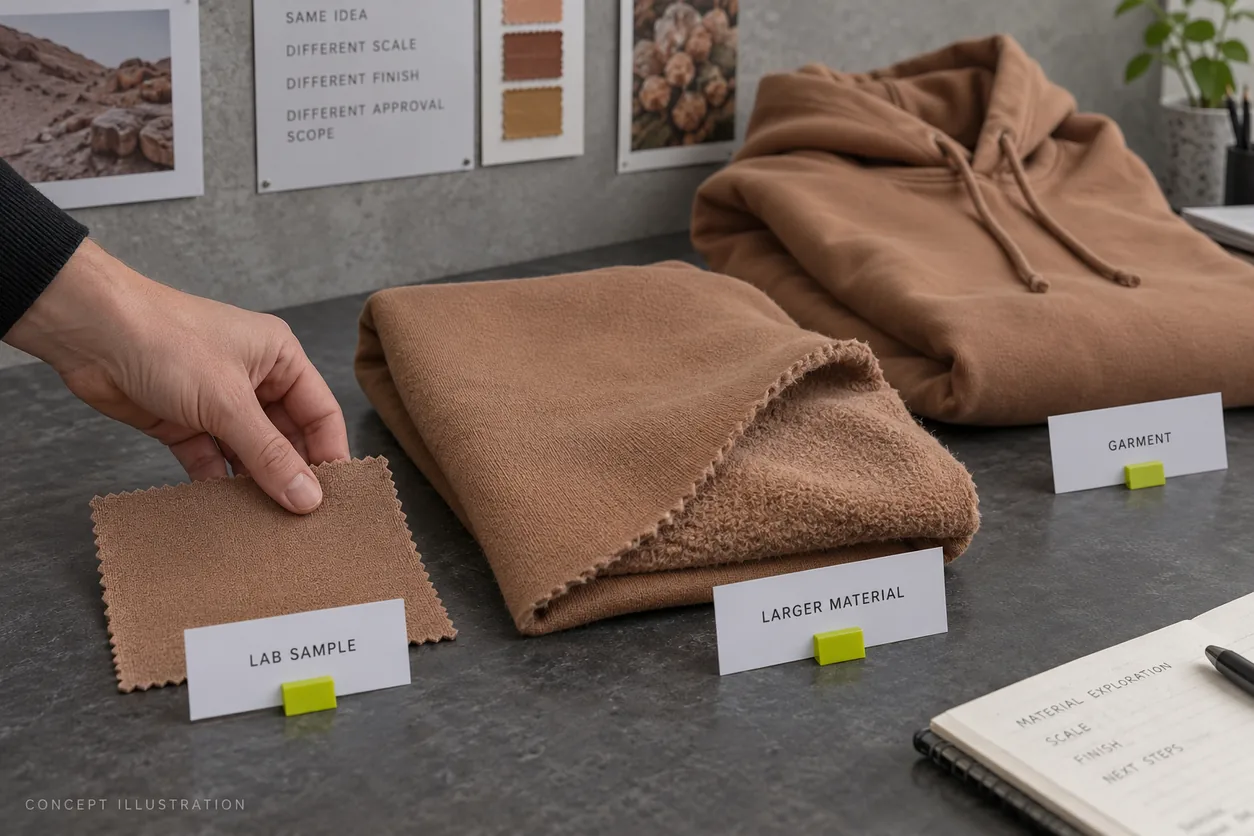
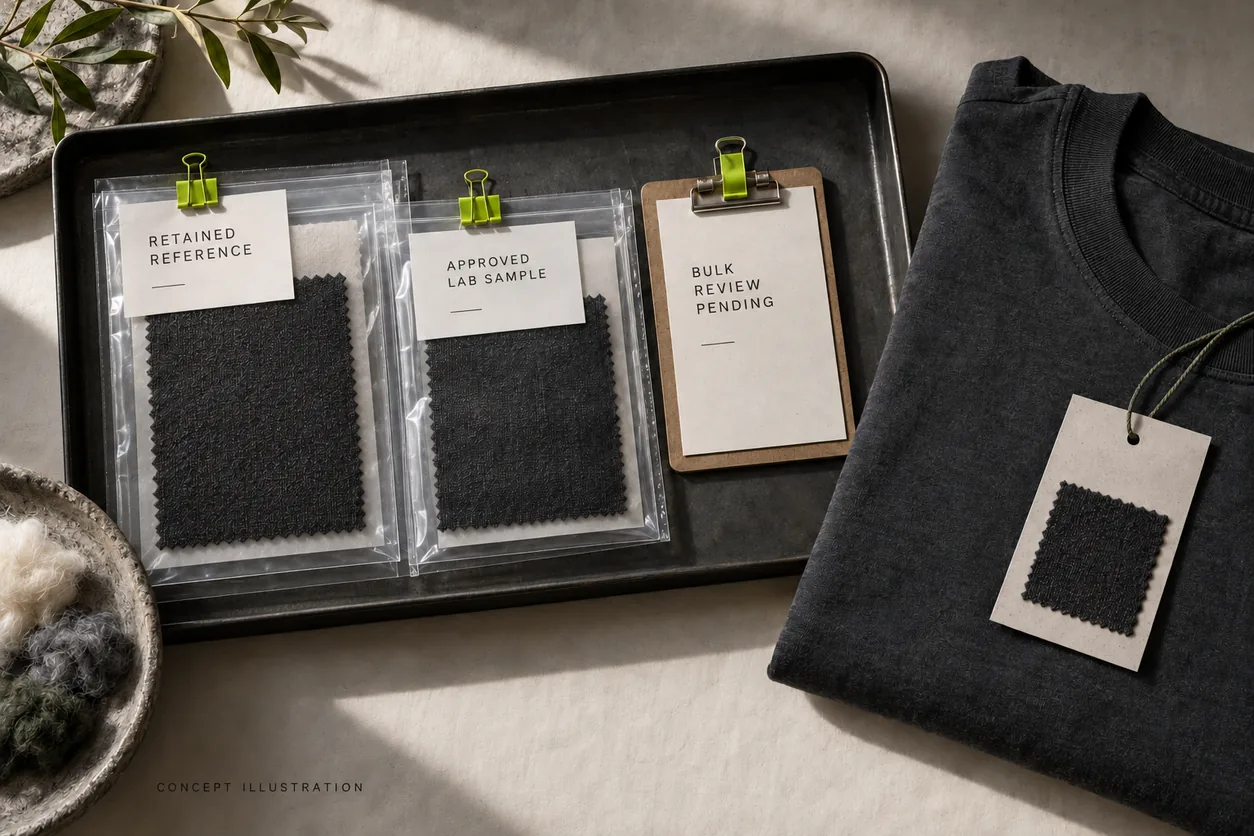
Concept illustration: the three labelled objects explain approval scope and scale. They are not production samples, measured matches or evidence that a finish has passed testing.
The complete hoodie adds decisions beyond body shade
A finished garment lets the buyer review the approved colour in its intended assembly. Check the areas that need an agreed relationship: body panels, hood, pocket and separately developed components. Record whether a visible difference is intentional or needs correction.
Do not assume that approval of the body material also approved rib, cords, zipper tape or decoration. Our hoodie set component colour guide explains that separate component relationship in more detail.
Also keep shade matching separate from care performance. A colour-comparison approval is not evidence that the fabric will meet an agreed washing, rubbing or other performance requirement. Ask what separate evidence is required for the garment and intended use. Neither an attractive swatch nor the conceptual images in this guide provide those results.
For the Clay Hoodie example, the buyer could accept the body material's shade while leaving the rib relationship and garment review pending. That is a limited decision, not approval of the complete order. Write the remaining decisions so production planning does not convert a partial approval into unrestricted release.
Give the supplier a revision they can act on
Comments such as “too dull,” “make it premium” or “closer to the picture” do not identify the comparison clearly. Build the correction around the sample ID, reference ID, viewing condition and observed direction of the difference.
Keep the comment about the outcome. The supplier or colour specialist should determine the technical adjustment. A buyer should not invent a dye formula from a visual impression or tell the mill to change a chemical percentage without the necessary process knowledge.
| Observation in an illustrative review | Clear revision request | Avoid assuming |
|---|---|---|
| Clay B appears lighter than R1 under the agreed primary source. | “Review Clay B against R1; it appears lighter in our agreed comparison. Submit a new identified candidate for review.” | That “darker” is a complete dye recipe. |
| Olive B appears close under source one but redder than the reference under source two. | “Keep approval pending and investigate the difference under both specified sources; return the findings with the new revision.” | That one photograph proves the cause or resolves the second source. |
| The submission is on a substitute material. | “State the purpose of this submission and resubmit on the proposed material before final material shade approval.” | That a shared colour name means equivalent approval. |
| A larger submission differs visibly from the retained approved lab sample. | “Identify the larger specimen and any material or finish change; compare to the retained lab sample before the next release decision.” | That the earlier approval automatically covers this new submission. |
The examples describe hypothetical observations, not measured Athletic Rush results. If the approved target itself is changing, say so separately. A correction towards R1 and a decision to replace R1 are different instructions.

Concept illustration: a revision comment connects the reference, sample and next review. The people are generated characters, not named buyers or a documented customer meeting.
Use one decision owner and keep the previous revision
Agree who can make the project's colour decision and how it will be communicated. Consolidate comments before sending them to the supplier so a designer's preference and a merchandiser's release instruction do not contradict one another.
Retain the earlier submission when asking for a revision. It helps the next reviewer understand whether the requested direction was followed. Mark its status clearly; do not allow an earlier rejected candidate to be mistaken for the approved sample because it is the only piece left on the desk.
If a candidate is held pending more evidence, use that status. “Pending physical review” and “rejected because of a specified difference” lead to different next actions. Accurate status language is a practical part of the colour brief.
Write an approval that names its boundaries
A useful record identifies the project, colour reference, sample or submission revision, material and reviewed stage. Add the evaluator, date, agreed viewing sources, decision and any remaining checks. Keep a physical retained specimen wherever the project workflow requires it, and tell both sides where that specimen is held.
An illustrative limited approval could read:
“Clay Hoodie body-fabric lab submission B2 is accepted against retained Clay Reference R1 for the identified proposed material under the agreed evaluation sources. This records lab shade approval only. Larger finished material and complete-garment reviews remain pending. Retain B2 with the project reference record.”
That wording is an example of scope, not a real approval receipt. The actual identifiers and conditions must come from your project.
If a later material substitution, finish change or revised colour target is proposed, decide which approval needs to be reopened. Do not let a date-free forwarded message cover a new submission simply because its colour name has not changed.
Concept illustration: keeping the physical reference and stage decision together makes the next review traceable. No actual order, signature or test result is represented.
Frequently asked questions
Can I approve a textile colour from a WhatsApp photograph?
Use a labelled photograph to discuss the submission and an identified concern. For the physical shade decision, agree a route to review the real reference and sample, either directly or through an appointed evaluator. Record what remains pending if the physical comparison has not happened.
How many lab sample rounds should a colour need?
There is no fixed number promised here. Ask what the first submission represents and give clear, consolidated comments for any revision. Repeated rounds caused by different references or conflicting instructions should prompt a review of the brief before more candidates are made.
What numerical colour tolerance should my brand use?
Agree any numerical acceptance rule with the supplier or qualified colour team for the specified material, reference and evaluation method. Do not borrow a pass value from an unrelated report. Identify how instrumental evidence and the required visual decision will be used together.
Does an approved lab sample release the complete bulk order?
Only if the actual project approval explicitly says that and all required decisions have been completed. A lab shade approval normally records a narrower development decision. State whether larger material, finished-garment, component or performance checks remain pending.
Bring the reference and the next decision to your enquiry
For your next streetwear development enquiry, prepare the identified colour reference, proposed garment and material, current sample revision, evaluation requirements and decision you need next. That lets the conversation focus on a physical target and a defined review instead of an ambiguous colour name.
Contact Athletic Rush at kamran@athleticrush.co or WhatsApp +923279008337 to discuss the colour reference and sampling brief for your clothing collection.