 Sialkot, Pakistan
 Worldwide enquiries

Why can a hoodie and jogger share the same colour name but still look mismatched? A colour name does not specify the physical material, finish or viewing conditions. To approve a coordinated set, establish an identified colour target, evaluate each visible component against it, and then review the assembled outfit under agreed lighting. Keep the approved samples and decisions tied to the exact materials and production references.
This guide helps streetwear brands approve the colour relationship between a hoodie body, jogger fabric, rib, drawcord, zipper tape and visible stitching. It is not a dye recipe or a universal colour-tolerance chart. The practical question is: which components must match, how will we judge them, and what evidence authorizes bulk production?
A subtle difference can be intentional. Charcoal rib on a black hoodie might be a design choice; the same difference on a set intended to look uniform may be unacceptable. Write that distinction into the brief before samples arrive, rather than deciding retrospectively that an unexpected shade is close enough.
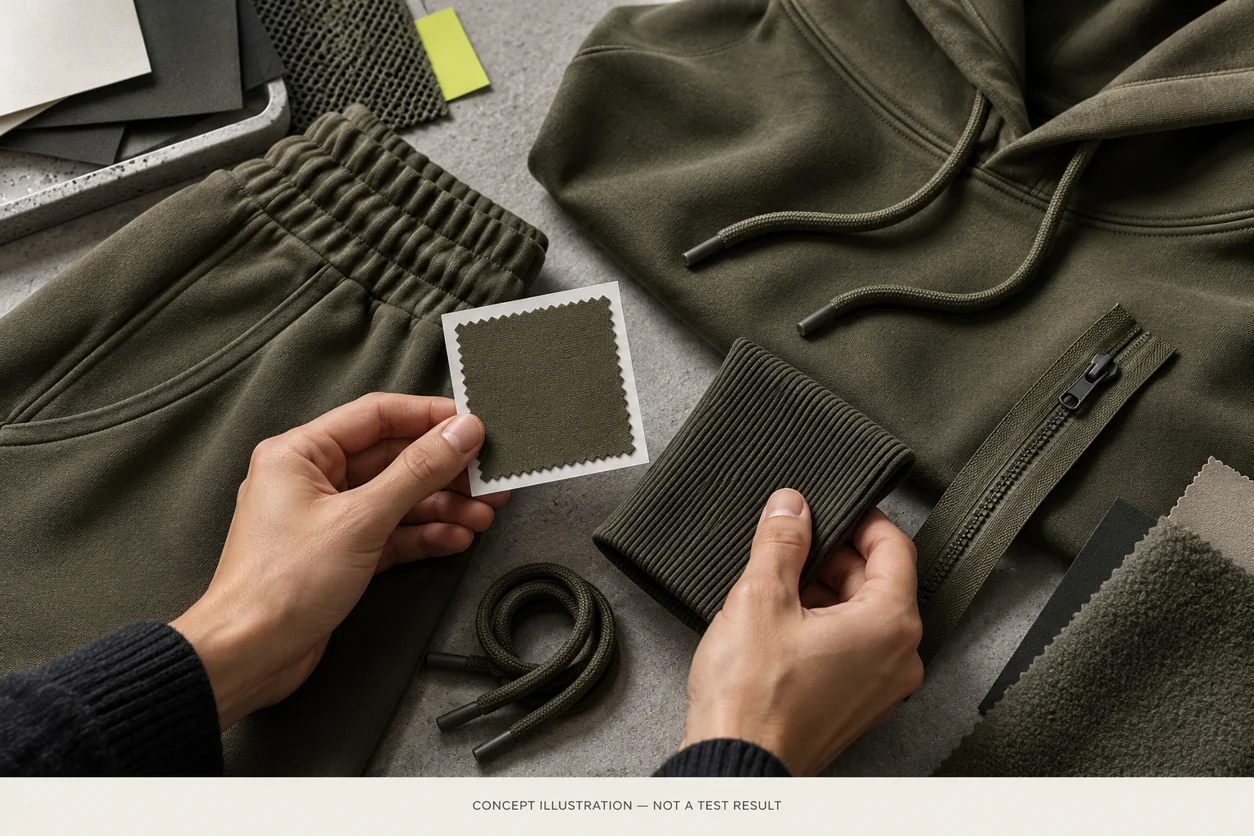
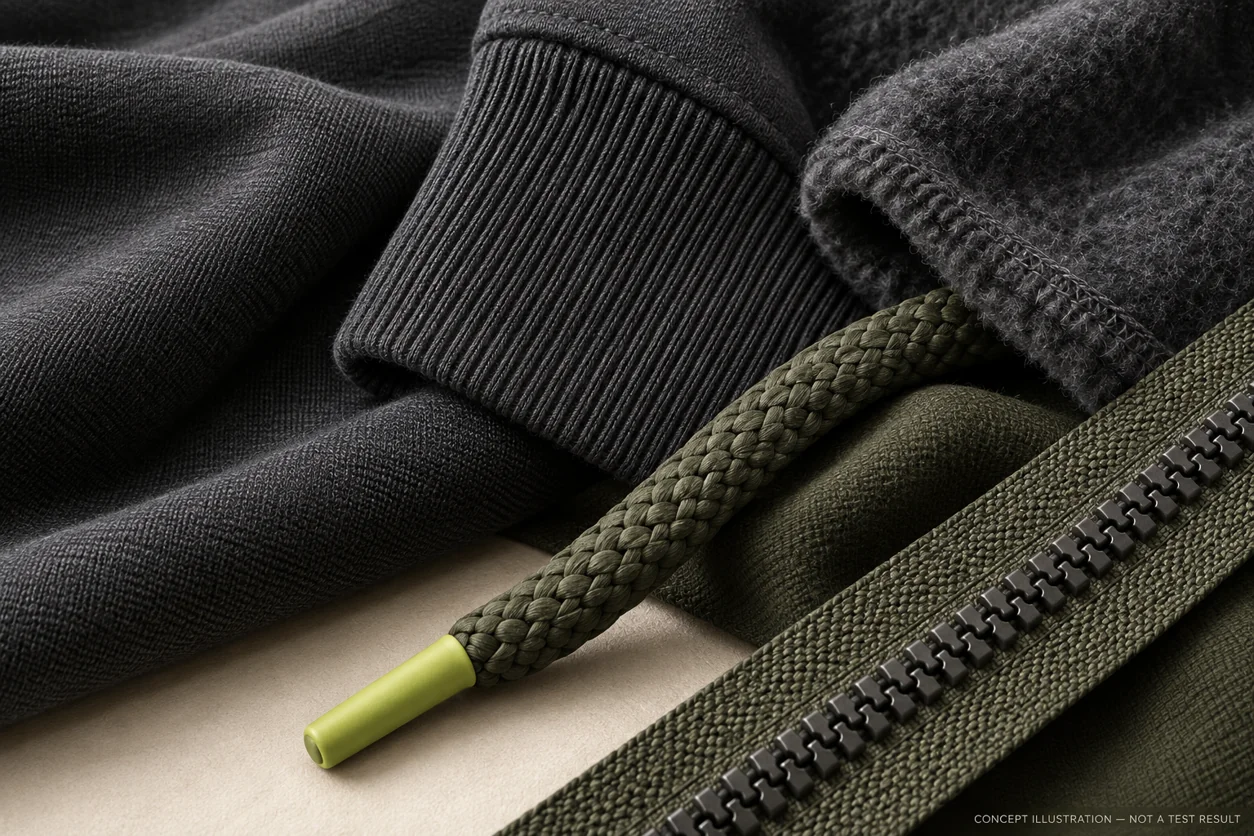
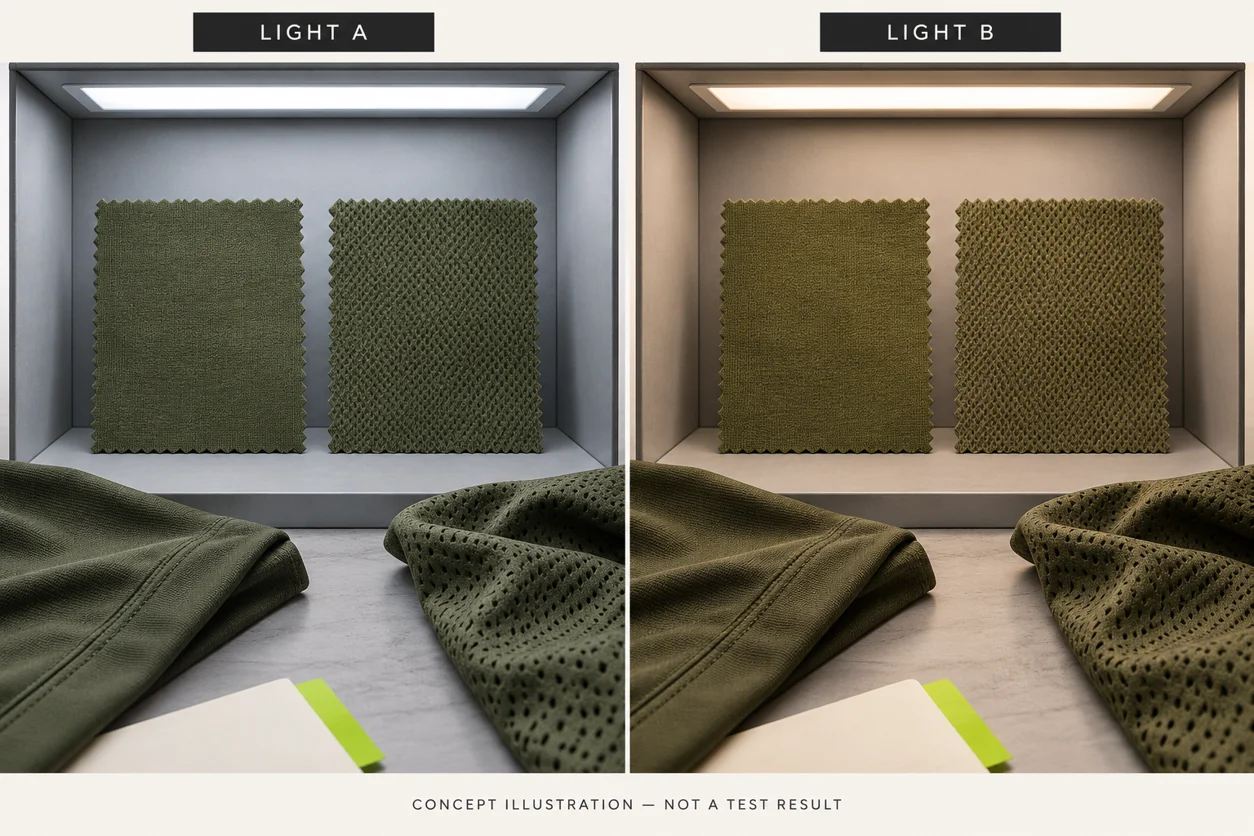
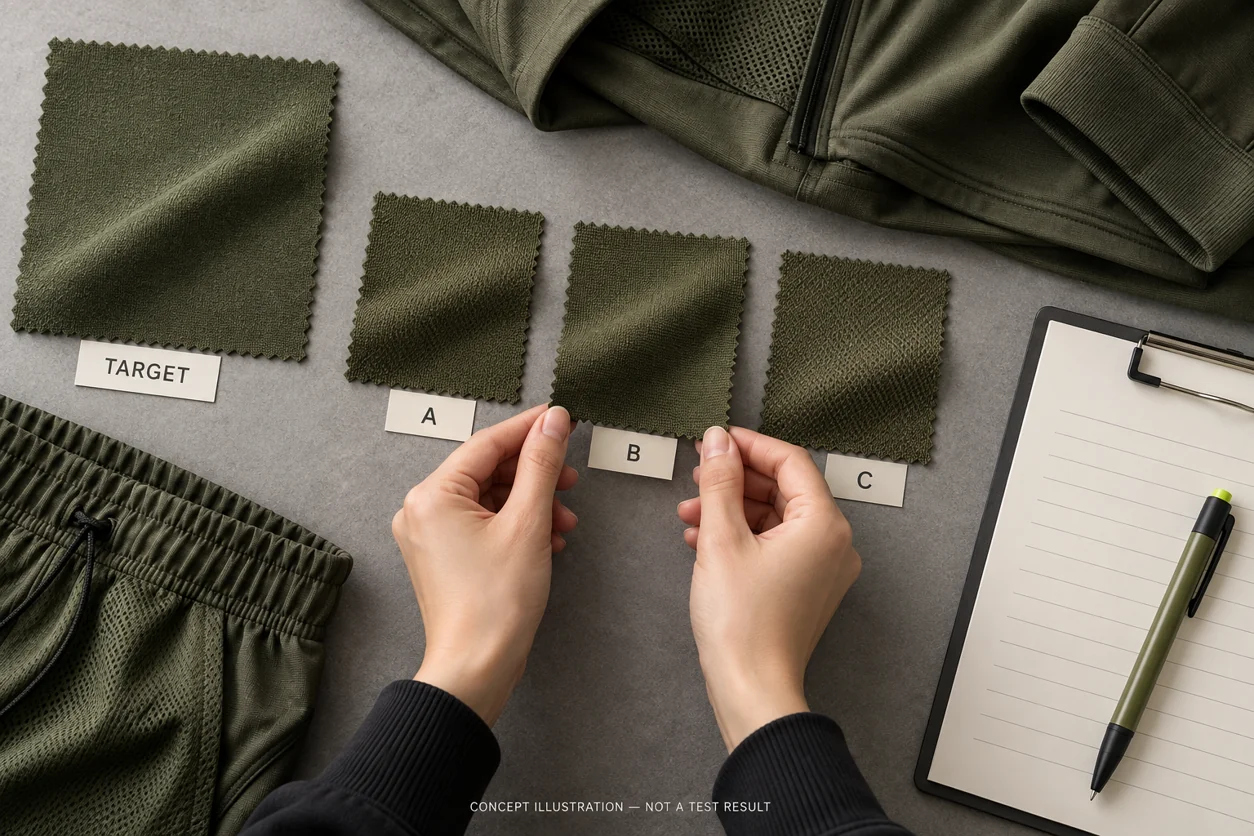
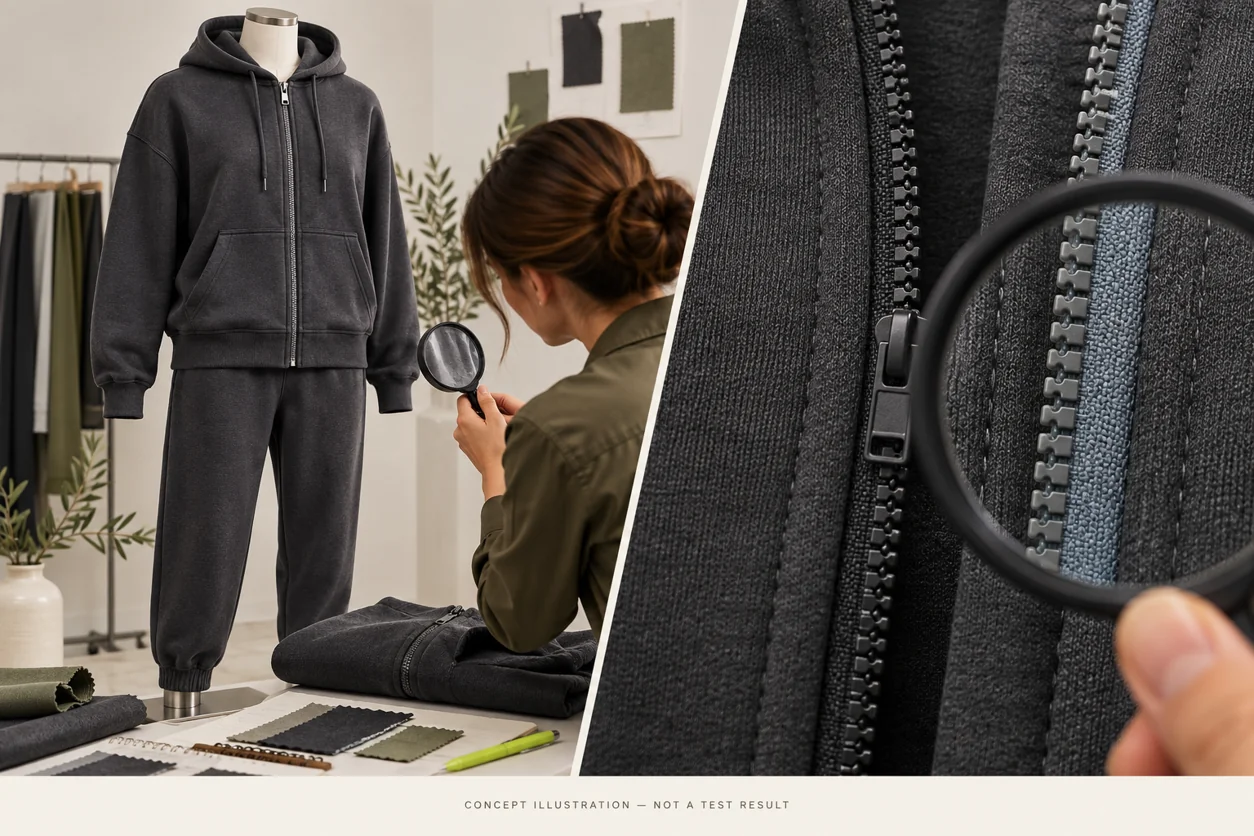
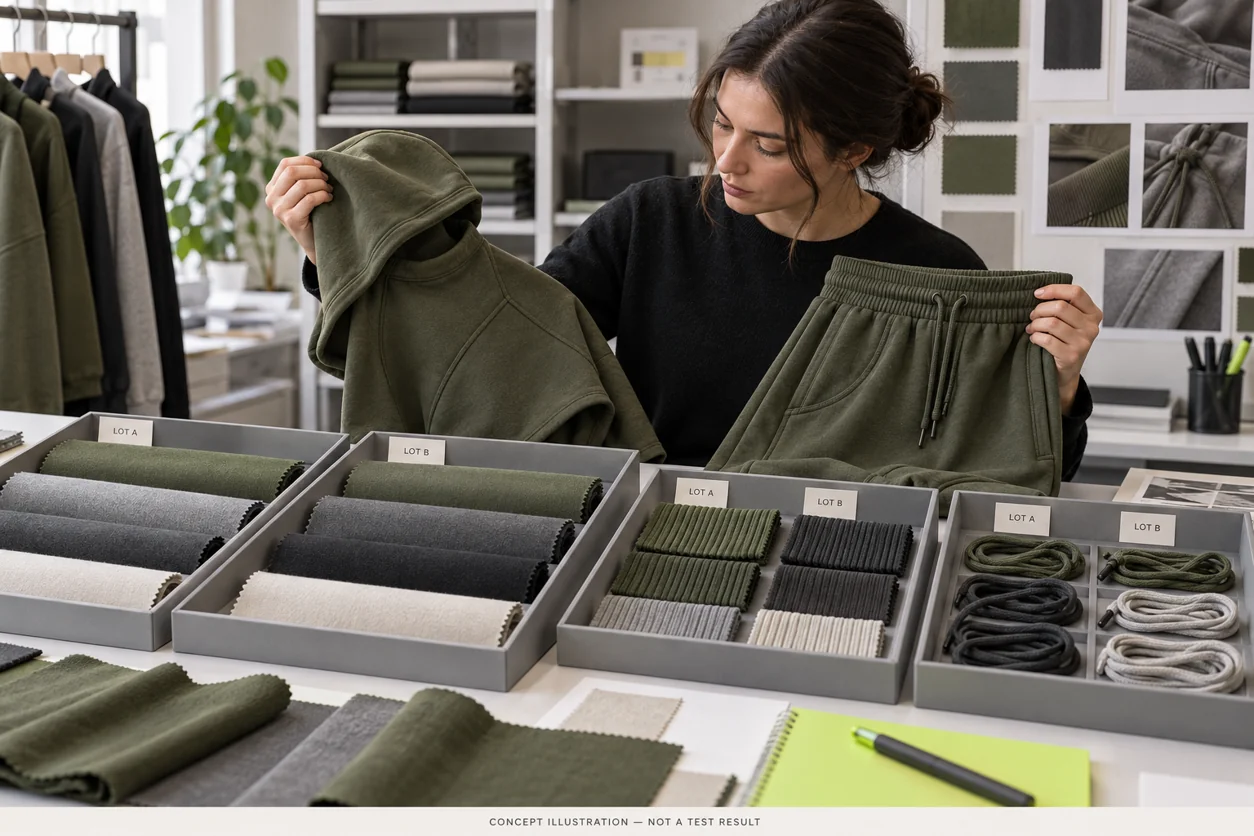
The six original visuals are conceptual illustrations, not colour standards, laboratory results or photographs of actual Athletic Rush production. Colours displayed on your screen are illustrative.
1. Turn a colour name into an approval brief
“Make everything olive” leaves too much open. The hoodie body, rib and drawcord may be different constructions or materials. A name helps organize the collection, but it cannot tell each supplier exactly which physical reference to match or which differences the buyer accepts.
Start with one identified target. Where a commercial colour standard is used, record the relevant system, exact reference and physical standard being supplied. If the target is a buyer-approved fabric cutting, identify that cutting and retain a protected reference. Agree how the supplier will access the same standard and how a replacement reference will be controlled.
Do not rely on a screenshot of a colour card as the approval master. Use photographs to communicate placement or show which samples are being discussed; keep the physical or agreed digital colour-management reference distinct from a casual phone image.
Decide what must match and what may contrast
| Component | Question for the buyer | Approval evidence to retain |
|---|---|---|
| Hoodie and jogger main fabrics | Is the outfit intended to appear uniform or deliberately tonal? | Identified swatches and the complete proposed set |
| Cuff and hem rib | Should the rib coordinate closely or form a contrast border? | Rib sample beside the actual body fabric |
| Drawcord and zipper tape | Is the visible textile trim expected to match the body? | Finished trim sample in its intended position |
| Sewing or embroidery thread | Should the stitching disappear visually or stand out? | Actual sewn or embroidered application |
| Metal or moulded hardware | Is this a separate finish choice rather than a textile match? | Approved hardware finish and assembled sample |
The table is a briefing framework. It does not claim that every component can be made visually identical. If a proposed match is impractical for the selected materials, ask for alternatives before approving the order: a different component, a defined tonal relationship or an intentional contrast.
Example brief: “The hoodie and jogger bodies should form one coordinated olive outfit. Cuff and hem rib should coordinate with the body. The zipper pull is a separately approved dark metal finish. The exposed zipper tape must be reviewed beside the front panels.” This is clearer than “all olive, all matching,” and avoids asking a metal surface to look like knitted fabric.
Identify the materials behind the colour
Record the material reference and finishing state for each approval sample. A body-fabric approval should not silently become approval of a replacement rib or cord. When a component changes, ask whether its colour needs to be resubmitted and whether the whole garment needs another visual review.
Cotton Incorporated's lab dip process explanation starts colour development with a specified colour and substrate. Its demonstration also explains that procedures vary with fibres and dyes. The buyer takeaway is to attach the colour decision to the actual material being developed, rather than assume one recipe or swatch settles every component.
2. Compare samples under controlled conditions
Arrange the target and candidate components together for the review. Agree the light sources, surrounding conditions and sample presentation with the supplier or colour specialist before either side makes an approval decision. If your office and the supplier use different conditions, an unexplained disagreement may be a review-process problem as well as a material problem.
Keep sample identity visible in the record. If three alternatives arrive, call them A, B and C and retain the supplier's references. “The one in the left photo” is fragile information: photographs can be rearranged, cropped or forwarded without context.
Understand a match that changes with the light
Two samples can appear to match under one light source and differ under another. This is commonly described as illuminant metamerism. Datacolor's colour-management explanation discusses this limitation and the role of physical colour evaluation.
For a buyer, the important step is to agree more than a casual single-room comparison. Ask the colour team to assess the proposed match under the lighting conditions relevant to the project and record the outcome. Do not label every visible mismatch “metamerism”; an ordinary shade difference or a change in sample presentation may also require investigation.
Illustrative case: the hoodie body and zipper tape look coordinated during one agreed review, but the tape looks noticeably different under a second agreed source. Put that observation into a hold or revision note. Ask the supplier to investigate the component and submit a revised comparison. A phone photograph alone cannot establish the technical cause.
Separate surface appearance from the colour decision
Look at the actual relationship between components. Rib has a different surface from a smooth jersey face; a braided cord presents a different shape from a flat fabric swatch. Compare the materials in a consistent orientation and then in the way they appear on the garment.
Ask the reviewer to describe the issue precisely. Is one component visibly lighter, darker, more yellow or more blue relative to the target under the agreed conditions? Is the concern limited to the way a raised surface catches light? These descriptions help define the question; they do not replace an instrument reading when the project requires one.
Do not keep changing the target to whichever sample looks most attractive in the latest photograph. If the brand chooses a new direction, issue a revised target and identify which previous approvals are superseded. Otherwise, different suppliers can continue working toward different versions of “approved olive.”
Use measurements with an agreed method
If instrumental colour evaluation is part of the project, agree the measuring method, sample preparation, relevant calculation and acceptance criteria with qualified personnel. A number described simply as “delta E” is incomplete without the method and conditions used to obtain it. This guide intentionally does not prescribe one tolerance for every fabric, trim and customer.
A useful buyer record contains the sample identity, target reference, evaluation conditions, relevant report and the authorized decision. Ask how an instrument result will be considered alongside the visible relationship of adjacent components. A pass shown on a detached sample report should not be interpreted as permission to ignore an unresolved assembled-garment concern.
3. Approve development, bulk material and the finished set separately
A small colour-development sample is a step in the process. Keep that decision distinct from approval of the actual bulk material and from approval of the finished outfit. This distinction makes it possible to accept a direction without accidentally authorizing every later substitution or batch.
Stage one: the development submission
Ask for an identified submission with the proposed component, target and revision details. If a supplier presents several lab dips, evaluate them against the agreed target rather than selecting one only because it looks best in isolation. Record one of three outcomes: approved for the stated stage, revise with a specific observation, or hold pending missing evidence.
CottonWorks describes lab dips as an iterative development process and notes that scaling a formula into production can require adjustment. Approval of that development sample should therefore have a clear scope; it is not a statement that all later bulk material has already been inspected.
Stage two: the proposed production material
Ask which actual material lots will be used for the hoodie body, jogger body and visible trims. Review the required bulk submissions against the approved reference and the other components before giving the relevant release decision. Agree the sampling scope and criteria for your project with the supplier; do not invent a universal number of rolls or pieces to inspect.
If different lots are involved, keep the identifiers with the review. Ask how components will remain traceable through cutting, sewing and packing. A reordering plan should also explain how later components will be compared with retained references rather than approved by memory.
The practical issue is not just whether each component was once called “approved.” It is whether the particular components being combined belong to the reviewed combination. A packing or production substitution can undermine an otherwise clear colour approval record.
Stage three: the assembled garment and complete outfit
Put the hoodie and jogger together. Inspect the hood-to-body relationship, cuff against sleeve, hem rib against body, and waistband and cuffs against the trouser legs. On a zip hoodie, look at exposed tape beside the front panels. Review visible stitch and embroidery areas at their actual scale.
Inspect both close up and as a whole outfit. A small contrasting thread may be an intended detail, while a differently coloured panel can dominate the garment. The approved design intent determines what matters; do not use a generic rule that all differences are either harmless or defects.
If you are still developing proportions or deciding whether customers can mix sizes, use our matching hoodie and jogger set approval guide. Colour approval is one part of that complete-set decision, not a substitute for fit and construction checks.
Write a correction that can be acted on
| Unclear message | More useful buyer instruction |
|---|---|
| “The colour is wrong.” | Identify the component, target and sample; describe the observed difference under the agreed light. |
| “Use the previous one.” | Name the retained reference and revision; confirm whether the instruction applies to body, rib, cord or the whole set. |
| “Everything is approved.” | List the approved components, review stage and outstanding checks. |
| “The photo matches.” | Use the image to identify samples; confirm the decision against the agreed physical or digital evaluation process. |
For example: “Hold zipper tape submission B. Against body reference HJ-01 under our agreed review conditions, the tape appears cooler than the intended coordinated match. Retain the approved body reference and resubmit the tape.” The reference code is illustrative. Use your real identifiers, conditions and authorized decision-maker.
Keep a reference archive for reorders
Retain the approved target, component samples and assembled-set reference in a way agreed with the supplier. Label them with the project, component, revision and approval date. Keep the associated reports and decision notes accessible to the people handling the reorder.
Do not assume a later batch or substitute trim is covered by an earlier approval. Compare the proposed replacement and decide whether the change needs a new component review or a repeat complete-set review. State any accepted contrast as a deliberate design choice in the revised specification.
A practical colour approval checklist
- One identified master target and a clear distinction between matching, tonal and contrasting components.
- A component list covering the two main fabrics, rib, cord, zipper tape and visible thread or artwork.
- Actual material and finishing references attached to each submission.
- Agreed lighting and evaluation conditions, with a defined process for disagreements.
- Sample identities, revision notes and approval scope recorded in writing.
- Relevant production-lot submissions and an assembled-set comparison before the applicable release decision.
- Retained references and traceability for later substitutions or reorders.
If a decision is unresolved, name what remains outstanding. A precise hold on one trim is more useful than an ambiguous approval of the entire outfit.
Buyer questions
Is sending a colour code enough?
It is a useful reference when the colour system is clear, but you also need the agreed standard, materials, viewing conditions and approval process. The same code in an email does not prove that every physical component has been evaluated.
Must rib, drawcord and zipper tape look identical to the body?
Only if that is the agreed design objective and the proposed materials can deliver an acceptable match. Define coordinated or contrasting relationships deliberately and review actual components together.
Can a phone photograph approve a shade?
Use it to identify samples or explain the location of an issue. Do not let an uncontrolled image replace the agreed colour standard and evaluation process. A specialist digital colour workflow is different from approving a compressed chat photograph.
Does lab dip approval authorize bulk production automatically?
The written scope determines what is authorized. Keep the development colour decision separate from required production-material and finished-set checks, and state any remaining conditions explicitly.
Build the colour brief before ordering the set
Send Athletic Rush your intended hoodie and jogger combination, colour references and the components that should match or contrast. Include any existing approved physical samples and explain how your brand currently evaluates colour.
Explore Athletic Rush hoodies and the hoodie zipper specification guide when preparing the component list. Email kamran@athleticrush.co or contact Athletic Rush on WhatsApp to discuss the required sample and approval stages for your project.