 Sialkot, Pakistan
 Worldwide enquiries

Specify how the hoodie must open first, then identify the complete zipper assembly and approve it sewn into the actual garment. A shiny finish, a size number or a supplier name alone does not tell you whether the zip is right for your collection.
This guide is for a clothing-brand buyer who has chosen a zip hoodie but has not yet fixed the closure specification. The practical problem is that “use a good-quality zip” leaves too many decisions open. Two suppliers can follow that instruction and deliver noticeably different samples.
Your brief should connect three things: the intended opening, an identifiable component, and the finished-garment checks required before production. This article provides a way to make that brief without inventing universal performance ratings or selecting hardware from appearance alone.
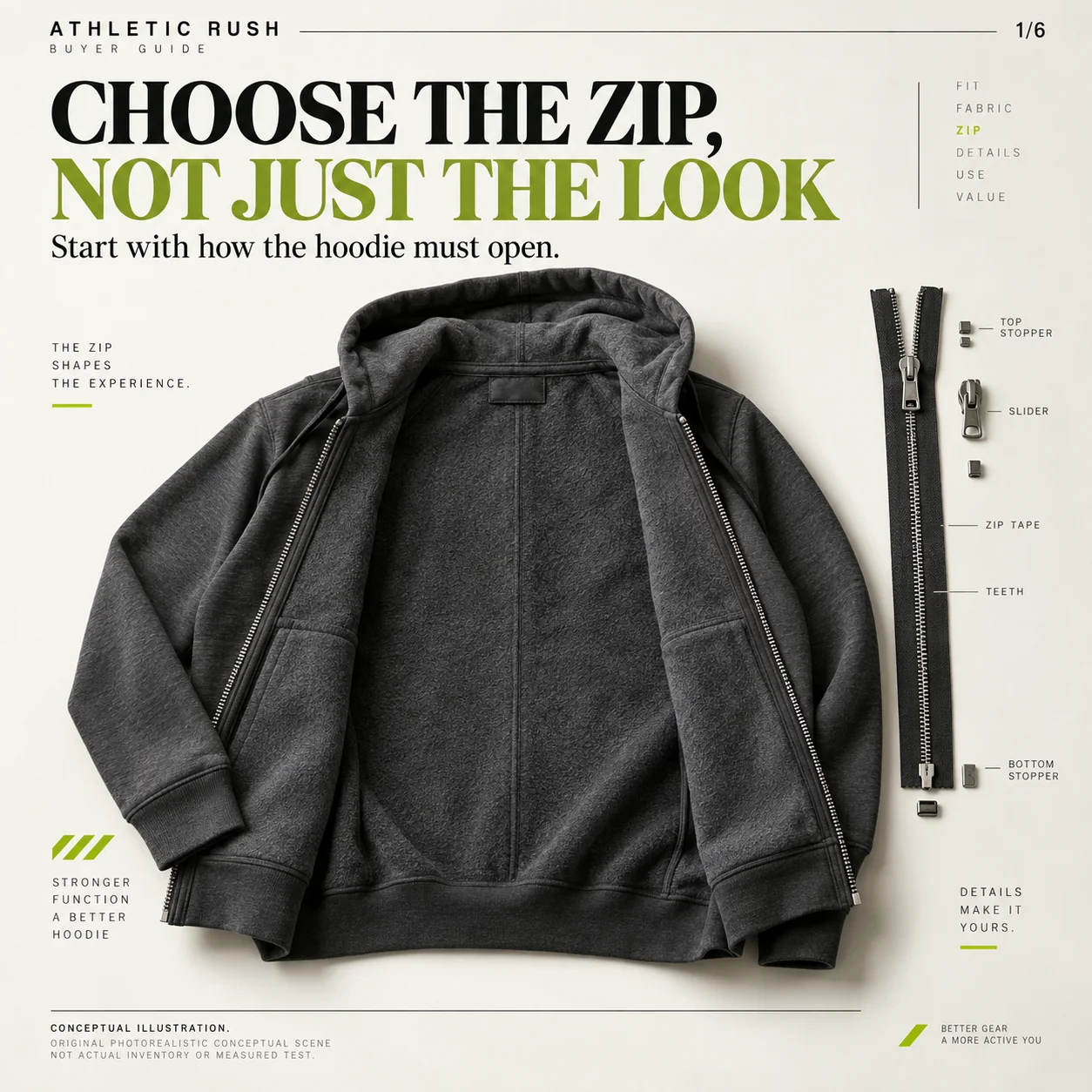
The six original AI-generated illustrations show development concepts. They are not photographs of Athletic Rush stock, approved components or measured test results. Confirm actual specifications and availability for your order.
1. Define what the opening needs to do
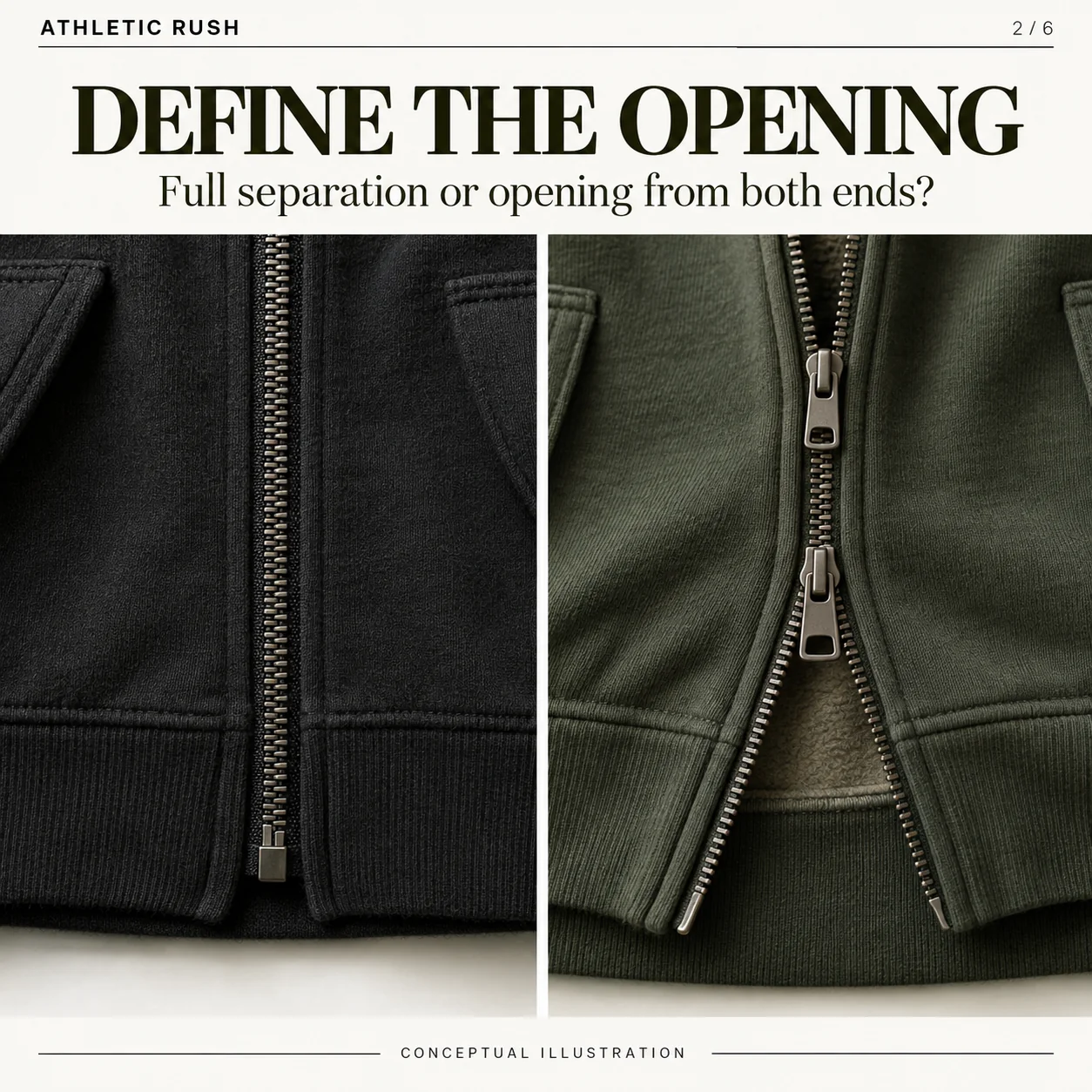
For a conventional full-front hoodie that comes completely apart, discuss a separating or open-end assembly. If the wearer needs to release the lower front while keeping the upper portion closed, discuss a suitable two-way separating construction. Specify that intended behaviour explicitly; “two-way” should not substitute for a clear description of how the garment opens.
A closed-end zipper does not separate completely at its lower end. It may serve another design, such as a short opening, but it is not the same brief as a fully separating hoodie front. Draw the opening and show where it begins and ends when words could be misunderstood.
Do not choose the more complicated construction simply because it sounds premium. Ask what the customer will do with it. For example, a seated styling concept may justify testing a lower opening. A simple everyday full-front layer may need only straightforward separation. These are development examples, not universal requirements for those customers.
Make the operation part of the sample review
Ask the supplier to demonstrate inserting, closing, opening and separating the proposed assembly. Review it in the same garment configuration that production will use. A loose zipper held in the hand cannot demonstrate how the finished hood, facing, pocket or hem interacts with the closure.
If a customer has particular handling needs, include those needs in the development brief and evaluate a suitable sample. Avoid treating a large puller as proof of accessibility or ease of use. Its shape, grip, position and interaction with the garment should be assessed together.
Specify the required insertion-side arrangement with a drawing or reference sample. Do not rely on an assumed convention based on a market or customer category. The supplier should acknowledge the actual arrangement requested.
| Buyer question | Put in the brief | Check on the sample |
|---|---|---|
| Must the front separate completely? | Required open-end arrangement | The garment opens and separates as intended |
| Must the lower front open independently? | Required two-way function and reference | Both sliders operate in the intended sequence |
| Where does the opening finish? | Defined top and bottom positions | Neckline and hem relationship |
| Which side has the insertion components? | Drawing or identified physical reference | The delivered arrangement matches it |
| How will the customer handle it? | Intended wearing routine and relevant needs | Handling in the finished garment |
If you have not yet decided whether the garment should be a pullover or full zip, start with our pullover versus zip hoodie guide. Here the decision is narrower: specifying the closure after choosing the garment construction.
2. Identify the complete component, not just the teeth
Metal, moulded plastic and coil are different element constructions. Request the supplier's exact product reference and a physical example rather than approving a descriptive label alone. Appearance can mislead: YKK's METALLION product description describes a plated coil construction with a metallic appearance. A metallic-looking surface therefore does not establish that the elements are metal teeth.
YKK's VISLON Standard description identifies injected plastic elements. These manufacturer examples explain why construction and appearance should be recorded separately. They do not mean an Athletic Rush quotation includes either branded product unless the order expressly specifies it.
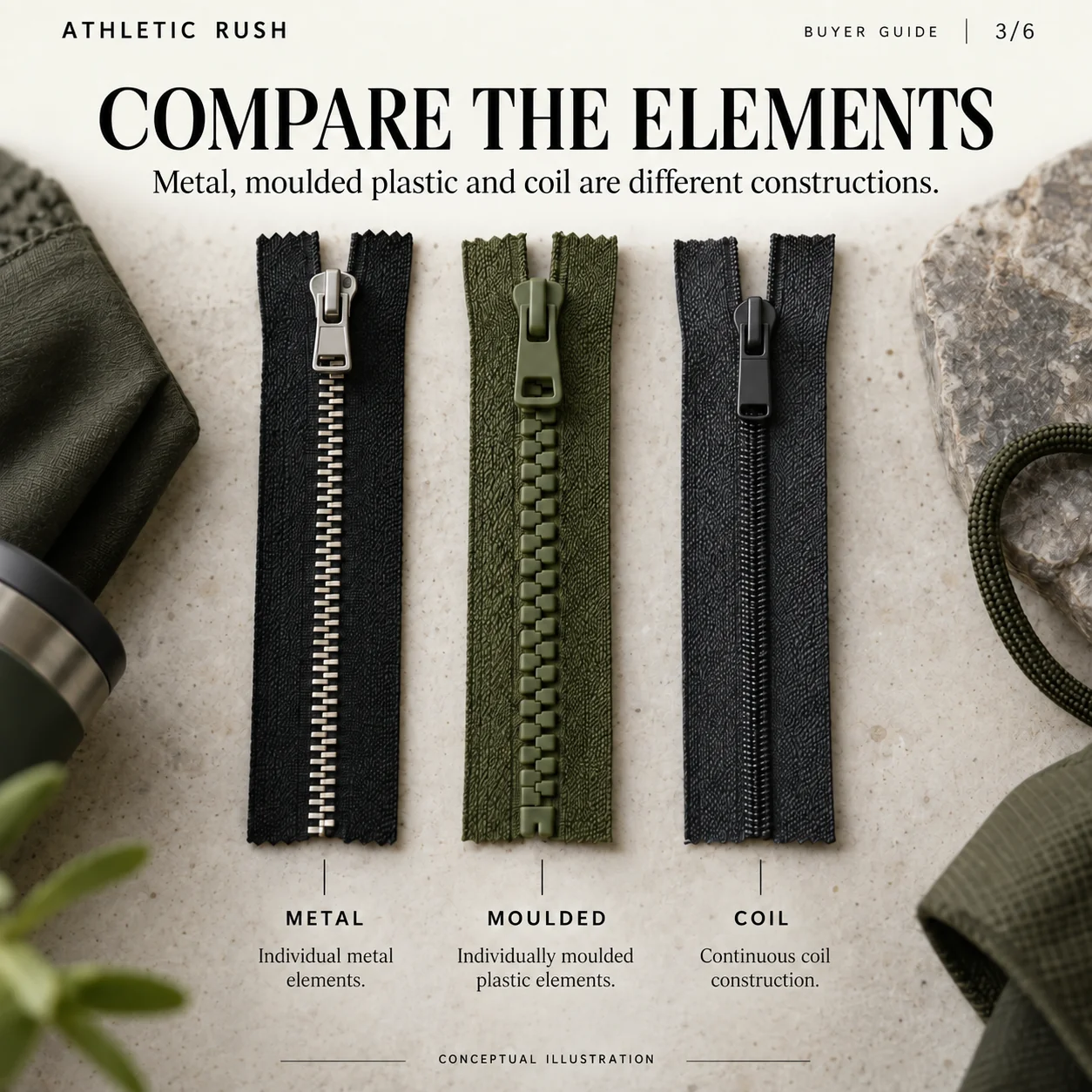
Avoid universal claims that one construction is always stronger, smoother or better for every hoodie. Performance depends on the actual component, its use and the garment assembly. If your product needs a particular performance claim, agree the relevant assessment with the supplier or a competent testing provider and obtain evidence for that component and application.
Treat size as an identified supplier specification
A size designation is useful only when tied to the chosen product family and supplier reference. Do not turn a number copied from a photograph into a universal measurement, strength rating or compatibility rule. Ask the supplier to state what the designation refers to and supply the relevant specification.
Compare the candidate with the actual front fabric, rib, facing and hood construction. Hardware that looks balanced on a heavy sample may look different on a lighter or shorter garment. That is a sample-selection question, not a reason to assume the largest visible elements are the best choice.
Record tape, slider, puller and finish together
The tape is part of the visible garment as well as the sewn assembly. Specify its colour reference and whether it is intended to blend with or contrast against the body fabric. Review the combination under consistent lighting with the actual garment material. A screen mockup is useful for direction but does not approve a physical colour match.
The slider and puller are related but distinct parts of the decision. Identify the required assembly and any locking or handling function with the supplier. Do not assume a different pull tab can be substituted without checking compatibility and the resulting use.
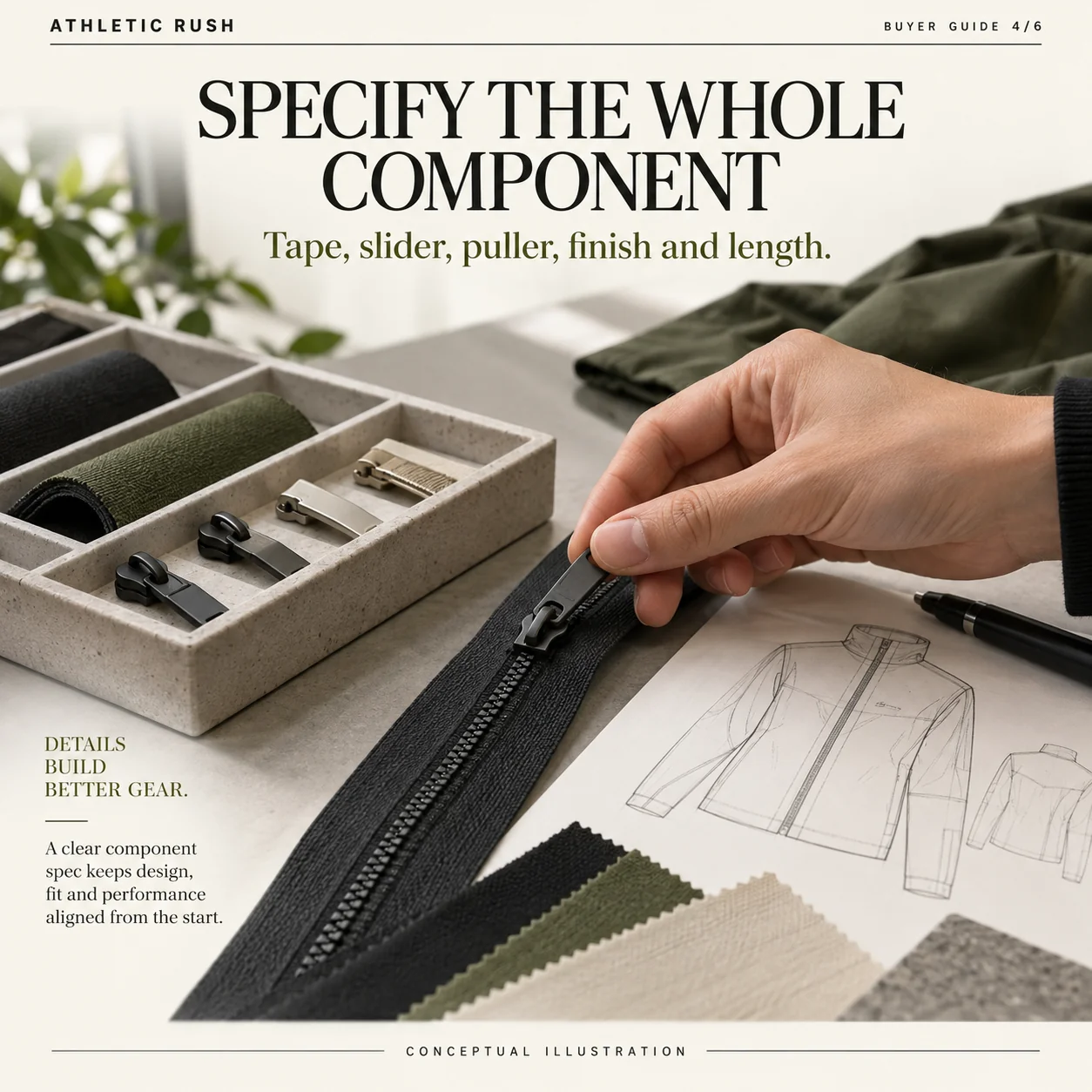
For a custom puller, provide the artwork and proposed dimensions, then request a physical sample and confirmed commercial terms. Confirm tooling, sample charges, availability and lead time for your project. Do not describe a custom component as available until the supplier has confirmed it.
Describe finish precisely and keep an approved reference. Terms such as silver, antique or dark metal can cover visually different results. If appearance after the garment's intended care matters to the collection, include that in the review rather than approving only the new loose component.
Define length using an agreed method
Give the opening's position in the garment specification and agree how zipper length is measured. Ask for a drawing identifying the measurement endpoints and any tape extensions. A total strip length and an operational opening length should not be silently treated as the same measurement.
Confirm the length requirement across the size range. One approved sample size does not automatically approve every graded length or placement. Ask the supplier to identify which sizes share a component and where a different length is proposed, then compare that plan with the garment measurements.
| Specification field | Useful record | Avoid leaving it as |
|---|---|---|
| Opening | Separating function, slider arrangement and reference | Standard hoodie zip |
| Component | Manufacturer or supplier, product family and exact code | Premium quality |
| Elements | Confirmed construction and size designation | Looks like metal |
| Tape and finish | Physical colour and finish references | Match the picture |
| Slider and puller | Identified compatible assembly and required function | Any similar puller |
| Length | Agreed endpoints and size-by-size requirement | Same length as before |
| Approval | Sample version, accepted details and open corrections | Approved in principle |
3. Approve the zip inside the finished hoodie
Request a sample using the proposed production component and planned fabric, facing, hood and rib arrangement. If the sample uses a substitute, record exactly what differs. Approval of a temporary component should not silently become approval of the production version.
Inspect the front with the garment laid naturally, then on the intended wearer. Check that the neckline, two front edges and hem meet the design brief. Look for unexpected waviness, uneven positioning or fabric caught near the moving parts. Record the observation before assigning a cause; a wavy front is a symptom, not a diagnosis of which component or sewing step is responsible.
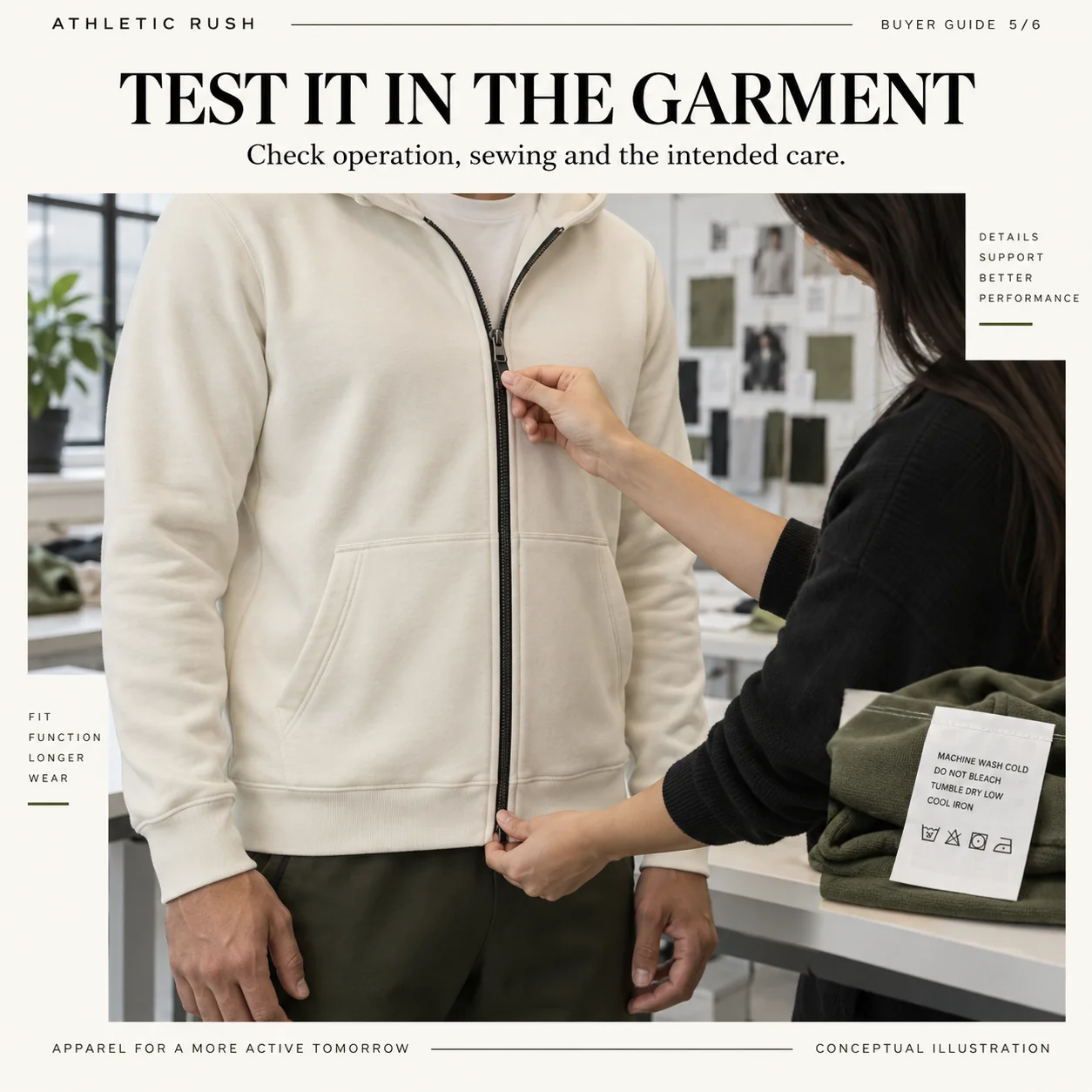
Use a short, repeatable review sequence
- Confirm the sample identity and compare the actual component with the agreed reference.
- Review the front laid naturally without pulling it straight to make it look correct.
- Operate the assembly normally and check the intended separation or two-way function. Stop if it catches rather than forcing it.
- Check the garment worn open and closed, including the neckline and hem relationships.
- Assess the sample after the agreed care procedure and record the conditions and observations.
- List accepted details and unresolved corrections before granting production approval.
This sequence is a development checklist, not a durability test standard. A few successful openings do not establish a service life. Likewise, one informal care trial may reveal a problem without proving long-term performance. Match any public claim to appropriate evidence.
The YKK Zipper Usage Instruction Manual provides component and handling guidance. Follow the guidance for the actual closure specified, together with the fabric and decoration requirements. Do not transfer instructions for a specialised zipper to every hoodie.
If the garment is washed or otherwise treated during manufacture, ask when the component is installed and how the complete process will be evaluated. Record the planned sequence and inspect the corresponding sample. Do not approve a clean untreated prototype as evidence for a materially different finished product.
Make corrections specific enough to act on
“Use a better zip” gives the development team little to investigate. A useful correction identifies the sample, the observation and the required next check. For example: “On sample H2, the left tape becomes visible below the neckline when the front is closed. Compare the installation with drawing C and return a corrected garment sample.” The identifiers are illustrative.
Keep appearance, operation and dimensional comments separate. This helps prevent a cosmetic change from being treated as a solution to an operating problem. If the supplier proposes a different component, review the change against the original requirements and update the specification deliberately.
Retain the approved physical reference and the corresponding component code, colour, length schedule and garment revision. For a reorder, ask the supplier to confirm these remain available. A visually similar substitute should be reviewed before it replaces an approved assembly.
Send a brief that can be quoted
Your enquiry can be concise while still giving the supplier enough information to respond:
“We are developing a zip hoodie for [customer and use]. The front must [required opening behaviour]. Please propose an identified zipper assembly with [element direction], [tape colour], [finish] and [puller requirements]. The garment drawing shows the opening positions; please confirm the length measurement method and requirements across sizes. Quote for [quantity and size allocation], including sample scope, component availability and lead time. Bulk approval will follow review of the complete garment.”
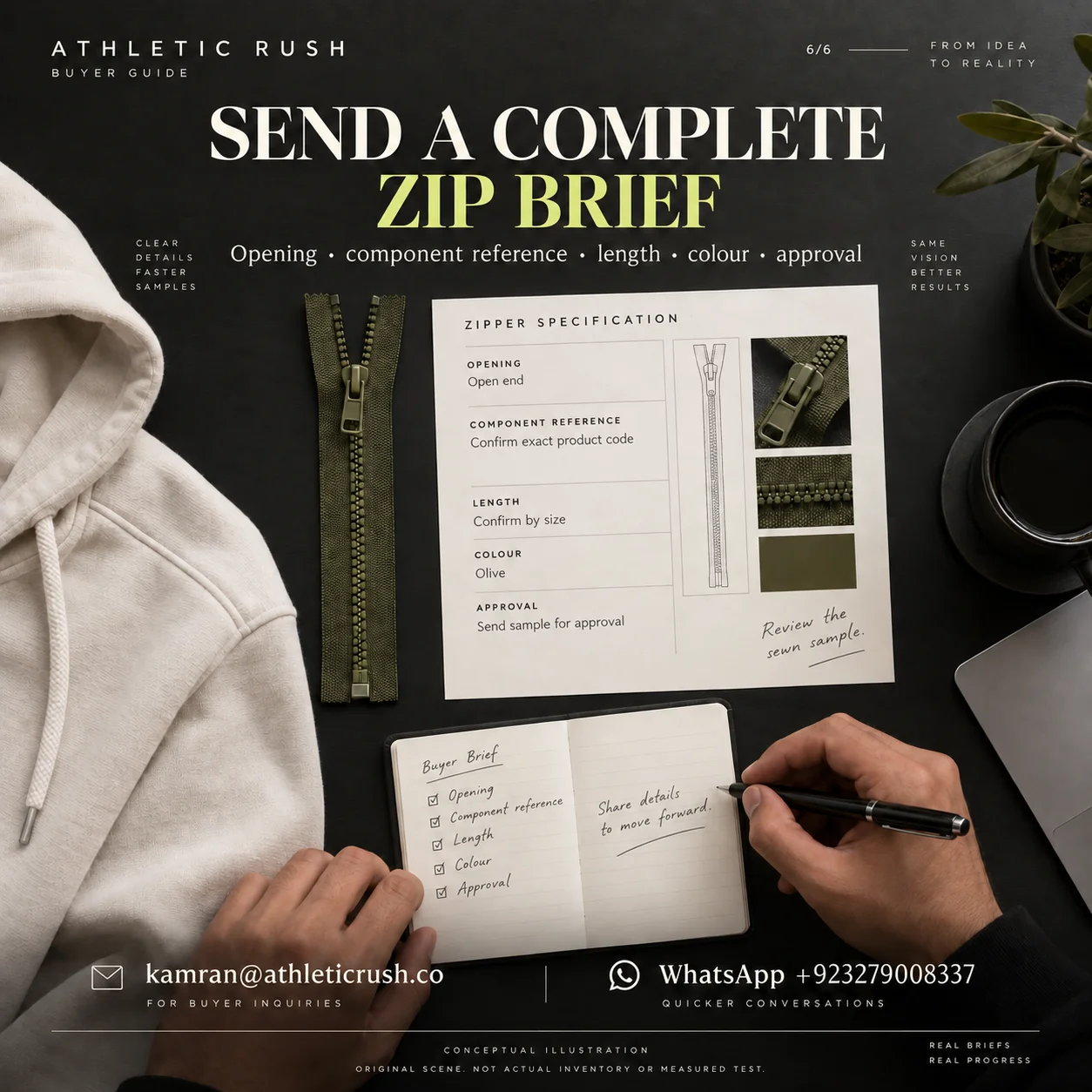
Do not insert a target price as if it were a confirmed offer. Compare quotations against the same garment and component specification, and ask which changes affect cost or timing. Keep private negotiated prices and customer details out of public product claims.
Frequently asked questions
What zipper is best for a hoodie?
There is no single best component for every hoodie. Start with the required opening, identify a suitable complete assembly and approve it in the actual garment. Construction, fit, appearance and intended care all belong in that review.
Is a metal-looking zipper necessarily metal?
No. Some coil constructions have a metallic-looking finish. Obtain the actual product reference and element specification instead of judging material from appearance alone.
Can I approve the zipper from a photograph?
A photograph helps establish visual direction. It does not demonstrate operation, handling, installation or the result after the intended care. Review the physical assembly in a representative garment sample.
Can the same zipper length be used for every size?
Confirm this against your size specification rather than assuming it. Agree the length measurement method and the component schedule across sizes with the supplier, and review any differences before production.
Plan your hoodie sample with Athletic Rush
Browse Athletic Rush custom hoodies, then send your customer brief, opening requirement, drawings, quantity and size allocation. If fabric choice is still open, use the hoodie weight and season guide to develop that separate decision.
Contact kamran@athleticrush.co or WhatsApp +923279008337. The next useful step is an identified component and a complete sample you can evaluate before committing to bulk production.