 Sialkot, Pakistan
 Worldwide enquiries

Choose a pullover when your concept needs an uninterrupted centre front. Choose a full-zip hoodie when opening the garment and showing the layer underneath are important to the customer. Then approve the actual fit, artwork and construction on a sample: neither opening makes a hoodie automatically warmer, more premium or better made.
This guide is for a clothing-brand buyer choosing the first hoodie style for a streetwear collection. The problem is simple: two attractive mockups can hide very different decisions about dressing, print placement and sample approval. Pick the opening around the product you want the customer to wear, rather than choosing a zip or pullover because one sounds more fashionable.
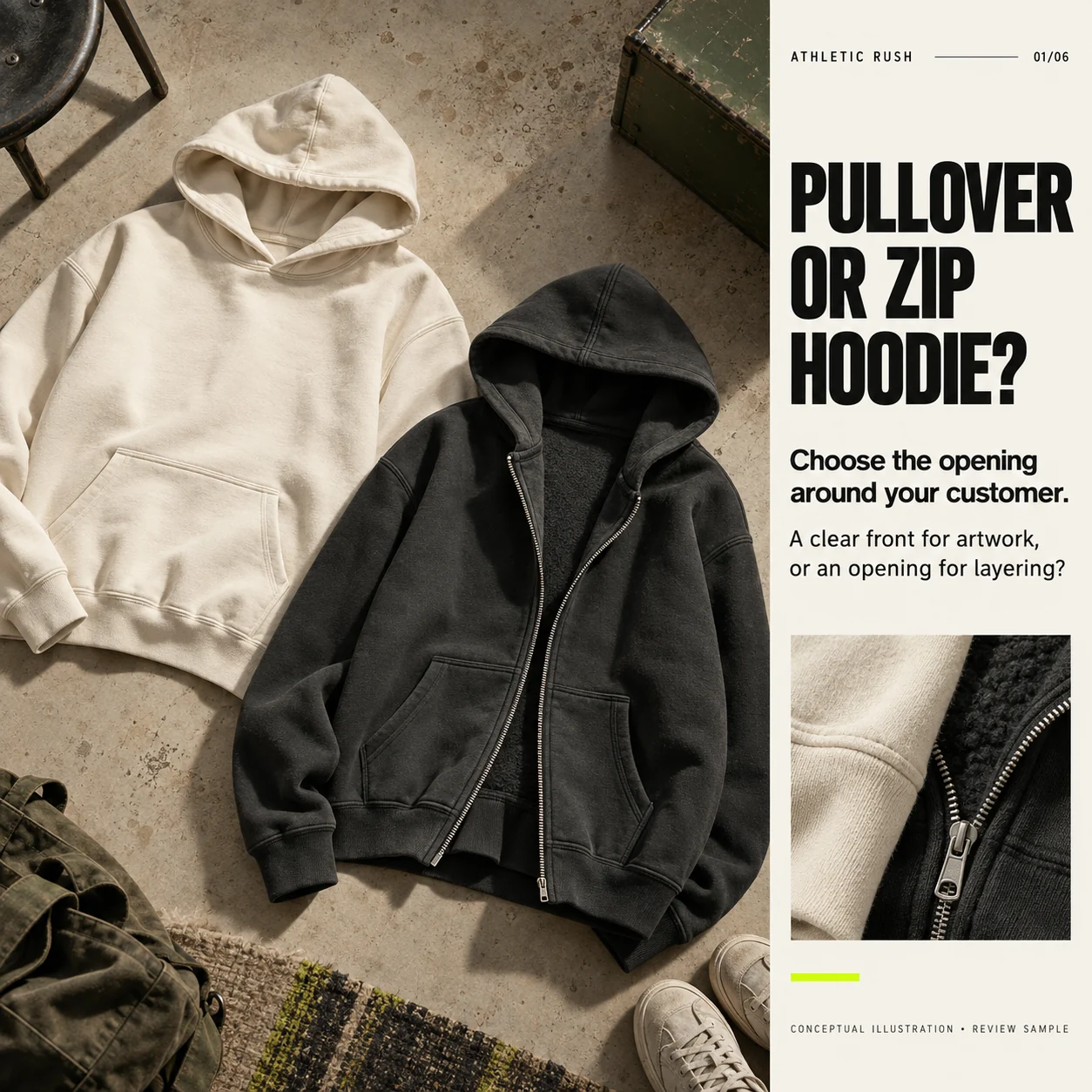
All six images are original AI-generated conceptual illustrations. They do not show Athletic Rush inventory, customer orders, laboratory tests or a real customer endorsement.
There are three decisions to make: how the hoodie will be worn, where the artwork belongs, and what the complete sample must demonstrate. The comparison below is a starting brief, not a universal ranking of the two styles.
| Buyer priority | Pullover starting point | Full-zip starting point | Verify on the sample |
|---|---|---|---|
| Centre-front artwork | No centre opening interrupts the design | The opening divides the front | Actual graphic placement and appearance |
| Wearing over a visible tee | The tee is mainly visible at the neckline and hem | The front can remain open | Outfit proportions in both positions |
| Taking the layer on and off | The garment passes over the head | The front separates | Dressing experience and opening operation |
| Pocket design | A joined front pocket is one option | Separate front pockets are one option | Pocket position, access and construction |
| Comparing supplier prices | Quote the complete specified garment | Quote the complete specified garment and closure | Equivalent quantities, material, decoration and delivery basis |
1. Choose for the customer's wearing routine
Start with one sentence describing the user and the occasion. For example: “An adult streetwear customer wears this over a graphic tee and removes it between indoor spaces.” That gives a full-zip sample a clear reason to exist. A different brief might be: “The hoodie is the main graphic garment, worn closed as a complete outfit.” A pullover is a sensible starting point for that concept.
These are examples, not rules about who can wear each style. Ask what the customer needs the opening to do. Avoid broad labels such as “everyday” unless you also explain the actual routine.
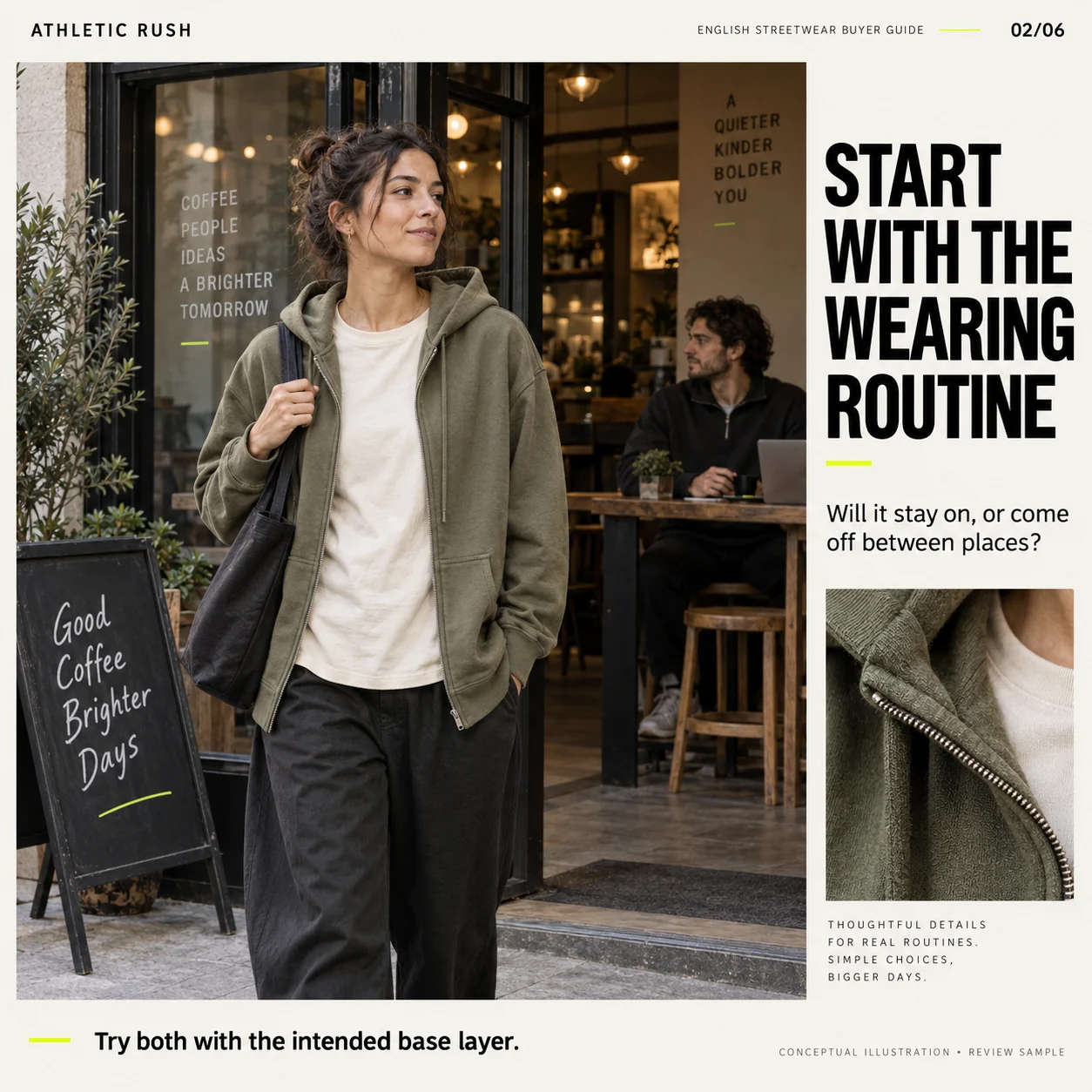
Compare with the intended outfit
Use the proposed base layer during a fitting. If the design will be worn over a loose tee, a fitted tee will not show the same combination. For a zip hoodie, inspect the garment fully closed and naturally open. Look at whether the front edges hang as intended, whether the tee remains visible in the way your artwork mockup suggests, and whether the hem suits the outfit.
For the pullover, review putting it on and taking it off as well as standing in it. Check the neck opening and hood arrangement on the wearer. Do not approve that experience from a flat drawing alone. Describe an observed problem precisely and ask the development team for a revised sample rather than guessing that a fabric change will fix it.
Photograph front, side and back views under comparable conditions. Add a seated view if sitting is part of the intended routine. Record the sample size and the wearer's relevant measurements with consent in your private development notes; avoid turning one person's response into a claim about every customer.
Keep fabric choice separate
The opening is one part of the garment. Body fabric, hood layers, fit and the outfit also matter. Do not assume the pullover is the winter version or the zip style is the summer version. Use our hoodie fabric weight and season guide to develop that separate material brief. If the decision is about the inside surface, consult the French terry versus fleece guide.
2. Design the artwork around the opening
A pullover provides a front without a centre zip. That can suit a continuous graphic, but a pocket, neckline, side seams and the available garment area still constrain placement. The size of a design file is not enough: identify where the artwork sits on the actual garment and review its relationship to those features.
A full zip divides the front. A large design crossing it needs a deliberate visual treatment. Decide whether the artwork is intended to read as one composition when closed, as two separate elements, or only on one side. Another option is to move the main graphic to the back and use smaller front branding.
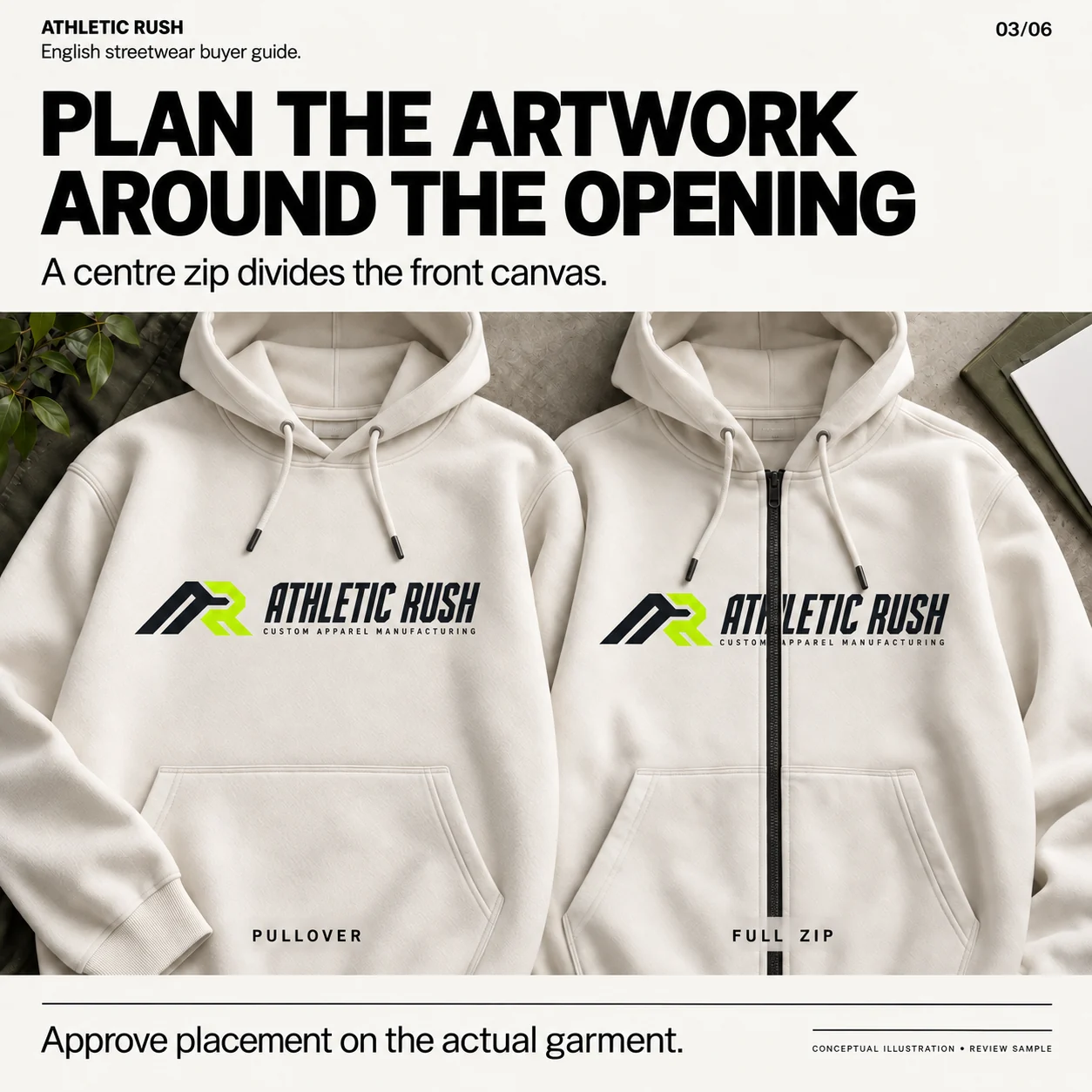
The illustration shows the design decision; it does not prove that any particular print process will reproduce the alignment shown. Ask the supplier to assess your actual artwork, garment and proposed decoration method. Review a decorated sample before accepting the result.
Give the placement an identifiable reference
State the artwork version, intended dimensions and agreed placement references in the specification. Show the front closed in the approval drawing. If the hoodie will commonly be worn open, include that view too. A graphic that looks balanced on a zipped mockup may tell a different visual story when the front separates.
Avoid vague feedback such as “make the logo look better.” A useful correction might read: “On sample Z1, the left artwork sits closer to the zip than the approved drawing. Please check both placements against revision B and return a corrected decorated sample.” The sample identifiers in this example are illustrative.
Do not invent a universal acceptable alignment tolerance. Agree the relevant dimensions, inspection method and tolerance with the supplier for your project. Keep the signed-off decorated garment with its approved artwork file so a later reorder has a usable reference.
Inspect the front as a complete assembly
For a full-zip sample, examine the neckline, front line and hem together. Check whether the front lies as intended when closed without holding or stretching it into place. Compare the two sides and look for an unexpected ripple, unequal length or catching near the opening. If you find one, document it; the visual symptom alone does not establish its cause.
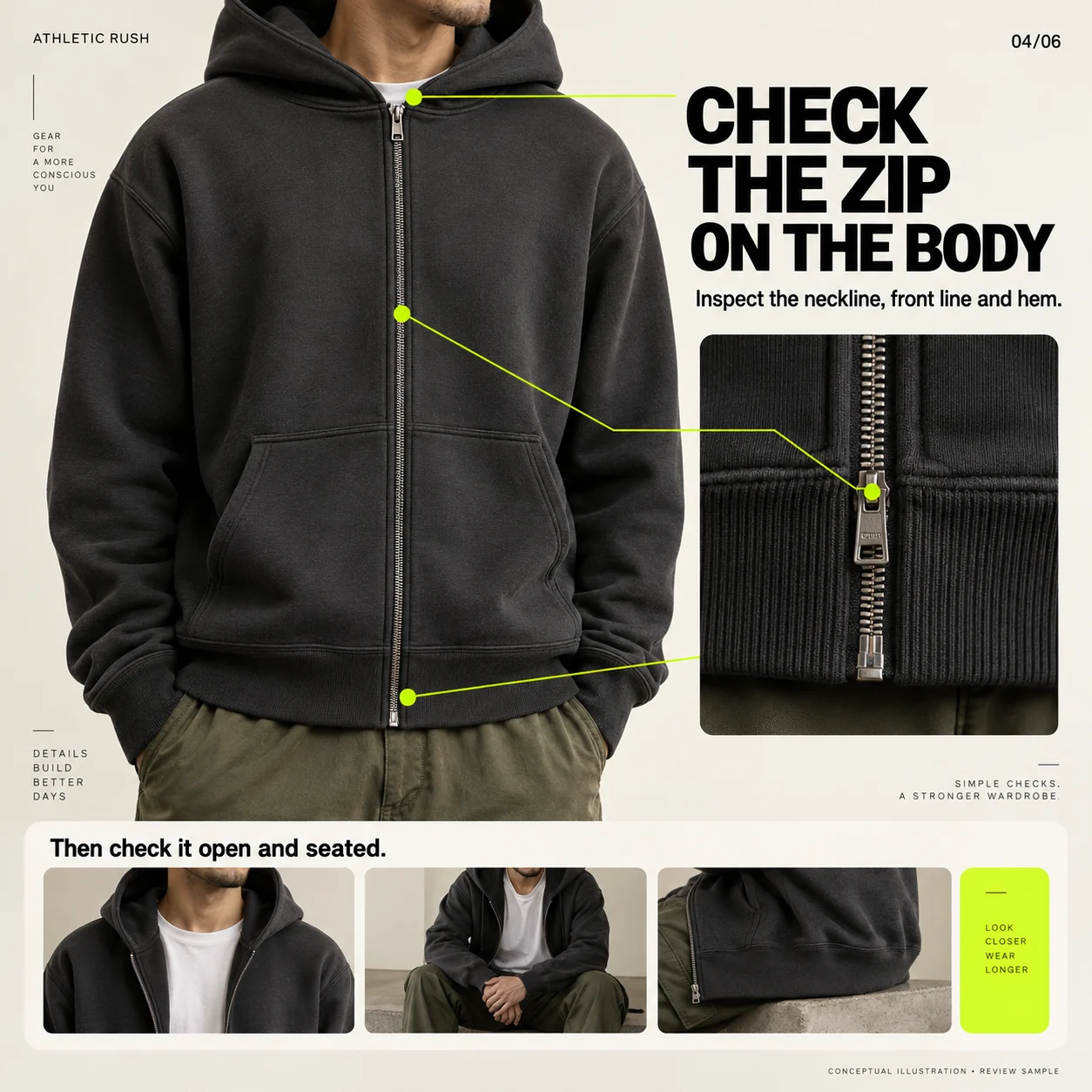
The YKK Zipper Usage Instruction Manual distinguishes open-end components and gives component-specific handling and sewing guidance. Use the instructions for the closure actually specified; a generic zip illustration is not an installation specification. Citing YKK here does not mean an Athletic Rush order includes YKK components unless they are expressly agreed in that order.
Ask the supplier to demonstrate normal operation on the garment. Do not force a stuck closure or treat a few successful openings as a durability certification. Choosing the zipper type, size and finish deserves its own specification discussion; this guide is about choosing the hoodie construction first.
3. Approve comparable samples before the bulk order
If the choice remains uncertain, compare samples with clearly identified differences. Keep the target size, base layer and review questions consistent. Where the fabric or pattern differs, note it openly. Otherwise, you may attribute a fit or drape difference to the opening when several variables changed at once.
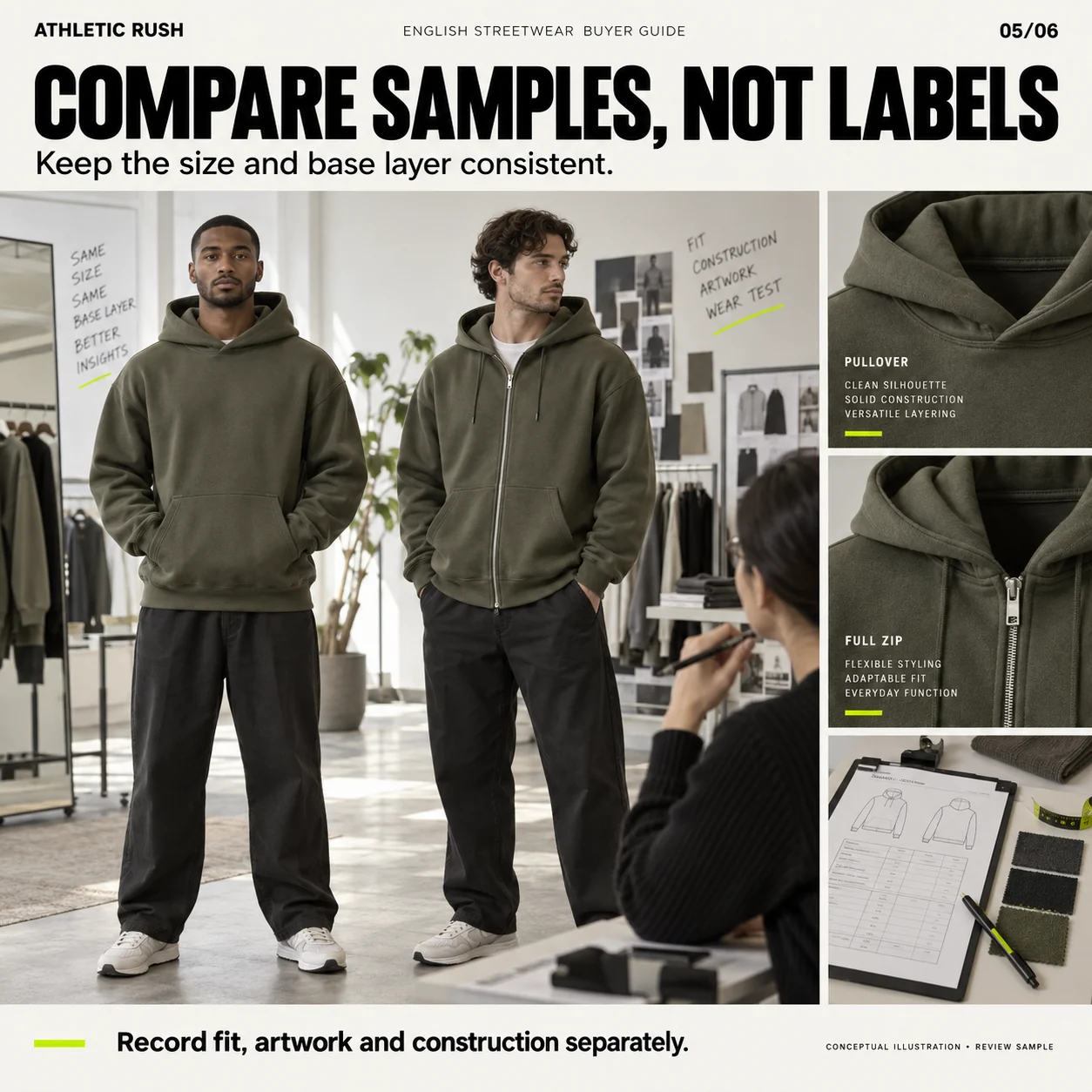
Use a short decision sheet instead of relying on impressions from separate meetings. Write what was observed, what matters for your customer and whether another sample is needed. “Feels premium” is not a clear instruction for production. “Approved front length and artwork placement; revise the hood opening and resubmit” is more useful.
| Review area | Record | Release question |
|---|---|---|
| Sample identity | Style, version, size and date | Are everyone’s comments about the same sample? |
| Wearing routine | Base layer and open/closed or dressing review | Does the garment serve the intended use? |
| Artwork | File revision, dimensions and placement views | Has the actual decorated garment been reviewed? |
| Construction | Hood, pockets, rib and closure details | Are production components the reviewed ones? |
| Care review | Agreed procedure and before/after observations | Are any changes still unresolved? |
| Decision | Approved elements, corrections and responsible approver | Is the production release explicit? |
Include care in the sample discussion
Agree how the finished garment will be evaluated after its intended care. Record the procedure and assess the garment when it is ready for a consistent comparison. Look at appearance, dimensions, artwork and the front assembly. Follow the selected fabric, decoration and closure guidance together; do not lift a care instruction for a specialised zipper and apply it to every hoodie.
If the front changes after care, retain photographs and the sample identification. Ask the supplier to investigate before approving production. One informal care trial can reveal a concern, but it does not establish long-term performance or a universal service life.
Compare complete quotations
A zip hoodie adds a closure specification to the brief. That alone does not establish a fixed price difference. Compare quotations using the same quantity, size allocation, material requirements, artwork, packaging and delivery basis. Ask each supplier to identify what is included, which sample version the offer covers and what would change if you switch construction.
For a first collection, decide whether both versions serve distinct customer needs. Two openings can create two sets of samples and specifications to manage. Launching both is a range-planning decision, not an automatic improvement over developing one clear product properly.
A practical brief you can send
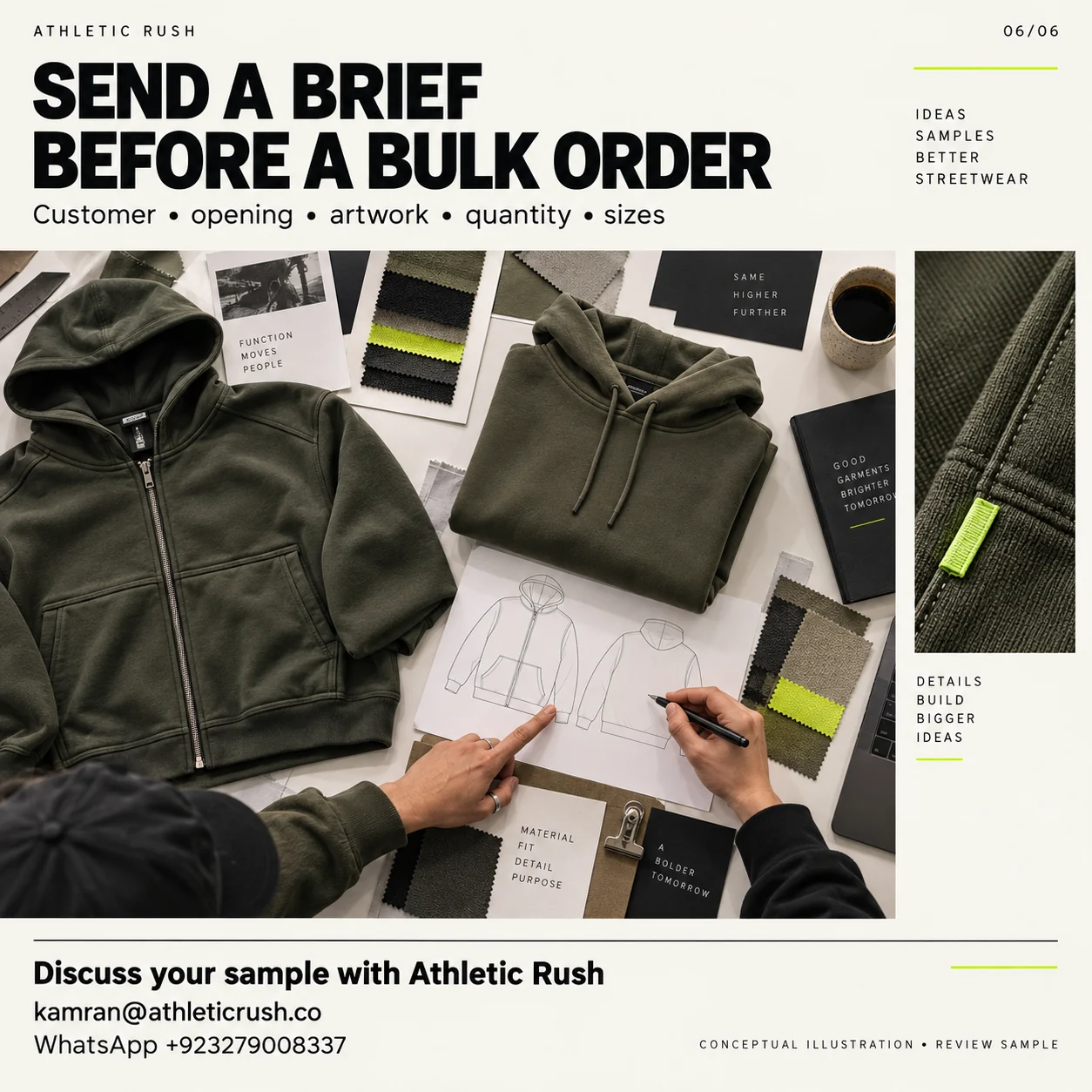
Before asking for a bulk quotation, complete this example structure with your own details:
“We are developing an adult streetwear hoodie for [customer and wearing routine]. Please quote a [pullover/full-zip] construction using [material brief], with [artwork placement and revision]. Our target quantity is [quantity], with [size allocation]. Please confirm sample scope, proposed construction, component availability, price basis and lead time. Bulk release will follow our written approval of the complete decorated sample.”
This is a starting brief, not a purchase commitment or a promise that every option is available. Add a reference garment or clear drawings where they communicate the result better than adjectives. Resolve open construction questions before treating the quotation as directly comparable with another offer.
Frequently asked questions
Is a pullover or zip hoodie better for a clothing brand?
Neither is universally better. A pullover suits a concept that needs an uninterrupted centre front; a full zip suits a concept where the front opening is part of the wearing routine or styling. Select against that brief and approve the sample.
Can a design cross the zipper?
It can be planned across the two fronts, but placement and the appearance of the closed opening must be reviewed on the actual decorated garment. Do not assume a digital mockup proves the result. Consider separate front elements or a back graphic when those better serve the design.
Is a full-zip hoodie always more expensive?
There is no reliable universal price rule for a complete garment. Request comparable quotations covering material, construction, closure, decoration, quantity and delivery terms. Confirm the actual difference for your project.
Can the same approval cover both versions?
A fabric approval can help establish a shared material direction. It does not automatically approve two finished constructions. Review each version's fit, opening, artwork and components, and identify exactly what has been released for production.
Turn the decision into a sample
Choose the construction that solves the customer's main need, then send one clear brief. Browse Athletic Rush custom hoodies and discuss the intended wearer, opening, artwork, quantity and sizes with our team. Confirm specifications, availability, sample charges and timing for your own order.
Contact kamran@athleticrush.co or WhatsApp +923279008337. The useful next step is an identifiable sample you can review, not a bulk approval based on a mockup alone.