 Sialkot, Pakistan
 Worldwide enquiries

Choose hoodie fabric weight around the customer's routine, layering needs and approved garment sample. GSM describes fabric mass per square metre; it does not assign a hoodie to a season or establish how warm it will feel. Start with the intended use, compare a small set of identified materials, and approve the complete hoodie before ordering.
For a clothing brand, a weight number is most useful when it helps make a decision. It should connect to a specific fabric, finish, pattern and wearing brief. Asking for the heaviest possible hoodie without those details can produce an expensive sample that looks substantial but does not suit the customer.
This guide focuses on choosing and approving weight for a seasonal collection. If your main decision is the inner surface, first see our French terry versus fleece guide. Here, the goal is to turn a seasonal idea into a practical comparison and a repeatable specification.
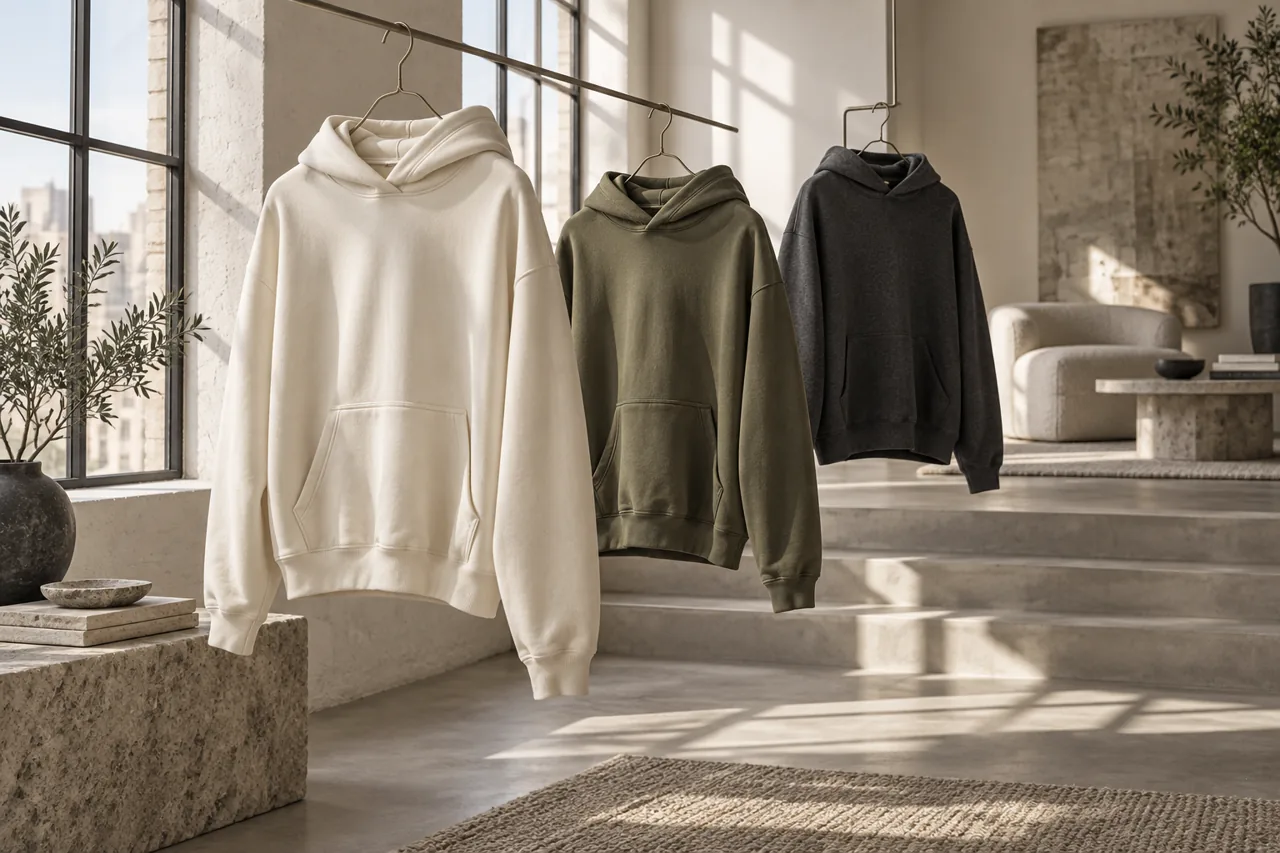
These six original AI-generated illustrations show development concepts. They are not photographs of Athletic Rush stock, a customer order or measured performance tests.
Understand what GSM actually measures
GSM means grams per square metre. It describes the mass of a known area of fabric, not the total weight of a finished garment. A large hoodie and a small hoodie made from the same material can have the same fabric GSM while their finished garment weights differ.
ASTM D3776 describes methods for measuring fabric mass per unit area. The choice of sampling and measurement basis matters. Ask the supplier what was measured and agree an appropriate method and tolerance for your order, rather than comparing figures obtained on different bases.
For a simple arithmetic illustration, a 0.01-square-metre specimen weighing 3.2 grams corresponds to 320 grams per square metre. This example explains the unit; it is not a laboratory procedure or a test result for any Athletic Rush fabric. Accurate assessment needs a suitable specimen, equipment and agreed conditions.
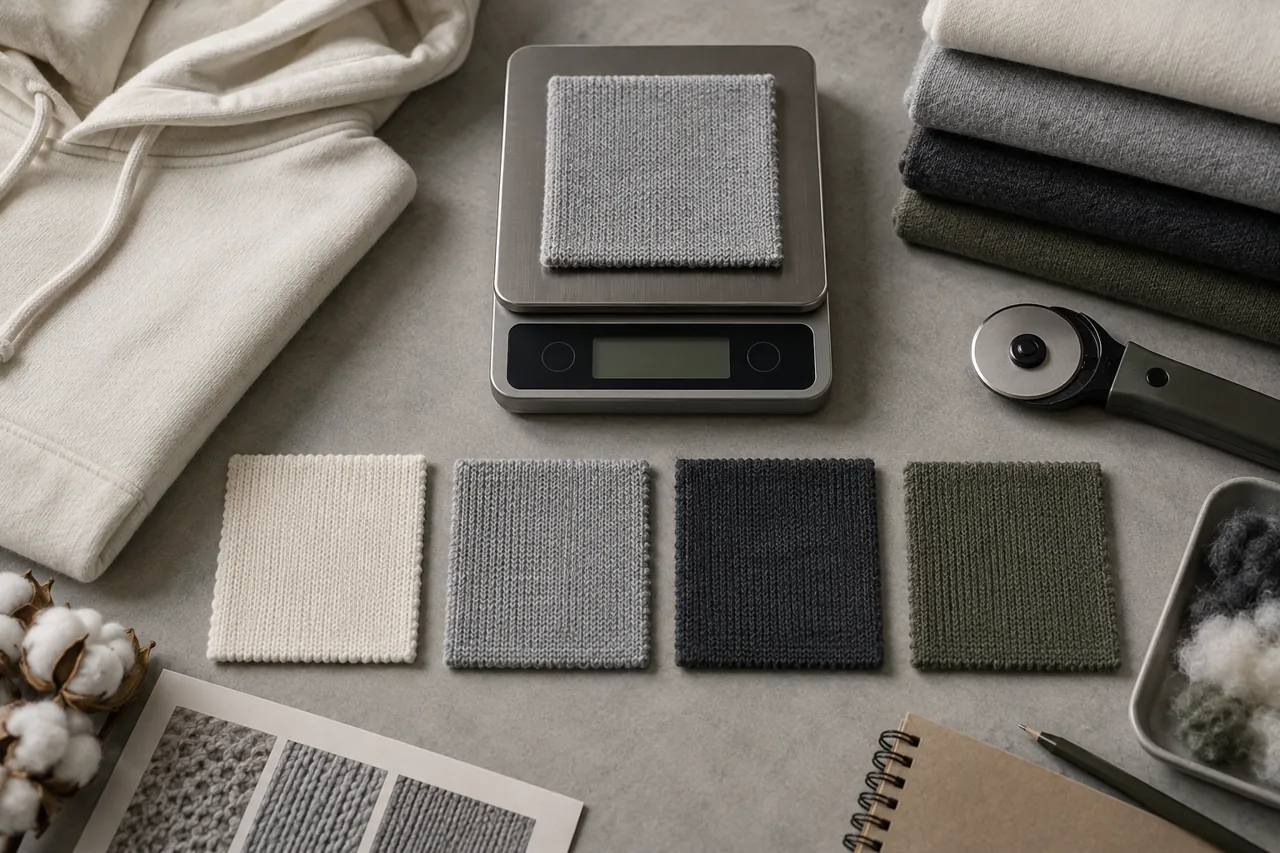
Keep three descriptions separate in your notes: fabric GSM, finished garment weight and perceived bulk. A lined hood, large pocket, zip or decoration adds to the garment independently of the body fabric's mass-per-area specification. A buyer comparing finished hoodies should record those construction differences too.
Define the season as a use case
Spring, summer and winter do not mean the same wearing conditions in every market. A summer travel hoodie may spend much of its time in air-conditioned spaces. A winter hoodie may be worn under a separate outer layer, rather than serving as the outermost garment. Define the setting before selecting a candidate weight.
Write down the destination market, intended launch period, typical use, base layer and outer layer. Include whether the wearer will mostly sit indoors, commute, walk outside or switch between settings. You do not need to invent a precise temperature rating to make this brief useful.
| Intended use | Start the sample discussion with | Check on the wearer | Avoid assuming |
|---|---|---|---|
| Indoor everyday layer | A manageable garment with the requested inner feel | Sitting comfort, cuffs and ease of removal | A light label means suitable for every warm setting |
| Transitional outdoor use | Materials that work with the intended layering plan | Movement with a tee and with the chosen jacket | One GSM number covers every climate |
| Substantial standalone streetwear look | The desired drape, hood shape and body structure | Balance, sleeve volume and overall weight | More mass automatically improves the silhouette |
| Cold-season mid-layer | Compatibility with the actual outer garment | Shoulder and sleeve crowding, hood interaction | A heavier mid-layer always fits better under a coat |
| Travel or changing environments | A clear compromise between appearance and packability | Carrying, packing and repeated layering | One hoodie can perform every role equally well |
The table is a development framework, not a set of universal seasonal thresholds. Use it to ask better questions and identify which candidate should move to garment sampling.

Use lighter and heavier as relative descriptions
Suppliers may apply lightweight, midweight and heavyweight labels differently. Ask for the actual finished GSM rather than relying on the category name. Then compare that number with the offered composition, construction and finish.
For example, your development team could request three candidates around 280, 340 and 420 GSM to explore a particular brief. These are hypothetical comparison points, not industry boundaries, seasonal recommendations or available-stock promises. The supplier may suggest different candidates based on the material and design you need.
Do not approve the middle number simply because it sounds like a safe compromise. Handle the swatches, compare the finished samples and write down why one works better. If none suits the brief, revise the candidate set instead of forcing an approval to keep the schedule moving.
Keep the comparison manageable. Three clearly identified candidates with complete specifications are usually easier for a small brand to review than a large pile of anonymous swatches. Eliminate unsuitable options with written reasons so a rejected material does not reappear in a later quotation under a different description.
Keep fabric weight separate from warmth claims
A weight measurement and a thermal assessment answer different questions. ISO 11092 describes measurement of thermal and water-vapour resistance under steady-state conditions. A GSM figure is not that measurement, and neither should be casually converted into a customer temperature rating.
If warmth is a central selling point, define the claim you intend to make and ask a competent testing provider what evidence is appropriate. Be specific about whether the question concerns a fabric, a layered assembly or the finished garment in use. Record the limits of the evidence rather than publishing a stronger claim than the test supports.
For ordinary sample selection, a structured wear review can still help you choose between candidates. Treat the result as feedback from those wearers in those conditions. It does not establish that every customer will have the same experience or that the hoodie is suitable for a particular outdoor hazard.
Your product description can be precise without exaggerated promises. State the confirmed fabric composition and weight where appropriate, describe the fit and construction, and explain the intended layering role. Use photographs of the actual approved product when preparing the eventual product listing.
Test layering with the complete outfit
A hoodie chosen as a mid-layer needs to work with the garment above and below it. Review the intended outfit rather than judging the hoodie in isolation. Use the same sample size, comparable base layer and consistent fit observations when comparing materials.
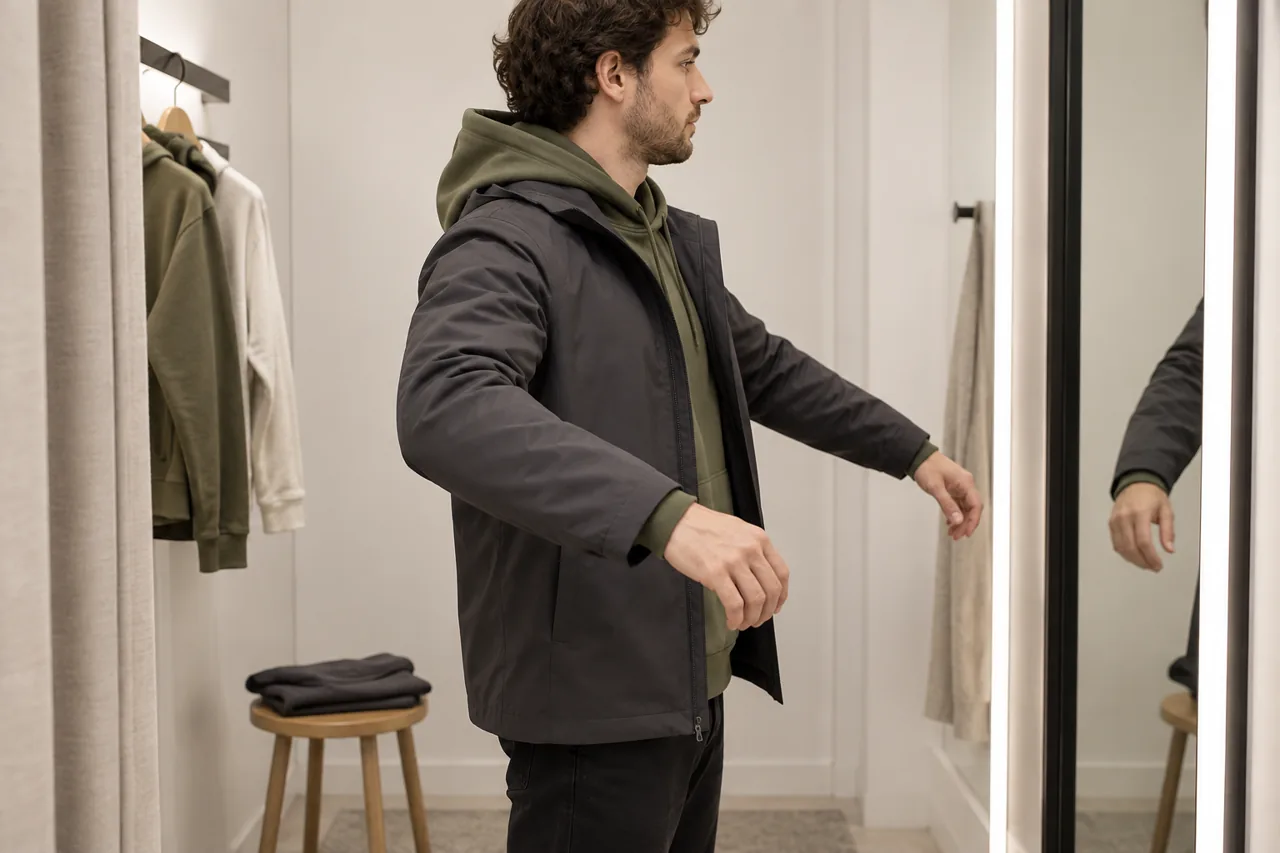
Ask the wearer to reach forward, sit, bend the elbows and put the outer garment on and off. Note where the outfit becomes crowded or restrictive. Check whether the jacket sleeves accommodate the hoodie sleeves and whether two hoods interfere with each other.
Separate a material issue from a sizing issue. If the hoodie is too long for the intended look, examine its measurements. If it fits alone but feels crowded under the jacket, review the layering combination and garment volumes. Reducing fabric weight is one possible development change, not an automatic fix for every fit complaint.
For a substantial standalone hoodie, check the outline without an outer jacket. View front, side and back, with the hood up and down. A large hood or gathered hem can change the visual balance even when the selected body fabric is exactly the requested weight. Our boxy hoodie fit approval guide provides a complementary garment checklist.
Inspect the places where layers accumulate
Fabric selection affects a complete construction, not a flat square. Inspect the neckline, hood attachment, pocket corners, cuffs and hem. Ask which parts use the main material, which use rib and which are lined or reinforced. Record those details alongside the body fabric reference.
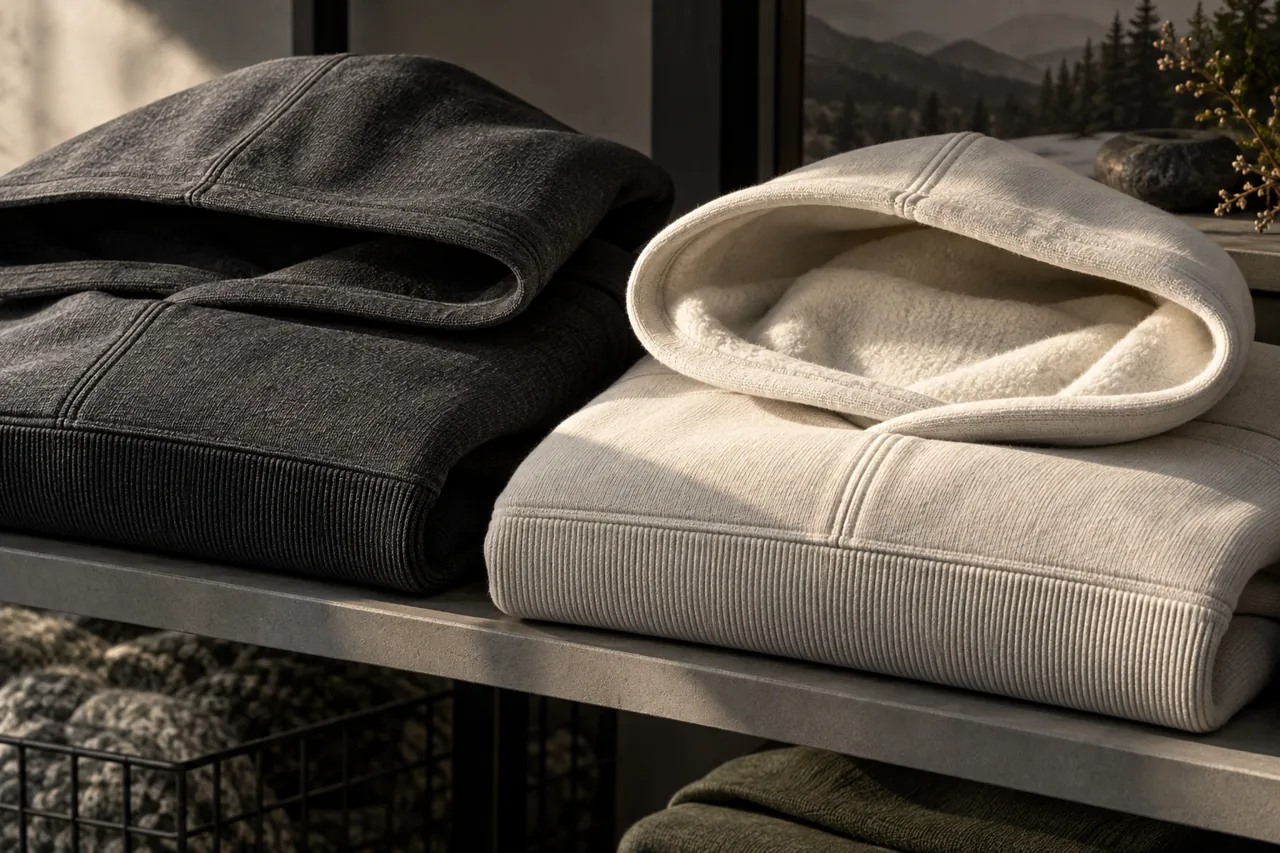
Compare the hood opening and neckline in the actual planned construction. If the sample has a single-layer hood but production will use a lining, that difference remains unreviewed. Do not describe the whole garment as approved merely because the body swatch passed.
Likewise, a change to rib quality or dimensions should be checked on the garment. Review how the hem falls and how cuffs sit during movement. Keep the approved body and rib references together, including colour approval, so a reorder does not substitute a visually similar component without review.
Decoration should also be part of the sample decision. Evaluate the actual artwork size and process on the selected material. A large printed area or dense embroidered element may change what the wearer notices, so do not carry an approval from an undecorated blank into a materially different finished design without checking it.
Build a controlled comparison before bulk approval
Create one review sheet for the candidate hoodies. Use the same questions and record the differences in construction instead of relying on memory. Where you can, hold the pattern, sample size and decoration constant. Where you cannot, identify the limitations clearly.
| Review field | What to record | Decision supported |
|---|---|---|
| Candidate identity | Fabric code, sample version, colour and date | Trace the sample being discussed |
| Material specification | Composition, construction, finished GSM and tolerance | Compare like-for-like quotations |
| Intended use | Market, indoor/outdoor routine and layering plan | Keep the choice tied to the customer |
| Complete construction | Hood layers, pocket, rib and decoration | Explain differences beyond body GSM |
| Fit observations | Measurements and consistent front/side/back views | Separate fit corrections from material changes |
| Wear review | Outfit, reviewer observations and limitations | Compare actual sample experience |
| Care review | Agreed care procedure and before/after findings | Check the product after intended care |
| Final decision | Accepted reference, open corrections and approver | Define the production release clearly |
If a care trial is part of approval, retain an original reference and document the trial conditions. Measure and photograph consistently. Review dimensions, appearance, seams, rib and decoration after the sample is ready for comparison. A single informal wash is not evidence of long-term performance, but unexpected changes are a reason to investigate before releasing production.
A useful correction states the observation and the next check. For example: Candidate B fits the body brief, but the hood feels crowded under our chosen jacket. Please propose a revised hood construction and return a sample for the same outfit review. This gives the development team a specific problem without guessing the solution.

Confirm the commercial consequences of your choice
Ask for the quotation to identify the approved fabric and garment version. Keep quantities, size allocation, artwork, packaging and delivery basis consistent when comparing offers. Confirm sampling charges and whether a material change requires another sample or affects the production schedule.
Do not estimate the final unit price by multiplying one fabric GSM by another. The quotation covers more than fabric mass: it must reflect the actual material, construction, decoration and agreed services. Ask the supplier to explain the difference between candidates rather than assuming a proportional price relationship.
For a new collection, consider whether you need several different weights at launch or one well-defined product. Each additional material creates another specification and approval reference to manage. That is a planning choice, not a reason to compromise on the fabric that your main product needs.
Keep the approved garment and material references available for reorders. If a supplier proposes a replacement, compare it against the same brief and review criteria. A matching GSM alone is not sufficient evidence that the product experience will remain the same.
Frequently asked questions
What GSM is best for a winter hoodie?
There is no single number for every customer and climate. Define whether the hoodie is a mid-layer or the outermost everyday garment, then sample materials that suit the intended construction and outfit. Do not turn a fabric weight into a temperature rating without appropriate evidence.
Is a 400 GSM hoodie always warmer than a 300 GSM hoodie?
The figures establish a difference in fabric mass per area, assuming comparable measurement. They do not by themselves establish comparative warmth. Review the actual materials and garments, and obtain suitable testing when a thermal claim is important.
Can the same hoodie work in several seasons?
It may suit several uses, depending on the customer and layering plan. Define which use is the priority and test the proposed outfit combinations. Describe that intended use clearly instead of treating all-season as a substitute for a specification.
Should I approve a fabric swatch before making a hoodie sample?
A swatch can help shortlist materials and confirm an initial direction. The complete sample still needs review for fit, construction, decoration and care. Keep swatch approval separate from permission to produce the finished garment.
Plan your hoodie sample with Athletic Rush
Browse Athletic Rush custom hoodies, then send the target market, launch period, intended outfit, silhouette, quantity, size range and decoration. Include a reference garment or clear photographs if they help explain the result you want. Ask for candidate materials and confirm availability, specifications, pricing and sampling scope for your project.
Contact kamran@athleticrush.co or Athletic Rush on WhatsApp. A clear use brief helps turn a weight preference into a sample you can evaluate and a product you can order consistently.