 Sialkot, Pakistan
 Worldwide enquiries

How do you make a hoodie and jogger work as a set, rather than two garments that happen to share a colour? Approve the outfit together, but specify and inspect each garment separately. The hoodie needs its own fit and construction brief; the jogger needs its own waist, seat, rise and leg specification. Link both to one set reference, an agreed material package and a clear size-pairing rule.
A matching photograph is not enough to approve a bulk order. A hoodie can look balanced standing still but cover the jogger pockets when the wearer sits. A comfortable trouser waistband does not tell you whether the hoodie hem sits where your brand intended. These are development decisions to resolve on samples before production.
This guide is for clothing brands developing adult streetwear sets. It covers three decisions: how the two silhouettes work together, what to specify and test on each component, and how to approve and pack the correct combinations. The examples are proposed development briefs, not Athletic Rush stock specifications or tested performance claims.
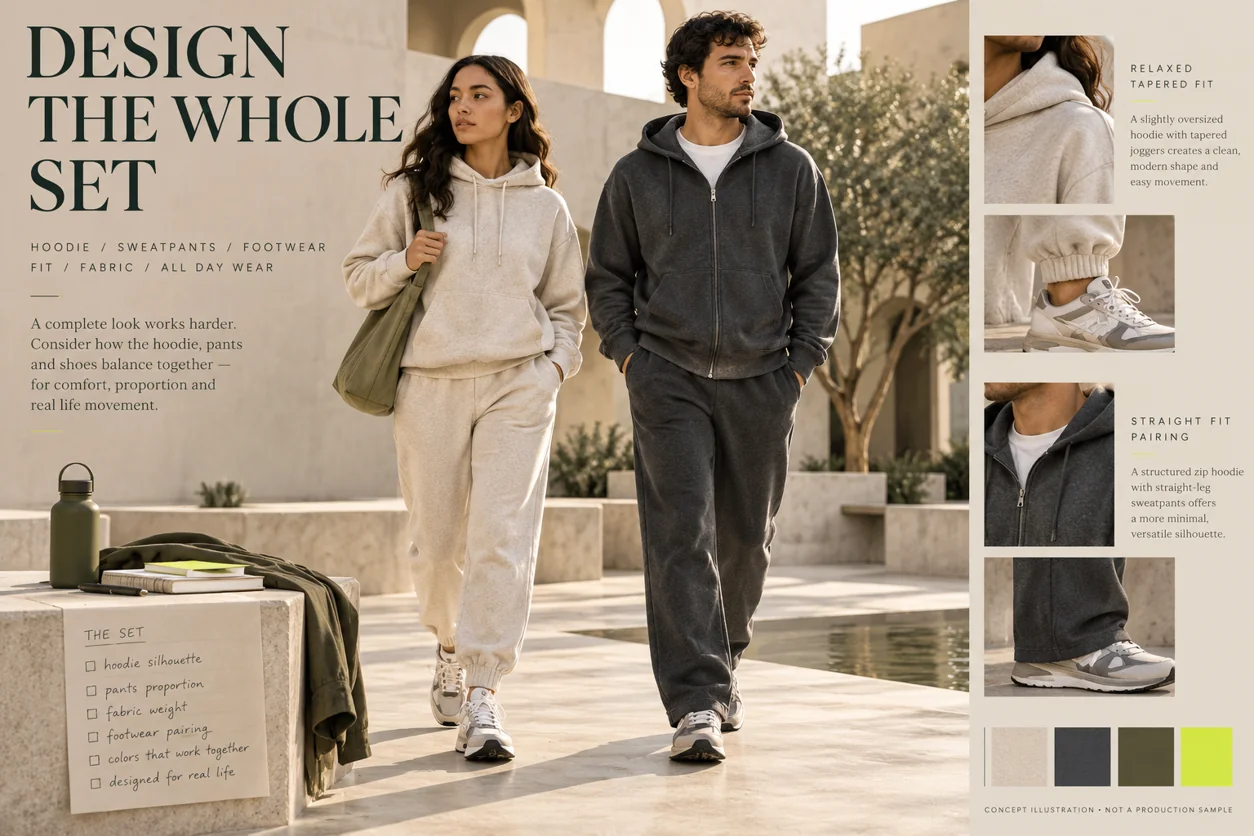
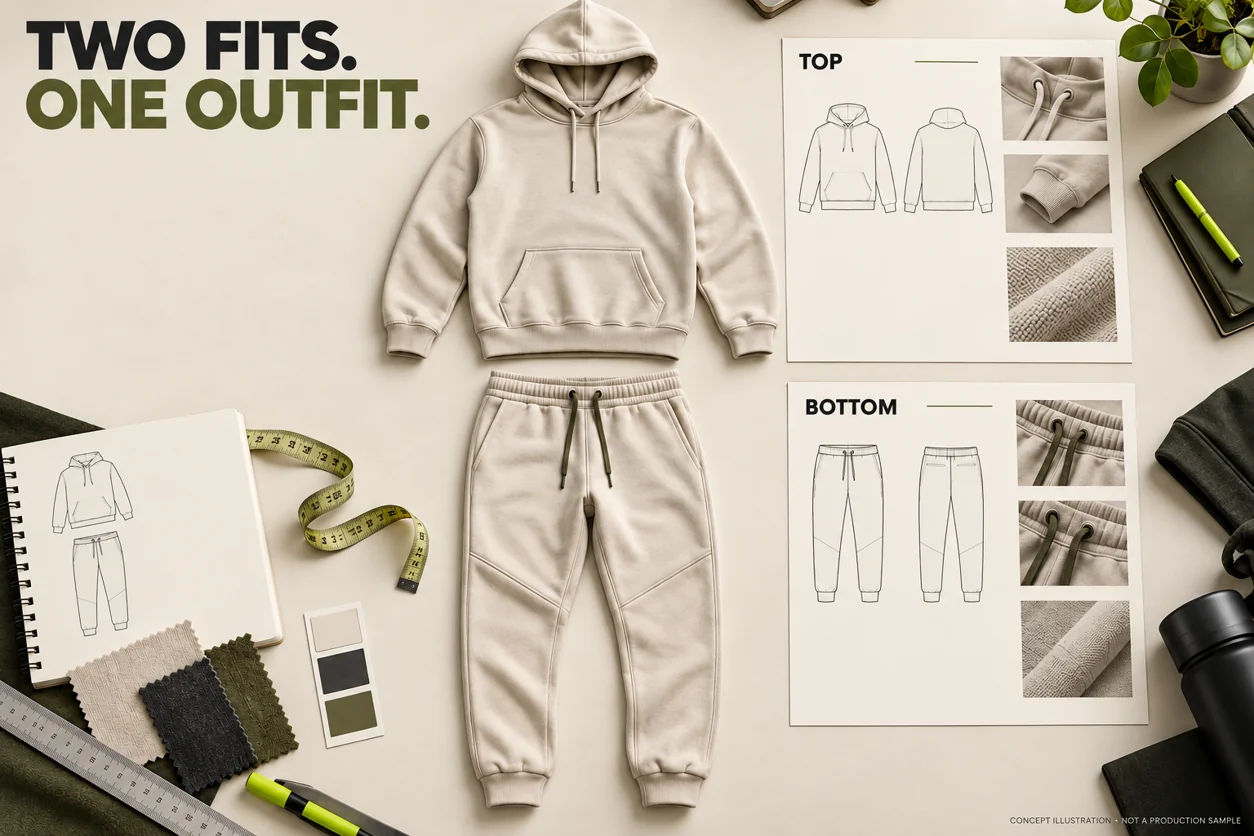
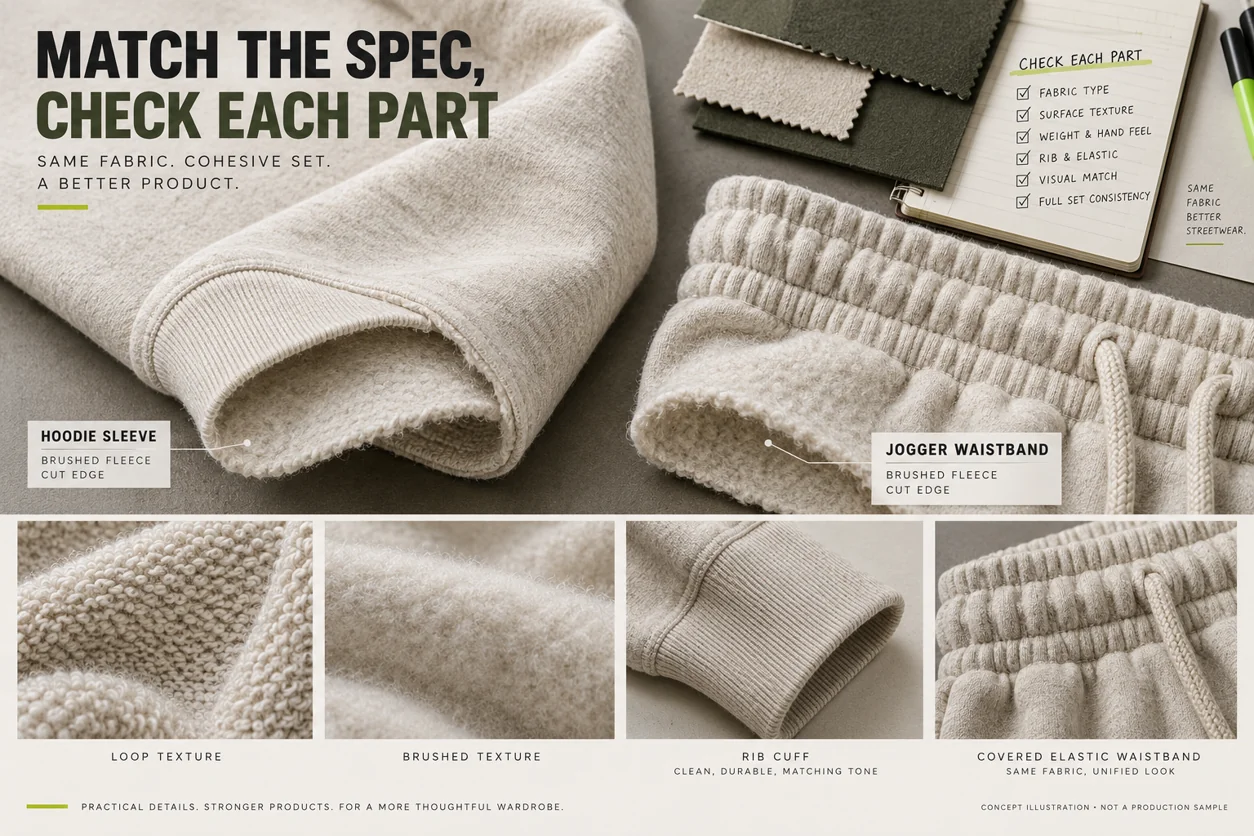
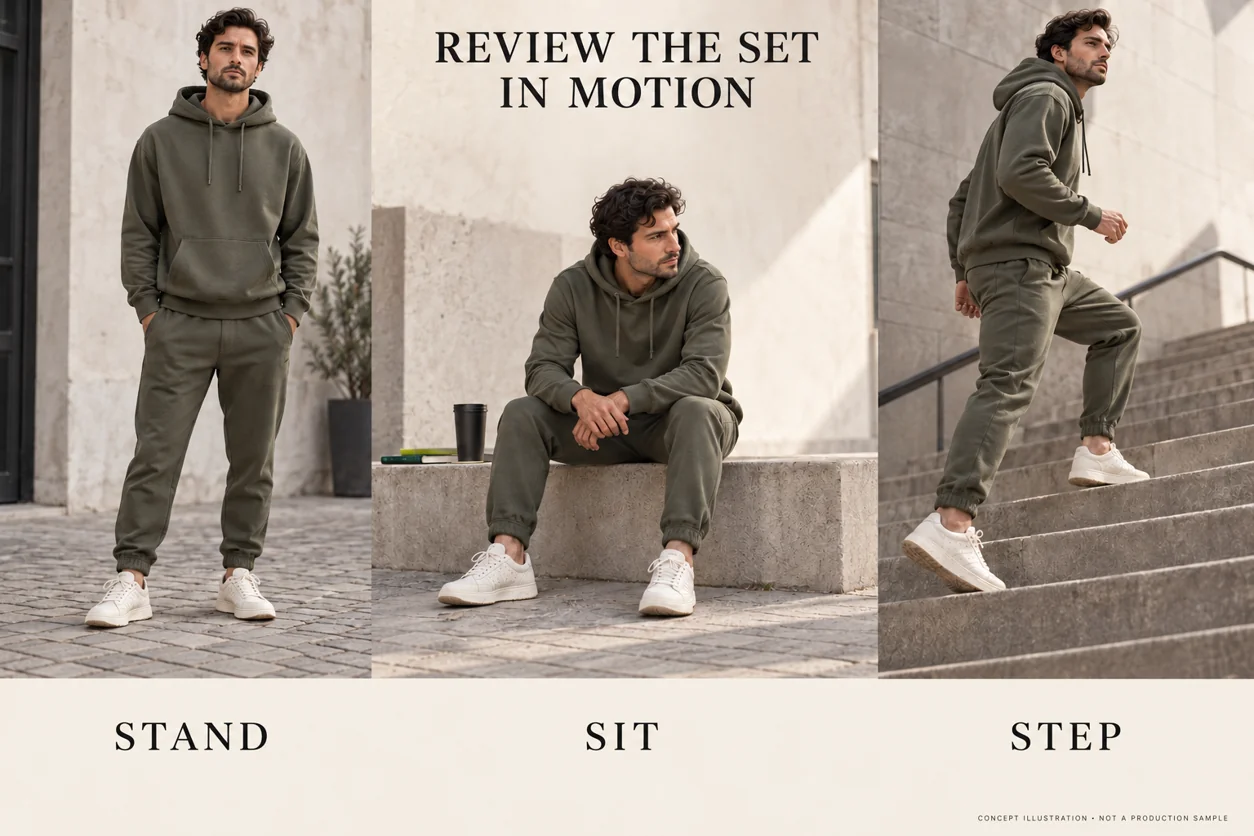
All six visuals are original conceptual illustrations. They explain development choices and do not show actual inventory, factory inspections or measured test results.
1. Define one outfit, then write two fit specifications
Start with the customer's intended outfit. Will the hoodie sit above the jogger waistband, meet it or overlap it? Will the trousers be worn at the natural waist or lower? Is the look a roomy top with a narrower leg, or volume through both pieces? Record the intended answer with reference images and a short written description.
Do not ask a supplier to make a “matching oversized set” and assume that phrase specifies the garment. Oversized describes an intended relationship between the garment and wearer; it does not define a universal chest width, body length or trouser shape. The top and bottom still need separate measurements, measurement methods and acceptable variation.
Compare complete outfits, not isolated trends
| Proposed set | Buyer decision to settle | What to inspect on the sample |
|---|---|---|
| Boxy pullover with relaxed tapered joggers | Where the shorter hoodie finishes against the intended trouser waist | Front, side and back coverage; pocket access; appearance when seated |
| Long relaxed hoodie with straight sweatpants | How much volume and overlap belong in the finished outfit | Whether the combined silhouette matches the brief; hoodie hem interaction with trouser pockets |
| Zip hoodie with cuffed joggers | Whether the outfit is intended to be worn open, closed or both | Layering room, closed-front balance, waistband comfort and cuff position |
| Cropped hoodie with higher-rise joggers | Desired coverage during movement, rather than on a standing photograph alone | Reaching, sitting and bending in the intended pairing |
These are styling options, not rules about which body should wear a particular shape. Use wearers who represent the intended customer and record the actual garment sizes they try. If the range covers different lengths or proportions, decide how those customers are represented in approval.
Keep top and bottom measurements independent
For the hoodie, the brief may include chest width, shoulder, body length, sleeve length and hem opening. For the jogger, define waist measuring conditions, seat or hip width, front and back rise, inseam, thigh, leg opening and cuff details where applicable. Agree the exact measurement points with the supplier instead of relying on the names alone.
For example, “waist” is incomplete if one person measures the elastic relaxed and another stretches it. “Hoodie length” can also be ambiguous unless the starting point and whether the hem rib is included are clear. Put diagrams alongside the measurement table and use the same method for the approved sample and later inspection.
Illustrative revision note: “Keep the approved hoodie chest and shoulder. Review the hoodie body length against the approved jogger waist position; preserve the current trouser rise while making the next sample.” This isolates the decision. Changing the hoodie length and trouser rise simultaneously can make it harder to identify which revision improved the outfit.
Our cropped hoodie proportion guide develops the hem-position question in more detail. Use it for the top, then confirm that choice with the actual bottom proposed for this set.
Decide whether customers can mix sizes
A customer may prefer one size in the hoodie and another in the jogger. Before confirming the order, decide whether your store will sell a fixed same-label pair, allow mixed sizes or offer the garments separately with a set presentation. Each option needs a different ordering and packing instruction.
A fixed pair is simpler to describe in the purchase order, but it may not serve customers whose preferred top and bottom sizes differ. Mixed-size selling can serve those customers, while requiring accurate component stock records and picking instructions. Neither option changes the need for separate garment size charts.
Do not assume a matching “M” label proves the pieces fit the same customer as intended. Review the actual measurements and try the proposed pairing on an appropriate wearer. Set sizing is a merchandising decision as well as a pattern decision.
2. Build a shared material brief without treating the garments as identical
Use one set reference to connect the two bills of materials, while keeping hoodie and jogger component lists distinct. A shared main fabric can provide a clear starting point, but the hoodie may contain a hood lining and hem rib while the jogger contains waistband elastic and pocket bags. Those components need their own approval.
“Same fleece” is not a complete instruction. Record the selected fabric reference, fibre composition, knit construction, agreed mass per unit area, surface finish and colour reference, along with the supplier's supporting information. A matching weight description alone does not establish that two fabrics have the same construction, feel or behaviour.
Two useful material directions to compare on samples
A coordinated brushed-fleece set: ask the supplier to present the intended hoodie and jogger fabric together, including the inside surface. Review hand feel, bulk around layered areas and how each garment sits. Do not promise that a particular weight automatically gives a particular warmth or quality level; decide against the actual use brief and sample.
A coordinated French-terry set: inspect the proposed loop-back material on both garments, including pocket areas and the inside of the top. Compare the finished outfit with your target season and styling. A fabric name is a starting category, not evidence that every supplier's version is interchangeable.
Cotton Incorporated's CottonWorks digital fabric collection includes fleece and French terry as development categories. Use such references to discuss the material direction, then approve your supplier's physical fabric and finished garments rather than treating a digital reference as the production specification.
If different fabrics are intentional, state that explicitly. For example, a brand might develop a structured hoodie and a softer trouser. That can be a valid design direction, but describe it as a coordinated set with different component specifications. Do not discover the difference only when the samples arrive.
Use a linked approval sheet
| Area | Shared set instruction | Separate component record |
|---|---|---|
| Main fabric | Agreed reference or intentional contrast | Actual fabric allocation for hoodie and jogger |
| Colour | One approved direction and review conditions | Each fabric, rib, trim and artwork reference |
| Trims | Consistent visual language where intended | Hoodie cord or zip; trouser cord, elastic and closures |
| Branding | Agreed artwork family and overall hierarchy | Placement, size and application on each garment |
| Care evaluation | Agreed care procedure and approval criteria | Measurements and appearance before and after care for both pieces |
| Packing | Set reference and size-pairing rule | Individual garment identifiers and labels |
Colour coordination still needs a physical comparison of the proposed components. Put the hoodie and jogger together under agreed viewing conditions and record approval. A screen image is not a substitute for that review. Detailed shade development deserves its own approval process; here, the key is that neither garment is signed off in isolation.
Check the components where they are used
Review hoodie rib at the wrist and hem, and jogger elastic at the waist, in their finished constructions. They have different functions. A comfortable hoodie cuff does not demonstrate that the trouser waistband is right, even when both look visually coordinated.
Test access to pockets while wearing the outfit. Can the wearer comfortably use the jogger pockets beneath the hoodie? Does a filled pocket change the silhouette in a way the brand accepts? If you intend a particular everyday item to fit, bring that item to the sample review and record the intended use without presenting an empty-pocket photograph as proof.
The hoodie pocket and cuff inspection guide provides more top-specific checks. For a set, add the interaction with the waistband, trouser pockets and normal movement.
3. Approve the outfit in use, after care and at packing
Bring the two garments into the same sample review. Record the set reference, sample revision, hoodie size and jogger size on the review sheet. A good photograph without those details is difficult to use later when production samples are compared.
Begin with a standing front, side and back view. Then ask the wearer to sit, reach forward, raise their arms and take a comfortable step. Keep the movements appropriate to the intended garment use. Observe the outfit rather than assigning a universal pass/fail rule to every style.
What to record during the fitting
- Coverage and overlap: where the hoodie hem sits against the jogger waistband, including during movement.
- Top comfort: sleeve reach, shoulder movement and whether the chosen layering combination works.
- Bottom comfort: waist position, sitting comfort, movement through the seat and thigh, and intended leg length.
- Component interaction: whether the hoodie covers pocket openings or bunches at the waistband in an unwanted way.
- Overall balance: whether the front, side and back views match the approved design direction.
Translate observations into specific revisions. “The outfit looks wrong” is not an actionable instruction. “On the recorded wearer and size pairing, the hoodie obscures the jogger pocket opening; review the proposed top length while keeping the approved trouser waist position” gives the sample team a defined issue to investigate.
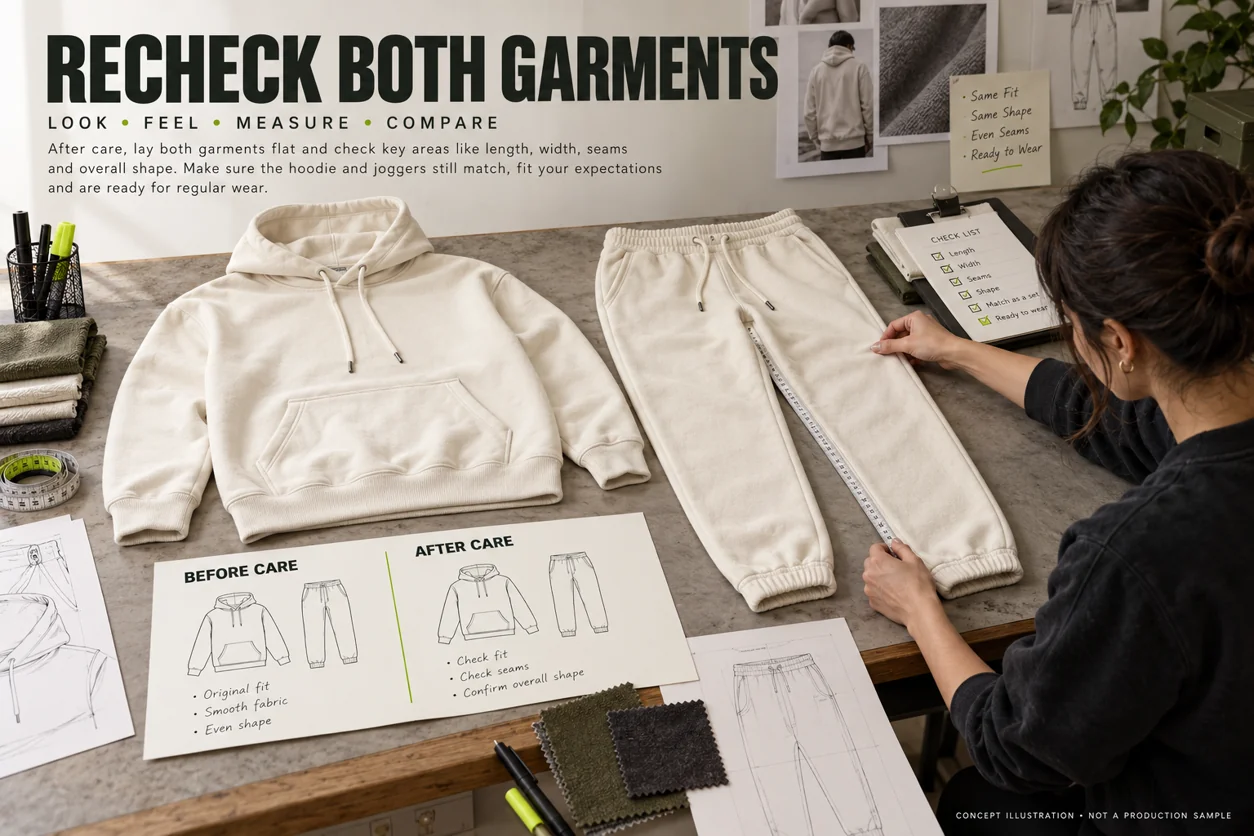
Repeat the comparison after the agreed care procedure
Review both garments before and after the same agreed care evaluation, using their individual measurement records. Do not conclude that the jogger will behave like the hoodie just because the main fabric reference is shared. Evaluate the finished pieces and the resulting outfit.
AATCC TM150 describes evaluation of garment length and width changes after home laundering. Its public summary notes that applicability can be limited for some stretch fabrics. Ask a qualified testing provider to select an appropriate procedure for your actual garments; this article does not reproduce the method or establish a universal acceptable shrinkage limit.
Agree acceptance criteria with the supplier before testing. Retain the starting measurements, care conditions and resulting measurements, together with appearance observations. If one garment changes enough to alter the intended overlap or leg position, assess the set again rather than approving the two measurements as unrelated paperwork.
For example, a brand can request a repeat front and side outfit photograph after the agreed care evaluation, tied to the same sample references. That is a useful comparison record. It is not a substitute for measurements or a laboratory report when formal testing is required.
Validate the proposed size range
One approved middle-size outfit does not establish that every offered pairing works. Agree which sizes and combinations need sample review based on the range and intended customers. Include the ends of the range or other combinations where the supplier and buyer identify a development risk.
Keep approval statuses separate: hoodie fit, jogger fit and complete-set review. If the top passes but the bottom needs revision, write that clearly. When the revised bottom arrives, recheck it with the approved top; do not automatically reopen already settled top measurements without a reason.
For women's ranges, our women's hoodie fit guide explains how to separate body references, garment measurements and range approval. Apply the same discipline to the bottom without assuming one universal body shape or a fixed amount of ease.
Make packing instructions as clear as the sample brief
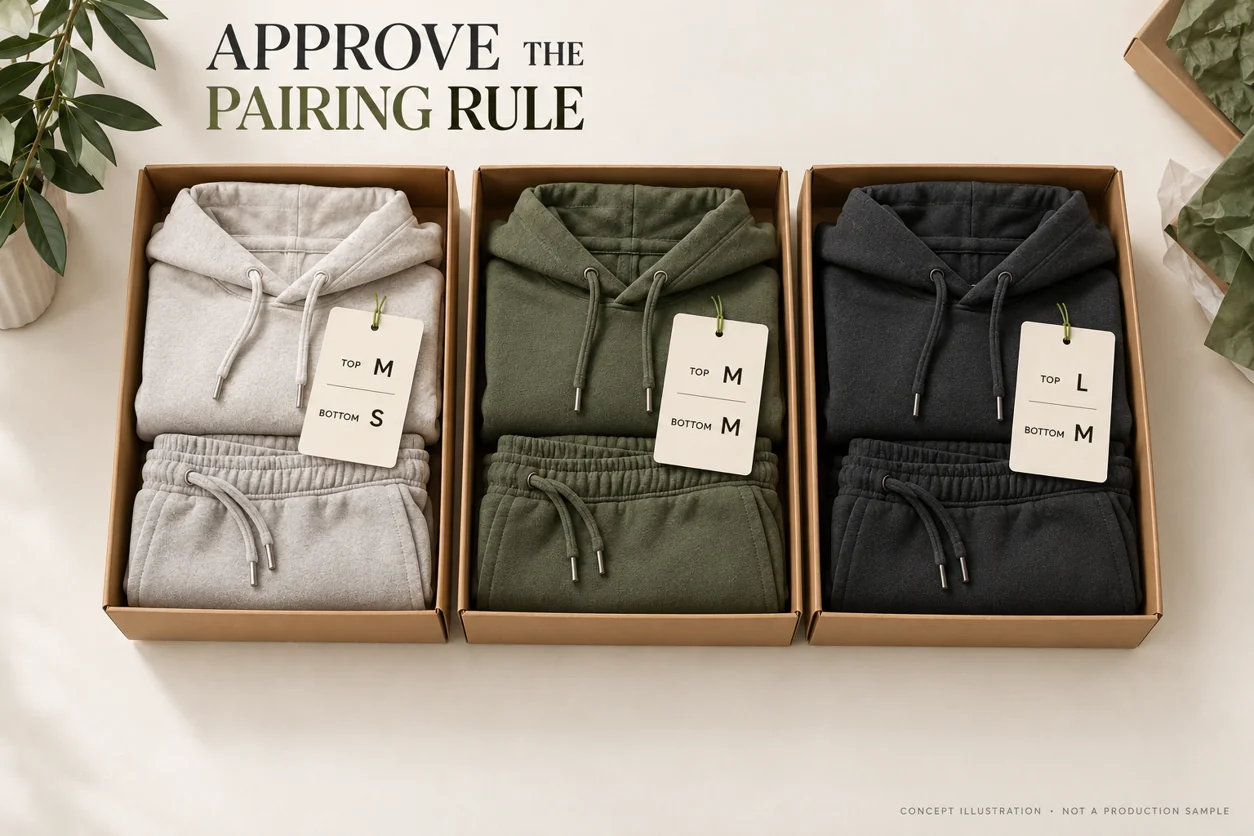
Create a set identifier that links two individually identified garments. State whether the shipment contains pre-paired sets or separate components to be paired during fulfilment. Confirm which labels go on each garment and how the outer package identifies the combination.
For a mixed-size offer, write “Top M / Bottom S” rather than a single ambiguous “M” on the pairing instruction. The exact code format is your business choice; consistency across the order, labels and packing list is the important part. Ask for a packing example before bulk dispatch and verify both garments inside against the outer description.
Keep spare or replacement components traceable to the same approved references. If later orders use revised materials or measurements, do not assume that an earlier hoodie and a newer jogger remain an approved pair. Reconcile the revision records first.
A concise brief to send before sampling
Use this as a starting checklist and replace every open choice with your actual requirement:
- Customer and use: adult target customer, intended styling and layering.
- Outfit: named hoodie shape, jogger shape, intended waist position and hem relationship.
- Measurements: separate top and bottom tables with diagrams, measuring conditions and agreed tolerances.
- Materials: linked main-fabric references, trims, linings, pocket bags and artwork approvals.
- Sample review: required sizes, pairings, movements and written acceptance criteria.
- Care review: agreed procedure, separate garment records and a repeat outfit assessment.
- Selling and packing: fixed or mixed sizes, component identifiers and one verified packing example.
The approval decision should be explicit: approve the set, request a defined revision, or hold approval pending a named check. “Looks good” in a message is much less useful than a dated approval tied to the correct samples and specifications.
Buyer questions
Must a matching hoodie and jogger use exactly the same fabric?
No. A shared fabric can be part of the brief, but an intentional contrast is also possible. Specify each garment and assess the combination. Do not describe two materials as identical when only their colour or weight description matches.
Should the top and bottom always carry the same size label?
That depends on the selling model. Fixed pairs and mixed-size combinations are both possible development choices. Use independent measurements and clear pairing instructions; the same label alone does not prove the intended fit.
Is approving the hoodie enough if the jogger uses the same material?
No. The jogger has its own pattern, waistband, pockets and use requirements. Approve it separately, then review the complete outfit together, including after the agreed care evaluation.
What should be signed off before bulk production?
The current top and bottom specifications, identified sample revisions, complete-set review, required care results and the packing rule. Resolve outstanding changes explicitly rather than assuming that one garment's approval covers the other.
Discuss your set brief with Athletic Rush
Explore the hoodie category, then send your intended hoodie and jogger shapes, target customer, size range and reference images. State whether you want fixed-size sets or mixed-size selling so that the development discussion begins with the whole order structure.
Email kamran@athleticrush.co or message Athletic Rush on WhatsApp. Ask for confirmation of the proposed materials, sampling scope, testing needs and commercial terms for your specific project; this guide does not promise a standard lead time, minimum quantity or product specification.