 Sialkot, Pakistan
 Worldwide enquiries

How should a clothing brand develop a women's hoodie fit? Define the intended wearer, the silhouette and the underlayer first. Keep body measurements separate from finished garment measurements, then review a physical sample for room, balance and movement. Do not assume that shrinking a men's hoodie or choosing a smaller unisex size will create the fit your customers expect.
A women's range can be relaxed, straight, shaped or oversized. The label does not prescribe one body shape or one styling preference. The useful question is more specific: does this identified sample deliver our chosen silhouette on the wearers and sizes we intend to serve?
This guide is for adult streetwear buyers developing cotton fleece or French terry hoodies. It covers three decisions: the fit brief, the sample review, and the size-range approval. It is a development checklist, not a universal size chart or a claim about Athletic Rush's current stock.
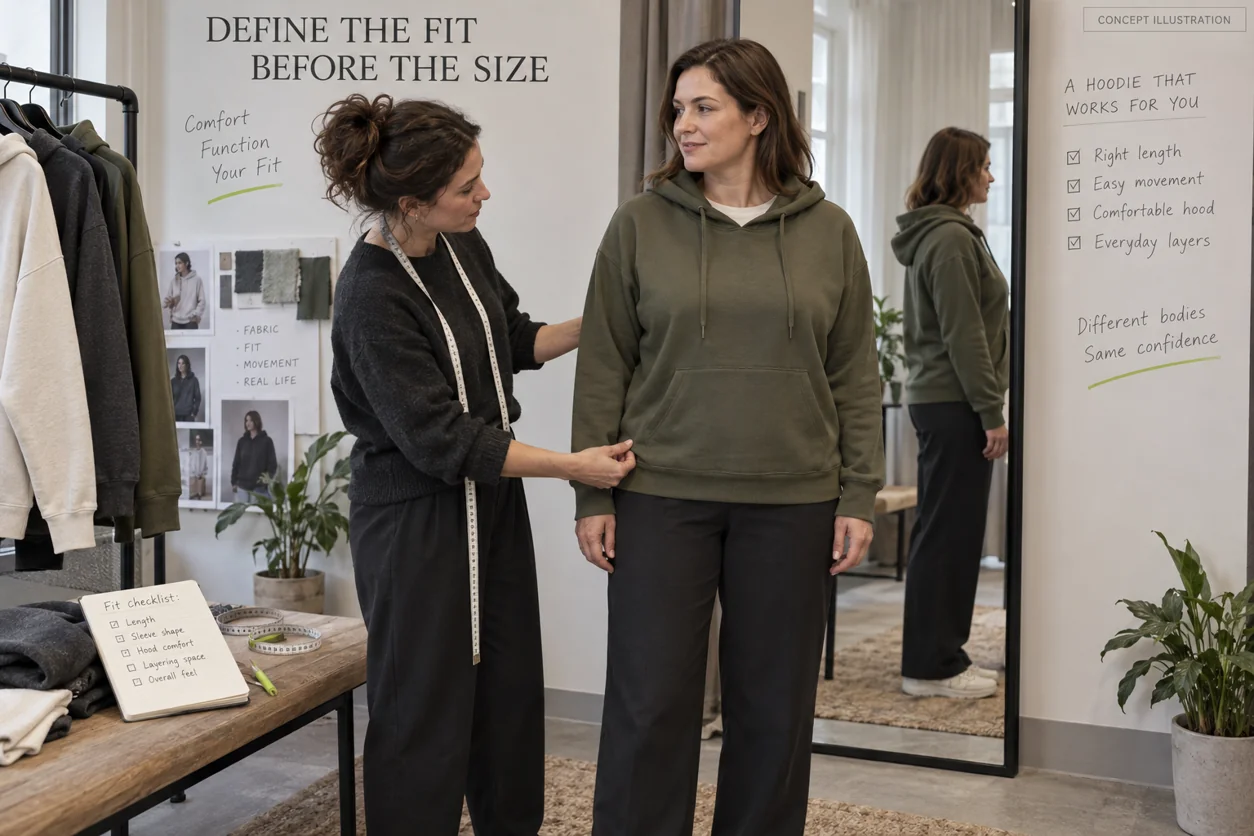
The six original visuals are conceptual illustrations, not photographs of actual orders, inventory or test results.
1. Describe the fit before choosing a size label
“Women's medium, relaxed” leaves important decisions open. The supplier still needs to know the intended coverage, shoulder position, body volume, sleeve shape and whether the hoodie will sit over a light tee or a thicker layer.
Begin with a short fit sentence. For example: “An adult relaxed hoodie over a lightweight tee, with a straight body, comfortable upper arms and a hem resting at the intended upper-hip position.” Pair it with front, side and back reference images. The upper-hip position in this example is a design choice to confirm on the wearer, not a standard required length.
A more shaped silhouette needs a different brief. Identify where you want shaping and where you want room rather than requesting “a feminine fit.” That phrase cannot tell a patternmaker whether you mean a narrower shoulder, a different waist outline, a shorter body or simply a different styling treatment.
Choose the silhouette deliberately
| Fit direction | What the buyer should describe | What a sample must establish |
|---|---|---|
| Straight, relaxed hoodie | Body volume, shoulder position, hem coverage and expected underlayer | Comfortable room without unintended restriction at the hem or upper arm |
| Shaped hoodie | Where the outline follows the body and where it remains relaxed | Intended front, side and back balance without unwanted pulling |
| Oversized hoodie | Deliberate extra volume, shoulder drop and sleeve outline | A controlled silhouette that still permits useful cuff, pocket and hood function |
None of these directions can be approved by colour, a size label or a front mockup alone. A shaped hoodie need not be tight, and a relaxed hoodie need not have an extremely dropped shoulder. Treat each feature as an explicit design decision.
If your collection uses a cropped silhouette, add a separate hem-position brief. The cropped hoodie proportions guide explains that decision; it does not replace a full fit review across the body and sleeves.
Separate body data from the garment specification
A body measurement describes the wearer. A garment measurement describes the finished product at agreed points. They belong in separate records even when both inform the same fit.
For example, a flat garment width across the chest is not a body bust circumference. Doubling a flat width may help describe that garment section, but it does not turn it into a complete statement about comfort, shaping or how the garment distributes space on a wearer.
ISO 8559-1 describes body-measurement definitions used in clothing development. It provides a measurement framework, not a ready-made women's hoodie pattern or a universal amount of ease.
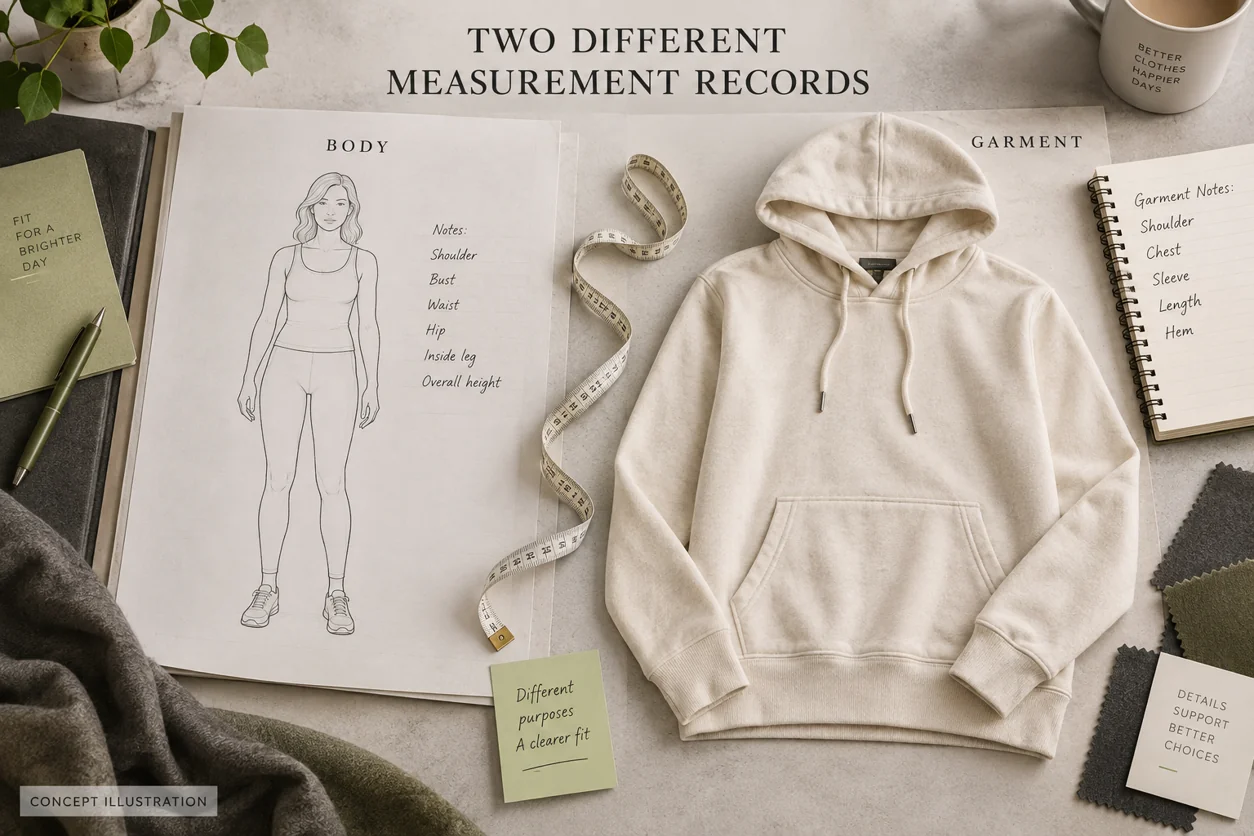
Use the illustration to distinguish the records. Agree real measuring points and methods with your development team; the sketch is not a scaled technical pattern.
Keep relevant wearer data confidential in the development file. Record the reference wearer's relevant measurements, posture during measuring and the underlayer used for the fitting. Use consistent definitions rather than mixing measurements from different supplier charts without checking what each one means.
On the garment sheet, define each measuring point with a sketch. Clarify whether body length includes rib, how sleeve length is measured, and the location of the chest and hem measurements. Confirm units, the relaxed or stretched state where relevant, and agreed tolerances.
Do not borrow a size chart without checking its basis
A chart from another hoodie can provide a discussion reference. Before adopting it, establish whether it describes body dimensions or garment dimensions, what silhouette it belongs to, and which fabric and finishing state were used.
Ask the supplier to explain how the proposed block relates to your fit brief. A block is a starting pattern foundation, not proof that the final garment fits the intended customers. Changes to fabric, length, shoulder or hem can require another sample review.
2. Review room and balance on the complete hoodie
Fit approval should connect measurements with wearer observations. A sample may match a specification sheet and still miss the intended silhouette. Conversely, a sample that looks attractive in a posed photograph may differ from the agreed dimensions.
Use an identified sample revision. Note the actual fabric, rib, hood, pocket and finishing state, not just the intended specification. Keep the underlayer consistent during comparisons. If a substitute component is present, make that limitation visible in the approval record.
Look at the front, side and back
Start with a natural standing position, arms relaxed. Review the neckline and hood opening, shoulder position, upper body, hem and sleeve outline. Look for where the garment rests and how its side seams and hem appear.
Observe pulling or folds before deciding the correction. A diagonal fold or an uneven hem is a clue to investigate, not a reliable diagnosis by itself. Ask the patternmaker to review the relationship between the wearer, garment measurements and construction.
Do not automatically add width to the whole garment because one area feels restricted. Check whether the issue is concentrated in the upper arm, across the back, around the bust, or at the hem. A broad change can remove an already approved silhouette while leaving the actual problem unresolved.
Give the bust and hem separate attention
Review whether the chosen amount of room works across the front and whether the body hangs as intended. For a relaxed design, the goal may be an easy straight outline. For a shaped design, review the intended contour without assuming every wearer has the same proportions.
Then check the hem at its actual resting level. A body that feels roomy higher up may still catch at the hem. Record whether the opening sits comfortably, climbs during movement or needs the wearer to pull it back down.
If the hem is ribbed, consider its dimensions and behaviour together with the body above it. “Loosen the fit” is less useful than identifying whether the body, rib opening or their relationship needs review.
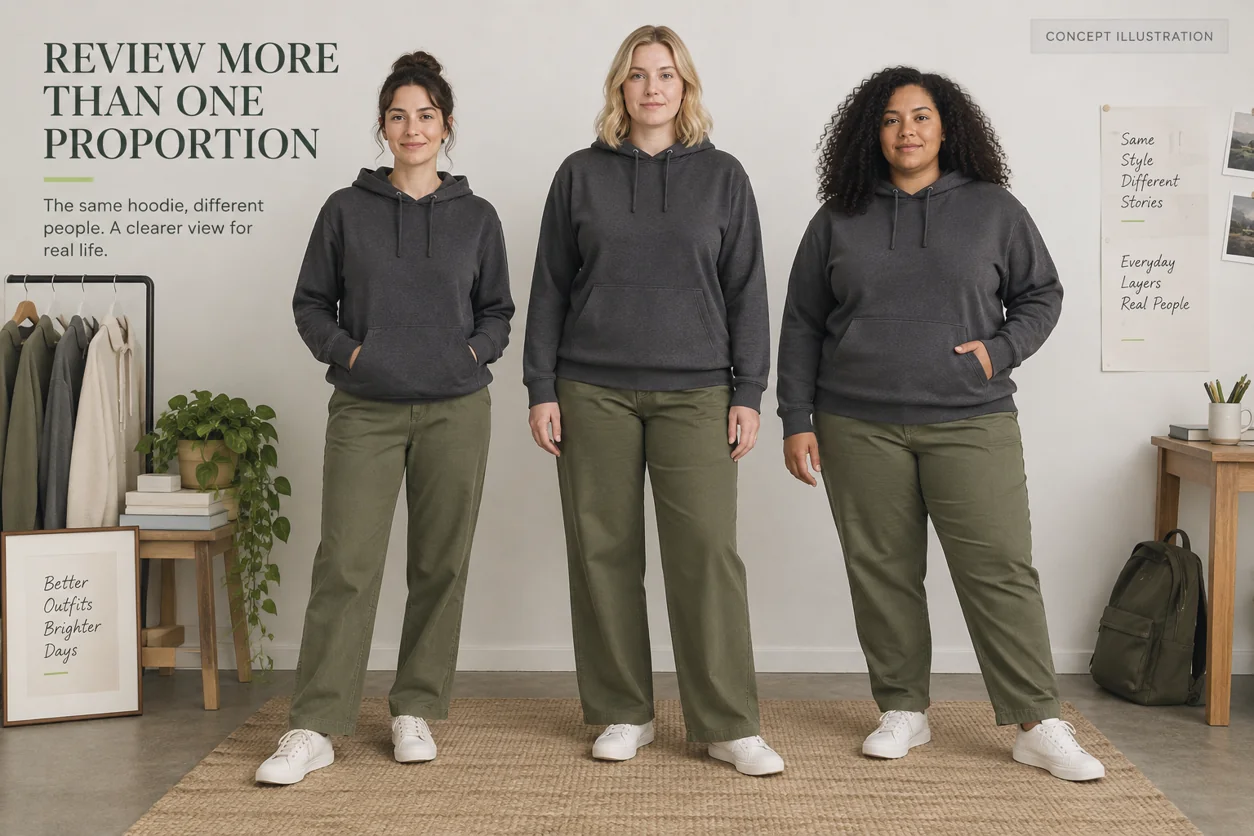
Different wearer proportions are part of the review, not a ranking of bodies. The illustration does not show validated sizes or prove range coverage.
Check shoulder, upper arm and cuff as a system
The shoulder position affects the sleeve's relationship to the arm. Review the sleeve measuring method alongside shoulder width, rather than treating a sleeve number in isolation.
Ask the wearer to bend their elbows and reach forward. Observe comfort at the upper arm and back, cuff position and whether the whole body is pulled out of its intended resting position. Distinguish normal garment movement from a result that conflicts with the fit brief.
Check cuffs at rest and during ordinary use. A cuff should meet the intended feel and position on the sample wearer; do not infer its recovery from how firmly it grips initially. Where recovery performance matters, agree appropriate testing on the selected material.
The hoodie pocket and cuff checklist covers these component checks separately. Complete-garment fit approval still needs to consider how those components work together.
Use a consistent movement sequence
- Stand naturally and photograph front, side and back.
- Reach forward as if using a desk or holding an everyday object.
- Bend both elbows and note sleeve and cuff position.
- Sit comfortably and observe hem coverage and pressure.
- Return to standing without deliberately rearranging the garment; record whether adjustment is needed.
- Put the hood up and down, and check the opening and its effect on the neckline.
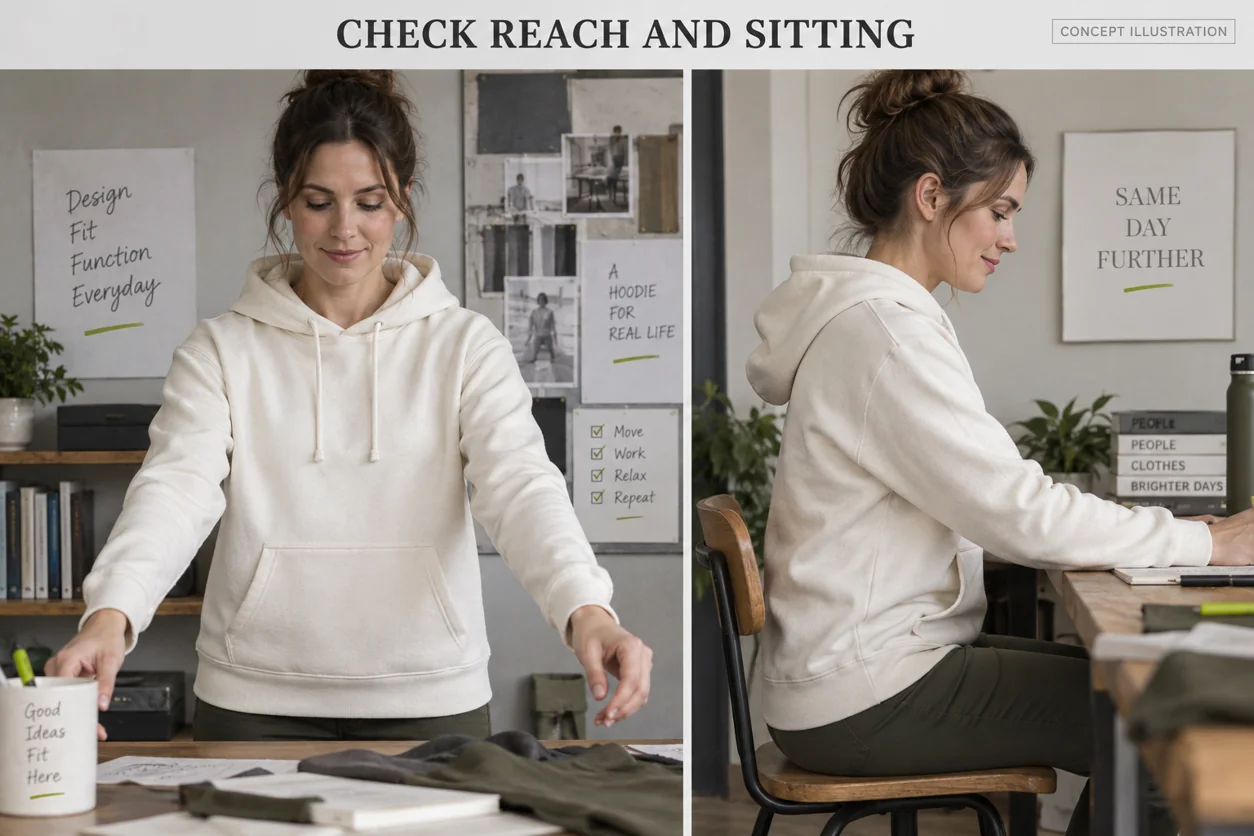
A fitting record should include the wearer's feedback as well as photographs. Ask specific questions: “Where do you feel restriction?” or “Does the cuff settle comfortably after reaching?” These give more useful information than asking whether the hoodie is simply “nice.”
Do not claim that one movement sequence proves suitability for every activity. It is a practical sample review based on the intended use, not a laboratory performance certification.
3. Approve the size range and material, not only one good photograph
An approved base-size sample establishes a direction. It does not demonstrate how every size will fit. Decide which additional sizes and relevant wearer proportions need physical checking before bulk approval.
Discuss the grading plan with the supplier. Grading changes the pattern between sizes; it should preserve your intended silhouette across the chosen range. Do not assume that every dimension should increase by the same amount or that one unreviewed increment works for every range.
For example, if the reference size has comfortable sleeves but another reviewed size restricts the upper arm, record that specific difference. Ask for the pattern and grading relationship to be reviewed instead of approving a larger chest measurement as a substitute.
Keep the selected fabric and rib in the review
Cotton fleece and French terry describe fabric directions, not complete fit specifications. Approve the actual proposed material, its finishing state and the accompanying rib. Substituting fabric after fit approval can change the result you are trying to reproduce.
A prototype made in another fabric can help communicate shape. Label it as a development sample and identify which decisions remain open. Do not treat its drape or movement as evidence for an untested bulk material.
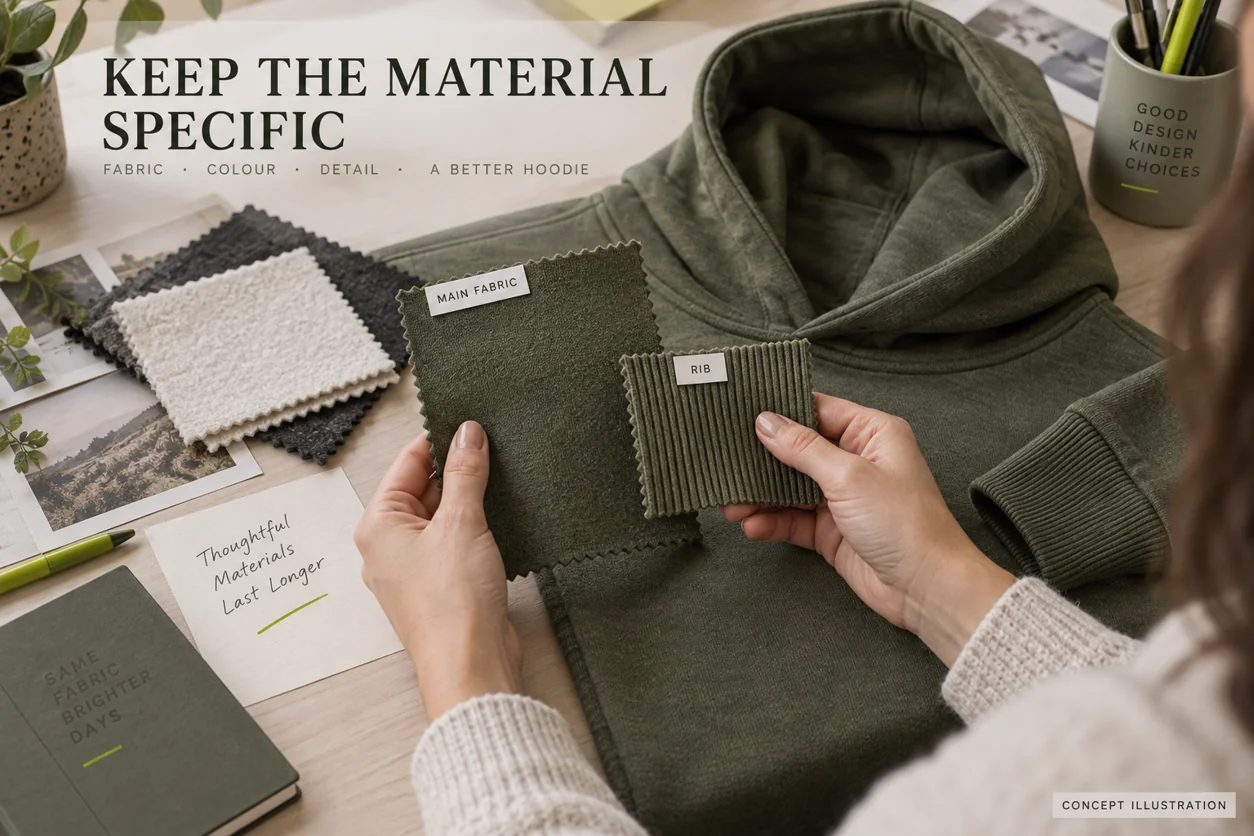
Where a care review is part of the brief, measure and assess the same identified sample before and after the agreed procedure. Record washing and drying conditions and recheck both dimensions and worn appearance. Do not apply an assumed shrinkage figure to all cotton hoodies.
AATCC's TM150 summary describes assessment of garment dimensional changes after home laundering. If a formal result is required, agree the applicable method and reporting with a competent testing provider. An informal wash check should be described as such.
Make each correction testable
A useful revision request preserves what already works and isolates what needs review. For example:
“Keep the approved body length and overall relaxed outline. The reviewed upper arm feels restricted when reaching forward. Check the sleeve and armhole relationship on the revised sample, then repeat the same movement review.”
This is an illustrative instruction, not a ready-made pattern correction. The patternmaker should determine the construction changes; the buyer should state the desired outcome and verify the next sample.
Avoid combining vague fit feedback with unrelated colour or print changes in a single approval note. Separate the open issues so it is clear which ones affect fit approval and which belong to another part of development.
A practical women's hoodie approval record

| Record | Include | Approval question |
|---|---|---|
| Fit intention | Straight, shaped or oversized direction, coverage and underlayer | Does everyone mean the same silhouette? |
| Body reference | Relevant private wearer measurements and consistent measuring definitions | Are the fitting observations tied to an identified reference? |
| Garment specification | Defined measuring points, units, dimensions and tolerances | Can the supplier reproduce and check the measurements? |
| Material identity | Main fabric, rib, components and finishing state | Was the sample reviewed in the intended construction? |
| Wear review | Standing, reaching, sitting, hood and cuff findings | Does the garment work for the intended use? |
| Range review | Selected sizes, wearer proportions and grading corrections | Have the relevant differences been physically checked? |
| Revision decision | Sample ID, photographs, accepted details and unresolved issues | Is this exact revision approved, or is another sample needed? |
Keep the approved sample and final specification linked. If a later revision changes a fit-critical component, record whether renewed approval is required. A message saying “looks good” should not be the only evidence of what was approved.
Before bulk production, resolve conditional notes. “Approved except for sleeve comfort” means a relevant fit issue remains open. Record the corrected sample and review outcome rather than leaving the condition to be interpreted during production.
Common buyer questions
Can a women's hoodie use a unisex block?
It can be considered if it supports the intended silhouette and wearer range. The label alone does not establish suitability. Review the actual block, sample and sizes against your brief; do not assume either a unisex or women's label proves a good fit.
Does a women's hoodie have to be fitted or shorter?
No. A women's collection can use straight, relaxed or oversized proportions. Choose body length, shaping and volume according to the intended customer and styling rather than applying a single rule.
How much ease should we add?
There is no single amount appropriate for every hoodie. The desired silhouette, body dimensions, underlayer, material and movement all matter. Agree the measurement basis and evaluate the proposed garment on a physical sample instead of using a generic percentage.
Is one fit model enough to approve the full range?
One reference wearer can help establish the base direction. It cannot demonstrate the result across all sizes and proportions. Agree additional sample and wearer checks that are relevant to your intended range before treating it as fully approved.
Start with a clear fit brief
Choose the wearer range, silhouette and underlayer before discussing final garment dimensions. Keep body and garment records separate, review the complete sample in motion, and document the sizes and revisions actually checked.
For a development discussion, explore Athletic Rush hoodies and share your fit reference, proposed size range and sampling questions. Contact kamran@athleticrush.co or Athletic Rush on WhatsApp.