 Sialkot, Pakistan
To check a streetwear sample after washing, record its starting condition, follow an agreed care procedure, and compare colour, dimensions, shape and worn fit as separate outcomes. Review the complete garment, including rib, trims and decoration. A sample that still looks attractive may have a dimensional issue; a sample with acceptable measurements may still need a colour or construction revision.
This guide helps clothing-brand buyers decide what to retain, what to question and what to recheck before a wider production approval. It covers a practical buyer review and how to ask for relevant formal evidence. It does not supply a laboratory procedure, universal pass limits or results for Athletic Rush products.
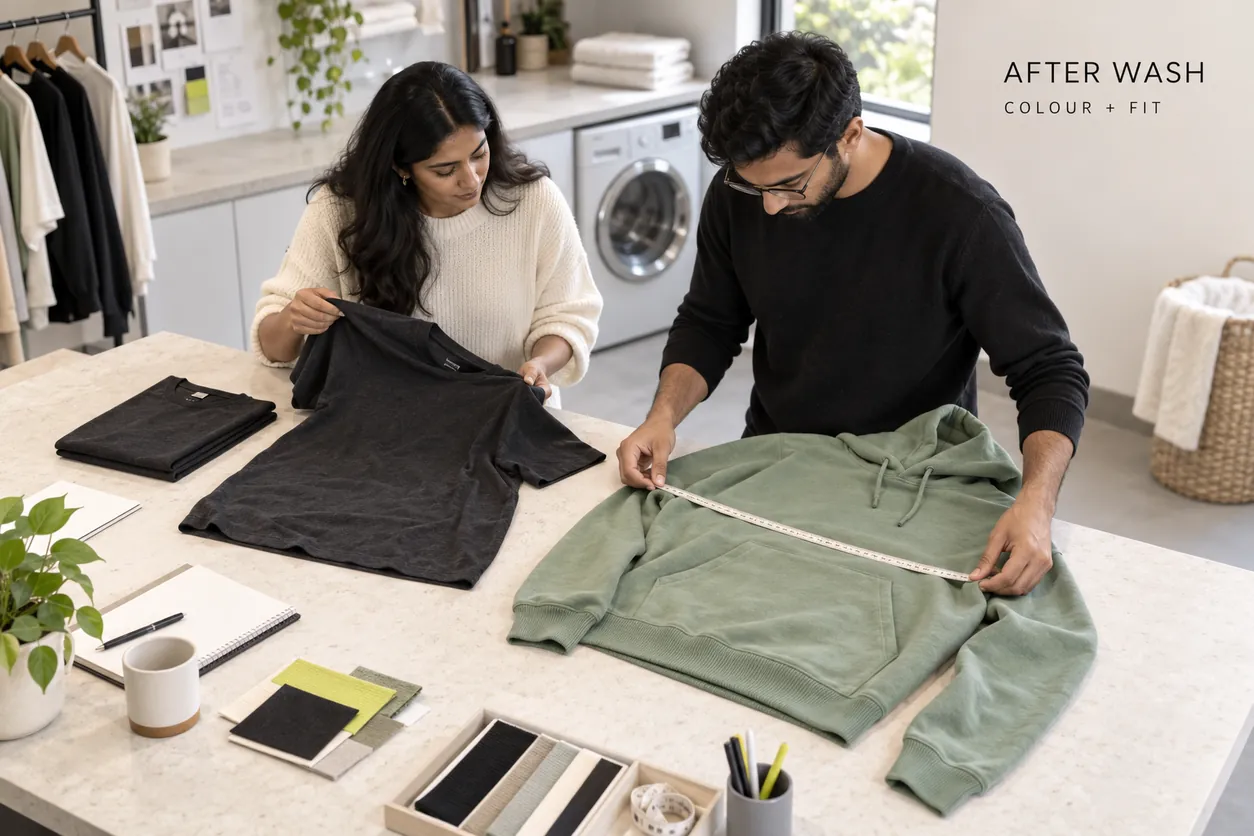
Concept illustration with fictional people and garments. The room, tape and samples are educational scenes, not Athletic Rush facilities, actual inventory or measured test results.
Start with a question that the review can answer
“Does it wash well?” combines several different questions. You might want to know whether a charcoal tee remains in the agreed colour direction, whether its body length remains suitable, or whether a hoodie’s rib and body still sit together comfortably.
Define those questions before care begins. Use two hypothetical garments to see the difference:
- Field Tee: a charcoal cotton jersey tee whose important features are a quiet body shade, the intended hem position and a clean neckline.
- Loft Hoodie: a sage pullover whose important features are the body-to-rib relationship, sleeve coverage, pocket appearance and comfort during movement.
These examples illustrate decision-making. They do not establish materials, sizes, tolerances or performance for an available product.
The garment-washed finish development guide deals with selecting an intended appearance before production. Here the starting point is an identified finished garment and the question is how it behaves after the specified care. Keep those states distinct: a factory finishing operation and a later customer-care check are not interchangeable records.
Define the starting state and retain its identity
Record the style, size, colourway, sample identifier and revision. Identify the body fabric, rib, trims and decoration represented by the sample. Note substitutes or omitted parts; an undecorated hoodie cannot settle every question about a decorated order.
Document whether the garment is received in an unfinished, finished or otherwise defined state. For a deliberately faded style, the baseline should capture the selected finish rather than compare it with an unrelated pristine garment.
Retain an identified unwashed comparison garment or relevant specimens where available, alongside the starting photographs and measurements of the garment undergoing care. A retained comparison is useful context, but it is not the before measurement of a different piece. Measure the actual review garment before and after if the question is its dimensional change.
Photograph the full front and back, then any critical detail. Include its identifier in the record. A close-up of a neckline without the style, size and starting condition may be difficult to interpret later.
Agree the care route instead of improvising one
State the washing and drying route, cycle count or review stages, detergent information and other relevant conditions with the supplier or laboratory. Confirm that the chosen procedure matches the purpose of the review. Record what actually happened.
There is no universal care route in this guide. Do not select an arbitrary hot cycle to make a sample fail, or an unusually gentle route solely to produce a favourable photograph. Resolve a proposed care-label instruction through the appropriate product development and evidence process.
Keep drying in the record. “Washed once” is incomplete when the reviewer does not know how the garment was dried or prepared for evaluation. Follow the agreed method for conditioning, laying out and measuring; do not invent a waiting time and describe it as a standard requirement.
If the question involves a formal claim, agree the applicable method and acceptance criteria before testing. Ask a suitable laboratory to explain the method’s scope for the actual garment, particularly when stretch materials or unusual assemblies are involved.
Build one baseline and separate the outcomes
A useful record separates four areas: the garment’s own colour, appearance on other fabric, dimensions and shape, and worn fit or function. Keep notes for each area, even when the same care sequence supplies the samples.
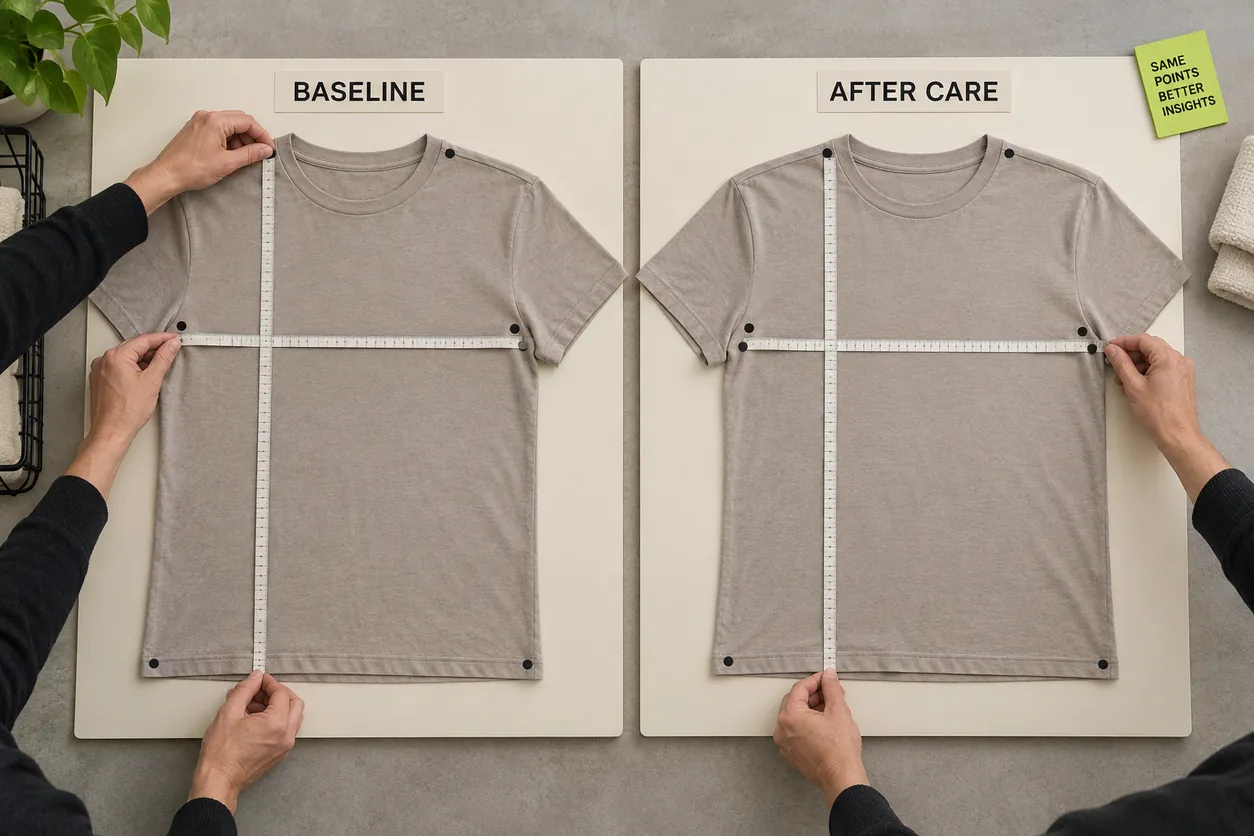
Concept measurement record: the dots and tapes illustrate documenting locations. This is not a prescribed points-of-measurement diagram, a standardized method demonstration or a measured comparison.
Use a written measuring map that states the start and end points, garment position and handling. For a tee, “body length” needs a defined reference; “chest width” needs a defined location. The supplier’s map and your before/after records must describe the same measurement.
Do not pull a garment until it returns to the starting number. Record the state and handling required by the agreed method. If you discover that a point was measured differently, flag the limitation instead of presenting the two numbers as a valid comparison.
The established T-shirt shrinkage guide develops dimensional calculations in more detail. This review adds the other outcomes needed to decide whether the assembled product still suits its brief.
| Review area | Useful starting record | After-care question | Limit of the observation |
|---|---|---|---|
| Own colour | Identified finished sample and retained physical comparison | Is the shade or effect still within the agreed direction? | A photograph alone does not establish a formal colourfastness grade |
| Other-fabric appearance | Defined adjacent material or the appropriate test arrangement | Is there a visible change on the other material? | An improvised cloth check is not automatically a standardized staining assessment |
| Dimensions and shape | Same garment, defined measuring points and starting layout | Which points changed, and where does the garment sit differently? | One width measurement does not establish complete fit or construction behaviour |
| Worn fit and function | Intended wearer context, layers and movement observations | Is coverage, access and comfort still suitable? | A fitting observation does not identify the technical cause of a change |
| Assembly appearance | Front, back and close-ups of relevant joins and decoration | Do rib, seams, pocket edges and graphics still express the brief? | A pleasing surface does not settle every physical-property requirement |
Ask for evidence that matches the question
The public scope of AATCC TM150 concerns length and width changes of garments under home-laundering procedures. It also notes a limitation for certain stretch fabrics. Use that scope to ask whether the method is appropriate for the submitted garment; do not treat its title as evidence that every dimension or fit has passed. AATCC TM150 public summary.
A relevant dimensional report should identify the sample, method and conditions, the measured outcomes and the acceptance basis. Ask what material or size the result represents. A report for a fabric specimen and one for a complete garment answer different questions.
Keep informal development observations clearly named. A buyer can record a useful comparison without claiming laboratory compliance. Conversely, a laboratory report may answer a narrow technical question while leaving the buyer’s intended silhouette or complete-outfit decision unresolved.
Check colour without confusing fading and staining
Begin with the garment’s own appearance. Compare the reviewed sample with its identified baseline and retained reference under consistent agreed viewing conditions. Look at the whole garment, then critical regions: body, neck rib, cuffs, hem rib, seams and decoration.
For the Field Tee, ask whether the body shade remains in the selected charcoal direction and whether any intended variation still suits the design. For the Loft Hoodie, check the body-to-rib relationship as well as the body alone. A component relationship can matter even when the garment remains broadly “sage.”
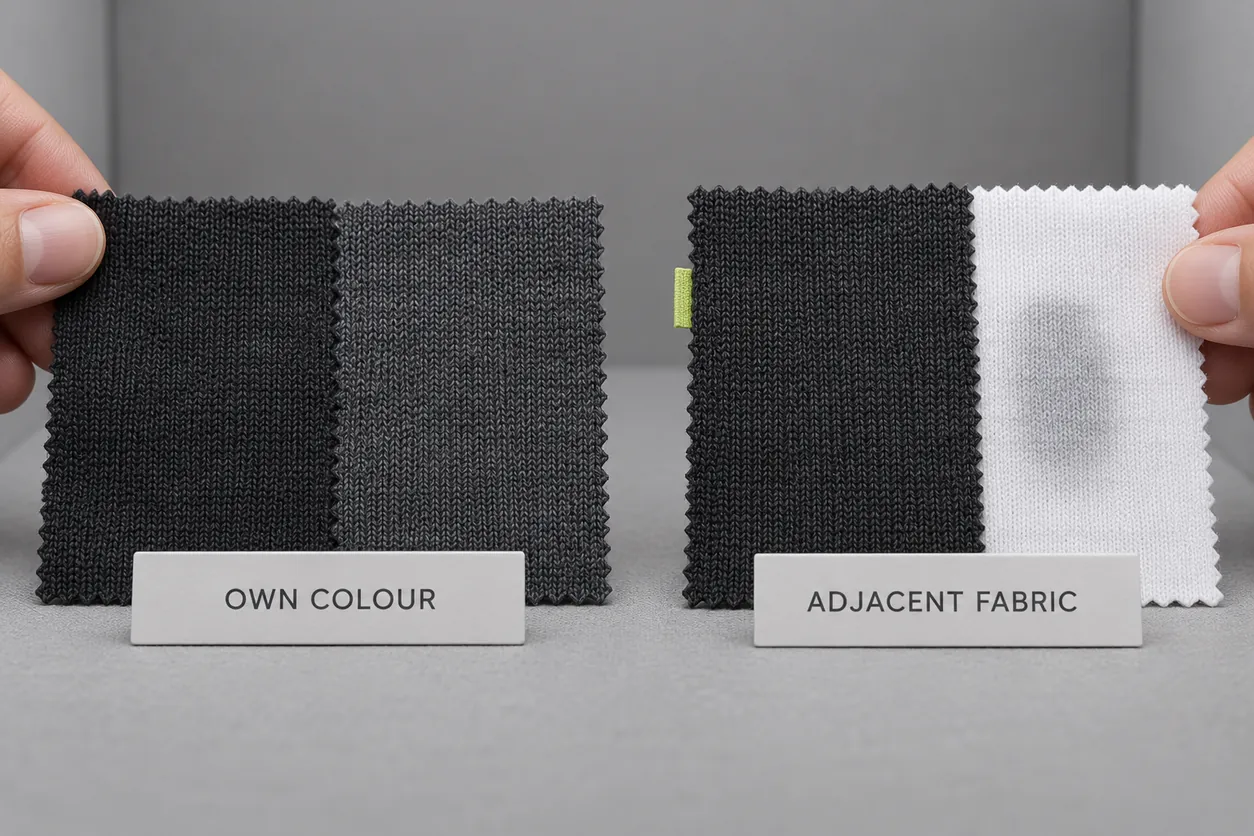
Concept specimens: the shade difference and grey patch are illustrative. They are not recorded laundering results, official grading scales or a validated laboratory arrangement.
Colour change refers here to a change in the garment or specimen’s own appearance. Staining is a separate observation about colour appearing on another material. Describe which you observed; avoid calling both “fading.”
Do not turn visible wash water into a conclusion about either outcome. Record a concern if one exists, then ask for the appropriate evaluation of the garment and any relevant other material. Likewise, a dark garment that looks unchanged in a phone photograph does not settle every transfer or colourfastness question.
Describe the visible condition before guessing the cause
Write “the washed specimen appears lighter across the central body against the retained comparison under the agreed lighting,” rather than “the dye is defective.” Write “a grey mark is visible on the identified adjacent material,” rather than claiming a particular chemical failure.
Name the location, sample and viewing context. Ask the supplier to explain what further evidence is needed and how any proposed correction affects the intended finish, other components and care instructions.
For a deliberately washed-look tee, distinguish the selected aesthetic from additional change after the review procedure. “It is supposed to fade” is not a complete acceptance criterion. Agree the acceptable appearance direction and supporting evidence for that style.
Keep accelerated testing and home observations distinct
The public summary of AATCC TM61 describes accelerated evaluation of laundering colourfastness using defined conditions to approximate certain effects of repeated laundering. A buyer’s single domestic wash is not automatically that accelerated method, and the summary is not a complete procedure to recreate. Ask the laboratory which option and outcome apply to your requirement. AATCC TM61 public summary.
When receiving a colourfastness report, ask which outcomes were assessed and how they were judged. Read the recorded result against the agreed criteria instead of reducing every report to an unsupported “wash test passed.”
A suitable colour outcome does not release dimensional or worn-fit checks. Maintain the separate rows in the review record.
Read the whole garment before the next fitting
Lay out and inspect the dry reviewed garment according to the agreed procedure. Compare front and back and revisit the relevant joins. Record the appearance before pressing, stretching or otherwise changing it, unless that preparation is explicitly part of the selected method.
Look for the observations that matter to the design: a changed hem line, a seam that no longer sits as expected, a rib join with a different relationship, a pocket opening that curls, or a graphic whose appearance has changed.
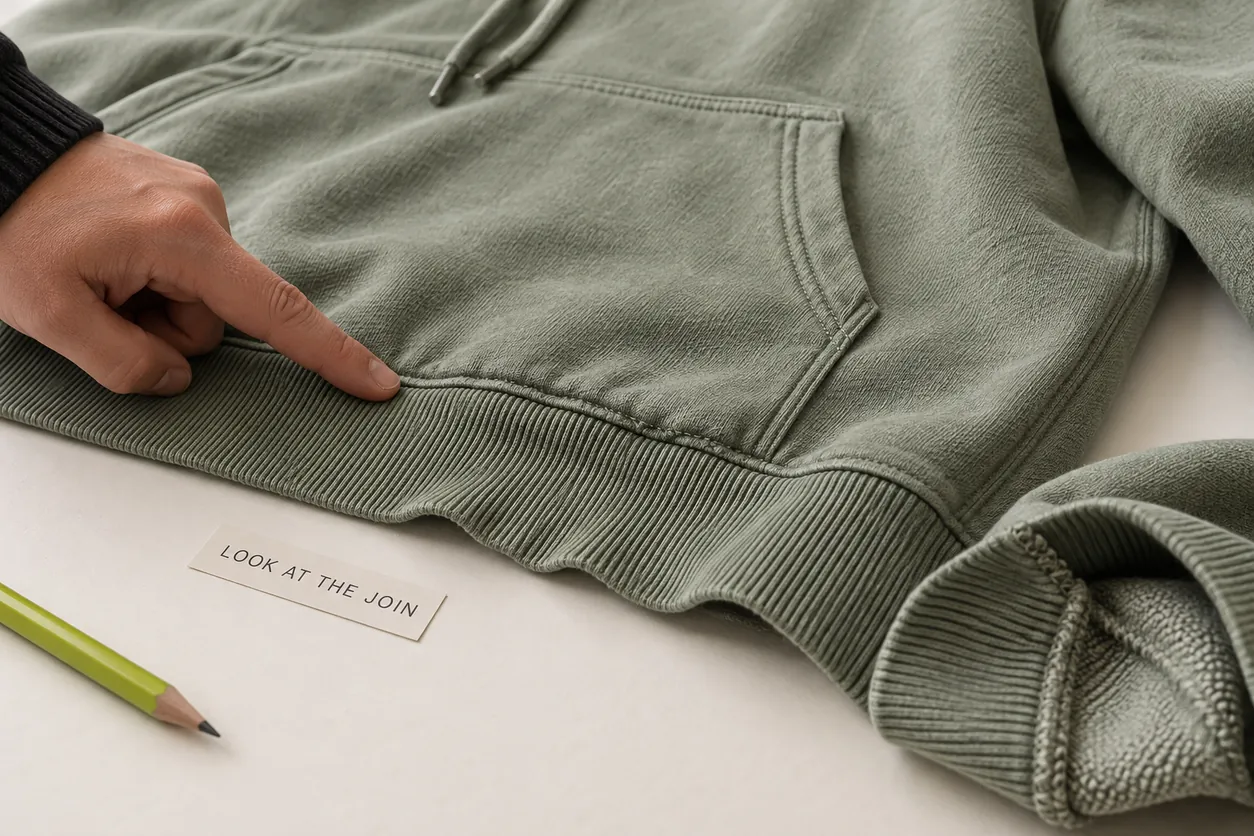
Concept close-up: the folds and join shape prompt inspection. They do not establish a defect, its cause, a material specification or a test result.
Do not diagnose from a macro photograph alone. An irregular join could need closer examination of several factors. Ask for an explanation based on the actual materials, construction and care record, and review the proposed correction on an identified complete garment.
For the Loft Hoodie, a body measurement may be acceptable while the hem rib sits differently from the intended silhouette. That calls for an assembly and fit review, not an automatic decision to increase the body size.
The public scope of AATCC TM143 addresses smoothness appearance of fabrics, seams and pressed-in creases in textile end products after home laundering. It illustrates why appearance needs its own assessment; it does not diagnose the cause of every ripple or cover every possible garment problem. AATCC TM143 public summary.
Do not allow one acceptable number to hide another issue
Review the measurement set together. Length, width, sleeve coverage and openings contribute differently to the design. A width within its agreed range cannot compensate for an unacceptable length simply by averaging the changes.
Suppose a hypothetical Field Tee retains the desired chest width but sits higher than intended after care. The useful question is whether its actual after-care length and worn hem position satisfy the agreed brief. There is no universal amount of change in this example that every brand should accept.
Record the starting and reviewed measurements at each defined point, the direction of change and the relevant requirement. If an outcome is near a decision boundary, resolve measuring consistency and the agreed evidence before labelling it acceptable or unacceptable.
Do not alter the proposed size chart solely from one unexplained sample. A pattern revision, material review or care-route question may be needed. The supplier should identify the proposed change and what it is expected to address, then provide the required recheck.
Repeat the intended wearing checks
Use the same relevant wearer context, underlayers, trousers and movement checks where practical. Document any difference in that context. The purpose is to understand whether the reviewed garment still performs the role selected by the design brief.
For the Field Tee, assess the relaxed silhouette, neckline, hem position and reaching coverage. For the Loft Hoodie, revisit sleeve and cuff coverage, hem behaviour when seated, hood position and pocket access.
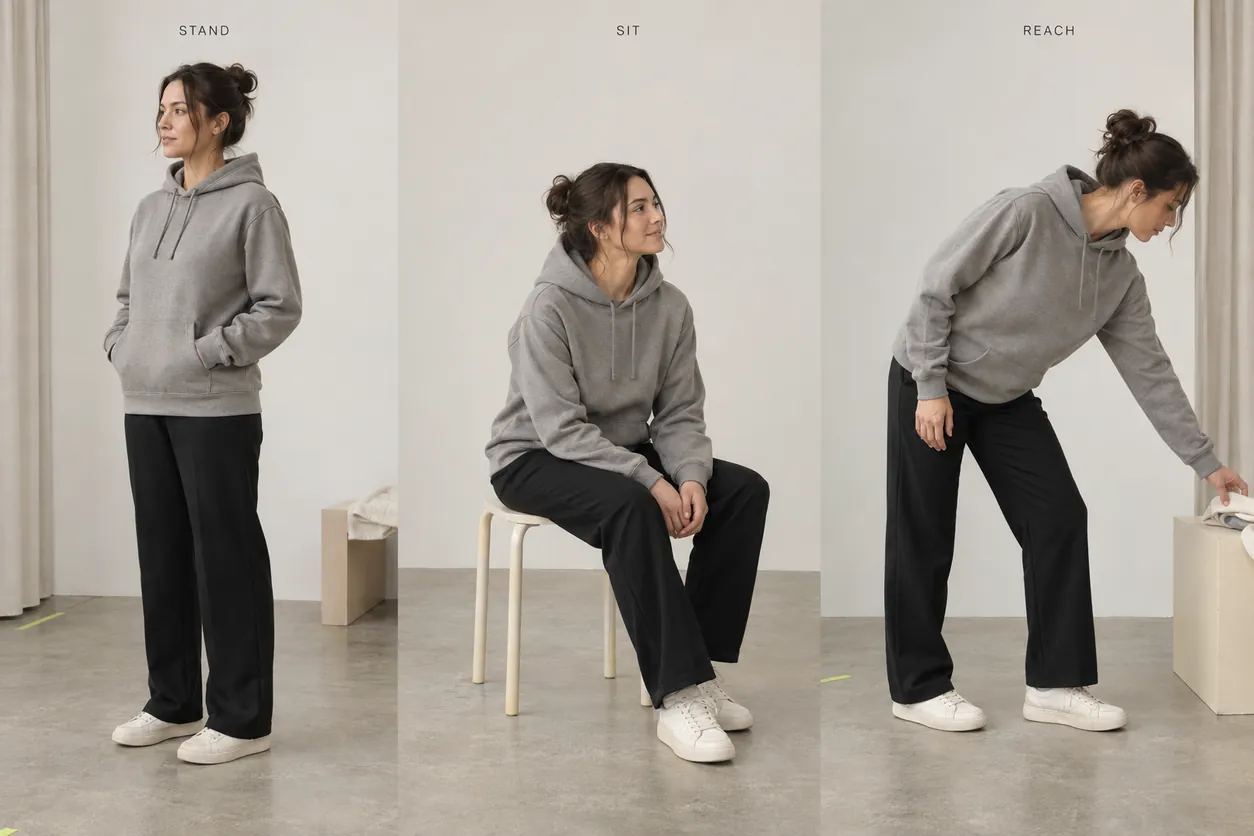
Concept fitting sequence with a fictional adult wearer. It illustrates observations to repeat, not measured fit, approved sizing or evidence of product performance.
A before/after fitting photograph is more useful when viewpoint, pose and styling are comparable. If one image shows a standing wearer with high-rise trousers and the other shows sitting with a different waistband position, document those differences instead of attributing all visible change to washing.
Ask the wearer for specific observations: where does an opening feel different, what coverage has changed, or which movement produces the issue? Translate those notes into a location and a review request. “Still comfortable” may be useful feedback, but it is not a complete record of sleeve coverage or hem position.
Keep body measurements separate from garment measurements. Changing the person, size or underlayer between fittings can complicate the comparison. If the context changes, identify it and explain what the observation can still contribute.
A fit concern and a laboratory result can both be valid. A technically acceptable result under its stated criteria does not automatically mean the silhouette suits your intended customer.
Convert the record into a specific next decision
Bring the colour observations, measuring record, assembly inspection, fitting notes and any formal reports together. Identify which requirement each piece of evidence addresses and where a decision remains open.

Concept review wall: the identifier connects an illustrative garment and record. It is not a customer approval, production release or actual laboratory report.
Use separate outcomes rather than one vague pass/fail label. You might retain the colour direction while requesting a length revision, or retain the silhouette while asking for further evidence about appearance on another material.
| Recorded observation | Useful supplier request | Follow-up decision |
|---|---|---|
| Field Tee chest remains suitable, but its hem is higher than the brief allows | Review the identified length result and worn hem position; explain the proposed correction | Recheck measurements and coverage on the corrected complete tee |
| Hoodie body and rib no longer express the selected relationship | Compare the specified components and care record; identify the proposed revision | Review the complete assembly and relevant evidence together |
| Own shade looks suitable, but another material has a visible grey mark | Identify the materials and observation; arrange the appropriate colourfastness evaluation | Decide against agreed evidence, not a favourable body photograph |
| Pocket edge or seam appearance has changed | Document location and condition; investigate without assuming a cause | Inspect the revised garment after the agreed care sequence |
| Revised sample looks suitable, but its procedure differs from the original review | State the changed conditions and why they were used | Decide which requirement the new evidence actually addresses |
These are hypothetical requests. They do not establish the cause of a change or instruct a factory to apply an unverified universal recipe.
A clear message might read: “Field Tee, size and sample revision identified in the attached record: retain the current colour direction. Body length and worn hem position remain open after the recorded care route. Please explain the proposed correction and supply a complete revised sample for the same agreed review. Do not change the neckline or decoration without identifying the change.”
Avoid requesting a longer body and a new care label without discussing the relationship between those decisions. A revised garment or process may need several checks repeated. Retain the previous record so the next reviewer can see what changed.
Separate development acceptance from production release
Name the decision explicitly: selected colour direction, accepted defined dimensions, accepted wearing observations, further evidence required, or approval withheld pending revision. Identify the sample and specification that the decision covers.
A single reviewed garment represents that garment and its stated conditions. It does not, by itself, demonstrate every size, material lot, colourway or future care outcome. Agree the representative range and production controls needed for the actual order.
For a new colourway or component substitute, ask whether existing evidence applies. Do not copy the result from the charcoal Field Tee to a different dye route or from a plain hoodie to a newly decorated assembly without review.
Keep the approved reference, records and relevant reports available for production and reorders. Their value is the continuity between an identified product, the evidence and the decision.
Questions clothing-brand buyers often ask
Does a garment-washed product need later care checks?
Yes, when the product requirements call for them. Approving an intended factory-finished appearance and reviewing behaviour after a defined care procedure are different decisions. Record the starting finished state and agree the later evidence required.
Can I approve from before-and-after photographs alone?
Photographs help record appearance, location and context. They cannot replace defined dimensional records, handled samples or the formal evidence needed for a technical claim. Use them alongside the appropriate physical review.
What percentage of shrinkage is acceptable?
This guide sets no universal limit. Agree requirements by relevant measuring point and product, then consider the intended silhouette and after-care fit. Confirm the method and applicability before comparing results with a tolerance.
Is one wash enough to approve the garment?
The required stages depend on the agreed question, method and product requirements. One observation is evidence of that particular review, not a claim about indefinite care or every garment in an order. Agree the scope before starting.
Send an enquiry with evidence that can be reviewed
Prepare the style and sample identity, complete assembly details, starting record, actual care procedure, before/after measurements, physical colour references, full-garment photographs and focused fitting notes. Identify the decision you need next and any unresolved evidence.
For a streetwear development enquiry, contact Athletic Rush at kamran@athleticrush.co or WhatsApp +923279008337. A useful after-wash review turns “it changed” into an identified observation, a precise question and a traceable next check.