 Sialkot, Pakistan
 Worldwide enquiries

Measure the same identified garment at the same defined points before and after an agreed wash-and-dry routine. Calculate length and width changes separately, then review the washed fit, seams and decoration against your approved requirements. A statement such as “pre-shrunk cotton” is not a substitute for this evidence.
For a streetwear brand, shrinkage is a fit decision as well as a fabric question. A tee can meet its original size chart and still become too short for the intended silhouette after care. This guide gives buyers a practical way to organise sample checks, understand the numbers and brief a supplier. It does not prescribe a universal shrinkage allowance or replace a laboratory method.
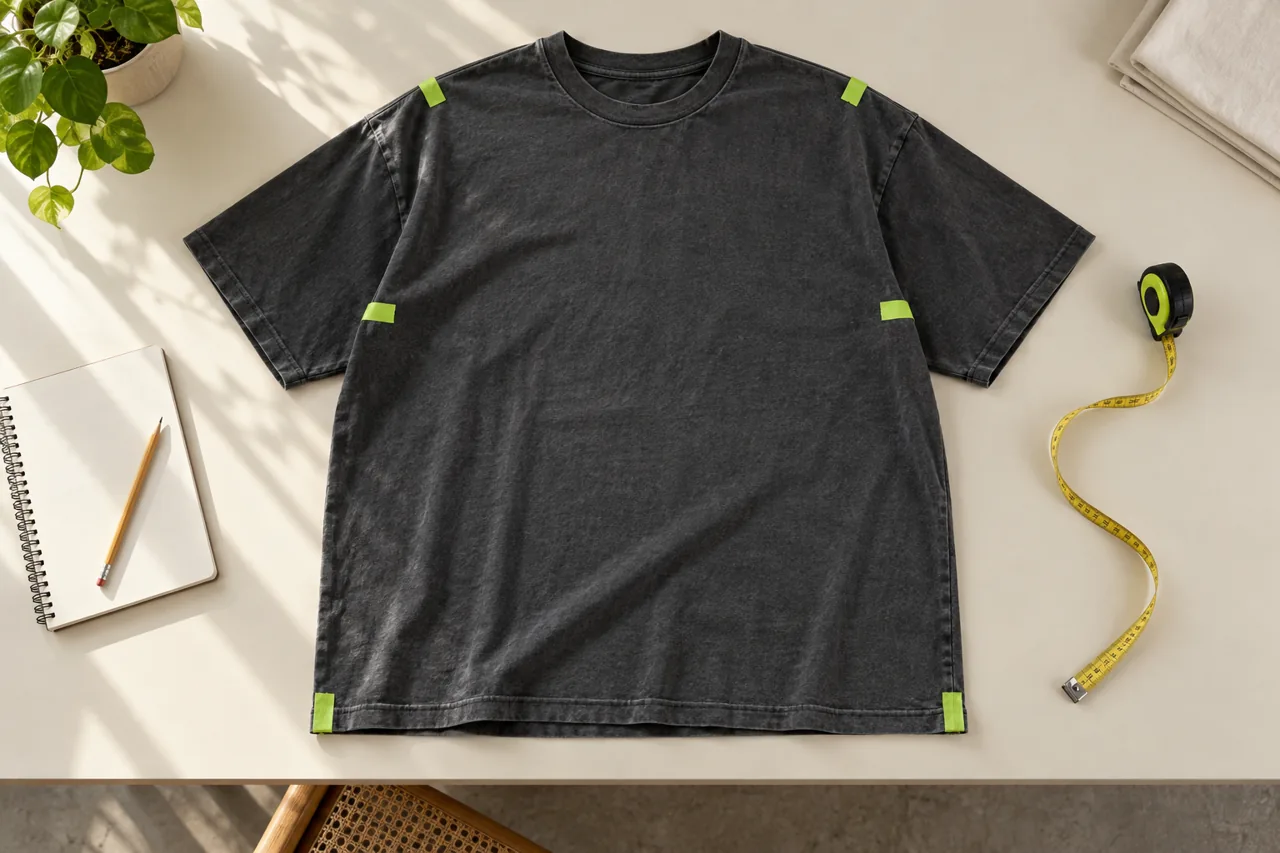
All six original AI-generated images are conceptual illustrations. They are not photographs of Athletic Rush production, laboratory testing or measured before-and-after results.
Decide what you are approving before washing a sample
Start with the actual product revision: material reference, colour, garment size, pattern version, finish and decoration. A result belongs to that combination. If the production fabric or finishing route changes, ask whether the original evidence still applies rather than carrying the approval forward automatically.
Define the intended care instructions with the supplier. Agree the washing and drying routine, number of cycles, measurement conditions and acceptance criteria before looking at results. Otherwise a buyer may evaluate a line-dried sample while the supplier quotes a result for another drying procedure, and both parties may believe they are discussing the same test.
Separate a buyer's development check from a standards-based test. AATCC's standards directory lists TM150 for garment dimensional changes after home laundering, TM135 for fabrics and TM179 for skew change. If your order requires a named method, ask a qualified testing provider to confirm the applicable version, procedure and report. The informal workflow below does not establish compliance with those methods.
For an early sample, write a small agreement: which revision will be evaluated, how it will be cared for, which measurements matter, and who will decide whether the result is acceptable. Do not insert a percentage copied from another brand's product page. The acceptable change must support your own fit promise and agreed specification.
Create a reliable baseline
Use an identified sample and retain its original measurements. Let the garment reach the agreed measurement condition, lay it on a flat surface, smooth ordinary folds gently and avoid stretching it into the desired dimensions. Use the same measuring tool and technique for the later comparison.
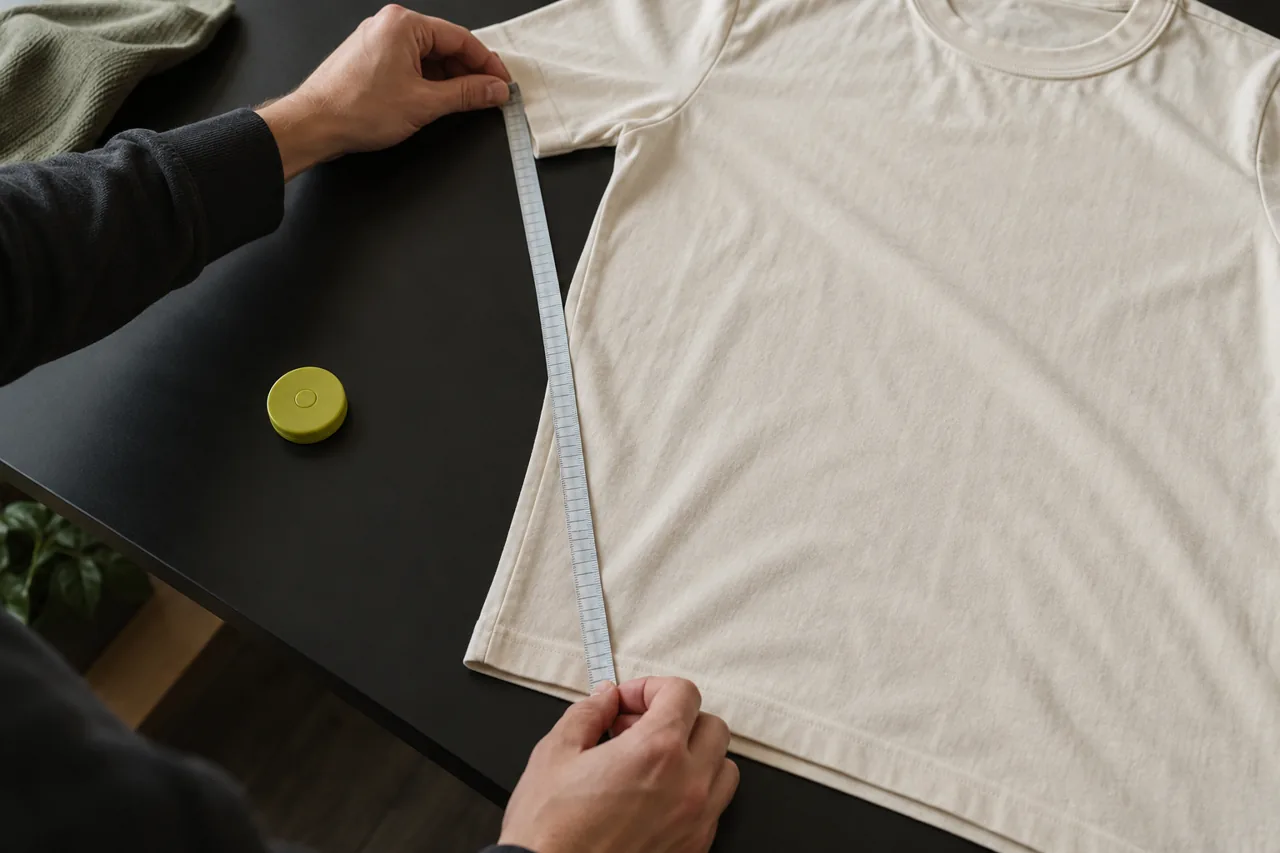
Define each point in words and a simple reference photograph. “Body length” is incomplete if one person starts at the shoulder near the neck and another starts at the centre-back neck seam. Likewise, half-chest width needs a defined position rather than a convenient place chosen differently each time. Use your T-shirt size chart and measuring-point guide to keep those definitions consistent.
Record the garment's actual starting size, not merely the target on the specification. If the sample already misses the target before washing, note that as a separate issue. Calculating change from the target instead of the actual original measurement mixes two different questions: whether the sample was made to size and whether it changed during care.
| Record | What to write | Why it matters |
|---|---|---|
| Sample identity | Revision, size, colour and material code | Ties results to a specific proposal |
| Measurement point | Exact start, end and garment position | Makes repeat measurement comparable |
| Before-care dimension | Actual measurement with units | Provides the correct calculation baseline |
| Care routine | Wash, dry and cycle details agreed with supplier | Makes the treatment traceable |
| After-care dimension | Same point and measurement conditions | Supports a fair comparison |
| Decision | Accepted, investigate or revise, with reason | Prevents a number becoming an unexplained approval |
Measure again if a reading appears inconsistent. A tape following a wrinkle, an angled chest measurement or a changed starting point can create an apparent difference. Keep original readings and the reason for any corrected entry; do not silently replace inconvenient values.
Keep the wash and dry routine identifiable
Use the agreed care routine for the specific sample. Record what was actually done, including any departure from the plan. If the programme changed or the drying method was different, report it instead of labelling the result as if the agreed procedure had been followed.
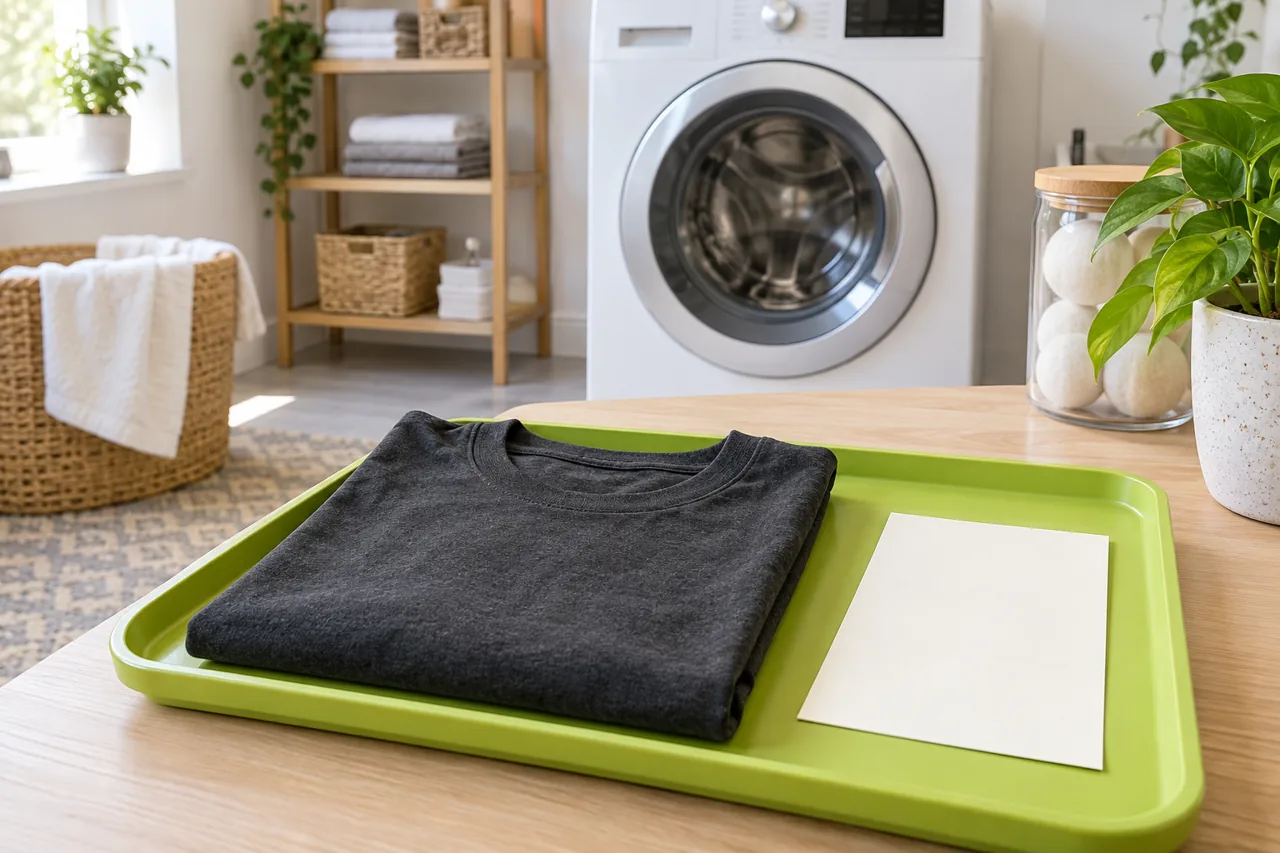
Identify the sample throughout the process. Keep the record attached to the sample identity even when the garment itself is being washed. When comparing several candidates, give each its own code and results. A pile of similar black tees is not a reliable record system.
The number of cycles should be agreed according to the project or formal method, not chosen by this article. If you check more than once, record each stage against the original baseline and keep the stages separate. Do not call a first-cycle observation a guarantee of lifetime stability.
After care, return the garment to the agreed measurement condition before measuring it. Do not pull it back to its original shape simply to obtain the expected number. If reshaping is part of the approved care procedure, record it consistently and make sure the comparison reflects that procedure.
For a commercial decision with tight requirements, unusual finishes or disputed results, ask for an appropriate independent report. Photographs and a home measurement record can support a development discussion, but they are not automatically a controlled test certificate.
Calculate each dimension separately
For this buyer worksheet, use a clearly labelled positive-shrinkage convention:
Shrinkage (%) = (before-care measurement − after-care measurement) ÷ before-care measurement × 100.
A positive result means the measured dimension became smaller. A negative result means it became larger. Some reports use a dimensional-change convention with the opposite sign, so read the report definition before comparing values. Always preserve the original measurements and units alongside the percentage.
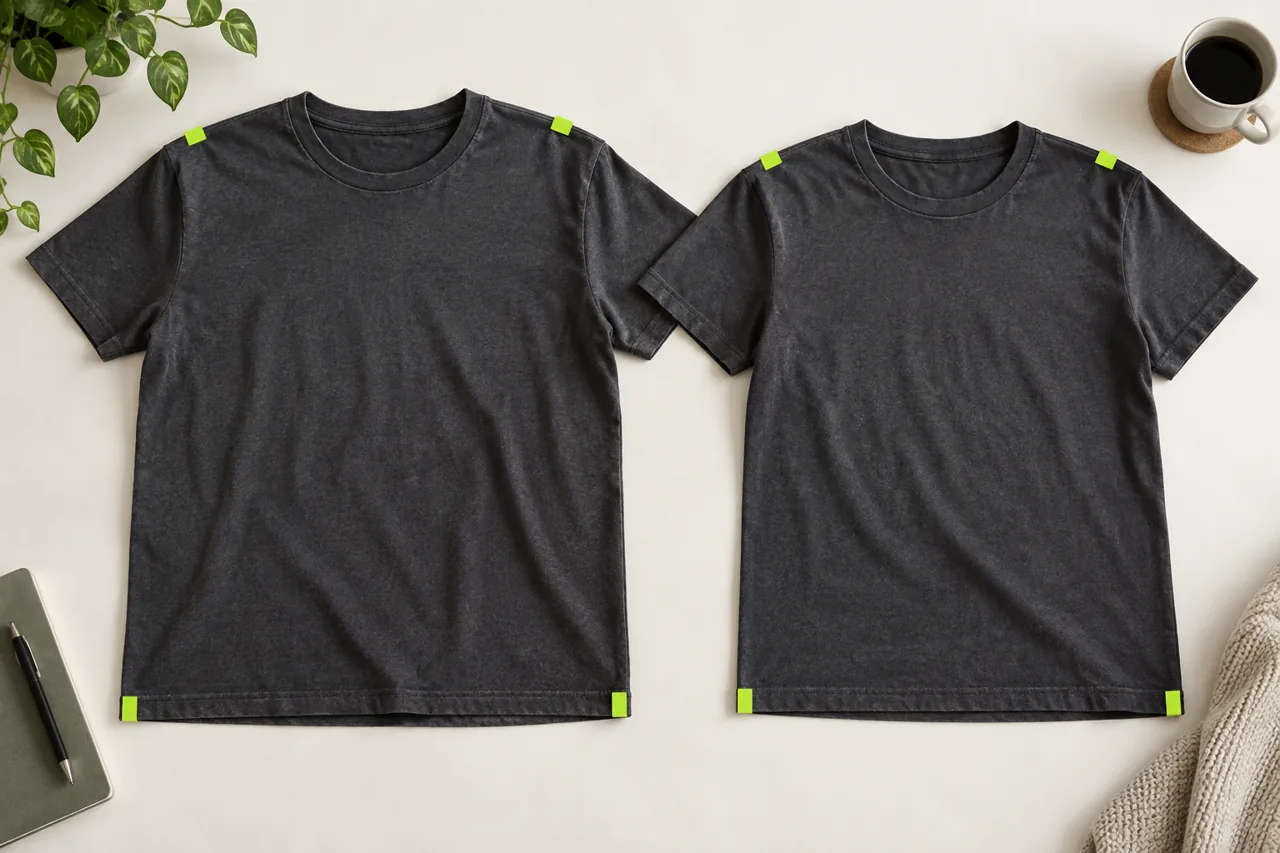
The following numbers are illustrative arithmetic only, not Athletic Rush test results or product tolerances:
| Measurement | Before | After | Calculation using this guide's convention | Observation |
|---|---|---|---|---|
| Body length | 72.0 cm | 69.8 cm | (72.0 − 69.8) ÷ 72.0 × 100 = 3.06% | Length decreased |
| Half-chest width | 60.0 cm | 59.4 cm | (60.0 − 59.4) ÷ 60.0 × 100 = 1.00% | Width decreased |
| Sleeve length | 24.0 cm | 24.2 cm | (24.0 − 24.2) ÷ 24.0 × 100 = −0.83% | Length increased slightly |
Do not average the length and width percentages into a single “shirt shrinkage” figure. That would hide the shape of the change. In this example, the body length needs a different discussion from the chest width. A short boxy tee and a long relaxed tee may also have different fit consequences from the same dimensional change.
Report sensible precision for the measuring method. More decimal places do not make a tape measurement more reliable. If a small difference could be measurement variation, repeat the measurement consistently and discuss uncertainty rather than presenting a false level of certainty.
Check what the percentage cannot tell you
A measurement result is one part of the review. Compare the washed garment's neckline, hem, side seams, surface and decoration as well. Record twisting, uneven edges or changes in appearance as observations, with photographs and the sample identity. Do not diagnose the manufacturing cause solely from a photograph.
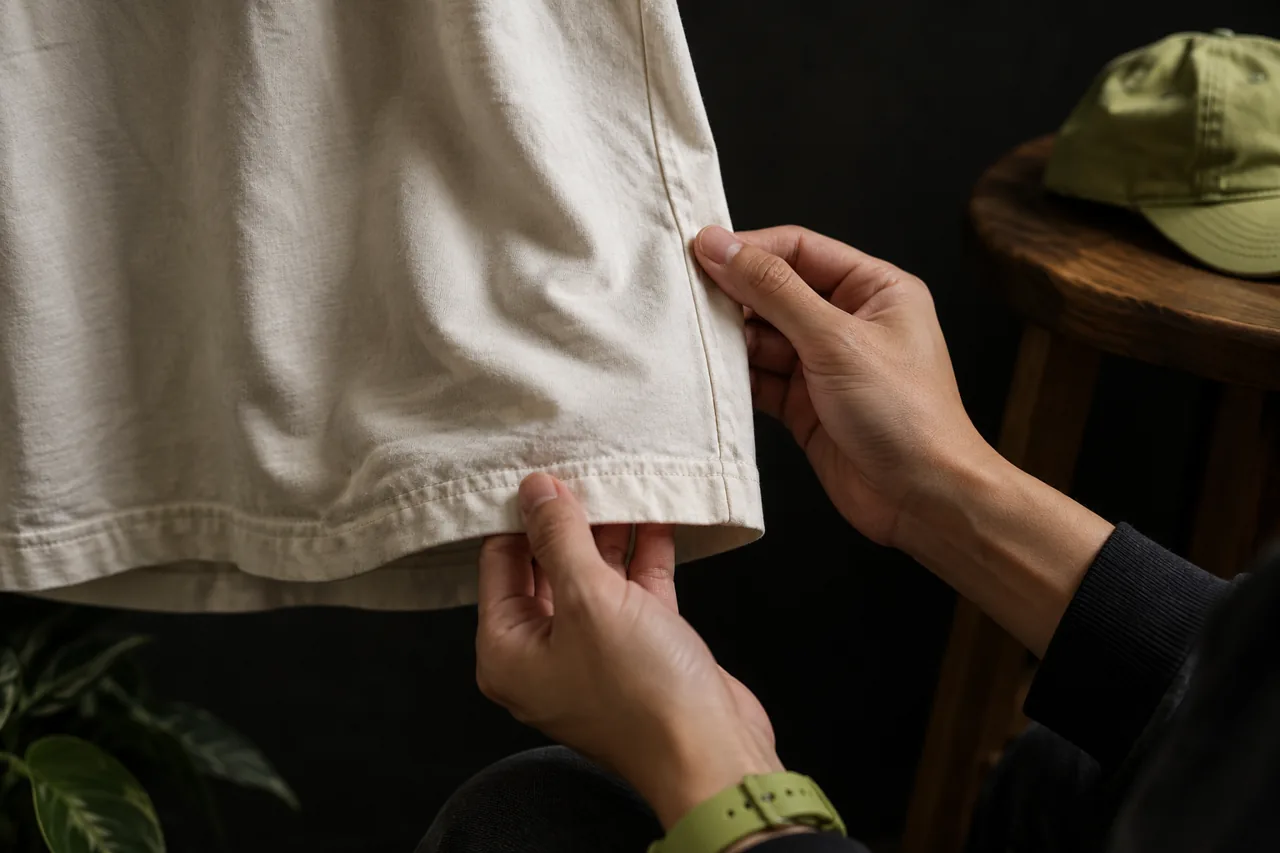
A tee may remain within agreed dimensions while the side seam no longer hangs as intended. Another may change in length while retaining a suitable silhouette. These are different outcomes and need different approval notes. Keep fit, dimensional change and appearance as separate fields so one favourable result does not hide another problem.
Try the relevant sample on the intended fit model or wearer where practical. Review sleeve coverage, body length and neckline together. For a deliberately roomy silhouette, compare against the approved oversized or boxy fit intention, not a general expectation that every loose tee should look identical.
Check the decorated garment when decoration is part of the product. A plain swatch does not represent the complete finished item. Also retain the neck rib and stitching reference so the body fabric and neckline are reviewed together.
Turn a failed check into a useful revision request
Send the supplier the sample code, before-and-after measurements, calculation convention, care record and clear photos. Describe the buyer consequence: for example, the washed body length no longer meets the intended coverage. Ask them to investigate the material, finishing and garment proposal rather than requesting an unexplained enlargement of every dimension.

If a revised pattern or material is proposed, identify the revision and repeat the relevant checks. Increasing the initial length may alter the unwashed fit; it is not automatically the right solution. Confirm both the supplied condition and the intended after-care condition before accepting a revision.
Keep the sample decision narrow and explicit: “Revision B accepted for the stated size, colour and care routine; other colourways awaiting review” is more useful than “fabric passed.” Agree which sizes, colours or production changes need additional evidence. Do not claim one sample represents every possible combination.
Before bulk approval, make sure the final record answers these questions:
- Does it identify the same material and garment revision as the order?
- Were the actual starting measurements recorded at defined points?
- Is the wash-and-dry routine and cycle count clear?
- Are changes reported separately with a defined sign convention?
- Does the washed fit still support the product brief?
- Are seam, neckline, surface and decoration observations included?
- Have any revisions and outstanding checks been resolved in writing?
Buyer questions
Does pre-shrunk mean no further change?
Do not treat the phrase as a numerical guarantee. Ask what the supplier means, which process and sample the claim refers to, and what evidence is available for the intended care routine. The approved requirement should be written explicitly.
Can I test a fabric swatch instead of a finished tee?
A swatch can support material development, but it does not include the full garment, seams, rib and decoration. Match the evidence to the decision. If you are approving a finished T-shirt, include the relevant finished sample in the review.
What shrinkage percentage is acceptable?
This guide does not set a universal percentage. Agree the requirement before testing, based on the garment, intended fit, care instructions and purchasing specification. A number without those conditions is incomplete.
Should I simply tell customers to size up?
First understand and resolve the product specification. A blanket sizing recommendation may create a poor initial fit and does not explain inconsistent results. Keep customer sizing guidance aligned with the product evidence you actually have.
Prepare a sample brief with Athletic Rush
Explore Athletic Rush streetwear and send your garment measurements, intended fit, material reference and care expectations. The cotton jersey specification guide can help identify the fabric before you evaluate the finished sample.
Contact kamran@athleticrush.co, share your brief on WhatsApp, or request a quote. Ask the team to confirm the sample scope, proposed checks and project terms before ordering.