 Sialkot, Pakistan
Choose jacket lining by deciding where it is needed, how it behaves against the intended underlayer, and whether the complete construction works after the agreed care process. Approve the body and sleeves separately, then review them together in the finished jacket. A fibre name, shiny surface or “fully lined” description does not settle those decisions.
For a clothing brand, the useful question is: what should the inside of this jacket help the wearer do? A clean inner appearance, easier sleeve entry, a particular feel, an inside pocket or a warmer design direction are different requirements. Write the required outcome before asking a supplier to recommend a lining.
This guide focuses on the inner construction of streetwear jackets. Our lightweight jacket development guide covers the wider garment brief. Here, the decision is narrower: which areas to line, which identified materials to consider, and what to inspect before approving production.
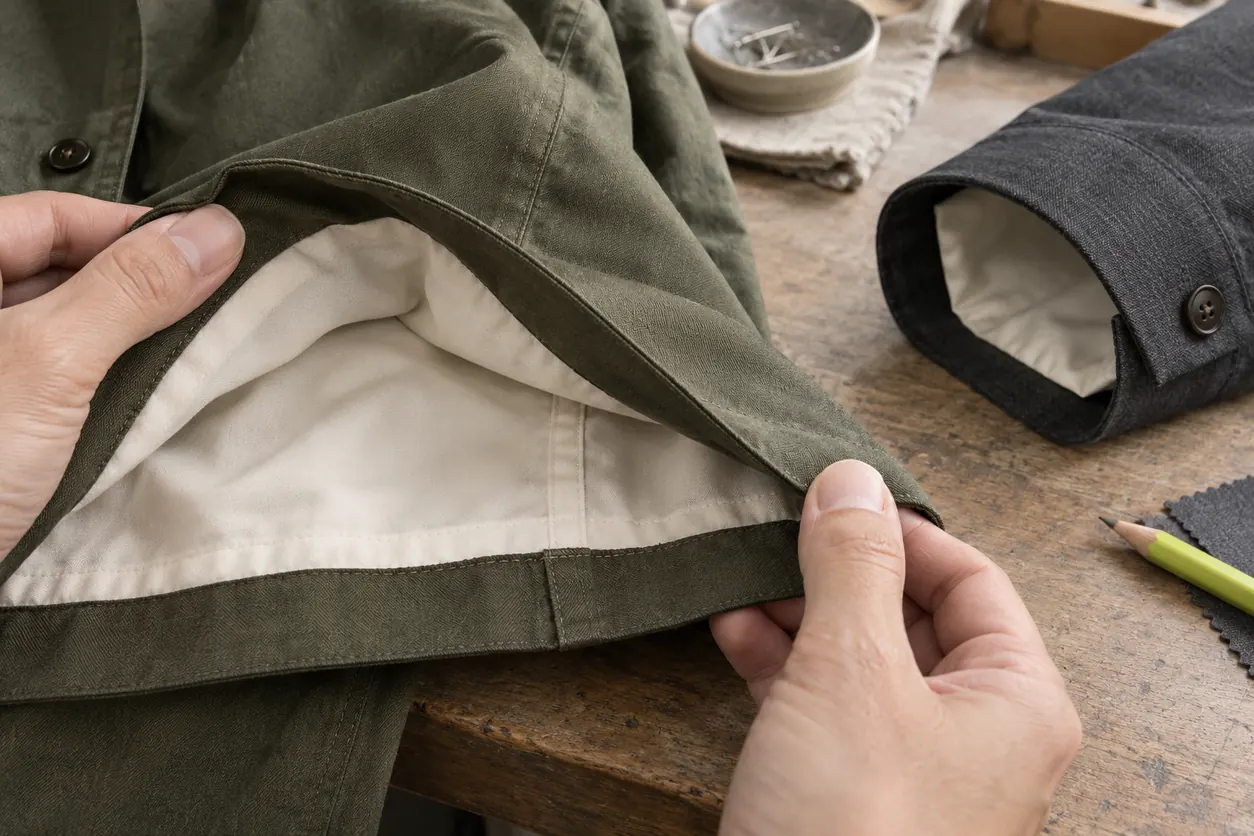
The named garments and six illustrations below are conceptual development examples. They are not Athletic Rush stock, actual customer orders or measured test results.
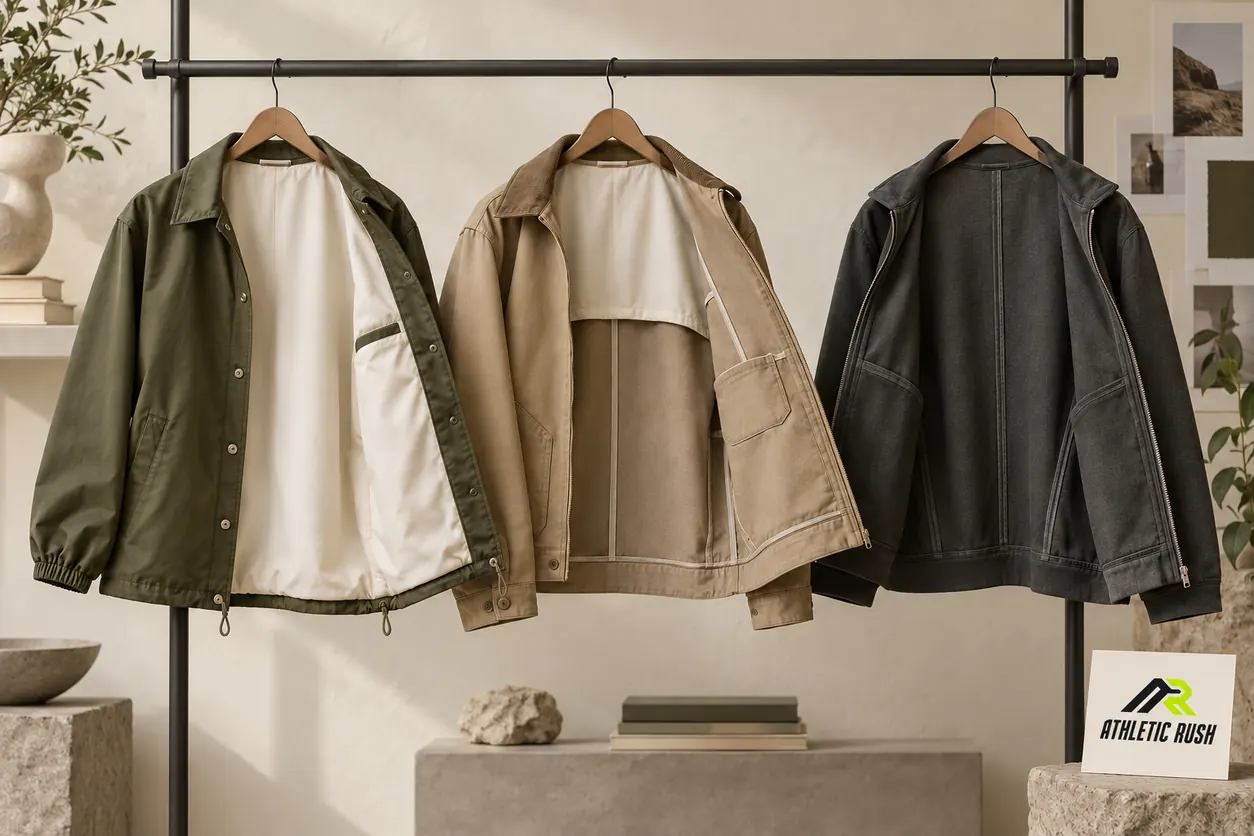
Decide the coverage before choosing the cloth
A lining is the inner layer presented toward the wearer or their clothing. It is not automatically the same as the shell, pocket bag, facing, structural support or insulation. Keep those parts separate in the brief, even when a maker proposes using one fabric for several roles.
A facing finishes a particular opening or edge; it does not mean the whole jacket is lined. Supporting interlinings also serve a different purpose. For example, Vlieseline's sew-in interlining range identifies applications in jacket fronts, collars and pocket areas. That is a component-support decision, not evidence of what the wearer-facing lining will feel like.
If insulation is proposed between the outer material and lining, record it as an additional component. Do not assume every lined jacket contains insulation, or that any lining gives a particular temperature rating.
Full, partial and unlined are coverage descriptions
For a proposed fully lined jacket, specify the lined body and sleeve areas on an inside sketch. Confirm any exceptions and how the lining meets the front, neck, hem and cuffs.
For a partially lined jacket, identify exactly which areas are covered. An upper-back section, sleeves only, or body sections with another sleeve material describe different proposals. “Half lined” alone leaves too much open to interpretation.
For an unlined jacket, inspect the exposed inside construction. Removing lining does not remove the need to define seam finishing, facing edges, pocket bags and the surface that touches an underlayer. A clean outside photograph cannot show those details.
| Coverage proposal | What to define in the brief | Useful inside view or wearer check |
|---|---|---|
| Full body and sleeve lining | Material in each area, attachment and opening finishes | Open jacket, sleeve interior, hem and cuff connections |
| Partial body with lined sleeves | Exact covered areas and every transition to exposed shell | Upper-back coverage, lower-body finish and sleeve entry |
| Body lining with a different sleeve material | Both material references and their colour relationship | Body feel plus dressing over the intended long sleeve |
| Unlined body and sleeves | Exposed seam, facing and pocket-bag finishing | Reverse view and contact with the intended underlayer |
This table is a specification aid. It does not rank coverage options by comfort, weight or price.
Use two named briefs to make the choice concrete
Transit Zip is a charcoal short zip jacket intended to be worn over a cream long-sleeve tee. The buyer wants a consistent inner appearance and an easy dressing routine. The starting proposal is body and sleeve lining, with an identified smooth woven sleeve candidate.
Studio Work is a sand work-style jacket with a roomy outline, worn mainly over an olive tee. The buyer wants the lower inside construction visible as part of the design. The starting proposal is an upper-back lining with carefully finished exposed lower-body seams; sleeve coverage remains a separate decision.
These are hypothetical briefs. Neither construction is universally better. They help the buyer explain why a lining is being considered and what must remain visible in a revision.
If the Studio Work buyer later requests a contrasting fully lined interior, treat that as a changed construction proposal. Review the resulting appearance, fit, complete garment bulk and quotation scope rather than approving it solely from a new swatch.
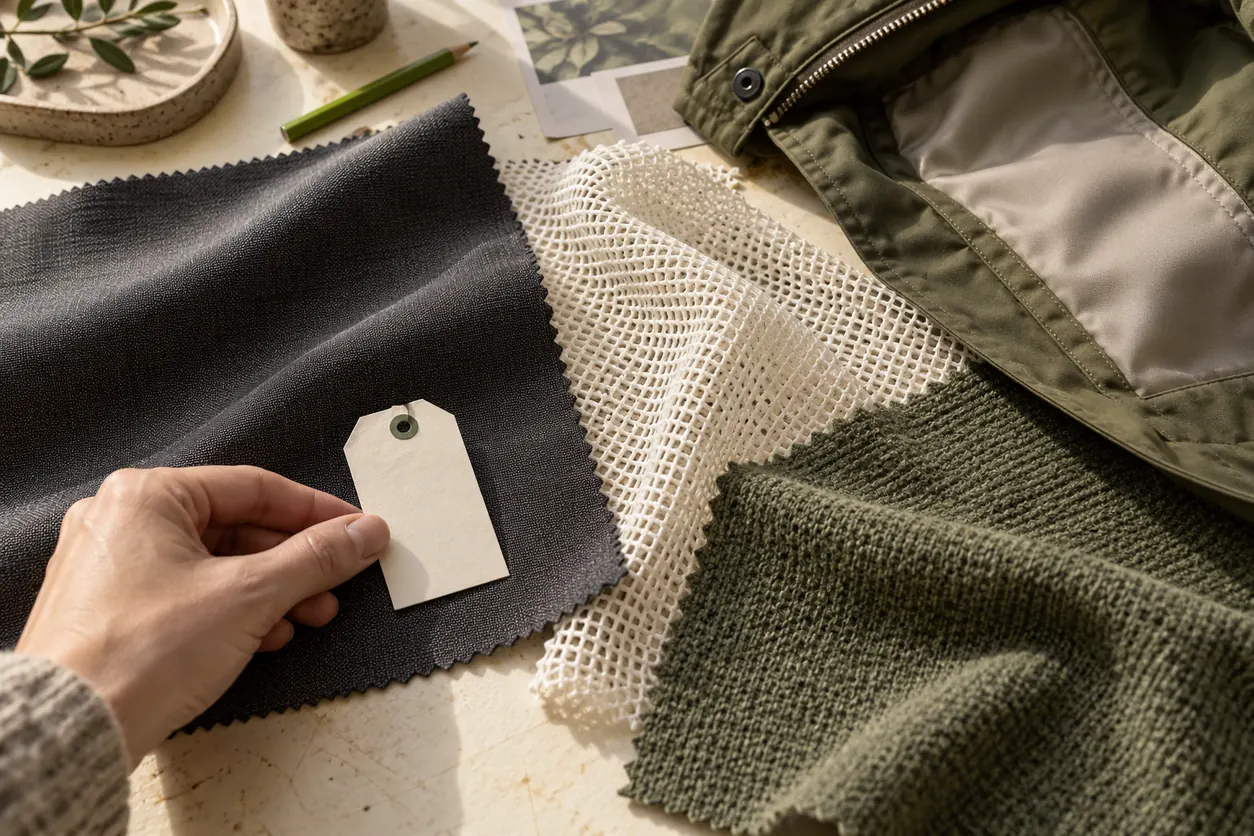
Select an identified material, then test the relevant interaction
Ask for the candidate's material reference, fibre composition, fabric construction, finish, colour and intended placement. “Polyester lining,” “mesh lining” and “soft lining” each leave important details unspecified.
Polyester and cupro describe fibre routes. Mesh describes an open construction; satin describes a weave rather than a fibre. A lining can therefore need more than one of these terms to identify it. Request a supplier reference or specification rather than interpreting appearance as proof of composition.
The exact fabric matters. A fibre category does not establish the behaviour of every finished lining made from it, and a material swatch does not represent a completed jacket.
Body feel and sleeve entry are different questions
For the body, place a candidate against the intended underlayer and inspect the feel, surface appearance, drape and visible colour. Consider how it sits behind the open front and whether it supports the chosen inside-pocket presentation.
For sleeves, review dressing and removal with the intended shirt, tee or hoodie. Observe whether the underlayer bunches, catches or is pulled out of position. Then review reach and sitting in the closed jacket where relevant.
A soft textured candidate may be attractive for the body but need a separate sleeve discussion. A smooth candidate may be worth trying in sleeves without deciding that it must cover the entire body. Write the placement before comparing proposals.
As a named material example, Asahi Kasei describes Bemberg cupro as having a smooth texture and moisture absorption/release properties, with lining among its applications. Its lining information discusses smoothness and moisture management. These are the producer's descriptions of its material, not results for an Athletic Rush jacket or a reason to transfer the same claims to every cupro, rayon or smooth lining.
If a branded material is requested, confirm the exact proposed supply and supporting identity. This example does not state that Athletic Rush currently stocks that material.
Inspect mesh as a construction, not a comfort promise
An open mesh proposal makes its holes visible, but those holes alone do not establish the comfort or airflow of the complete jacket. The shell, other layers, coverage, fit and wearing conditions are part of the product.
On the physical sample, look at mesh around joins, openings and areas that may contact trims or pocket contents. Observe snagging or interference during the intended routine if it occurs; do not claim durability from appearance alone.
Similarly, a brushed or fleece-like lining can change the design direction and the space occupied inside the garment. Review the actual candidate with the intended layers. Avoid attaching an unsupported climate range or thermal performance claim to a visual texture.
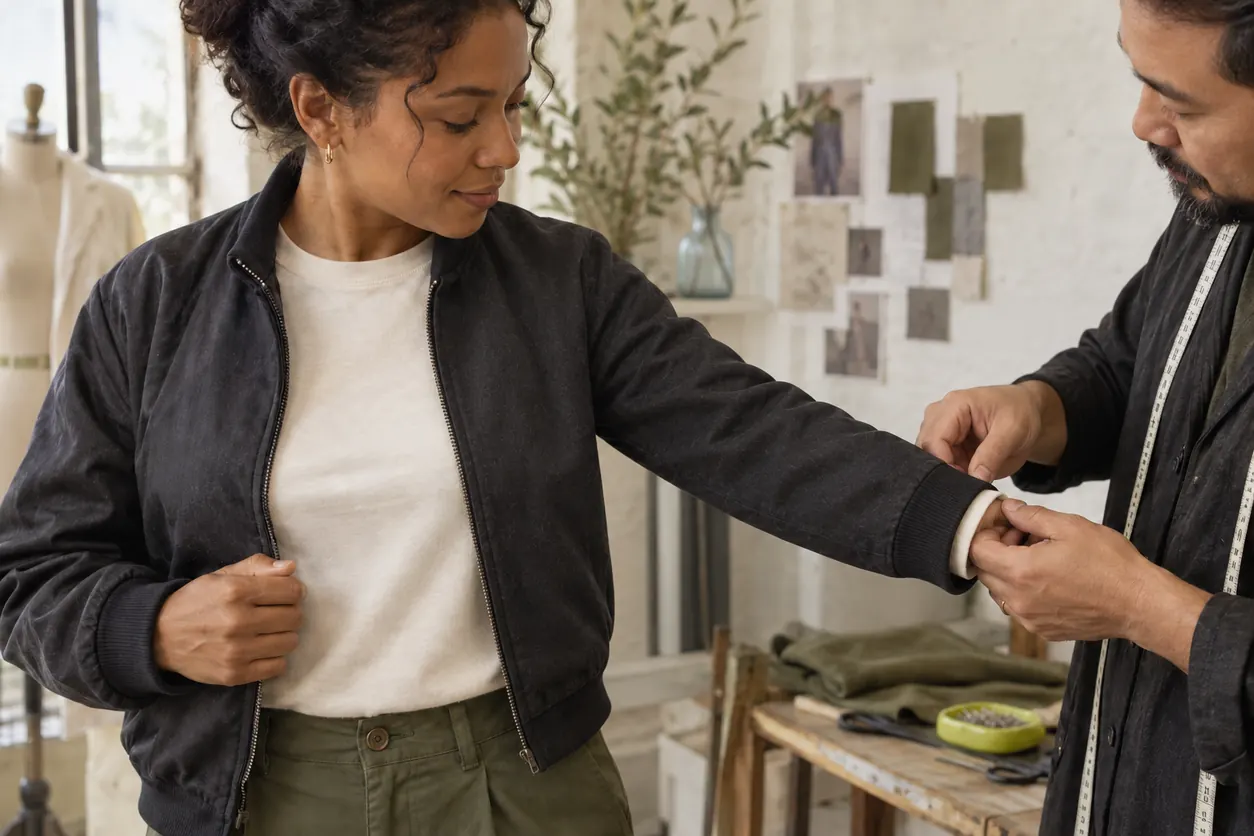
Keep the comparison honest
If you are comparing two lining materials, ask which other parts of the proposal remain the same: shell, pattern, size, coverage, sleeve material, pockets and care condition. Identify any differences before attributing a worn result to the lining.
A tee under one sample and a bulky hoodie under another do not give a simple lining-only comparison. Nor does a full body-and-sleeve lining versus an unlined jacket isolate the properties of one cloth. You can compare both complete proposals, but describe that comparison accurately.
For Transit Zip, a useful review might retain the accepted shell, size and tee reference while comparing two identified sleeve-lining candidates. If the supplier also changes the sleeve pattern, record that revision. It may improve the garment, but it changes what the comparison can establish.
Choose colour on the assembled interior
A matching lining, contrasting body lining and separate sleeve colour can all be design proposals. Check the chosen colour next to the shell, facings, zip tape, pocket opening and label area in the opened jacket.
Look at the front both open and closed, and inspect any lining that becomes visible at the cuff or hem. Decide whether that visibility belongs to the design or requires correction. A swatch approval does not automatically approve every exposed edge.
For a pale shell, inspect the proposed lining through the actual shell as well as from the inside. Record any visible colour or pocket outline under the agreed viewing conditions. Do not claim opacity or colourfastness merely because one studio view looks clean.
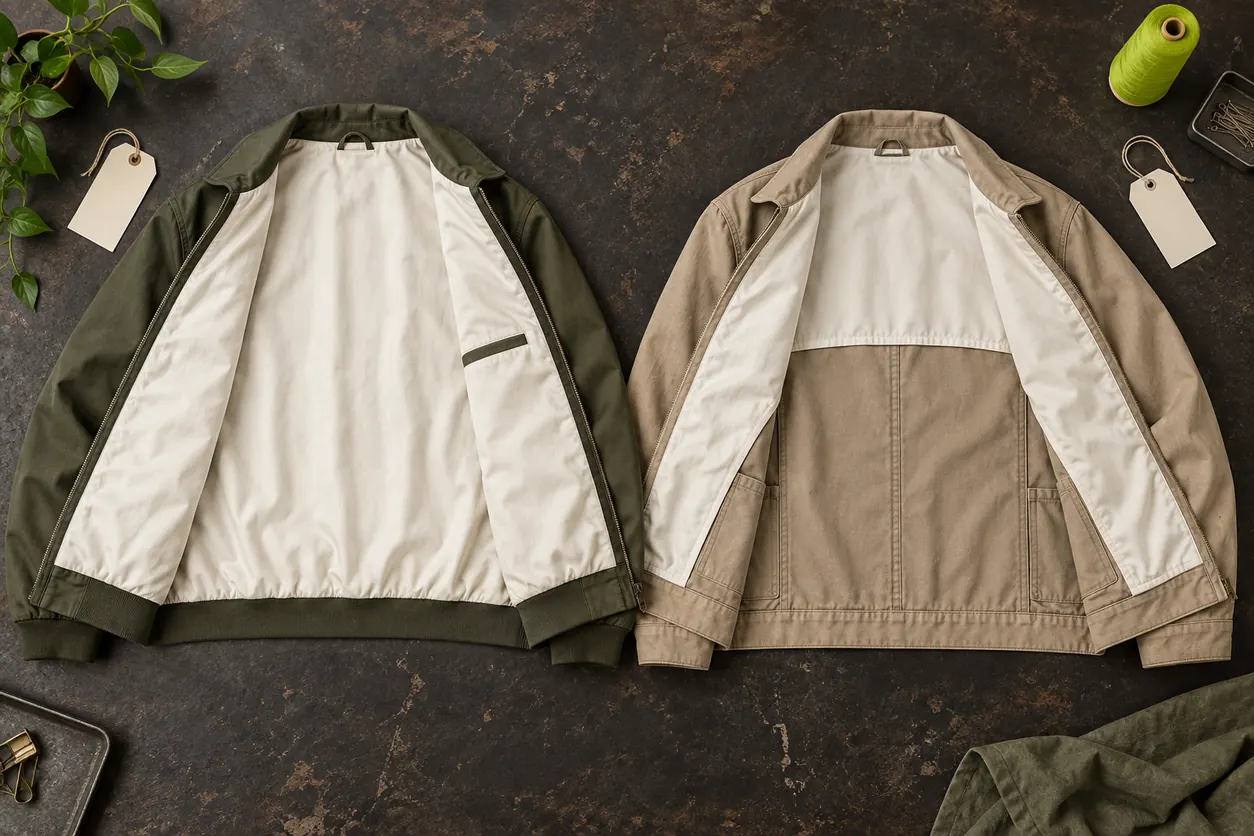
Approve the assembly through a repeatable inside-to-worn review
The lining needs to work with the shell and the garment pattern. Inspect it as an assembled layer rather than adding a standard amount of extra cloth or a universal hem gap.
A maker may use shaping, folds or construction allowances to accommodate the design. Ask them to identify their proposed arrangement and review its result. A visible fold is not automatically a defect; equally, a tidy flatlay does not prove sufficient movement room.
Use the intended wearer range and underlayer when reviewing fit. Keep the existing garment measurement record alongside the worn observations. If the jacket pulls during movement, do not assume the lining is the sole cause without examining the pattern and assembly.
Follow the same inspection route each time
- Identify the sample. Record style, size, shell and lining references, colour, revision and condition.
- Open the jacket. Compare body and sleeve coverage against the inside sketch. Check facings, labels, pockets and material transitions.
- Review the connections. Look at the neck, front, armhole, cuff and hem areas. Note hanging, twisting, visible raw edges or unwanted lining exposure.
- Dress and remove it. Use the intended underlayer and observe sleeve entry, bunching and contact with closures.
- Wear it in relevant positions. Close the front, reach forward and sit if these actions belong to the brief. Inspect where the lining or shell moves and pulls.
- Review the agreed care condition. Repeat the relevant views after care, with the same identity and clearly recorded process.
Do not pull hard on a seam to turn a visual review into an improvised strength test. If attachment strength or another technical property is required, agree the appropriate evidence and criteria separately.
Pay attention to the parts hidden by a good-looking lining
A lining can conceal the construction beneath it. Ask how inside pockets are supported and attached, how labels meet the wearer-facing surface, and how the lining is connected around closures. Review accessible details without damaging the sample.
An inside pocket attached to the lining raises a different question from a pocket supported elsewhere in the construction. Specify its location, intended contents and support arrangement. Then review the complete pocket in use. A neat pocket opening is not capacity or attachment-strength evidence.
Decoration also needs a sequence discussion. Ask whether the intended print or embroidery is completed before lining assembly, and what will be visible on the inside. Confirm the actual proposed construction rather than assuming every jacket can be decorated in the same way after sewing.
The buttons and snaps guide explains why fastener action and attachment evidence should remain separate. Adding a lining does not remove those closure questions.
Make care compatibility an assembly decision
Record the proposed care method for the complete jacket, including shell, lining, supporting parts, decoration and trims. Do not approve the jacket's care instructions from the lining supplier's fabric advice alone.
After the agreed process, inspect the relationship between the layers. Look for changed hem or cuff exposure, pulling around joins, puckering, twisting or a different hang. Compare the same views and measurement references, and record what actually changed.
The public summary of AATCC TM150 covers garment length and width changes after home laundering and notes a limitation for certain stretch fabrics. That scope does not establish abrasion resistance, seam strength, colourfastness or all aspects of lining appearance. Agree the relevant checks for the product instead of treating a dimensional-change result as complete lining approval.
A useful care record includes sample identity, chosen process, number of cycles, before/after condition and observations. Do not invent a universal acceptable shrinkage percentage or infer the cause of a distorted hem from a photograph.
Send an observation that the maker can investigate
| Observed condition | Clear revision comment | Evidence to review next |
|---|---|---|
| Lining is visible below the front hem when worn | Keep the accepted outer hem; investigate the lining pattern and connection on this revision | Standing, seated and inside hem views on the revised sample |
| Tee sleeve bunches during jacket removal | Retain the accepted body coverage; review sleeve lining and assembly against the same tee | Dressing/removal observation and sleeve interior |
| Inside pocket pulls the lining with intended contents | Review the specified pocket support and attachment without changing its accepted opening location | Reverse construction view and worn carrying check |
| Partial-lining edge looks unfinished | Keep the approved covered area; revise the transition finish | Close inside view and contact with the intended underlayer |
| Hem hangs differently after agreed care | Compare recorded layers, joins and measurements before deciding the correction | Traceable before/after record using the same care process |
These comments name a condition and retained features. They leave room for the maker to diagnose the cause; they are not technical recipes or reported results from actual orders.

Retain a compact lining approval record
Attach the inside sketch and material references to the accepted sample record. State body and sleeve coverage, any different materials, colour, connections, inside pockets, intended underlayers and care evidence.
Separate “material accepted for development” from “complete lining assembly accepted for production.” If a material, coverage or supporting component changes, identify which checks need repeating. Link the final approval to the actual sample revision and order specification.
For Studio Work, the record should show where partial lining ends and how the remaining inside is finished. For Transit Zip, it should identify the body and sleeve candidates and the long-sleeve tee used during review. “Same lining as before” is useful only if the earlier reference and construction remain identifiable.
Questions buyers ask about jacket lining
Is full lining better than partial lining?
It depends on the intended inner appearance, coverage and wearing routine. Full lining and partial lining are construction choices, not quality grades. Specify the covered areas and inspect the complete garment, including exposed finishes on a partial or unlined proposal.
Can the body and sleeve use different linings?
Yes, the design brief can propose different materials or coverage. Identify each candidate and its placement, then review colour, joins, dressing and movement together. Approval of a body swatch alone does not settle the sleeve construction.
Does a mesh lining make a jacket breathable?
An open mesh structure alone does not establish the performance or comfort of the finished jacket. Review the complete layered construction and intended use. Any specific product claim needs suitable supporting evidence.
Can changing the lining fix a tight jacket?
It may be one part of a revision, but do not assume it is the cause. Inspect the pattern, shell, lining, connections, size and intended underlayer. Record the pulling or restriction precisely, then review the identified revised garment.
Bring the inside brief to the sample discussion
The next useful step is a short lining brief with an inside sketch, candidate references and the actual wearing routine. Settle coverage, assess material interactions, and approve the complete assembly with traceable observations.
Athletic Rush develops custom apparel from Sialkot, Pakistan. Explore our streetwear jacket development page, then send your jacket reference, intended underlayer and lining questions to kamran@athleticrush.co or WhatsApp +923279008337.