 Sialkot, Pakistan
Develop a lightweight streetwear jacket by defining how it will be worn, what the complete garment must feel like, and which functions need evidence. Choose the silhouette, intended underlayer and construction together. A low fabric mass alone does not establish a light finished jacket, comfortable layering or protection from rain.
For a clothing brand, the first useful question is not “Which thin fabric is best?” It is: what should this jacket do in the customer's outfit, and what will we inspect before committing to production? A short coach-style layer over a tee and a roomy zip jacket over a hoodie can both be described as lightweight. They need different development briefs.
This guide follows the complete jacket through three decisions: its role in the outfit, the balance of material and built details, and an identified sample review. The garment names and illustrations are conceptual development examples, not Athletic Rush inventory, tested performance or fixed product specifications.

1. Define the jacket's role before selecting a fabric
Write a wearing scenario that the maker can act on. Include the intended wearer range, underlayer, opening routine, length direction and the way the jacket will be carried when removed. State whether weather protection is actually part of the product brief.
“Summer jacket” is too broad on its own. An evening layer worn over a tee, a jacket worn through a commute, and a compact piece carried in a tote describe different situations. Record the intended conditions in plain language; do not attach a universal temperature range without evidence for the proposed product.
Use a named example to make the brief concrete
Consider these two illustrative starting points:
- Urban Coach: an olive woven jacket with a pointed collar, straight hem and snap front, usually worn over a cream T-shirt. The buyer wants a clean outline both open and closed, useful lower pockets and a light complete garment.
- Layered Zip: a cream woven zip jacket intended to sit over an olive hoodie. The buyer wants room through the upper arm and body without losing the chosen short outline. The hoodie's hood stays outside the jacket collar.
These are design proposals, not rules for their colours or closure types. The briefs make it possible to discuss a material and a pattern in relation to a real outfit. If the intended product must serve both tee and hoodie layering, review both situations rather than assuming the thinner layer proves the thicker one.
Decide which silhouette features matter
A coach-style direction often invites a collar, front fasteners and a relatively straight outline. A bomber-style direction may use a zip front and ribbed edges. A hooded shell direction adds a different neck and hood relationship. Describe the actual proposed details instead of relying on a style name to communicate all of them.
Compare the front opening, collar or hood, shoulder line, sleeve shape, cuffs and hem as a connected design. A ribbed hem and a straight hem do not present the same outline on the same wearer. Keep the intended appearance visible in the brief so that reducing material or changing a component does not quietly change the product.
| Design direction | Buyer decision to settle early | Sample situation worth seeing |
|---|---|---|
| Coach-style layer over a tee | Open-front outline, collar, overlap and straight hem | Front open and closed over the intended tee |
| Short bomber-style layer | Relationship between body volume and ribbed edges | Standing and seated, with cuffs in their intended position |
| Zip jacket over a hoodie | Neck opening, shoulder and upper-arm room | Hoodie underneath, front operated and arms moved |
| Jacket intended to travel in a bag | Complete garment bulk and removal routine | Fold, carry, unfold and wear the identified sample |
The table is a way to ask better questions. It does not establish that any one style is lighter, more comfortable or suitable for a particular climate.
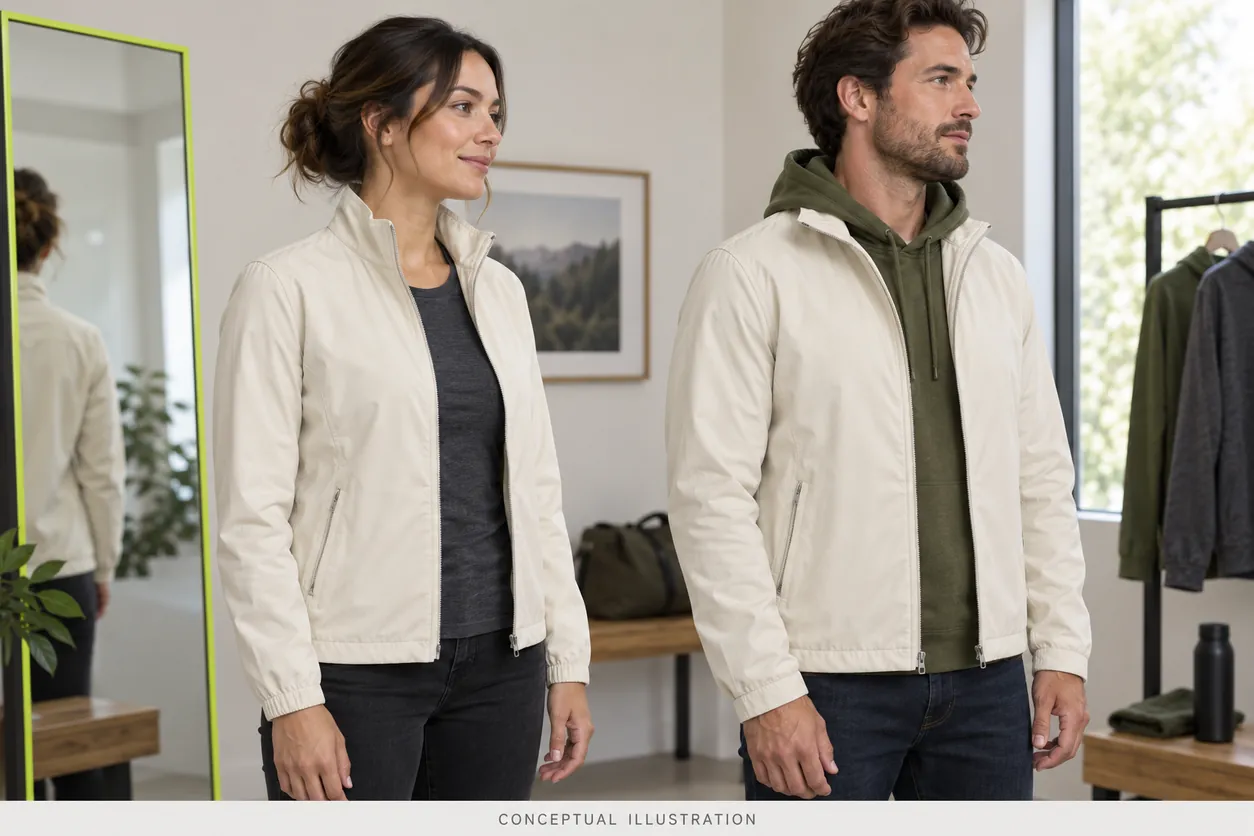
Approve layering through the actual sample
Give the maker an underlayer reference or a clear description of what the wearer will use. Review the jacket with that layer rather than filling the fit brief with “oversized” alone.
Look at the shoulder, upper arm, armhole, chest, neck opening and hem. Close the front if that is part of the wearing routine. Ask the wearer to reach forward, sit and raise their arms as relevant to the product. Record where the garment pulls, lifts or interferes with the layer beneath.
If the cream jacket closes over a tee but strains over the intended hoodie, “use lighter fabric” does not fully describe the problem. A useful comment is: “Layered Zip, sample B: the front pulls across the upper chest when closed over the specified hoodie. Keep the accepted hem length and investigate the pattern and assembly needed for this layering situation.”
Do not assign a universal amount of ease from the style name. A flat measurement record and a worn review answer different questions; retain both with the sample identity. The women's hoodie fit guide explains that separation for an underlayer.
2. Develop the complete jacket, including the hidden parts
Ask for an identified material proposal with its fibre composition, construction, mass per unit area and finish. Then review that material in the actual jacket design. Do not let “nylon,” “cotton” or “lightweight woven” stand in for a complete fabric description.
Our overshirt fabric guide covers swatch identity and material comparison. Here the decision goes further: the jacket's area of fabric, inside construction, pocket bags, facings, closures, cuffs and any other built parts must be considered together.
Keep fabric mass and garment mass separate
Fabric mass per unit area describes a material, commonly recorded in grams per square metre. Complete garment mass describes an assembled piece in an identified size and revision. Their units and their meaning differ.
The public scope of ASTM D3776/D3776M concerns fabric mass per unit area. It should not be presented as a complete-jacket performance test.
If low finished mass is an important requirement, agree how the complete sample will be recorded and compared, including size, revision and relevant measurement conditions. Retain the material reference separately. Avoid comparing a small unlined sample with a larger garment containing extra components and describing the difference as a fabric-only result.
A larger fabric area, additional layers or different trims can change the complete proposal. That does not mean they are unnecessary. The buyer's task is to decide which features earn their place in this jacket and which can be simplified without losing an accepted function.
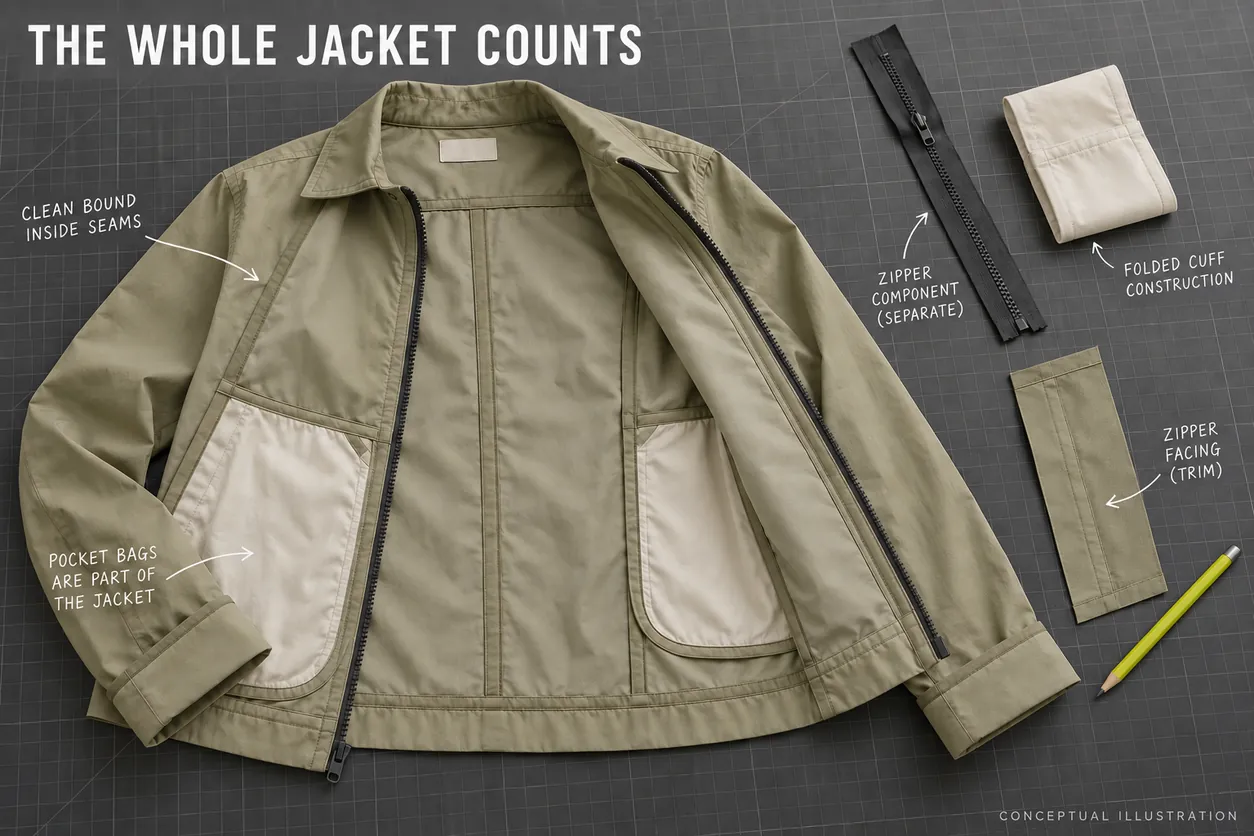
Review the tradeoffs in construction
Unlined is a construction description, not an automatic quality grade. It makes the inside finish a visible part of the garment proposal. Ask how seams, facing edges and pocket bags will be finished and inspect them from the inside.
If a lining is proposed, identify it and its role in the complete garment before treating the sample as comparable with an unlined version. Lining material selection needs its own review; it cannot be settled by the outer fabric name.
Watch the folded areas. A light body material still has to work at a cuff, collar, front edge and pocket opening. Inspect the built detail rather than asking for all supporting materials to be removed in pursuit of thinness.
For Urban Coach, compare the collar's intended outline and front overlap with the proposed snap assembly in place. For Layered Zip, look at the zip front, facing and hem together. A closure or support change may alter how the front lies; review the revision on the jacket.
The buttons versus snaps guide explains why the visible closure face is only one part of an approval. A maker should identify the complete proposed system and its intended foundation.
Make pocket use part of the sample review
State what the lower pockets are expected to hold and how the wearer will access them. Use ordinary intended contents in the sample review, such as the specified phone or a small key set. Identify the situation instead of asking for “strong pockets” with no definition.
Inspect the opening angle, entry room, pocket bag, attachment and location. Compare the empty jacket with the same jacket carrying its intended contents. Note changes in outline, local pulling, swinging or awkward access.
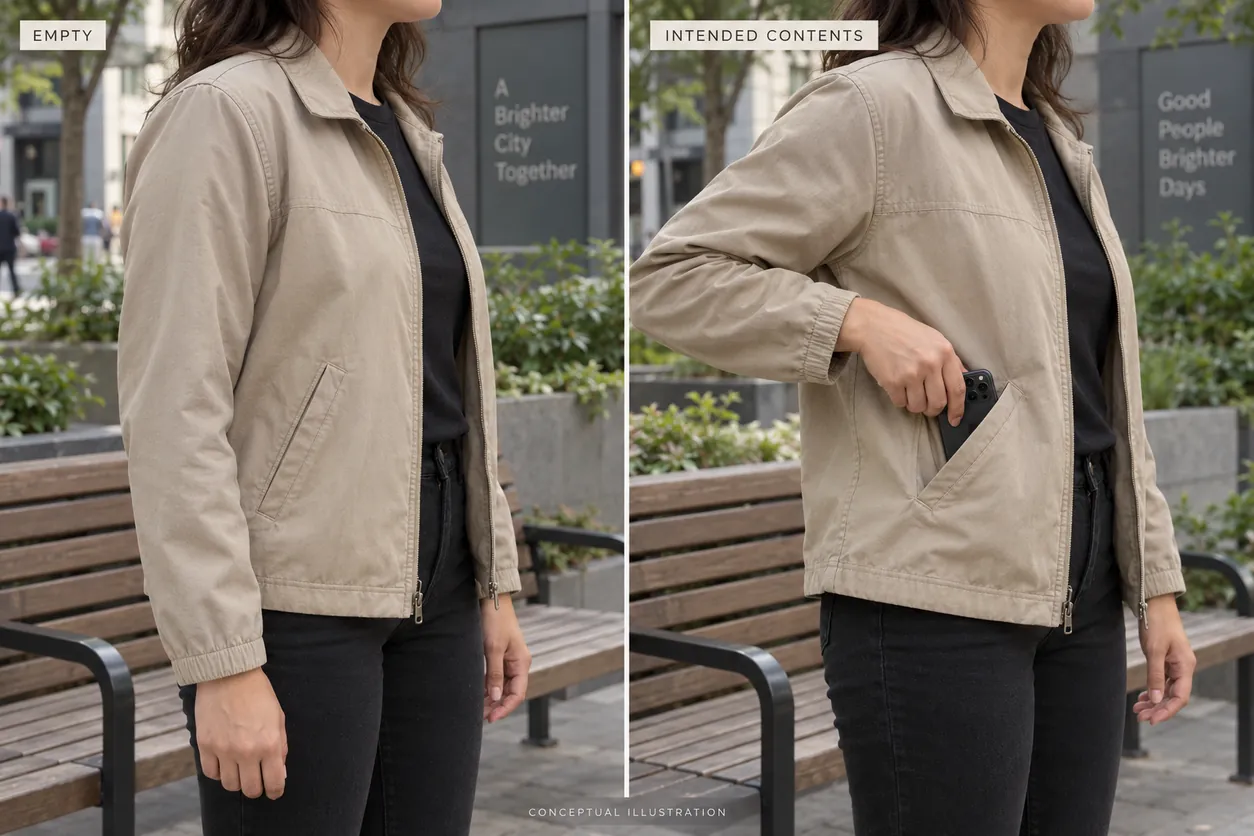
This is an observation of an identified sample, not a quantified durability or retention result. If the brief needs formal evidence, agree the property, method, assembly and acceptance criteria with the maker and an appropriate testing provider.
For example: “Urban Coach, lower right pocket: the front hem changes direction when the specified phone is carried. Retain the accepted opening angle, investigate the bag and attachment arrangement, and show the revised sample empty and carrying the same phone.”
That comment describes the problem and preserves what is already accepted. It does not assume that simply adding thicker fabric will solve it.
Check portability as a complete-garment requirement
If the jacket should fit into a customer's everyday bag, review the actual garment with that bag or an identified space reference. Include closures, cuffs and all other parts. A folded outer-fabric swatch cannot establish the bulk of the jacket.
Have the wearer remove, fold, carry, unfold and put on the sample in the proposed routine. Observe the resulting appearance and whether operating the garment becomes awkward. Keep comments specific to that sample and routine.
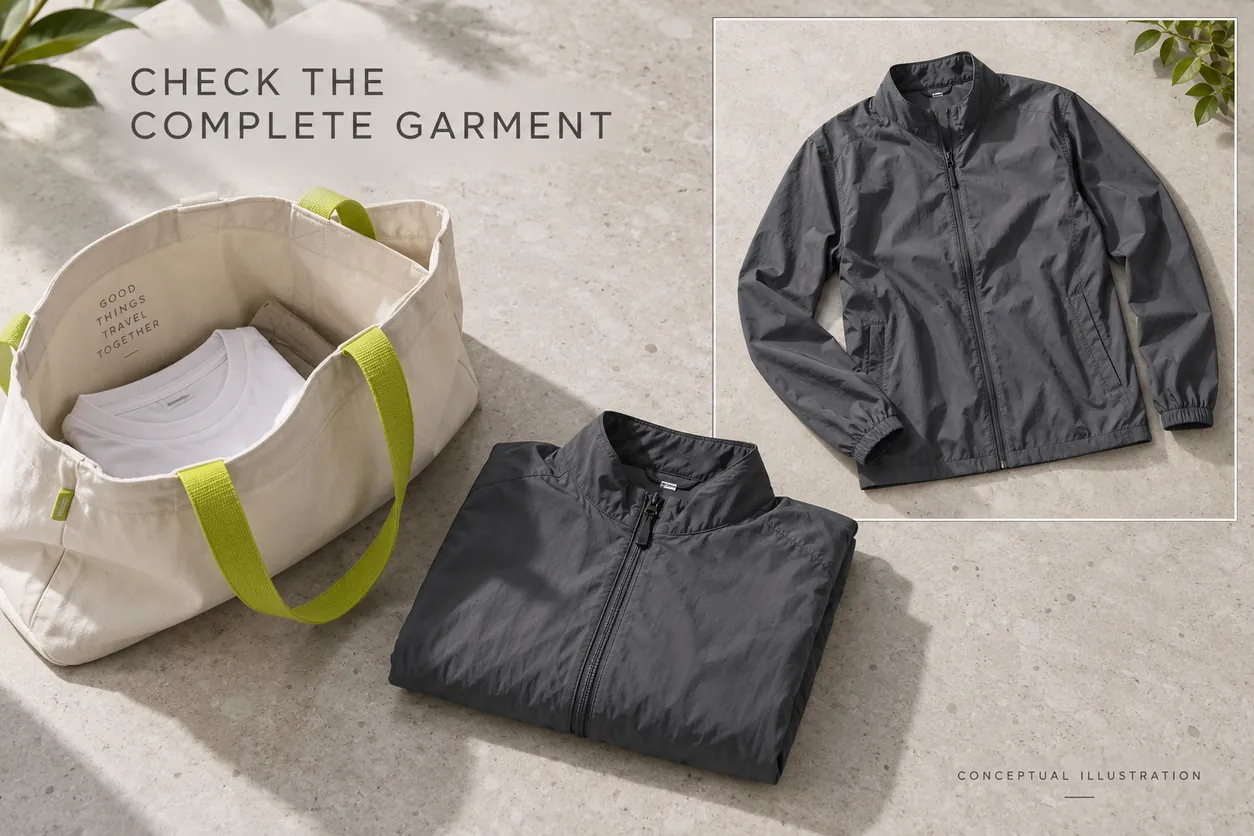
Do not describe a product as packable solely because a conceptual image shows a folded jacket. If “packable” will be a product claim, define what the claim means for the exact garment and retain suitable supporting evidence.
3. Separate sample observations from product claims
A sample review can show whether the brief is being met in the observed situations. It cannot prove every property customers might associate with a lightweight jacket.
Set up the review with the sample revision, material and trim references, intended underlayer and agreed appearance reference. Photograph the complete front, back and inside as needed, then focus on the details that still require a decision.
| Review question | Practical observation to record | Follow-up when unresolved |
|---|---|---|
| Does the silhouette match the intended outfit? | Open and closed front, side profile, hem with intended trousers | Identify the pattern or assembly revision while preserving accepted features |
| Does the chosen layer fit underneath? | Closure, upper-arm space and relevant movement | Reassess the complete fit proposal with the same underlayer |
| Do the pockets suit the wearing routine? | Empty and carrying identified contents, entry and outline | Review pocket placement, bag and attachment together |
| Is the inside finish suitable? | Seam, facing and pocket-bag presentation on the built sample | Identify construction changes and inspect the revised inside |
| Is it practical to carry when removed? | Complete sample folded and used with the intended bag | Review bulk, handling and the unfolded appearance |
| Is a performance claim supported? | Evidence tied to the stated property and actual proposal | Agree the appropriate method, conditions and acceptance criteria |
Be precise about weather language
“Lightweight,” “water-repellent” and “waterproof” do not answer the same question. Do not infer rain protection from a low fabric mass, a smooth surface, a coating description or a water-beading photograph.
AATCC TM22's public summary describes resistance to surface wetting by water. AATCC's spray apparatus explanation explicitly separates that observation from water penetration through fabric. A spray-repellency result therefore does not establish complete-jacket rain protection.
If protection is required, state the property and expected conditions, then agree appropriate evidence for the proposed material and garment construction. Check which seams, openings and components the evidence covers. Do not write a technical rating, waterproof claim or temperature promise into the product description without a basis for that exact proposal.
The same care applies to “breathable,” “windproof” and similar language. Ask what has been assessed and which product it describes. A wearer's brief impression and a documented test result should be recorded as different kinds of evidence.
Include care and decoration in the final proposal
Agree the proposed care route for the complete jacket and trims. Keep identified initial and after-care records for the properties under review. Look again at the outline, dimensions, front operation, pockets and inside finish where relevant to the brief.
An initial sample that presents well does not settle its later condition. Record changes and ask for a traceable revision or further evidence rather than inventing a passing result.
Show decoration at its intended location and final design direction. A mark placed across a seam, fold or pocket introduces a different decision from a mark shown on a flat artwork sheet. Review the decorated garment before treating the undecorated sample as final.
Any care or performance evidence should identify the proposal it covers. If material, finish, closure, decoration or construction changes, ask which previous conclusions still apply and which need renewed review.
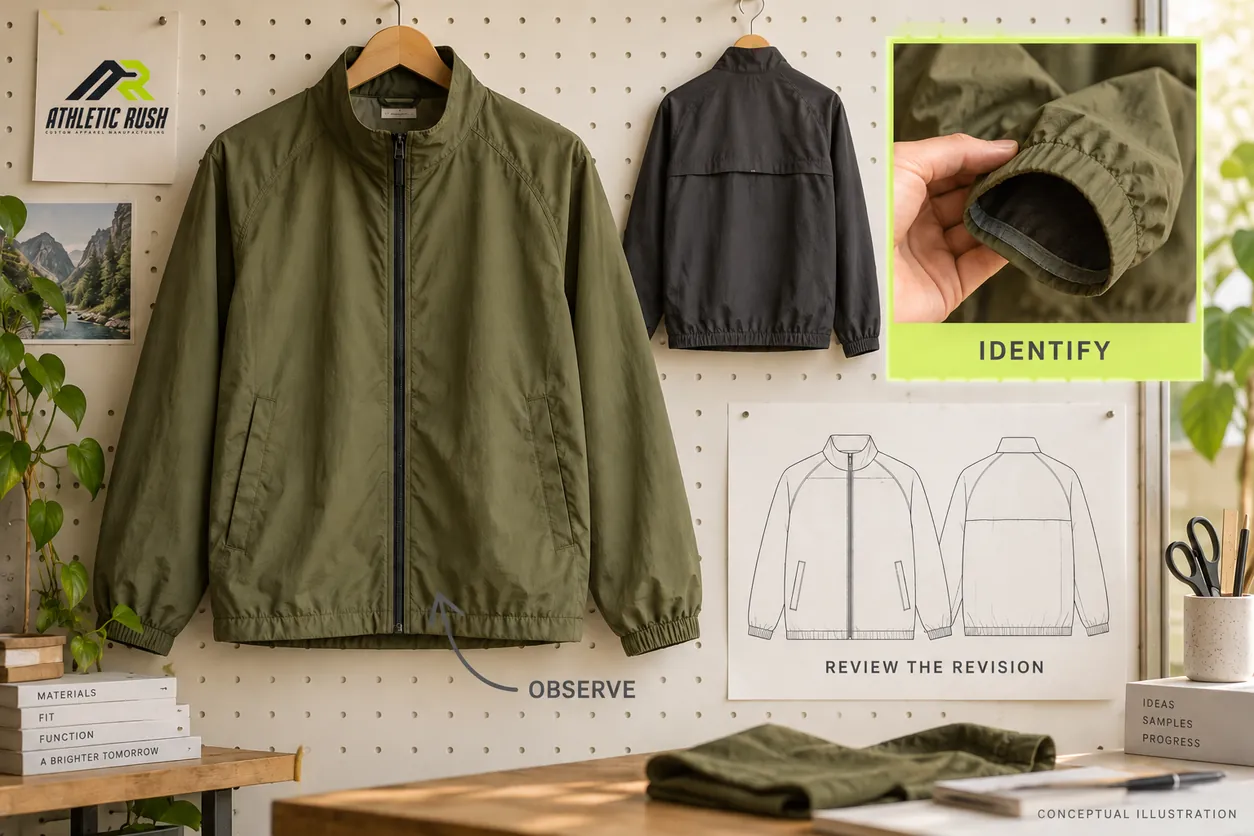
Close the sample review with a specific decision
Avoid “looks good, proceed” when fit, components or evidence remain open. Record which appearance, construction and wearing situations are accepted, which issue remains unresolved, and the identified sample revision the maker should reproduce.
A useful final record contains the garment drawings and measurement references, outer material and any lining, trims and supporting parts, pocket construction, decoration, intended underlayer, care direction, accepted sample and relevant evidence.
If a change is proposed to reduce bulk or cost, name the component being changed and the intended result. Ask for the consequences to be reviewed rather than assuming that an earlier fit or appearance decision survives automatically.
For Layered Zip: “Keep the accepted body length, cream material reference and zip appearance. Please identify the cuff revision intended to reduce bulk, then show the complete revised jacket over the specified hoodie, with the inside finish visible.”
This keeps the development decision clear enough to check. It gives the maker a focused outcome without imposing an unsupported technical recipe.
Lightweight jacket development: buyer questions
Is there a universal fabric weight for a lightweight streetwear jacket?
No single cutoff settles the product brief. Record fabric mass separately from the assembled sample's mass and review the intended wearing and carrying situations. The complete construction matters.
Should a lightweight jacket always be unlined?
No. Compare the identified complete proposals and their intended roles. An unlined jacket still needs an appropriate inside finish, while any lining forms part of the assembly being reviewed.
Can the same jacket be approved over a tee and a hoodie?
It can be developed for both, but review both intended layers on the identified sample. An accepted tee-only review does not establish the hoodie fit.
Does water beading prove that a jacket is waterproof?
No. Surface wetting and water penetration are different evidence questions, and a fabric observation does not establish protection through a complete jacket. Use claims that match the evidence for the proposed product.
Turn the idea into a sample brief
Start with the outfit and wearing routine, shortlist a complete construction, and keep lightness separate from unsupported protection claims. Review the actual jacket with its intended layer, pocket contents and carrying situation. Then record the accepted revision and evidence before bulk production.
Athletic Rush develops custom apparel from Sialkot, Pakistan. Explore our streetwear jacket development page. Send the jacket reference, intended underlayer and sample questions to kamran@athleticrush.co or WhatsApp +923279008337.