 Sialkot, Pakistan
 Worldwide enquiries

To order custom netball uniforms in bulk, define the complete garment range, audience-specific fits, fabric and coverage requirements, position-identification system, artwork, player roster and approval process before production begins. Approve a physical sample and one controlled specification so the supplier has a clear reference for cutting, decoration, personalization, quality control and packing.
This guide is designed for clubs, schools, academies, leagues, teamwear brands, retailers and distributors sourcing a repeatable netball uniform programme—not only a set of attractive mockups.
Start your enquiry: Email kamran@athleticrush.co or message Athletic Rush on WhatsApp. WhatsApp: +92 327 9008337. Include the product list, quantities, delivery destination and the questions you need answered.
1. Define the Complete Netball Programme
Buyer checkpoint: Agree the complete netball programme before requesting a comparable quote.
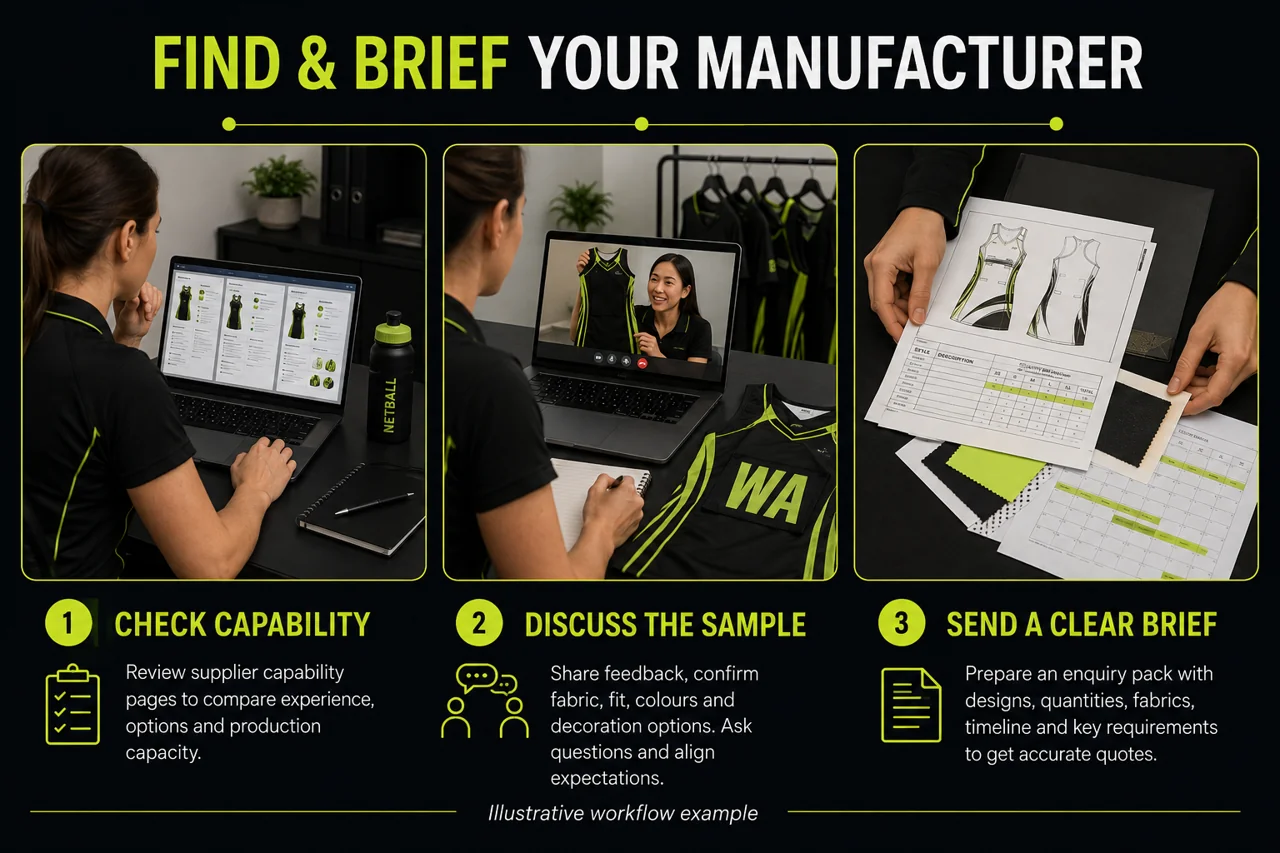
Agree the product range and prepare a clear supplier enquiry. AI-generated educational illustration; not a photograph of actual staff or an approved production sample.
Start the RFQ with a product list rather than the general phrase “netball kit.” A programme may include:
- Match dresses
- Playing tops with skorts or shorts
- Compression shorts or leggings for layering
- Positional bibs or integrated position patches
- Training tops and shorts
- Warm-up jackets, quarter-zips and tracksuits
- Hoodies, bags and supporter products
- Separate home, away or tournament colourways
For each product, state the estimated quantity, fit group, size range, colourway, personalization, intended use, destination and required arrival date. If the club expects replacements or new-player orders later, include reorder requirements in the first brief.
Review the Athletic Rush Teamwear range and custom netball uniform page when deciding which products belong in the programme.
2. Choose the Garment System Before the Artwork
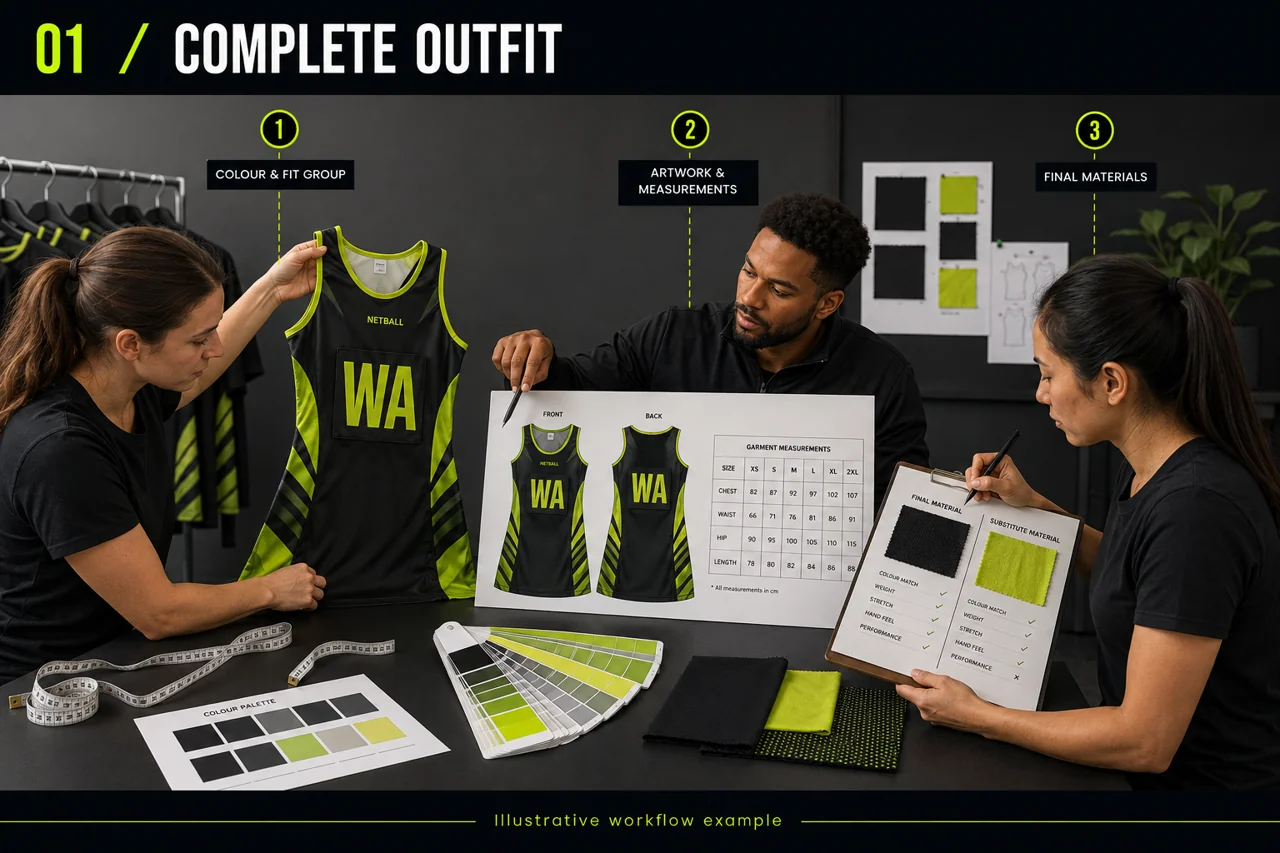
Compare the complete dress or separates system with the agreed specification. AI-generated educational illustration; not a photograph of actual staff or an approved production sample.
The silhouette affects fit, fabric, artwork placement and roster data. Select the uniform system before finalizing graphics.
Netball dresses
A dress creates one coordinated match garment, but its fit must be controlled through bust, waist, hip, torso and finished-length measurements. The sample should be reviewed while running, jumping, reaching, landing and changing direction—not only while standing.
Tops with skorts or shorts
Separates allow players to combine different top and bottom sizes. This can improve ordering flexibility, but the roster must record both sizes separately. Confirm waistband construction, short or skort length, under-short integration and how the top sits during overhead movement.
Underlayers
Compression shorts and leggings require their own fabric, stretch, recovery, opacity and waistband approval. Do not assume that the match-dress material is also suitable for a fitted base layer.
Positional identification
Decide whether position initials will be supplied on separate bibs, removable patches, reversible panels or an integrated garment system. The solution must remain secure, visible and compatible with the competition rules that apply to the team.
3. Develop Women’s and Youth Fits Deliberately
Buyer checkpoint: A size label alone does not establish the correct fit or coverage.
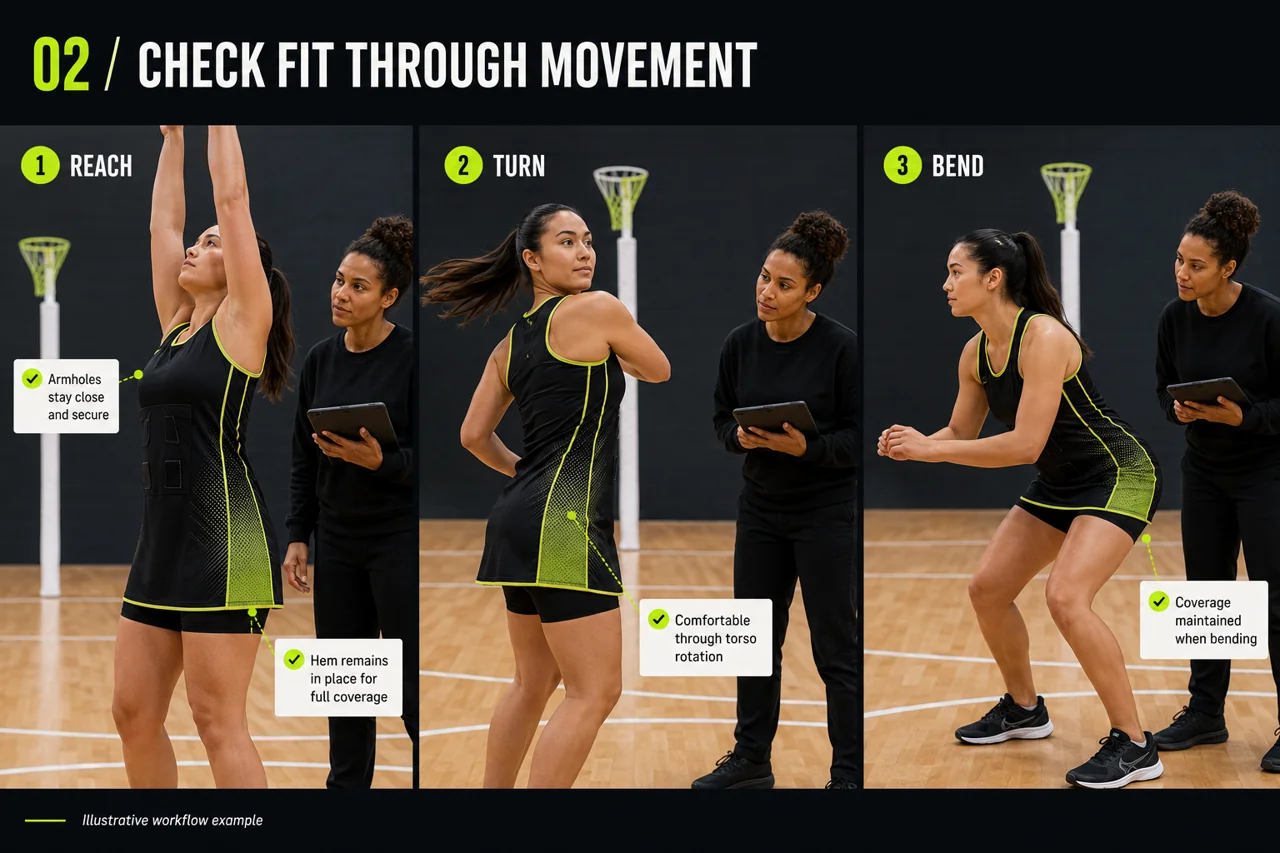
Assess movement and coverage in the appropriate fit group. AI-generated educational illustration; not a photograph of actual staff or an approved production sample.
A netball programme should not treat one adult unisex block as the answer for every player. The product specification may need separate fit blocks for women and youth, with grading appropriate to each group.
Control these measurement areas:
- Bust and chest
- Waist and hip
- Shoulder width
- Armhole depth
- Front and back torso length
- Dress, skort and short length
- Hem sweep
- Rise and thigh room
- Underlayer length
- Waistband relaxed and stretched measurements
A player-facing size guide and a production measurement chart perform different jobs. The first helps the wearer select a size; the second gives the factory measurable sample and bulk targets. Label both clearly and do not merge body measurements with finished-garment dimensions.
Where practical, use a sizing sample set before locking the roster. Record the selected size rather than relying on age, usual retail size or informal descriptions.
4. Specify Fabric by Performance, Not GSM Alone
Buyer checkpoint: Approve opacity, stretch and recovery alongside fabric weight.
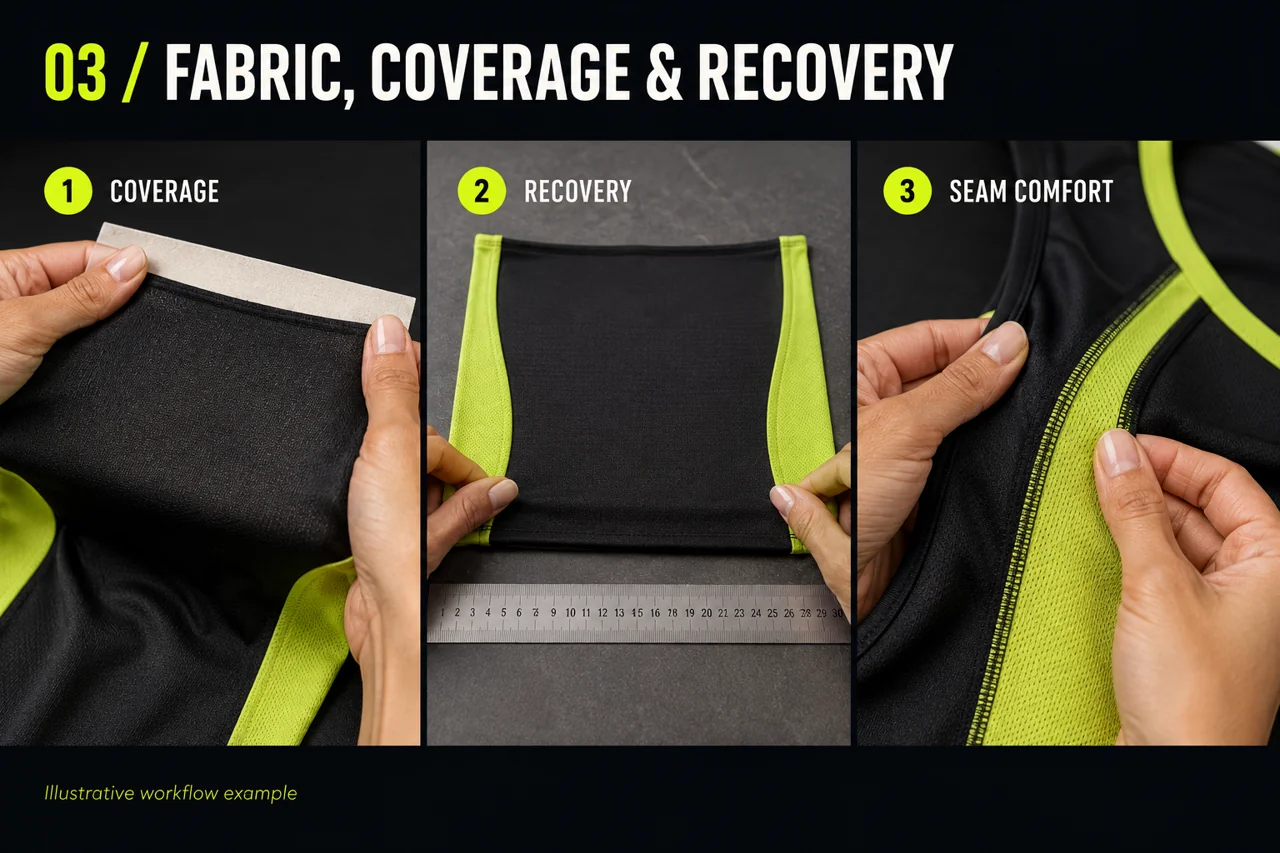
Examine fabric coverage, stretch recovery and comfort on the actual sample. AI-generated educational illustration; not a photograph of actual staff or an approved production sample.
GSM describes fabric weight, but it does not confirm stretch, recovery, opacity, breathability, snag resistance, colour behaviour or comfort. A usable material specification should include fibre composition, knit structure, weight target, stretch direction, recovery, hand feel, opacity, colour requirement and decoration compatibility.
The following ranges shown on the Athletic Rush netball category page can be used as discussion starting points; the actual fabric must be sampled and approved for the specific product.
| Material route | Indicative weight | Typical netball use | Critical approval points |
|---|---|---|---|
| Poly-spandex interlock | 180–220 GSM | Dresses, tops and skorts | Recovery, opacity, drape, print clarity |
| Stretch bird-eye | 150–190 GSM | Breathable match panels | Transparency, snag risk, panel placement |
| Performance jersey | 160–200 GSM | Training tops and dresses | Hand feel, coverage, stretch, decoration |
| Compression knit | 220–260 GSM | Shorts and leggings | Opacity under stretch, recovery, waistband hold |
| Brushed tricot | 220–280 GSM | Warm-ups and tracksuits | Surface durability, warmth, embroidery stability |
For light colourways, test opacity under stretch and under realistic indoor and outdoor lighting. For sublimated garments, review colour saturation, white areas, panel-to-panel alignment and whether dark graphics show through or distort when the fabric stretches.
5. Confirm Position and Competition Requirements
Buyer checkpoint: Confirm the position-identification system required by the competition.
Competition rules should be checked before artwork approval because requirements may differ by governing body, country, school system, league or tournament.
World Netball states that match players must wear a registered playing uniform that is distinct from the opposing team’s uniform. Its equipment guidance also specifies position initials that are 150 mm high, clearly visible, worn above the waist on both the front and back. The recognized positions are GS, GA, WA, C, WD, GD and GK. Buyers should verify the current edition and any local competition rules before production using the official World Netball facilities and equipment guidance.
Before approving the uniform, confirm:
- Permitted garment styles and coverage
- Home and away colour requirements
- Position-initial dimensions and visibility
- Whether bibs, patches or integrated positions are accepted
- Club crest, sponsor and league-mark placement
- Player name or allocated team-number requirements
- Jewellery, trim or fastening restrictions that affect the garment
- Any school, safeguarding or modesty requirements
Give the manufacturer the exact rulebook or competition document that governs the order. “Standard netball rules” is not precise enough for production.
6. Match Decoration to Fabric and End Use
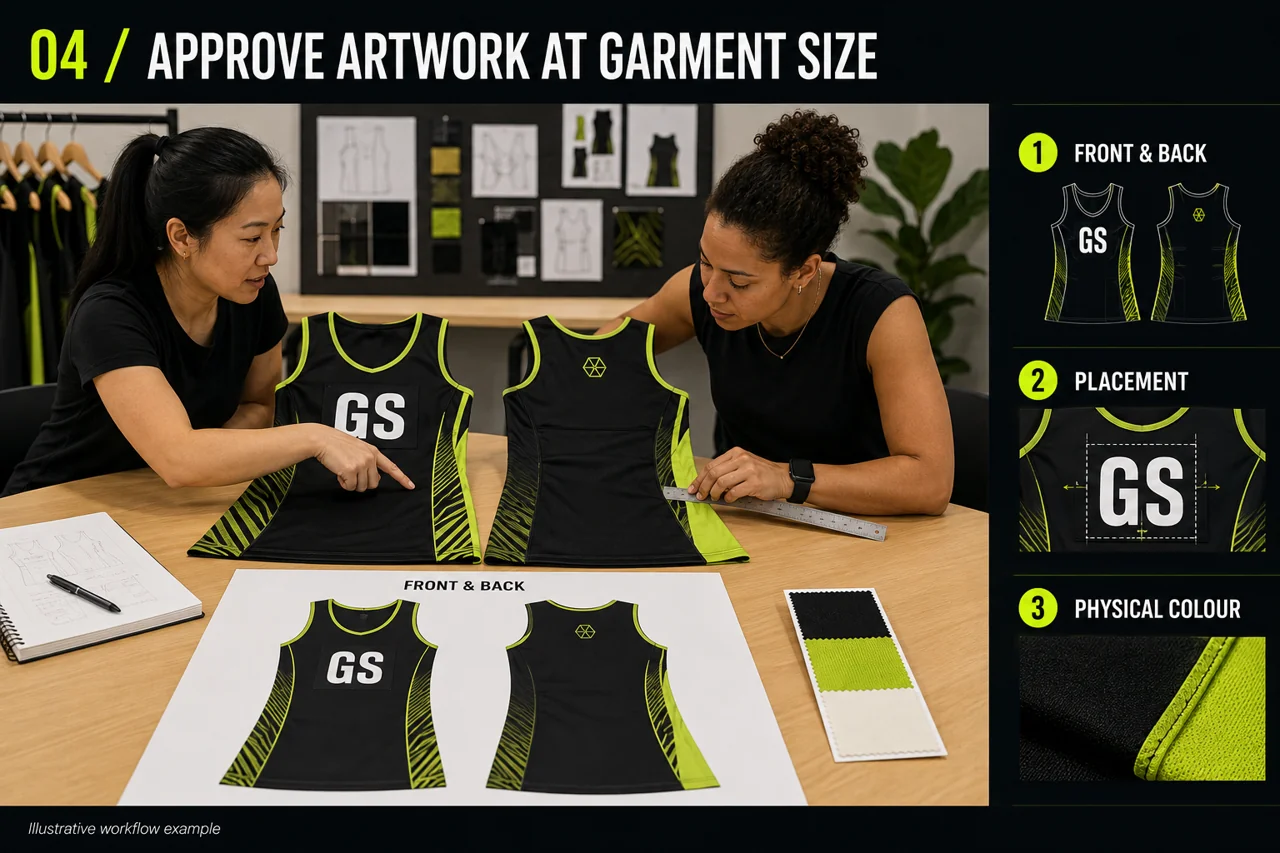
Compare artwork, colour and placement with the physical sample. AI-generated educational illustration; not a photograph of actual staff or an approved production sample.
Netball uniforms often use sublimation because it can integrate team colours, patterns, crests and sponsor graphics into polyester fabric without adding a heavy surface layer. It is not automatically the correct answer for every garment.
Sublimation
Use for suitable polyester dresses, tops, skorts and shorts requiring all-over graphics. Approve colour targets, scale, panel alignment, placement, white retention and stretch appearance.
Heat-applied graphics
Names, numbers or sponsor marks may use heat-applied films or transfers. Confirm the film and adhesive are compatible with the selected fabric and review adhesion, stretch, edge finish, migration risk and hand feel.
Embroidery and patches
Embroidery can suit stable areas, polos, jackets, bags and warm-ups. On lightweight or stretch matchwear, review backing, stitch density, stiffness, weight and skin-side comfort before approval.
Athletic Rush’s printing and decoration methods page explains the available processes. The final route should be confirmed against the approved fabric, artwork and garment construction.
7. Build One Controlled Artwork and Roster Package
Buyer checkpoint: Use one current artwork and roster package for all approvals.
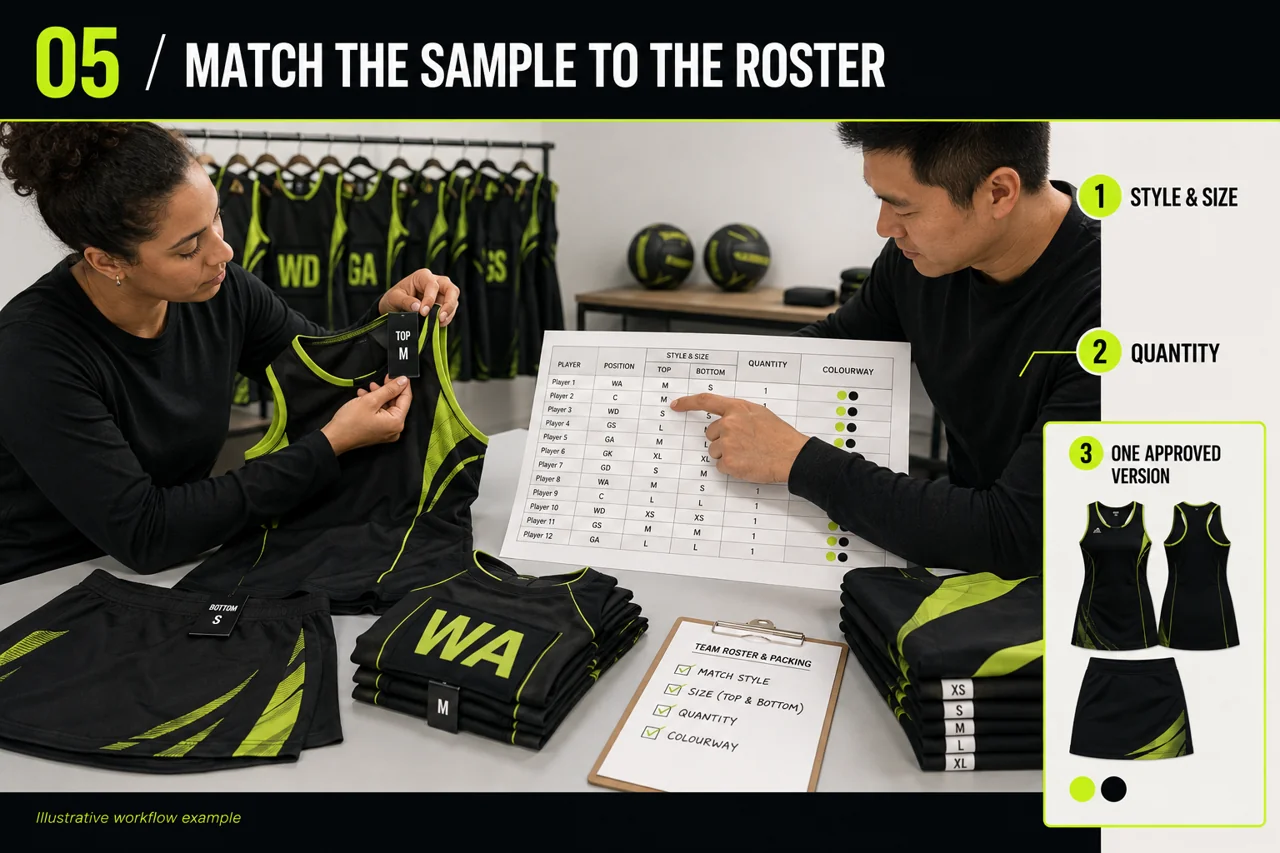
Link each garment size and quantity to the controlled player roster. AI-generated educational illustration; not a photograph of actual staff or an approved production sample.
Artwork files and player data should not be scattered across email threads, screenshots and voice messages. Create one controlled package.
The artwork map should show:
- Garment front, back and relevant side views
- Team colours and colour references
- Crest and sponsor artwork
- Position-mark dimensions and placement
- Player-name or number positions where required
- Safe distances from seams, necklines, armholes and hems
- Scale and orientation for every garment size
- Colourway and SKU references
The roster should use one row per player or ordered set and separate columns for:
- Player or order reference
- Dress size, or separate top and bottom sizes
- Underlayer size
- Player name exactly as it must appear
- Player or team number where required
- Position-bib or patch requirements
- Colourway
- Quantity
- Packing group
- Approval status
- Notes
Add coaches, officials, staff, spares and unpersonalized garments as explicit rows. Check spelling, capitalization, duplicate numbers, blank fields, size totals, colourway totals and product totals. The roster must reconcile with the purchase order and packing plan.
8. Approve a Production-Representative Sample
Buyer checkpoint: Resolve sample corrections before releasing bulk production.
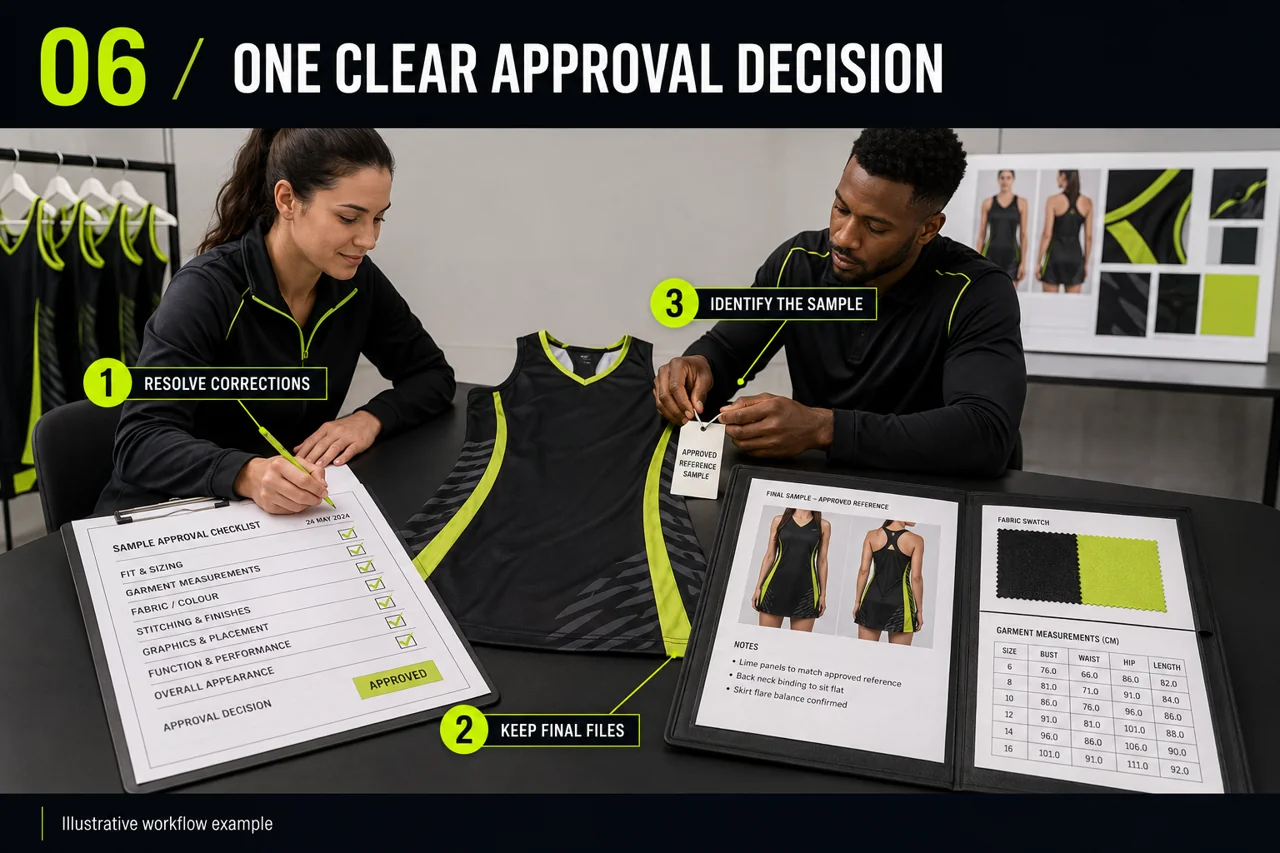
Record the exact sample and file revision receiving approval. AI-generated educational illustration; not a photograph of actual staff or an approved production sample.
A useful sample tests the decisions that will be repeated in bulk. It should use the intended fabric, construction and decoration wherever possible.
Review the sample in this order:
- Confirm the written specification, measurement chart and artwork revision.
- Check fabric identity, weight, stretch, recovery, opacity and hand feel.
- Measure the garment against the approved points of measurement.
- Test movement, coverage and comfort during netball-specific actions.
- Review neckline, armholes, seams, hems and waistband construction.
- Check every crest, sponsor, position mark, name and number at actual size.
- Review colour under relevant lighting and compare it with the agreed target.
- Wash or wear-test where the programme requires it.
- Record all corrections in one dated revision.
- Approve the final sample and active specification in writing.
For youth and women’s fits, approve the relevant sample rather than assuming that one approved size confirms every fit group. If the buyer accepts a virtual or partial approval instead of a complete physical sample, the untested variables should be documented as risks.
9. Control Bulk Production, QC and Packing
Bulk production should follow the approved sample, active specification, artwork and roster. Any change after approval should be documented with its effect on cost, timing and product performance before work continues.
Incoming material checks
- Fabric type, shade, weight and width
- Stretch, recovery and opacity where specified
- Visible defects and lot consistency
- Trims, labels, elastic and drawcords
Cutting and construction checks
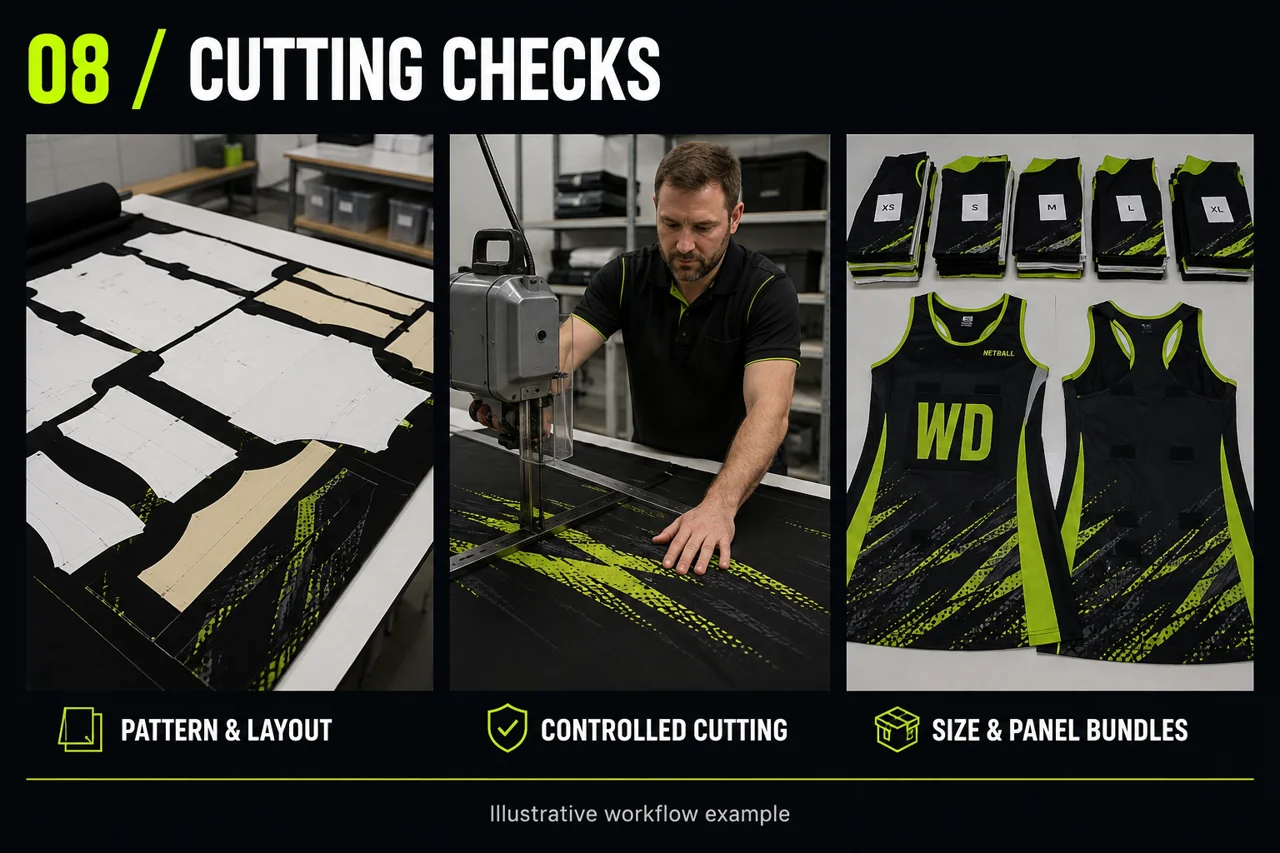
Check pattern layout and keep cut panels traceable by size. AI-generated educational illustration; not a photograph of actual staff or an approved production sample.
- Correct pattern and size grading
- Panel orientation and bundle control
- Seam security and stretch compatibility
- Neckline, armhole and hem consistency
- Waistband function and garment measurements
- Dress, skort and short length control
Decoration and personalization checks
- Artwork colour, scale and placement
- Position-initial size and visibility
- Crest and sponsor accuracy
- Name and number spelling
- Transfer adhesion, print registration or stitch quality
- Correct colourway and orientation
Final reconciliation and packing
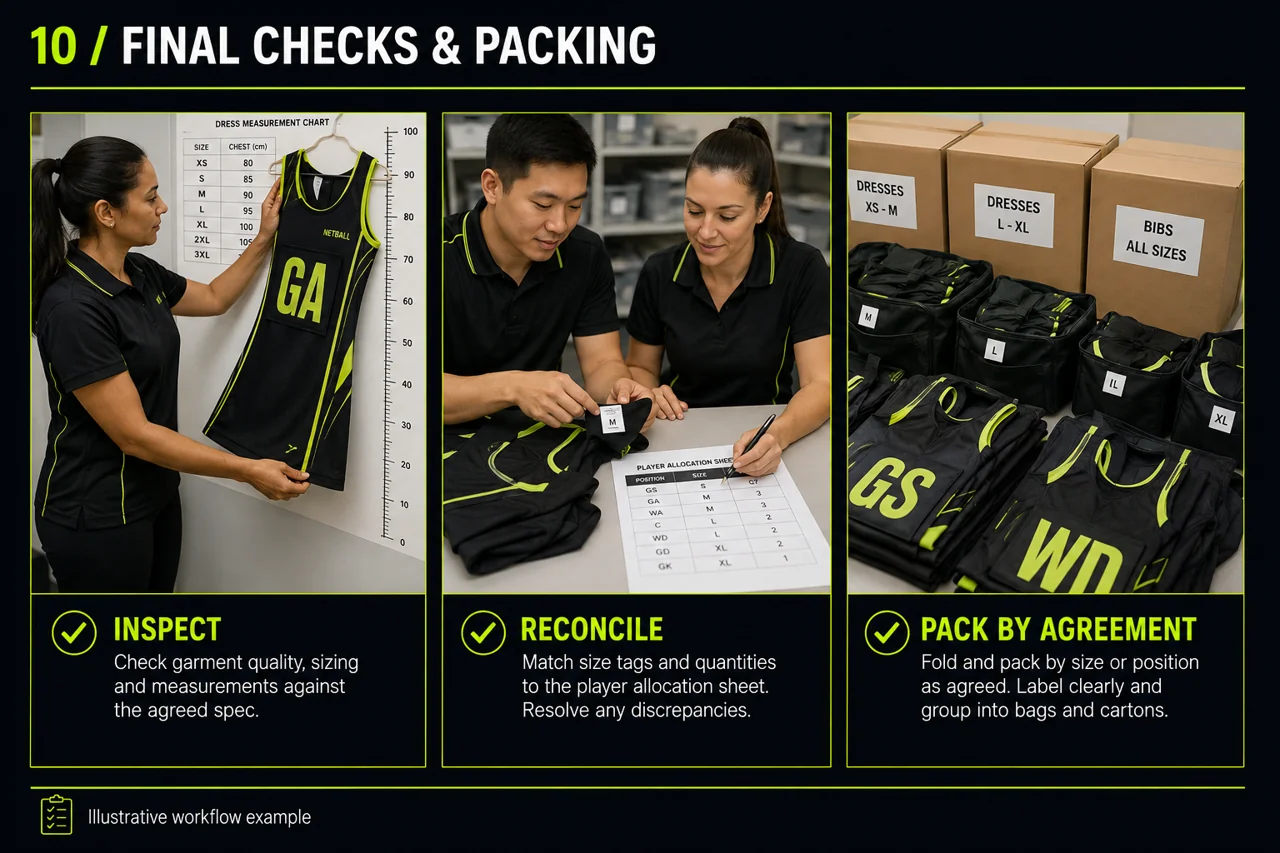
Reconcile inspected garments with the roster before packing. AI-generated educational illustration; not a photograph of actual staff or an approved production sample.
- Player-level garment combinations
- Top, bottom and underlayer sizes
- Position bibs or patches
- Colourways and quantities
- Labels, size stickers and barcodes
- Player-based, team-based or size-based packing
- Carton counts and carton marks
The Athletic Rush manufacturing workflow shows the stages from development and material control through sewing, decoration, inspection and packing.
10. Plan Reorders Before the First Order Ships
Buyer checkpoint: Retain the specification and sample reference for future reorders.
Netball clubs often need replacements, new-player garments and additional colourways. Reorder accuracy depends on the records retained from the first order.
Keep the approved:
- Style and colourway SKU
- Pattern and grading revision
- Fabric specification and supplier reference
- Colour targets
- Artwork files and placement map
- Decoration settings
- Size charts
- Roster format
- Position-identification system
- Label and packing specification
- Final sample record
A reorder should still be reconfirmed. Fabric lots, trims and colour processes can change, so compare new materials and decoration with the approved reference rather than assuming an automatic match.
Bulk Netball Uniform RFQ Checklist
Before requesting a quotation, confirm:
- Buyer, club, school or brand name
- Product range and colourways
- Dress or separates system
- Quantities by product and fit group
- Women’s and youth fit requirements
- Size chart or measurement reference
- Fabric and coverage requirements
- Artwork and colour references
- Position-bib or patch system
- Applicable competition rules
- Personalization and roster
- Labels, barcodes and packaging
- Destination and delivery location
- Required arrival date
- Sample and approval expectations
- Reorder requirements
Frequently Asked Questions
What information is needed to quote custom netball uniforms?
Provide the garment range, quantities, fit groups, size range, material requirements, artwork, colourways, position-identification system, personalization, roster, packaging, destination and required date. Include the governing competition rules where relevant.
Should a club order a physical sample before bulk production?
For a new custom product, a physical sample is the main control point for fit, measurements, fabric, coverage, colour, construction, decoration and comfort. Record corrections and identify the final approved reference before bulk production.
Are netball dresses and separates sized the same way?
Not necessarily. Each garment type needs its own approved chart. Separates should record top and bottom sizes independently, while dresses require controlled bust, waist, hip, torso and length measurements.
Which fabric is best for a netball dress?
There is no universal best fabric. The choice depends on the silhouette, fit, coverage, climate, stretch, recovery, opacity, artwork and budget. Compare production-representative swatches and approve the complete sample.
Is sublimation suitable for netball uniforms?
It is commonly suitable for compatible polyester garments requiring all-over colour and integrated graphics. Fabric stretch, colour targets, opacity, panel alignment and final appearance still need approval.
How can buyers reduce roster and personalization errors?
Use one controlled roster, preserve exact spelling and capitalization, check duplicates and blanks, reconcile all totals, compare artwork proofs with the roster, and inspect finished garments against the same approved file.
What should be retained for future reorders?
Keep the style SKU, pattern revision, fabric reference, colour targets, artwork, decoration settings, size charts, roster format, position system, packing specification and approved sample record.
Request a Netball Uniform Manufacturing Review
Send Athletic Rush your product list, estimated quantities, fit groups, artwork, draft roster, material direction, position requirements, destination and required date. The team can review the brief for missing information and confirm the appropriate development route for the actual programme.
Request a production quote after reviewing the custom netball uniform page. Commercial terms, timing, minimums and manufacturing details must be confirmed for the specific order.
Email kamran@athleticrush.co or message Athletic Rush on WhatsApp. WhatsApp: +92 327 9008337. Include the product list, quantities, delivery destination and the questions you need answered.
For a closer visual walkthrough of sampling and production, read the netball ordering process guide.
Use the team uniform size chart and player roster guide when preparing your order files.