 Sialkot, Pakistan
 Worldwide enquiries

Ordering custom netball uniforms starts before the design is approved. Define what your team needs, choose a manufacturer who can demonstrate the relevant capabilities, and agree the product specification and commercial terms. Then review the sample before releasing bulk production. This illustrated guide connects the first enquiry to colour and fabric decisions, sample approval, sublimation, cutting, stitching and final packing.
Before you approve: Fit, coverage, artwork and roster details should point to the same approved specification.
Before sampling: find and brief a netball manufacturer
Start with the team’s requirements: dresses or separates, adult or youth fit groups, estimated quantities, colourways, destination and required arrival date. These details make supplier comparisons more useful than asking only for a price per kit.
When searching for a manufacturer, look for netball-specific product information and ask to see relevant sample work. Discuss fit development, the available decoration route, how sample corrections are recorded and how player-level orders are controlled. Verify the business identity and contact details, and request evidence for the capabilities that matter to your order.
Explore Athletic Rush’s custom netball uniform range to review the available product categories, fabric directions and customization route. Use the page as the starting point for a detailed enquiry; confirm the actual sample, specifications and order terms with the team.
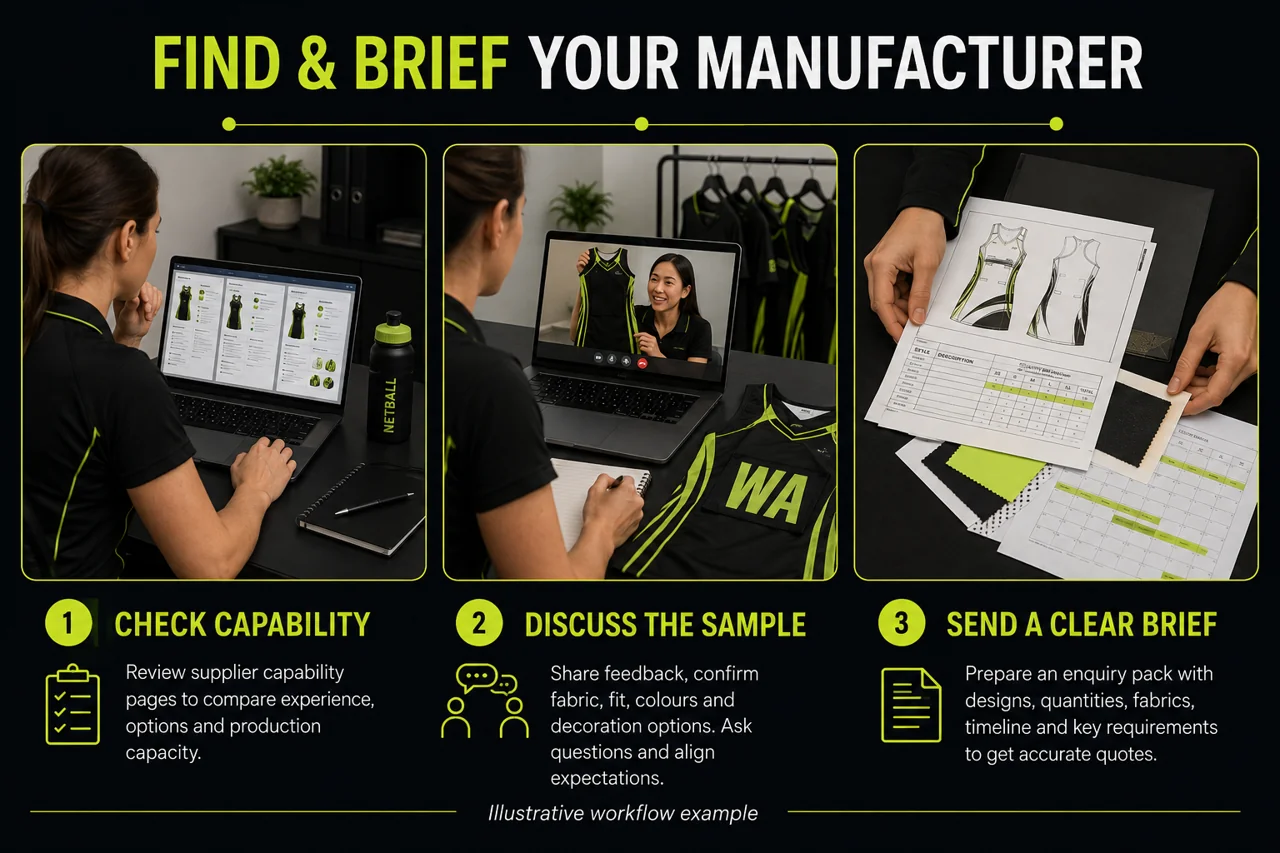
Supplier selection starts with relevant capabilities and a clear brief. AI-generated workflow illustration, not a photograph of actual staff.
Contact Athletic Rush and compare the quotation
Email kamran@athleticrush.co, message Athletic Rush on WhatsApp, or use the production quote form. WhatsApp: +92 327 9008337.
Include the product list, quantities by fit and colourway, draft artwork, proposed sizes, delivery destination and target date. Ask the quotation to identify the garment specification, personalization, sample scope, packing, freight responsibilities and any applicable minimums. Compare quotations on the same scope rather than the headline price alone.
Confirm sampling and payment arrangements in writing. Final bulk approval should follow agreement on fabric, colour, measurements and the sample; do not treat a preliminary enquiry or design choice as permission to start bulk production.
Buyer decision: Choose on the evidence and the complete quoted scope. Prices and timelines need confirmation for your actual order.
Sample development and approval
Use the following six checks together. Colour, fabric and fit decisions affect one another, so some sample revisions may repeat a check before final approval. Keep one current specification rather than treating each decision as an isolated message.
1. Start with the complete match outfit
A netball dress can look right on a hanger and still need changes when worn with an underlayer and position bib. Review the complete combination that players will use: dress or separates, shorts or leggings, and the agreed position-identification system. Include warm-ups as separate products when they are part of the order.
- Confirm the product, colourway and fit group for each sample.
- Match the sample to the current artwork and measurement chart.
- Record which materials and details are final, and which are substitutes.
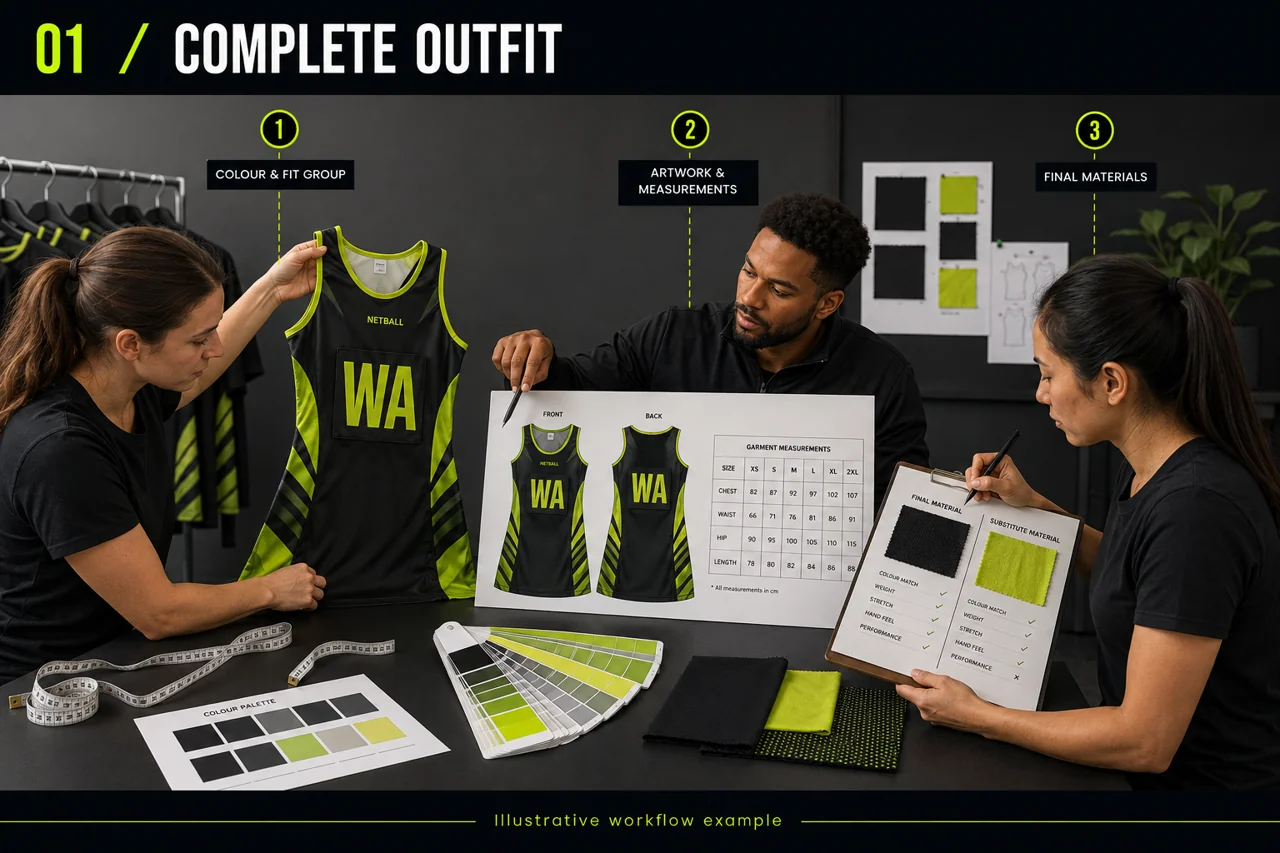
Compare the sample with the colour reference, artwork, measurement chart and material record. AI-generated workflow illustration; not a photograph of actual staff or an approved production sample.
Approval note: A design image establishes appearance. A physical sample checks the decisions that will be repeated in production.
2. Check fit through movement
Ask the sample wearer to reach overhead, bend, turn and move as they would on court. Review armhole comfort, torso length, hem coverage and how the outfit works with the intended underlayer. For separates, assess the top and bottom independently; one player may need different sizes.
Measure the sample using the agreed points and methods. Keep body measurements separate from finished-garment measurements. Women’s and youth fit groups should refer to their own approved charts where appropriate.
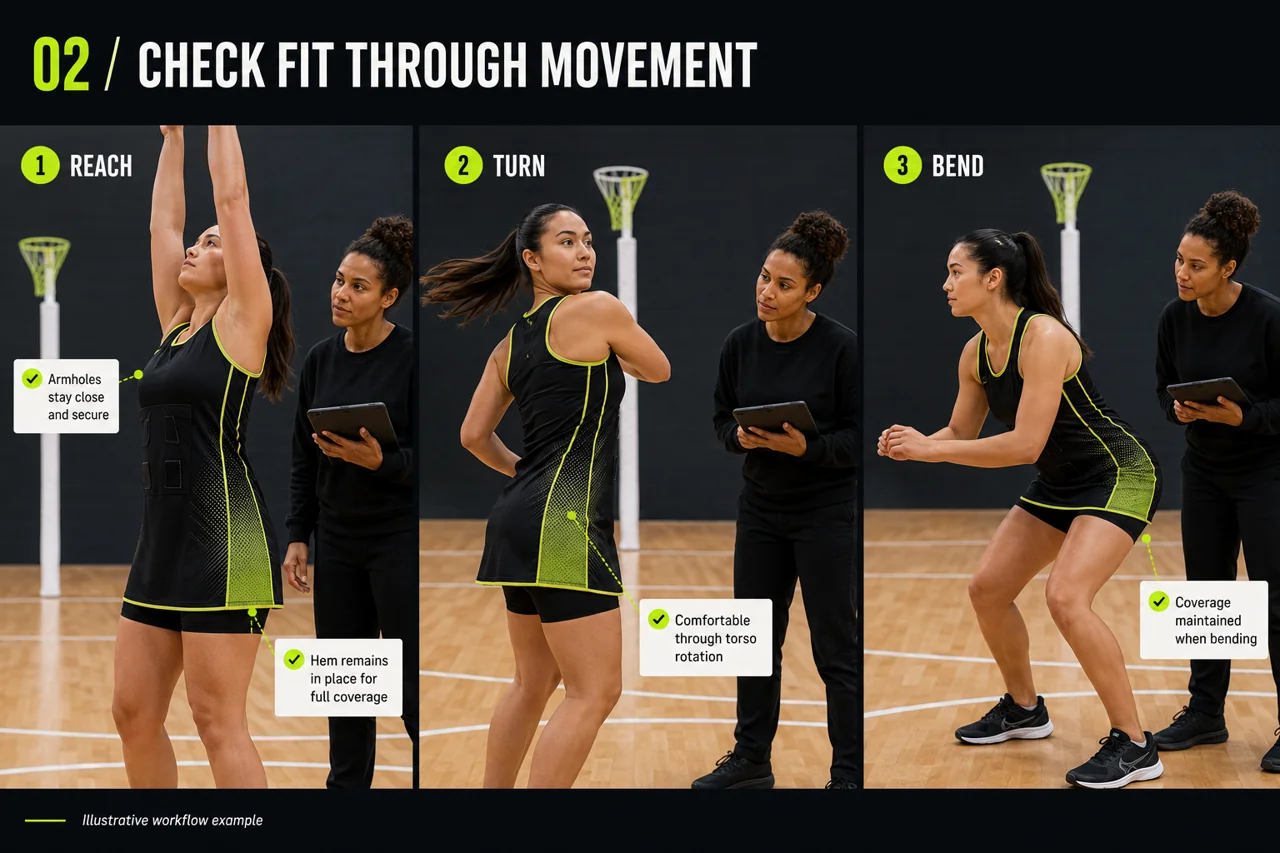
Review reach, turning and bending to assess movement, coverage and comfort. AI-generated workflow illustration; not a photograph of actual staff or an approved production sample.
Approval note: Write the correction precisely: identify the measurement, current result and agreed target. “Make it fit better” does not give the manufacturer a usable instruction.
3. Assess fabric, coverage and recovery
Review the material on the sample, not only a fabric name on a quotation. Look at hand feel, stretch, recovery and coverage in the positions used during play. Check lighter panels under realistic lighting and with the intended underlayer.
- Inspect opacity while the fabric is stretched.
- Check whether seams restrict movement or create discomfort.
- Compare the material and colour with the agreed reference.
- Record any wash or wear checks agreed for this order.
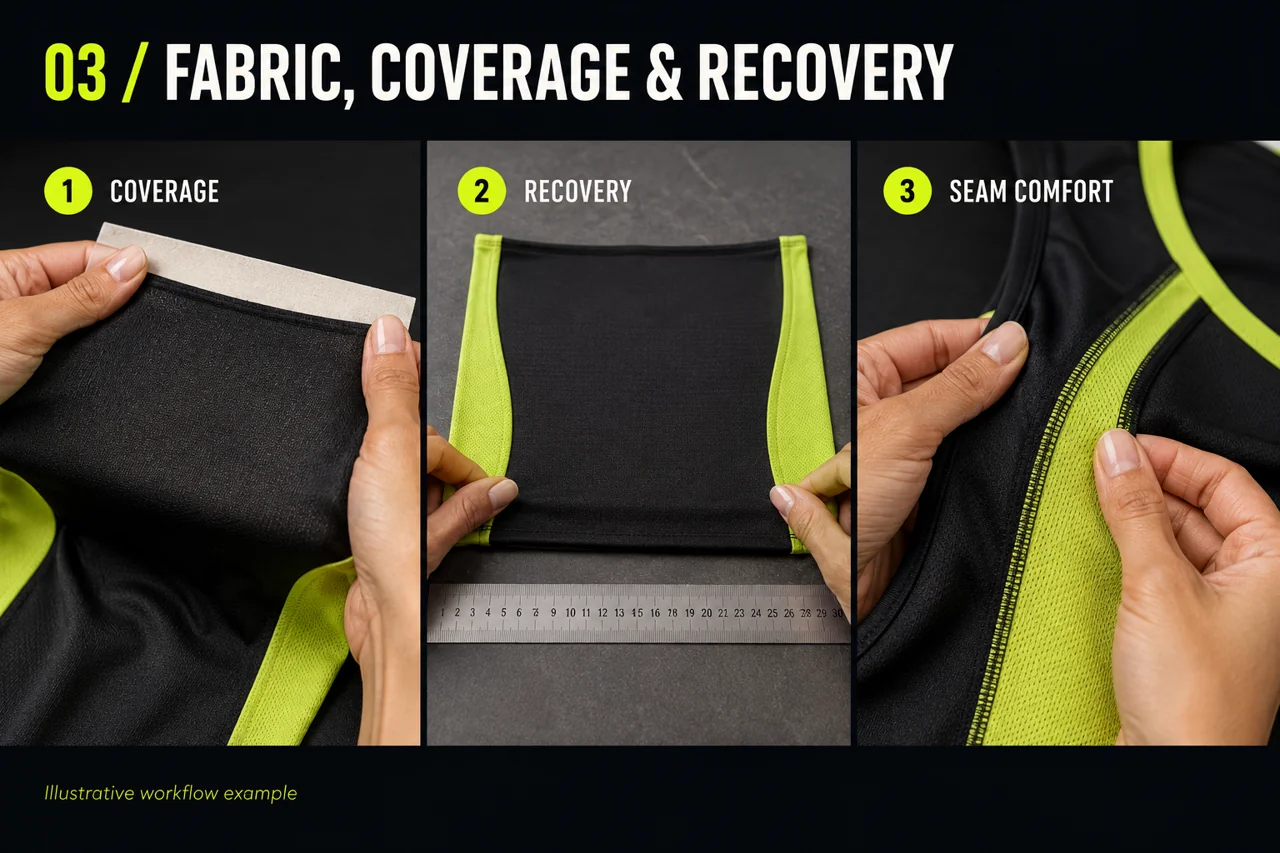
Examine fabric coverage, stretch recovery and seam comfort on the proposed sample. AI-generated workflow illustration; not a photograph of actual staff or an approved production sample.
Approval note: Fabric weight alone does not establish suitability. The full garment must be reviewed for its intended use.
4. Approve artwork at garment size
Compare the crest, sponsor marks and position identification against the approved artwork. Check the front, back and side views. Pay attention to graphics near seams, armholes and hems, where a balanced flat design may change on a worn garment.
Use the competition requirements supplied for the actual team when checking position identification and permitted branding. Confirm the applicable requirements before approving production rather than assuming every competition uses the same rules.
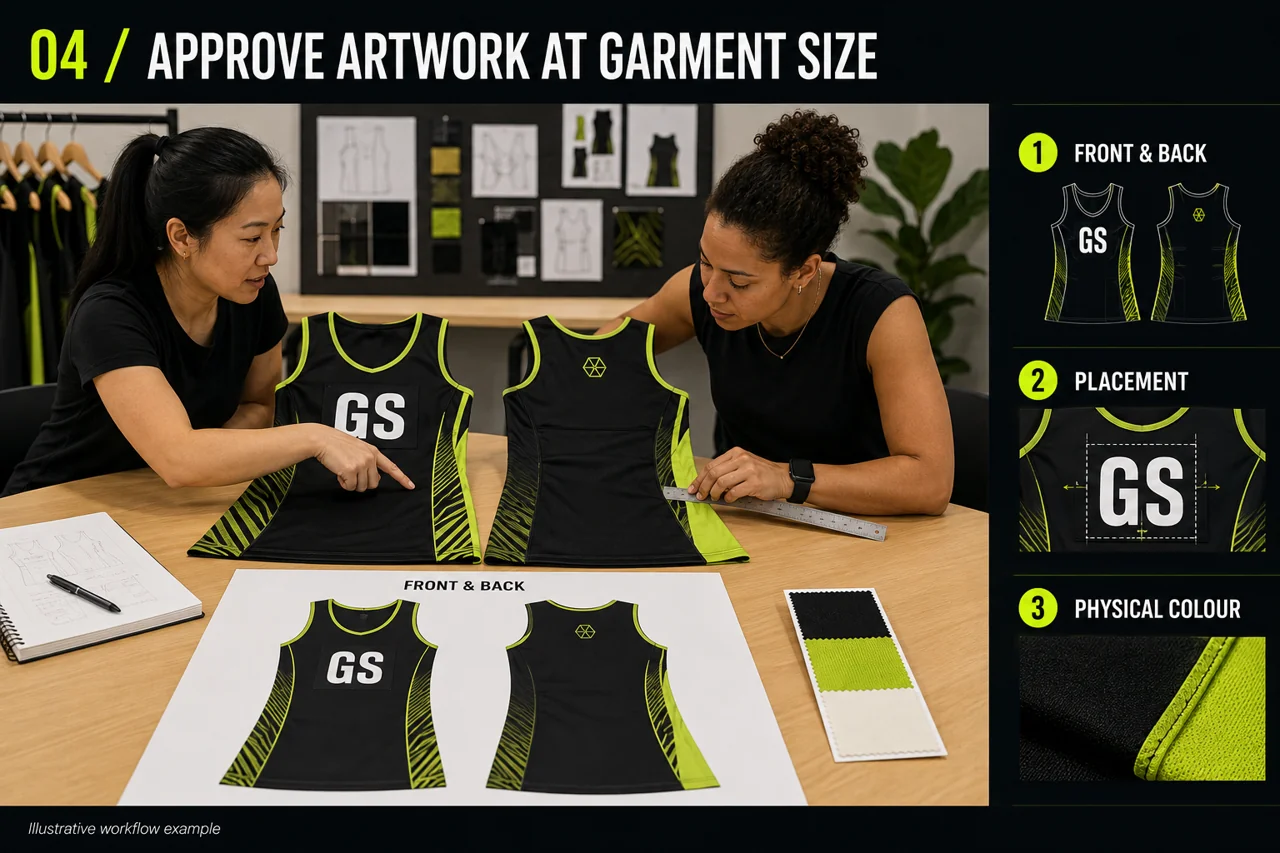
Compare front and back artwork, placement and physical colour against the sample. AI-generated workflow illustration; not a photograph of actual staff or an approved production sample.
Approval note: A screen colour is a starting reference. Agree the physical colour target and review it on the proposed material.
5. Link the sample to one controlled roster
The sample approval and player order should refer to the same garment style, fit group and colourway. Record dress sizes or separate top and bottom sizes clearly. Include underlayers, spare units and position bibs as explicit items.
- Verify names and other personalization exactly as required.
- Reconcile quantities by product, size and colourway.
- Identify the current roster revision and approval contact.
- Agree whether packing will be by player, size or team.
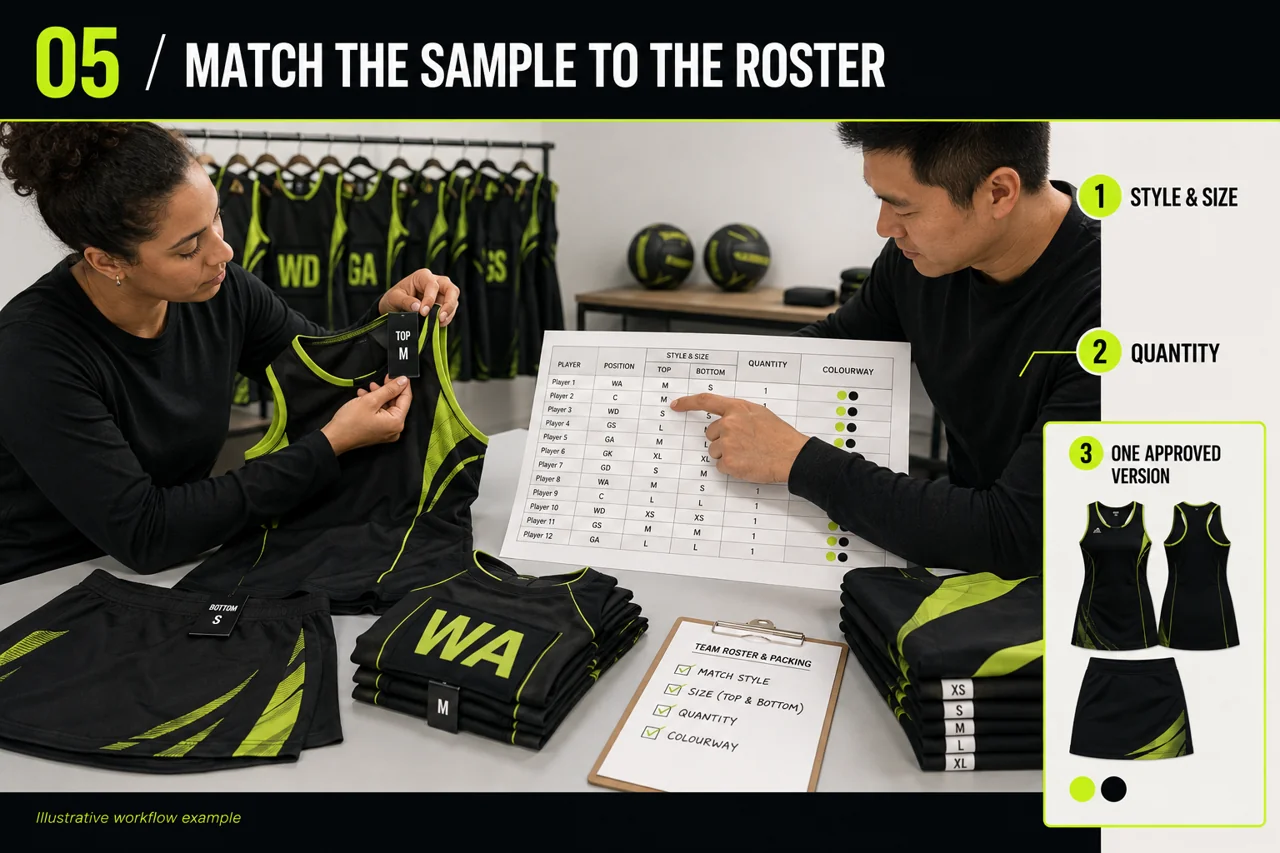
Match the garment style, fit, size and quantity to one controlled roster. AI-generated workflow illustration; not a photograph of actual staff or an approved production sample.
6. Give one clear approval decision
Collect corrections in a single dated record. For each point, include a photograph where useful, the location of the issue, the requested correction and who must confirm it. Avoid splitting instructions across unrelated messages.
If a change affects fit, fabric, coverage or construction, agree what evidence is needed before release. Keep the approved sample reference, artwork, measurement chart and roster together so the manufacturer knows which version controls the order.
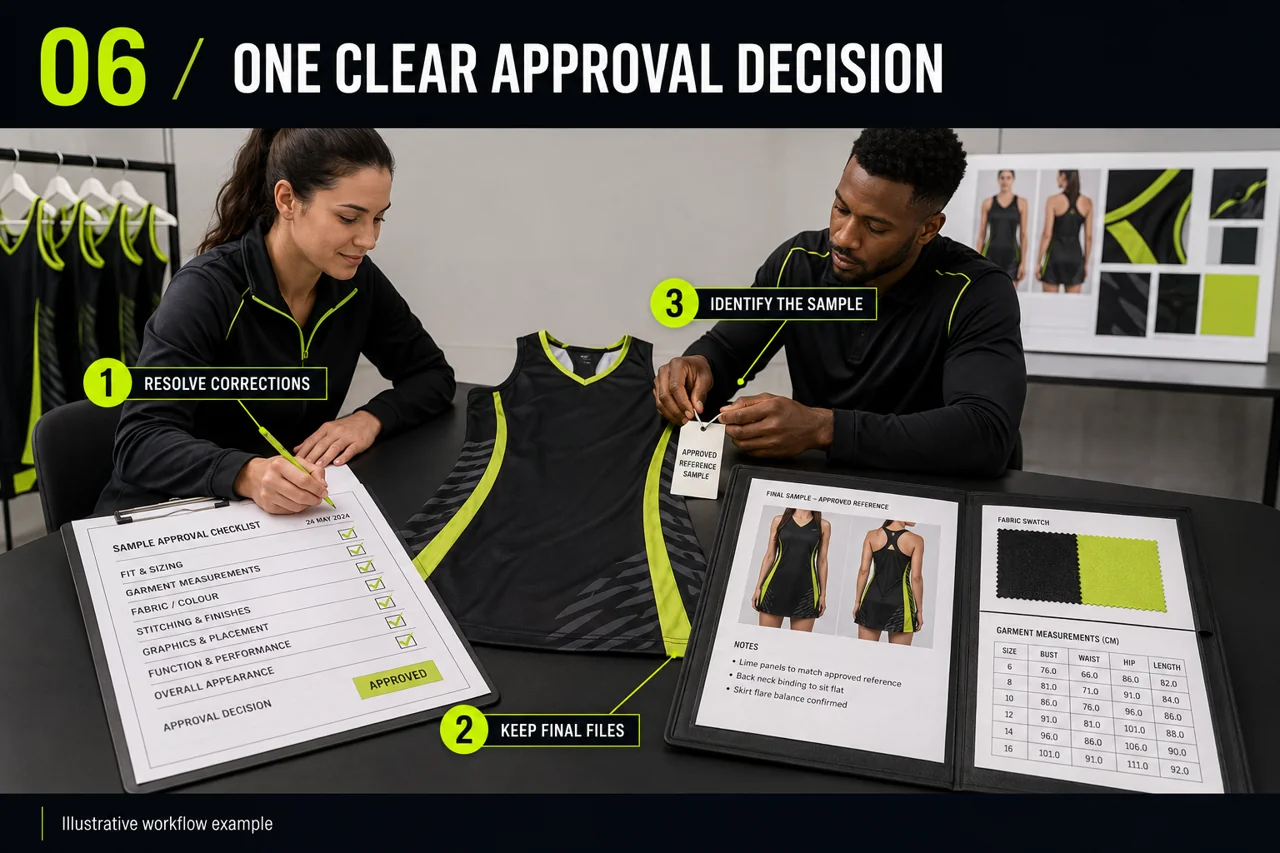
Resolve corrections and identify the exact sample and files that receive approval. AI-generated workflow illustration; not a photograph of actual staff or an approved production sample.
Approval note: Approval should identify the exact sample and document versions. An informal “looks good” beside an old image can leave the production reference unclear.
Bulk production after sample approval
The following is an example production route for a sublimated uniform. Confirm the actual printing and cutting sequence with your manufacturer, as it depends on equipment and production method. The approved sample and documents remain the reference throughout.
7. Review the sublimation process
For a compatible polyester uniform, a transfer-sublimation route starts with the approved panel artwork. The design is printed onto transfer paper, then transferred to the fabric with controlled heat and pressure. The production route may use fabric lengths or prepared panels; confirm the actual sequence with the manufacturer before approving the sample.
Compare the printed result with the agreed physical colour target. Check scale, orientation, white areas and alignment where graphics meet at seams. The sample should use the proposed fabric and decoration route so its result is relevant to bulk production.
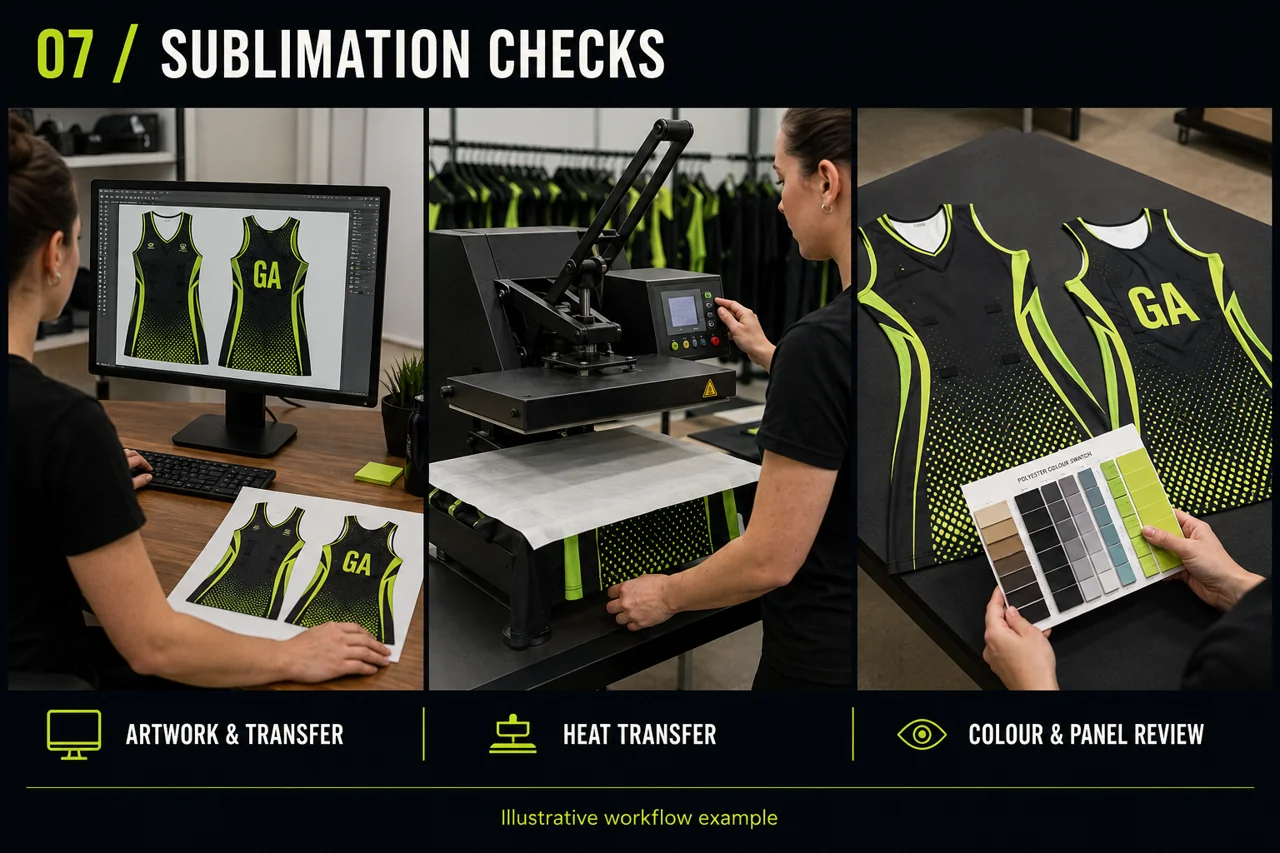
Follow the transfer-sublimation route and compare the printed result with approved fabric and colour references. AI-generated workflow illustration; not a photograph of actual staff or an approved production sample.
Production check: Approve the actual printed fabric. Screen colours and a paper print alone do not establish the final garment colour.
8. Check pattern layout and cutting
Cutting translates the approved pattern into the panels that will form the garment. Confirm the active size and fit pattern, fabric direction and panel layout before cutting. Where printing and cutting interact, the layout must account for artwork placement, seam allowances and the chosen manufacturing sequence.
Inspect a set of cut panels for correct shape, size identification, orientation and matching pairs. Keep bundles labelled by style, size and colourway. A cutting error can change fit or move a graphic even when the artwork file is correct.
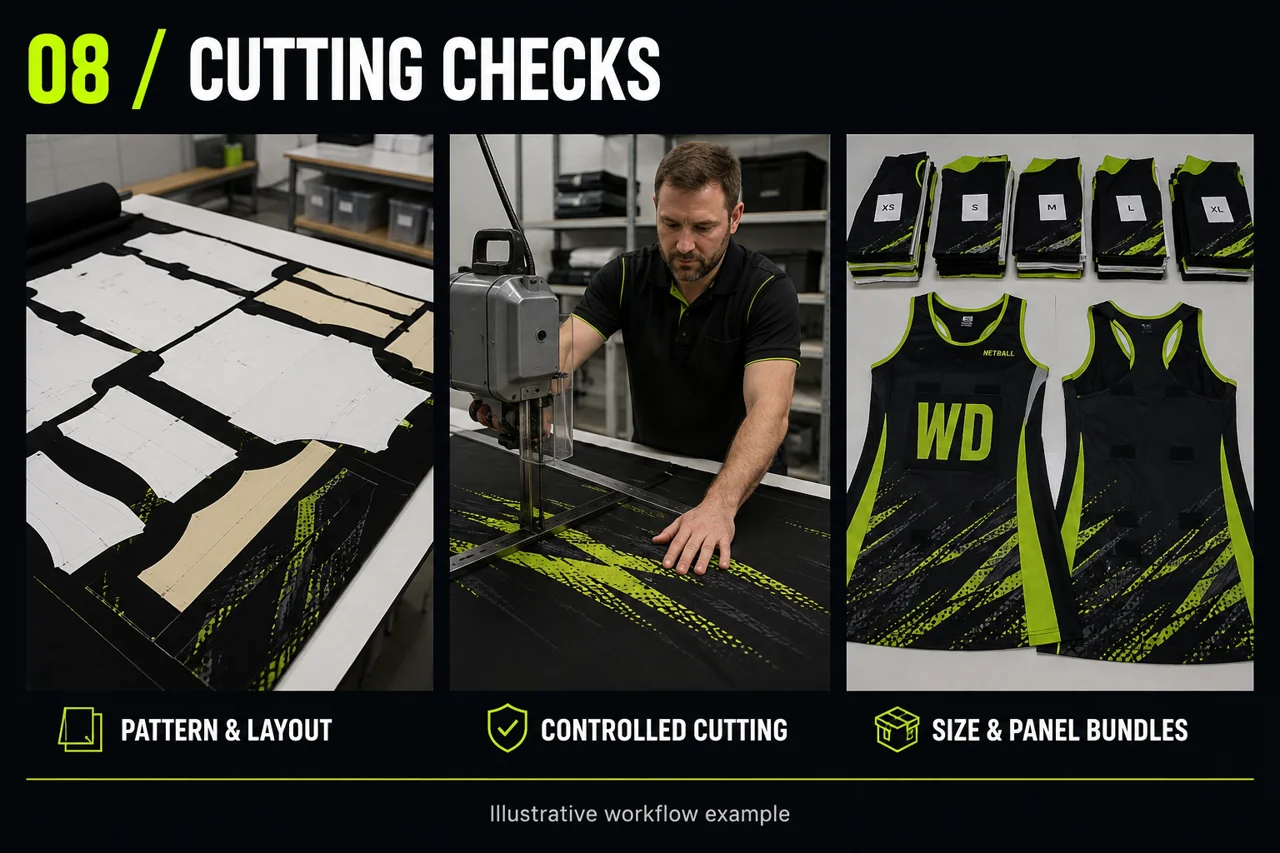
Check pattern layout, controlled cutting and traceable size bundles. AI-generated workflow illustration; not a photograph of actual staff or an approved production sample.
Production check: Match cut panels to the approved pattern and keep size bundles traceable through sewing.
9. Review stitching and garment finishing
During stitching, the cut panels become the complete uniform. Review panel joins, neckline and armhole finishing, hems and any underlayer or position-bib attachment details. The seam construction should suit the fabric stretch and the intended use of the garment.
On the finished sample, look for skipped or broken stitches, uneven seams, puckering and uncomfortable edges. Check measurements again after sewing and assess movement on the complete outfit. Record corrections by location and confirm the agreed seam and finishing reference before bulk production.
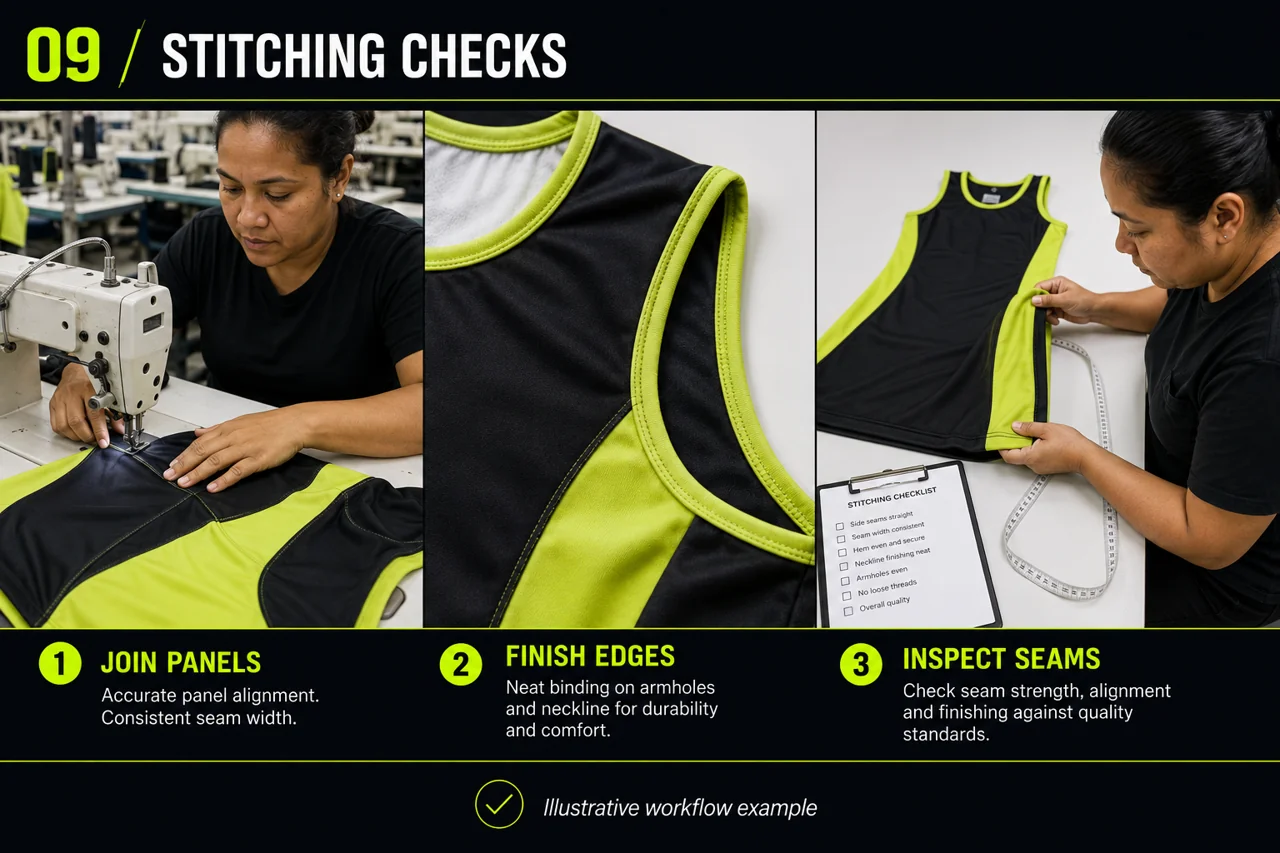
Review panel joining, edge finishing and seam inspection on the sewn garment. AI-generated workflow illustration; not a photograph of actual staff or an approved production sample.
Production check: A neat-looking seam must also be suitable for movement and wear. Approve the actual construction, not only its appearance.
10. Inspect, reconcile and pack the order
Before dispatch, compare finished garments with the approved sample, measurement chart, artwork and roster. Review measurements, appearance, seams, position marks and any personalization. Reconcile the quantity for each style, size and colourway rather than checking only the carton total.
Agree whether the order will be packed by player, size or team. Check garment combinations and labels against that packing plan, record any shortages or corrections, and confirm the agreed shipping documentation and delivery responsibilities. Keep the approved references for later player additions and reorders.
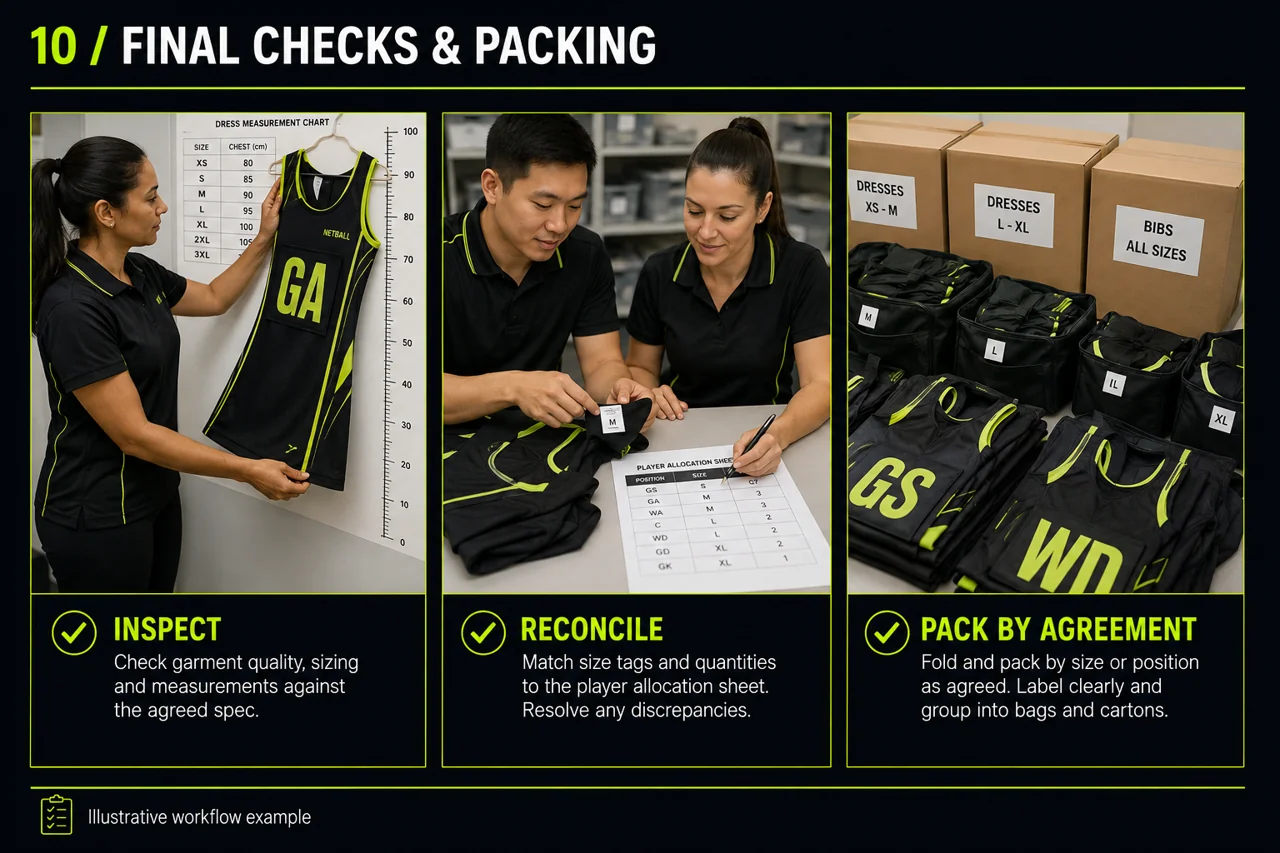
Final checks connect the physical garments to the approved roster and packing plan. AI-generated workflow illustration, not evidence of a completed customer order.
Before dispatch: Confirm the inspected quantities, packing arrangement and unresolved corrections with the manufacturer.
Your sample sign-off checklist
- Product, colourway and fit group identified
- Measurements checked against the agreed chart
- Movement and coverage reviewed
- Fabric and colour references recorded
- Artwork and position identification checked
- Roster quantities and sizes reconciled
- Corrections resolved and final versions identified
Common questions
Can a mockup replace the physical sample?
A mockup helps communicate the design. It does not establish physical fit, coverage, seam comfort or material performance. Agree which checks require a physical sample for your order.
Does approving one size approve every fit group?
One sample does not automatically confirm every size or audience. Agree the size and fit coverage of the approval with the manufacturer.
What if the sample needs changes?
Record the corrections together and agree whether a revised sample, measurement report or other evidence is required before production.
Prepare your netball brief
Explore the netball uniform range, use the size chart and player roster guide, and read the complete bulk netball ordering guide.
Send your product list, quantities, fit groups, artwork and sample requirements through the production quote form. Sampling scope, timing and commercial terms should be confirmed for the specific order.