 Sialkot, Pakistan
 Worldwide enquiries

How do you know whether a puff print will work on your hoodie before ordering a full run? Approve the finished effect on the actual garment fabric, at the intended artwork size and placement. Check the raised surface, open spaces, colour, surrounding fabric and performance after the agreed care procedure. A three-dimensional digital mock-up can communicate the idea, but it cannot approve the printed result.
For a streetwear brand, the decision is not simply whether the print looks raised. The useful question is whether that particular raised effect supports the design without losing important detail or creating an uncomfortable garment. This guide covers three buyer decisions: define the effect, inspect a representative sample, and record exactly what authorizes production.
The examples below are development scenarios, not Athletic Rush stock specifications or measured outcomes. Ask the printer to confirm the suitable ink system and process for your fabric and artwork rather than transferring settings from an unrelated job.
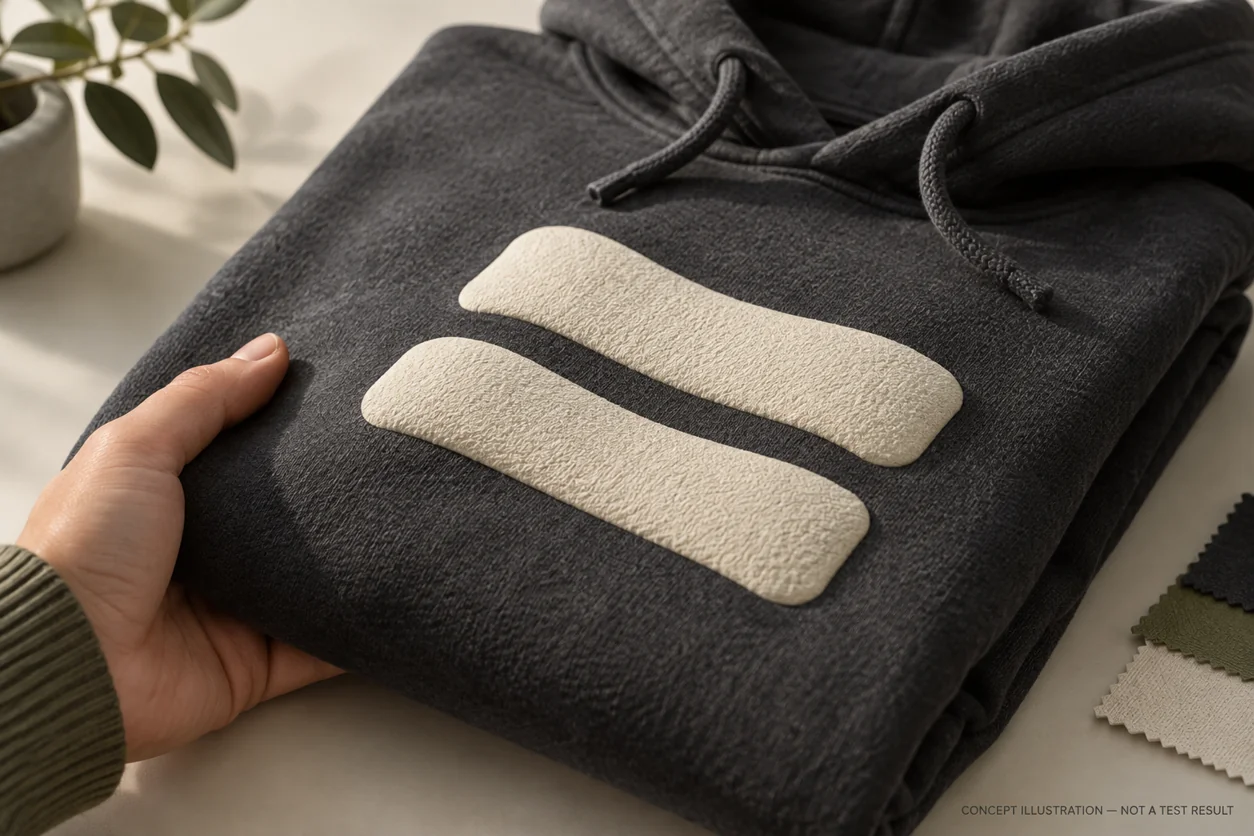
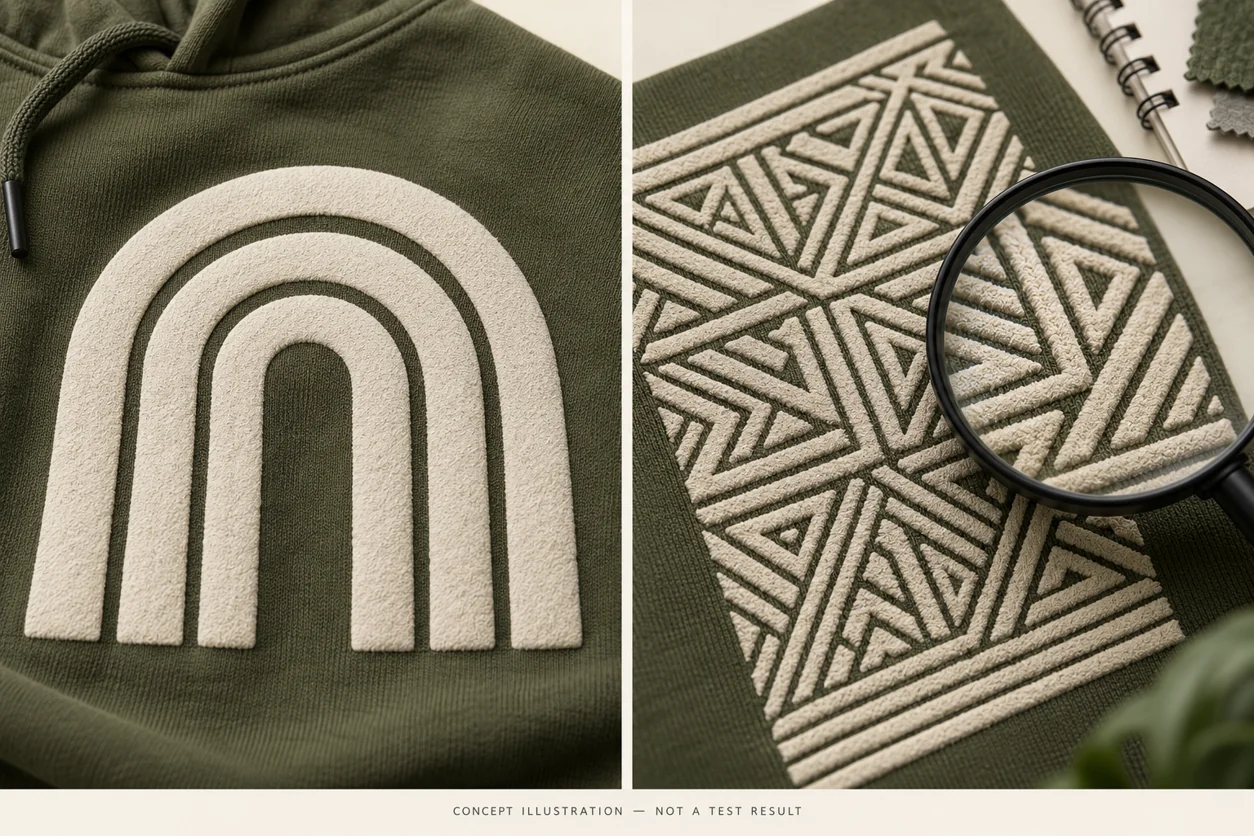
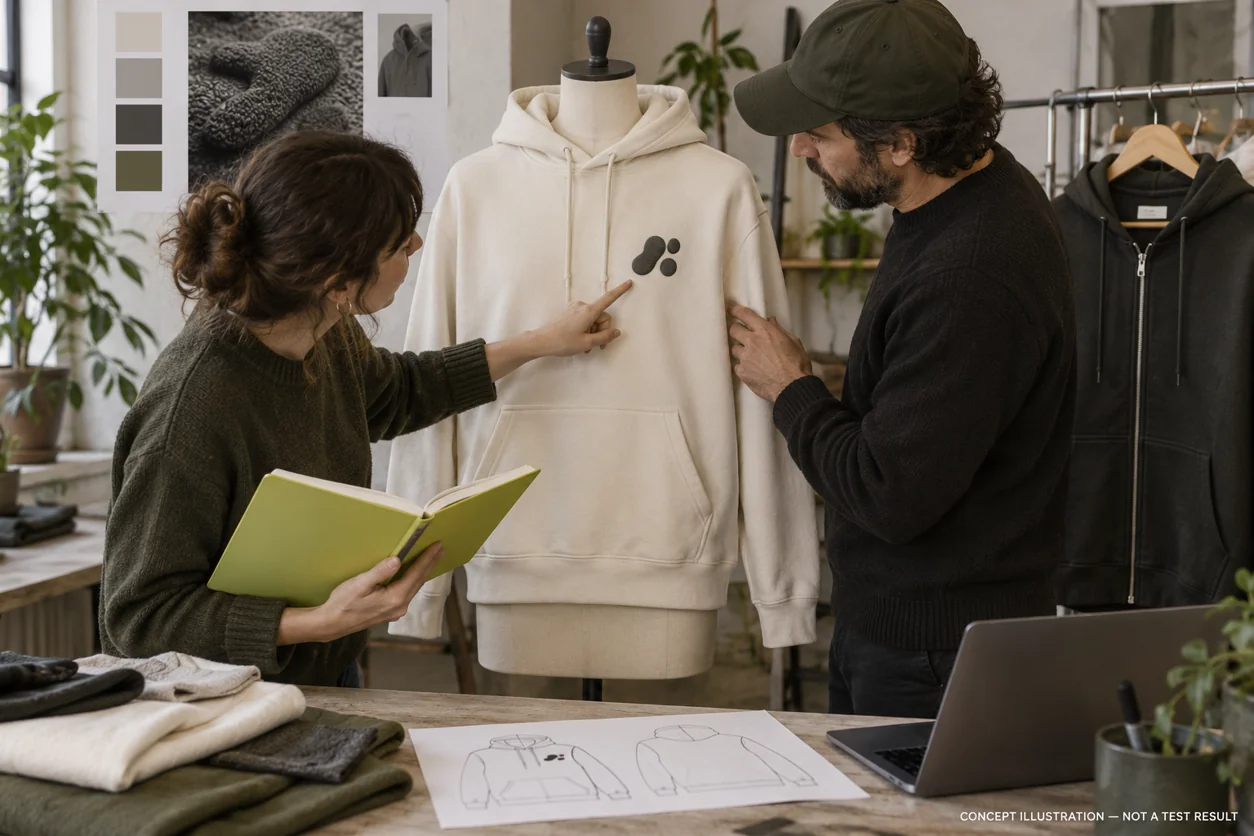
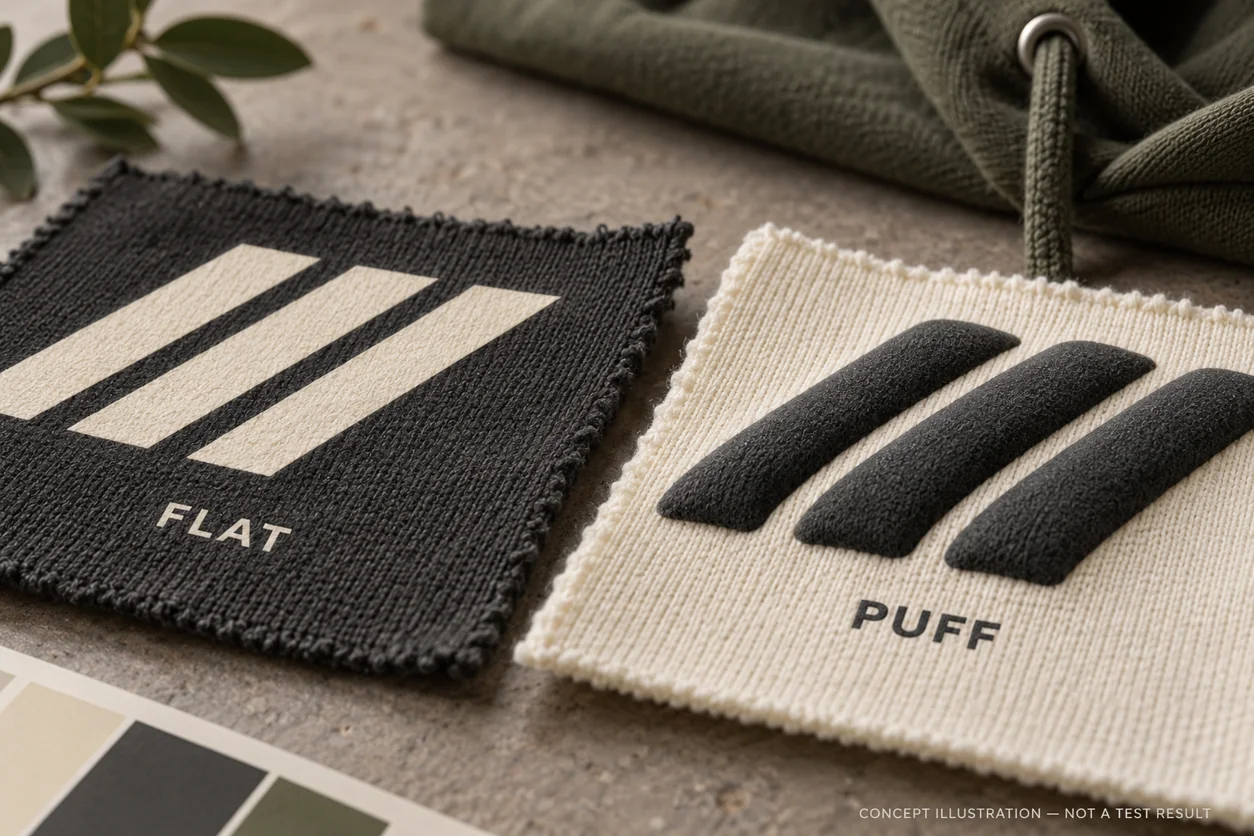
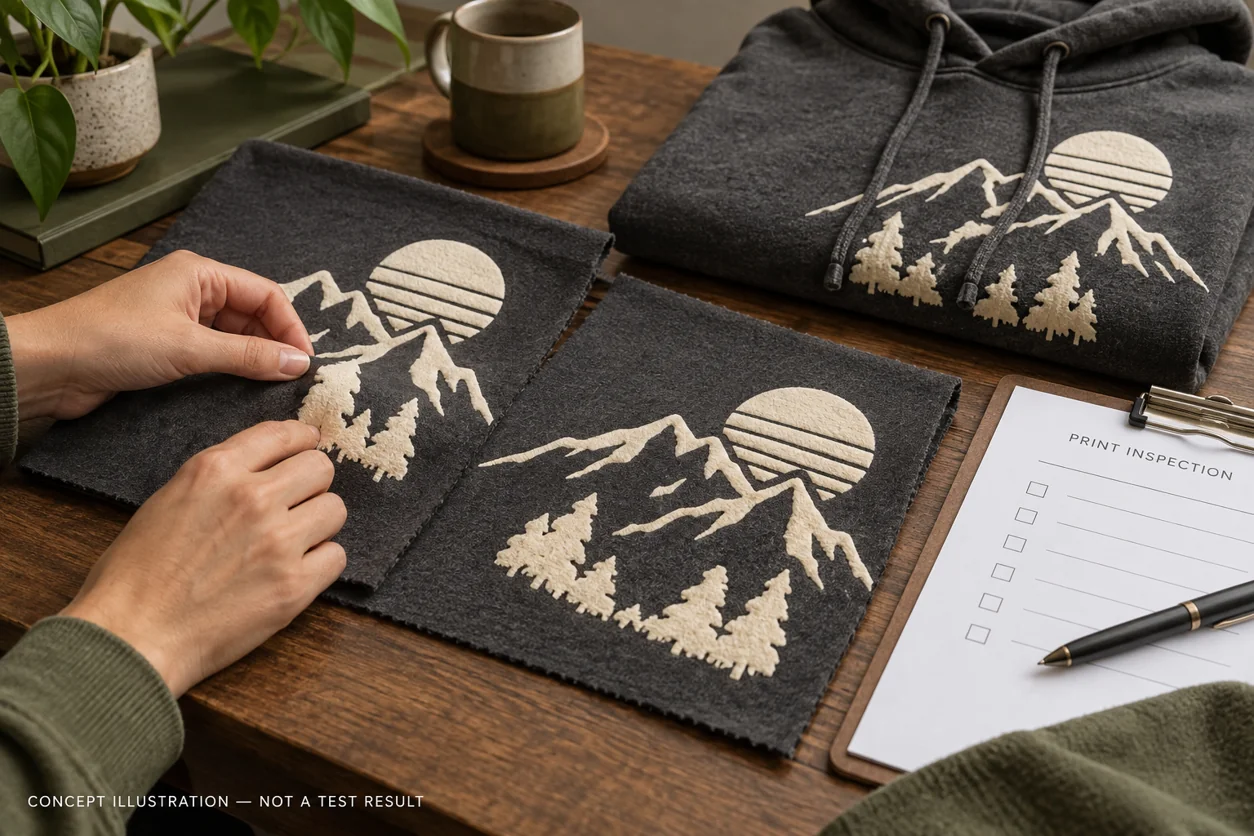
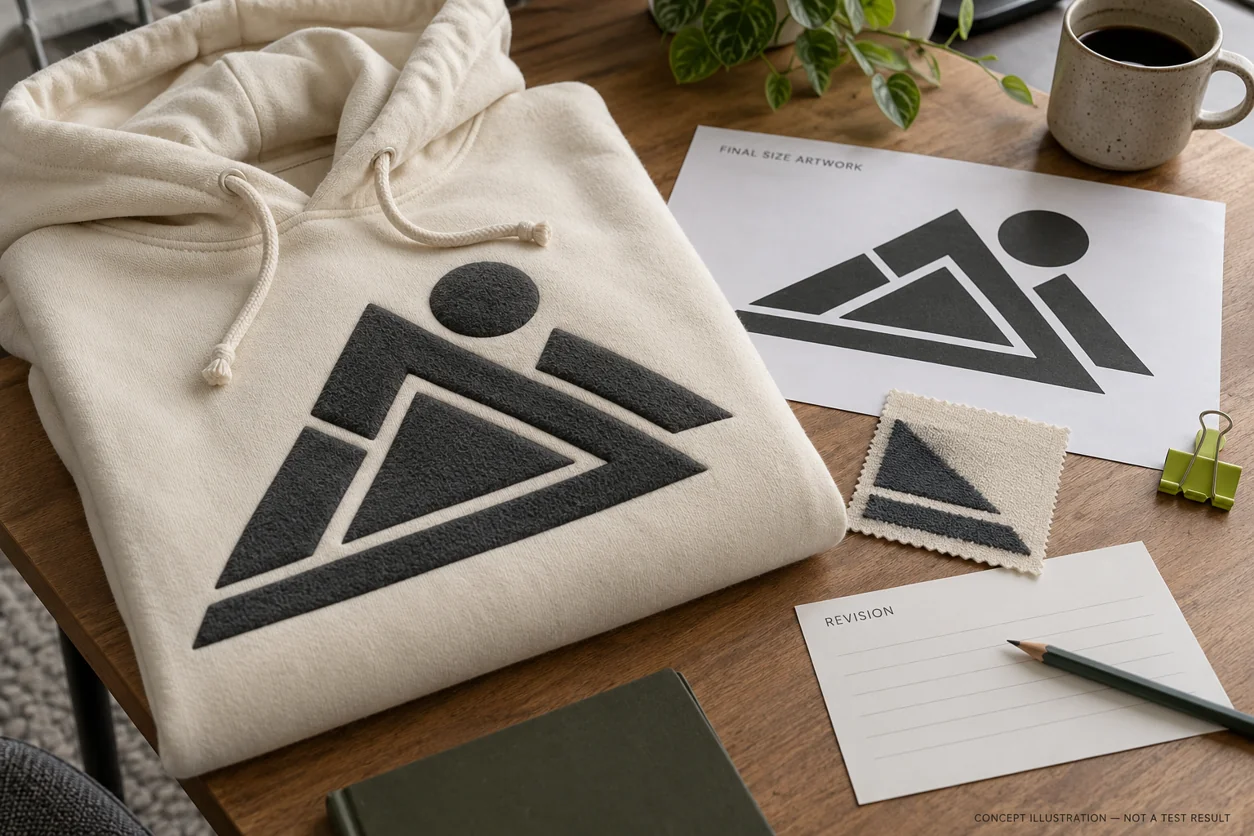
All six visuals are original conceptual illustrations. They are not photographs of actual Athletic Rush orders, measured print heights or laboratory test results.
1. Specify the effect instead of asking for more puff
Puff screen printing creates a raised ink effect. In its Plastipuff technical bulletin, Avient explains that the described ink expands when heated, including sideways. The practical design implication is to review both the height and the finished outlines: the artwork on a screen is not the whole approval decision.
Describe what you want the buyer to notice. Is it a discreet tonal mark, a rounded chest graphic or one raised accent within an otherwise flat design? Those are different briefs. A reference photograph helps convey the direction, but attach it to a written explanation of which qualities matter rather than asking the printer to copy an unidentified process.
Separate puff from other raised decorations
Puff ink, high-density ink, embroidery and an attached patch should not be treated as interchangeable specifications. They may all add visible dimension, but the construction and surface are different. Ask the supplier to name the proposed technique and provide a physical example when the terminology is unclear.
For example, a buyer wanting a rounded, expanded ink surface may be disappointed by a stitched badge, even if both look dimensional in a small image. Conversely, a design built around crisp squared edges may need a different approach from the puff effect shown in a reference. Review the actual finish before deciding which process fits the collection.
| Buyer objective | What to clarify in the brief | What to inspect on the sample |
|---|---|---|
| Small tonal chest mark | Intended visibility and acceptable contrast | Readability, colour relationship and edge definition |
| Bold rounded statement graphic | Final artwork size and desired surface character | Open spaces, consistency and overall garment appearance |
| Raised accent within a flat design | Which elements are raised and which remain flat | Alignment and the relationship between the two effects |
| Decoration close to a pocket or seam | Exact placement and construction clearance | Whether the finished print interferes with garment use |
This table is a briefing aid, not a promise that every design is suitable for puff. The printer should assess the actual artwork and substrate before recommending a process.
Review the final-size artwork
Send vector artwork where available, identify the required print size, and show its position on the hoodie. Do not approve only an enlarged screen view. Look at the design at its intended physical size, especially if it contains small lettering, closely spaced lines or narrow internal spaces.
Ask for the printer's proposed artwork adjustment as a separate revision. If opening a gap or simplifying a fine detail changes the brand mark, the brand needs to approve that change. Avoid an informal instruction such as "make it work" when important artwork details are involved.
There is no single minimum line width or spacing stated here. The suitable detail depends on the chosen process and the result demonstrated on a sample. Have the printer identify the vulnerable areas and show what remains legible after the effect is developed.
Keep the fabric and garment identity attached
A print on a convenient spare fabric is useful for exploration, but it should not silently approve a different hoodie. Identify the garment fabric, colour and relevant finish being sampled. If the fabric or finish changes, ask whether the decoration needs to be sampled again.
An oversized fleece pullover and a lighter French terry zip hoodie are different development contexts. Specify the actual intended garment instead of assuming an attractive print swatch will behave the same way on either. You can explore Athletic Rush hoodies while preparing that garment brief.
2. Inspect the whole decorated hoodie
A representative sample should let you judge the graphic, its surrounding fabric and its position on the garment together. Start with the intended viewing distance, then move close enough to inspect the details. A macro photograph may make the relief look impressive while hiding awkward placement or an overly dominant chest graphic.
Put the hoodie on a suitable wearer or form for the intended fit review. Check its normal resting position and ordinary movement. Keep the evaluation tied to the garment size and artwork revision so that later comments refer to the same sample.
Placement matters near seams, pockets and openings
Review a pullover graphic in relation to the neckline, armholes and kangaroo pocket. On a zip hoodie, decide deliberately whether the artwork is split into two parts, kept on one side or moved elsewhere. Do not assume a centre-front graphic can cross a zipper without a specific printing and alignment plan.
Ask the printer about construction areas that complicate the proposed application. Then inspect those areas on the actual sample. The buyer's role is to approve the usable outcome; the printer's role is to establish a suitable production method.
Example: a brand selects a rounded chest graphic for a boxy pullover. The flat mock-up looks balanced, but the sample places its lower edge too close to the pocket opening. A useful revision identifies the intended garment size and asks for a revised placement sample. It does not approve the print merely because the raised surface looks attractive.
Check the finished surface and surrounding fabric
Look for a consistent intended effect across the graphic, readable internal spaces and an edge quality that matches the approved reference. Describe what you see rather than diagnosing the production cause from appearance alone. An uneven result should prompt a process review by the printer, not an invented cure adjustment from the buyer.
Inspect the fabric around the print as well. Avient's Flexipuff additive bulletin specifically warns that large printed areas on lightweight fabric may cause puckering. That is a product-specific caution worth discussing when sampling; it is not a prediction that every hoodie or large graphic will pucker.
If the fabric pulls or waves around a proposed design, record the observation on the complete garment. Ask whether changing the artwork, application or selected substrate is appropriate, and review the revised result before approval. Do not reduce the decision to choosing the tallest possible ink effect.
Approve colour after the effect is produced
Review the finished colour under agreed viewing conditions beside the garment fabric. An ink selection or a digital colour value does not by itself settle the appearance of the final decorated hoodie. The cited Flexipuff bulletin notes colour lightening for that particular system, reinforcing the need to approve a finished sample rather than assuming an unprocessed colour reference is sufficient.
Do not apply that behaviour as a universal correction formula. Ask the printer to follow the current instructions for the actual ink and show the proposed result. If the decoration must coordinate with matching trousers or trims, use the same identified references throughout the project.
Our hoodie set colour approval guide explains how to separate matching, tonal and deliberately contrasting components. For puff artwork, the important addition is to judge the colour once the intended surface has been created.
Compare the feel, not only the photograph
Handle the sample and consider the print area in normal wear. Decide whether the amount of decoration suits the intended garment and customer. A small chest accent and a large back graphic place different demands on the design review, even when they use the same technique.
Record the agreed surface character using the retained physical sample. Words such as "premium," "soft" or "high quality" are too broad on their own. A reference sample plus a specific comment about the feature being approved is more useful than a marketing adjective.
3. Separate appearance approval from production approval
An attractive first sample is not evidence that every production variable is settled. Ask the supplier to identify the ink system, garment reference, artwork revision and relevant application instructions. The technical settings belong to the confirmed process, not to a generic online recipe.
The two manufacturer bulletins linked above describe different products and parameters. This guide intentionally gives no universal additive percentage, cure temperature, print height or fixed wash-count claim. The printer must use current product guidance and validate the actual garment application.
Agree the care and performance checks
Before approving bulk production, agree how the decorated garment will be evaluated after its intended care procedure. Specify who will conduct the check, which sample it covers, what will be recorded and which acceptance criteria apply. Do not invent a standard wash count simply because another brand used it.
Compare the resulting sample with the retained reference. Review print surface, attachment, visible changes, readability and the surrounding garment. Record relevant observations and photographs with the sample identity. If a change appears, ask the supplier to investigate rather than assuming that more heat or more additive is the answer.
The Plastipuff bulletin explicitly requires testing the ink and fabric for the intended application. A manufacturer's product description is useful process information, but it is not a test report for your order. Ask for evidence tied to the proposed garment and process where your project requires it.
Give a specific approval or revision
| Vague response | More actionable response |
|---|---|
| "Make it more 3D." | Identify the retained effect reference and request a revised sample demonstrating the desired surface. |
| "The logo is wrong." | Identify the artwork revision and the precise filled gap, changed outline or placement concern. |
| "Colour approved." | State which finished decorated sample and viewing conditions the decision covers. |
| "Go ahead with everything." | List approved appearance, placement and garment references, plus any outstanding performance checks. |
For example: "Appearance approved on pullover sample P-02 with artwork revision C. Keep the current open spaces and placement. Bulk release remains on hold until the agreed care review is complete." The sample code is illustrative; use your actual references and authorized decision-maker.
If a revision changes more than one aspect, record each change. A different artwork size may also change the overall garment appearance; a replacement fabric should not inherit the old approval without review. Keep the final approval linked to the exact combination you intend to order.
Retain a production reference
Keep the approved decorated garment or agreed sample reference accessible to the supplier and brand. Attach its artwork revision, fabric reference, colour decision and approval scope. Agree how the production run will be compared with that reference and how departures will be escalated.
For a reorder, ask whether any garment material, finish, ink system or production method has changed. If it has, determine what must be resampled. A saved photograph remains helpful for identification, but it should not replace the evidence required by the agreed quality process.
Buyer checklist before releasing a puff-print hoodie
- The decoration technique and intended raised effect are clearly identified.
- Artwork size, revision and placement are approved on the intended garment.
- Fine detail and internal spaces remain acceptable after printing.
- Finished colour, surface character and surrounding fabric have been reviewed.
- The printer has confirmed the suitable ink and process for the actual substrate.
- Agreed care and performance checks are complete, or outstanding conditions are explicit.
- A retained reference defines the combination approved for production and later reorders.
Common buyer questions
Can every logo be puff printed?
Do not assume so. Ask the printer to assess the final-size artwork, especially fine detail and tight spaces, then review a physical sample. Any change to the brand artwork should be approved explicitly.
Is a higher puff always better?
No. The desired effect must work with the design, garment and intended use. Approve the complete outcome rather than treating maximum height as a universal quality target.
Can I approve a sample on a different fabric?
You can use it to discuss the direction, but identify its limits. Final approval should address the intended garment material and finish, with any substitutions reviewed rather than assumed equivalent.
Can a photograph confirm durability?
A photograph can document appearance at a particular moment. It cannot establish the results of care or performance checks that were not carried out. Ask for evidence tied to the actual sample and agreed evaluation.
Prepare a sample brief for Athletic Rush
Send your hoodie style, fabric reference, final-size artwork, intended placement and a clear description of the raised effect you want. Identify which details are essential to the brand and which can be adjusted during sampling.
For the broader decoration decision, see our screen printing versus DTF guide. To discuss your hoodie sample brief, email kamran@athleticrush.co or contact Athletic Rush on WhatsApp.