 Sialkot, Pakistan

Your garment sample can look ready while its care label is still an unanswered question. Before printing labels for a U.S. launch, connect the proposed instructions to the identified garment, supporting information and a named reviewer. This guide helps a clothing brand organize that handoff without guessing a wash recipe.
Before you print
- ✓Keep decorative branding, required product information and care instructions distinct.
- ✓Identify the complete garment, including decoration, trims and every material revision.
- ✓Ask what supports the proposed instructions and what still needs checking.
- ✓Review the actual-size label and its attachment on the intended garment.
- ✓Release one dated version with responsibilities and unresolved decisions visible.
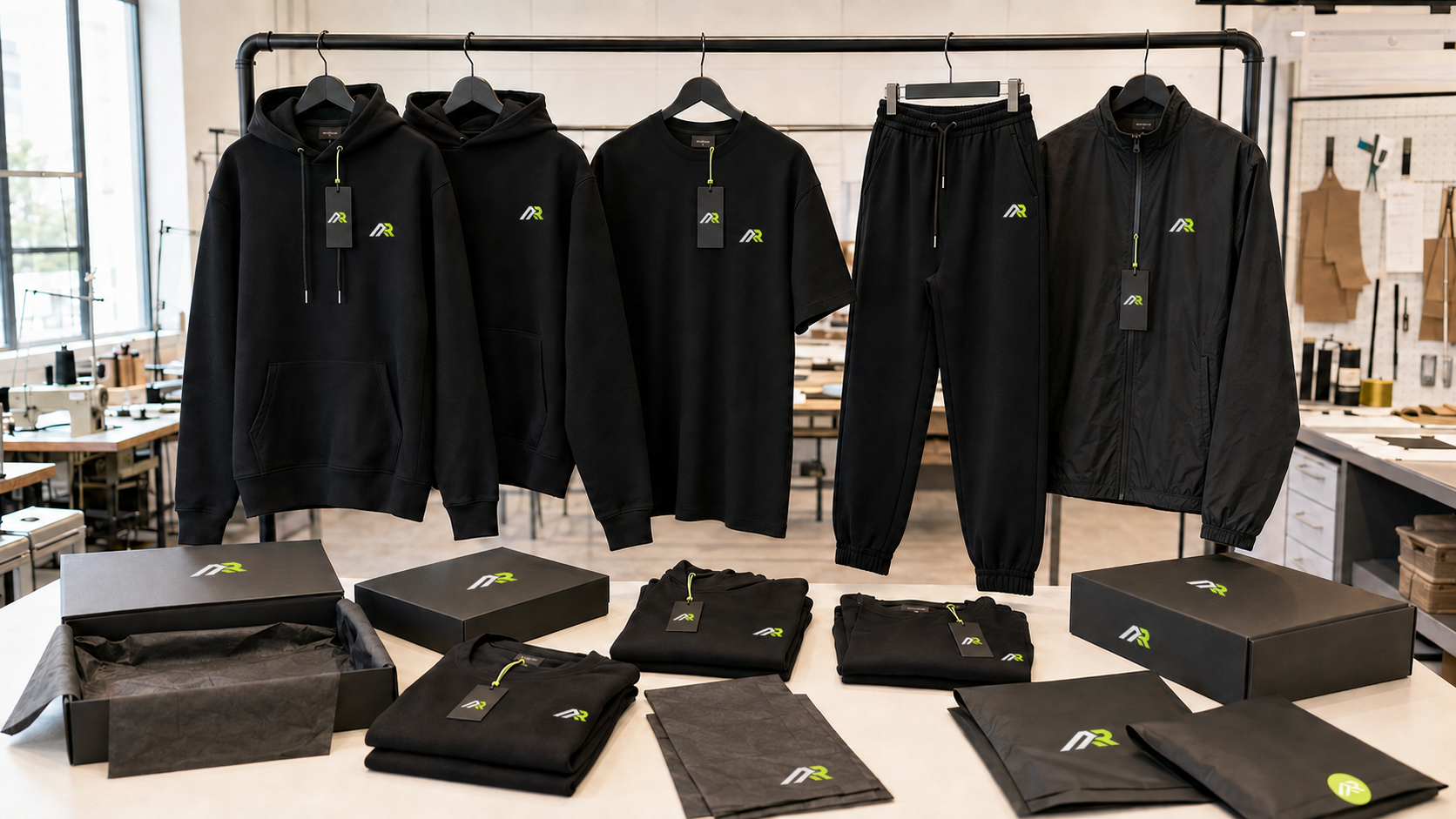
Website illustration of a private-label range. The tags and packaging shown do not establish complete care labeling, product origin, available stock or production evidence. View the source service page.
DECISION 01
Separate the information before designing the label
Start with three lines in your development brief: brand identity, product disclosures and care information. A logo label establishes a visual identity; it does not settle the other two jobs. Decide who supplies each data field, who checks it and who can release the artwork. A designer should not have to invent missing information to finish the layout.
The FTC’s textile and wool labeling guide explains that most covered products need fiber content, country of origin and the identity of a responsible business. Care instructions fall under a separate rule. Confirm the requirements for your actual product and market; this brief is not a complete U.S. compliance review.
For a tee, hoodie or woven jacket, create a field list before choosing the label dimensions. Mark unknown information as pending. Agree the label arrangement with the person reviewing the applicable requirements, including placement; do not assume one side-seam label settles every disclosure. The private-label development service is a useful starting point for discussing the physical label package.
DECISION 02
Build a component file for the exact garment
Give the style a code and revision, then list its body fabric, rib, lining, interlining, threads, closures and decoration. For each, record the supplier reference, color or finish, and available care information. Attach the material documents rather than copying a familiar instruction from a different product. Keep proposed substitutions visible.
A cotton tee with a chest print, a contrast-panel hoodie and a lined jacket present different questions. Ask whether the supplied information addresses only a fabric, a particular decoration trial or the assembled style. If the answer is unclear, record the gap. The purpose of this component file is to make the question specific, not to convert every supplier statement into a finished-garment claim.
Use fabric sourcing references to identify material proposals and the decoration options to discuss the intended application. A print method name alone is insufficient: identify the actual artwork, substrate, finish and application proposal. Keep those references together in the garment tech pack so the label review follows the same revision as the sample.
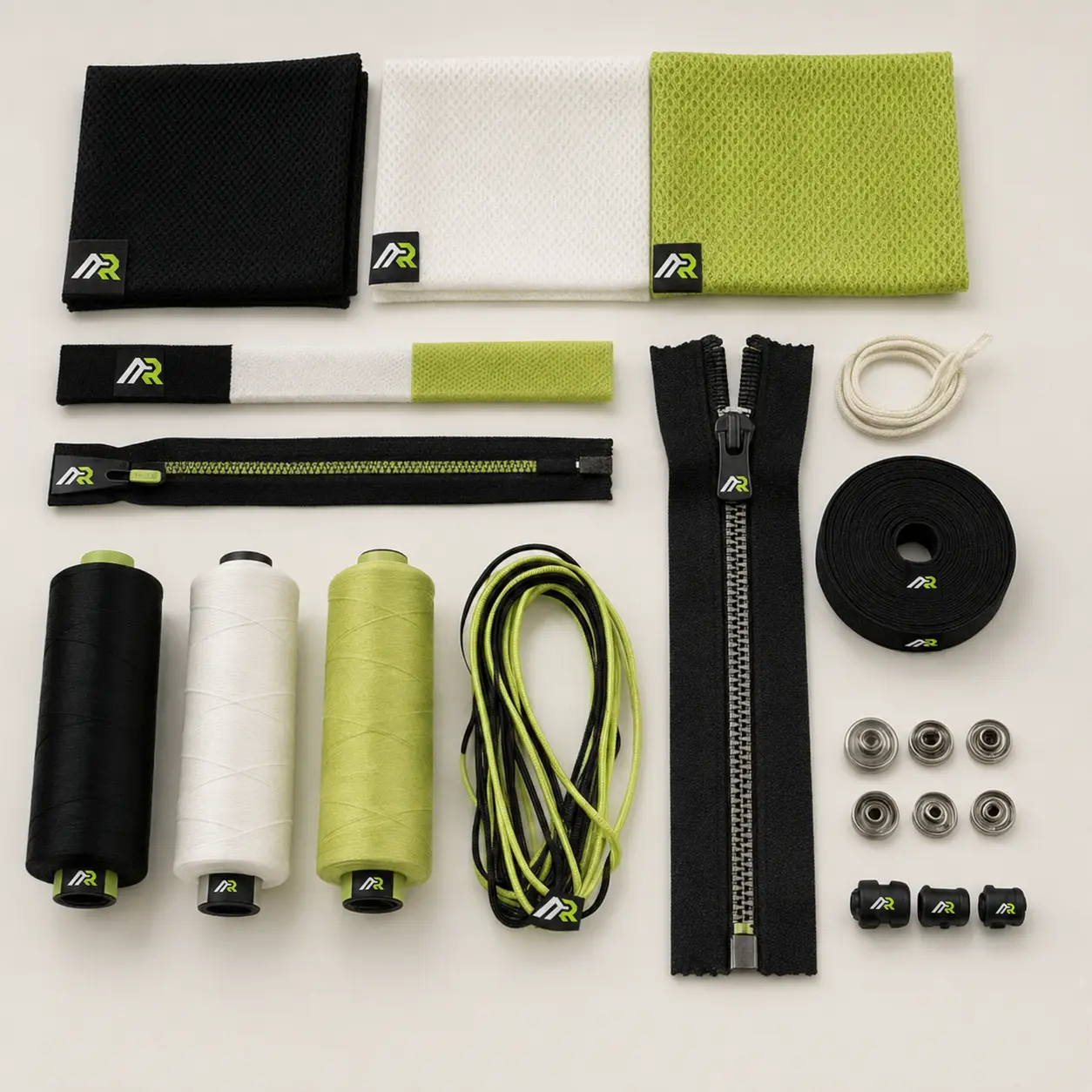
Website illustration of a component assortment. Use the actual component references for your garment; pictured materials do not establish composition, compatibility or care performance. View the source service page.
DECISION 03
Agree what supports the proposed care instructions
The FTC’s Care Labeling Rule, sections 423.5–423.6, requires a reasonable basis for care information before sale. Component evidence must be considered with reliable evidence for the garment as a whole. Ask the responsible reviewer to identify the basis for the proposed instructions, including relevant warnings. Do not choose wording simply because it looks cautious.
Build an evidence log with the sample revision, document or observation reference, method used, result and open question. Agree any additional evaluation with a suitable specialist. A casual home wash can reveal a concern, but do not present it as a standardized laboratory report or automatic proof of every care statement.
Fictional example: A startup develops a cream hoodie with a dark contrast hood and printed chest mark. Its fabric sheet covers the body material, while the proposed decoration and contrasting assembly remain unresolved. The brand holds label text, asks what evidence covers the complete revision and records the next evaluation. No actual test, defect or Athletic Rush customer is represented by this scenario.
Keep observation separate from conclusion: name the sample and the affected area before requesting a revision. The after-care color and fit review guide helps organize observations; it does not prescribe a universal care method or replace the reviewer’s evidence decision.
Have the garment but not the label brief? Share the style references and unresolved decisions. Request a development proposal or discuss the brief on WhatsApp.
DECISION 04
Compare label formats and proof the real size
Once the content is resolved, ask for an actual-size proof. Check the smallest text, line breaks, front and back, seam allowance and the area that remains visible after attachment. Request an attached label sample when reviewing access and feel. A large screen rendering can hide crowded wording or a line disappearing into a seam.
The Care Labeling Rule defines a care label as permanent, securely attached and legible through the product’s useful life. Select the substrate, printing and attachment with that purpose in mind. A temporary marketing tag should not be treated as the normal replacement for an attached care label; product-specific exemptions need separate review.
Use the comparison below to brief the proposal. These are development tradeoffs, not certification of a material or a universal placement rule. For the physical brand-label details, see the separate woven-label artwork and attachment guide.
| Format | Useful role | What to review |
|---|---|---|
| Printed care label | Space for resolved wording in a compact format | Actual-size legibility, print durability and attached sample |
| Woven brand label | A recognizable logo or brand signature | Artwork, fold, edge feel; separate required-information review |
| Combined information label | Several approved fields in one planned layout | Data ownership, available space and applicable placement rules |
| Separate label set | Different functions organized across identified labels | Correct pairing, accessibility and consistent product identity |
| Hangtag or packaging panel | Marketing and any separately required visible information | Do not assume it replaces the permanent care label |
Website illustration of brand labels and trims. Decorative labels are shown, not a verified care-label specification or an approved labeling system. View the source service page.
DECISION 05
Use a print-release record that follows the sample
Separate information approval from layout approval. One person may verify product data while another checks readability and attachment. Record both decisions against the same file. A message saying “looks good” is ambiguous when several versions are circulating; ask which text, artwork and garment revision it refers to.
The timeline below is a suggested production handoff. Agree who can authorize each stage with the supplier. If a material, color treatment or decoration changes, reopen the affected questions before releasing replacement labels. Record what changed rather than silently updating a file already sent to print.
Keep the accepted physical label reference with the garment record. Ask the manufacturing and quality team how the released artwork and attachment will be checked during production. Specify how obsolete artwork and unused label stock should be identified and held, and what requires your further decision.
1
Identify
Freeze the garment revision and list the information still missing.
2
Resolve
Assign evidence questions and record the reviewed wording.
3
Proof
Check actual-size artwork and the proposed attached label.
4
Release
Name the accepted file, date, decision-makers and change controls.
Care-label print-release checklist
- Style, revision, color and destination match the order.
- Every proposed field has an identified information owner.
- Care wording and warnings have a recorded supporting basis.
- Open evidence questions are resolved or explicitly held.
- Proof, substrate and attachment match the reviewed proposal.
- Text remains readable after the agreed attachment allowance.
- The accepted file and further-change responsibilities are recorded.
DECISION 06
Send a brief that makes the open decisions clear
A useful enquiry names the garment and destination, then separates confirmed information from requests for proposals. Include style codes, size range, colors, quantity, material and decoration references, label locations and the review work still needed. Ask the factory to state what it can supply and what the brand or its specialist must resolve.
Athletic Rush offers development, sampling, cut and sew, decoration, finishing, QC and packing under one roof in Sialkot, Pakistan. For planning, samples are approximately 7–10 days, bulk about 14 working days and MOQ from 20 pieces. Confirm the final price, MOQ, sample scope and timing in the written quotation for the particular style; allow separately for shipping.
For a repeat order, identify the previously released label and any changes to the garment or destination. Do not reuse old care text merely because the style name is unchanged. Make the label file, product specification and order instructions describe the same current product.
Ordering for the United States: Tell the Sialkot supplier where the goods will be sold and identify your importer and label reviewer. Agree who checks destination-specific product information and who supplies the final wording. Keep shipping, receiving and any specialist review outside an assumed factory production allowance.
Start with a clear label-development brief
Copy the brief, replace the brackets and attach your current specification.
We are developing [style/revision] for sale in [U.S. destination/channel], in [colors/sizes/quantity]. Attached are [materials, decoration and supplier references]. Confirmed label data: [fields]. Pending decisions: [care evidence, wording, placement or attachment]. Please identify your proposed label material, actual-size proof, attached sample and review scope. Name the inputs we must supply, and confirm style-specific price, MOQ, timing and print-release responsibilities in writing.
Request your style-specific quote · Talk on WhatsApp
Athletic Rush · Sialkot, Pakistan · kamran@athleticrush.co
Care-label questions from clothing brands
Can I copy care instructions from a similar garment?
Do not use similarity as the approval basis. Identify the actual materials, decoration and complete garment revision, then ask the responsible reviewer what supports the proposed care instructions.
Is a fabric supplier’s care sheet enough?
Treat it as one identified input. Establish its scope and ask how the complete garment, including component interactions and decoration, is covered before releasing the wording.
Can care instructions go on the hangtag only?
For ordinary covered apparel, plan for a permanent care label. The rule has specific exceptions, and packaging or display can create additional visibility requirements; check the actual product rather than assuming a hangtag is sufficient.
Does a woven logo label replace a care label?
A logo alone supplies no usable care procedure. Review decorative branding and the required information separately, then decide whether an appropriate combined layout or separate labels should be developed.
What should I approve before labels are printed?
Approve identified wording, its review basis, actual-size artwork, material and attachment proposal against one garment revision. Record who releases printing and which changes require another review.
References and scope
Reviewed November 9, 2026. Primary references: FTC Care Labeling Rule and FTC textile and wool labeling guide. U.S. apparel planning only; other product rules and other markets need separate review. This is a production-planning tool, not legal advice or a compliance certification. The worked example is fictional. Images are existing Athletic Rush website illustrations with the limits stated in their captions.