 Sialkot, Pakistan
 Worldwide enquiries

Two quotations can describe the same team colours and still cover very different orders. One may include a jersey and shorts, while another prices the jersey alone. One may include player names, while another leaves personalisation as a separate charge. Before deciding which custom team uniform quote offers better value, make the scope comparable.
This guide gives clubs, schools and team buyers a practical way to compare what suppliers have actually offered. Use it to prepare questions and organise written responses. Prices, minimum quantities, services and delivery arrangements must be confirmed for your specific Athletic Rush enquiry.
1. Give every supplier the same order brief

A lower price may cover fewer items. Compare the same garment scope first. AI-generated educational illustration, not a photograph of Athletic Rush staff or a customer transaction.
Create one dated brief that lists the sport, garment types, approximate quantities, size range, fit groups, colourways and delivery destination. Include the required arrival date and explain whether it relates to a tournament, season launch or another fixed event. Describe names, numbers, sponsor marks, labels and packaging separately.
Send the same version to each supplier. If a supplier proposes a different fabric, construction or decoration method, record it as an alternative rather than silently treating it as the original requirement. A quotation is easier to compare when assumptions are visible.
For example, a youth training jersey and an adult match jersey are not automatically equivalent products. Likewise, one complete kit per player may mean different combinations of garments. Define the components of a set and confirm whether independently sized tops and bottoms are possible for the proposed order.
The team uniform size chart and player roster guide helps you separate garment specifications from player allocation. Even before the roster is final, explain which quantities are estimates so the supplier can state how changes would affect the quote.
2. Compare specifications before unit prices
Place the quoted garment details next to your brief. Ask for clarification wherever the description is too broad to identify what will be made. Terms such as “premium fabric” or “custom printing” do not, by themselves, define the product or all included work.
Record the proposed material and construction, fit reference, size range, decoration method and any agreed sample reference. Ask how the supplier will handle fine artwork, different garment sizes and any requested colour matching. Avoid ranking fabrics by one number or a marketing label without considering the intended use and actual sample.
If one supplier offers a substitution, ask what changed, why it was proposed and whether it needs a revised approval. Keep that option on its own line. Your comparison should show which offer follows the original brief and which offers a different solution.
3. Separate the garment price from other charges
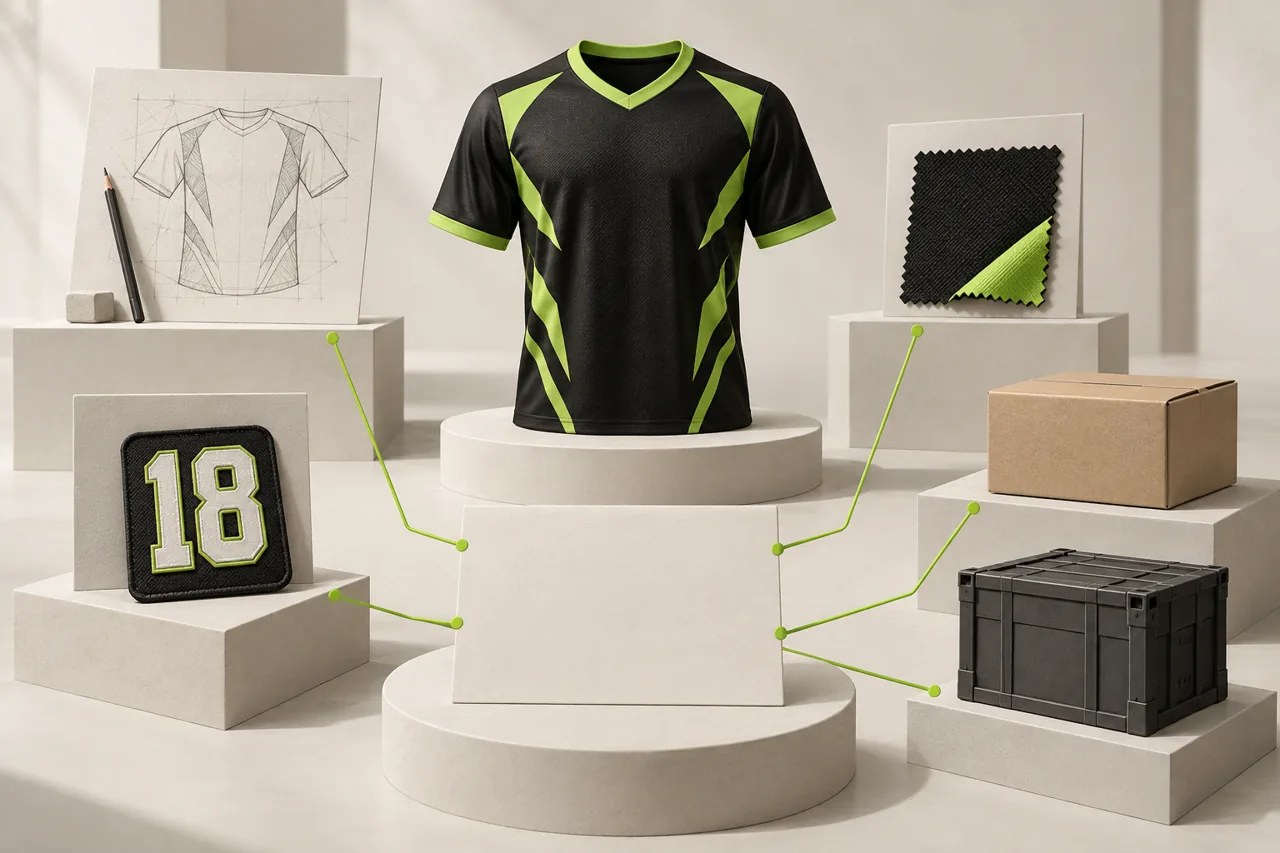
List the components of the quotation so exclusions remain visible. These objects illustrate possible cost categories; they do not imply that every category is charged separately.
Ask what the quoted unit price includes and what is additional. Depending on the order, questions may cover artwork preparation, sample development, names and numbers, extra logo positions, labels, special packing and delivery. Do not assume that any of these is free or always charged separately.
A useful comparison sheet can use the following columns: requirement, supplier response, included or additional, confirmed amount, and question still open. Mark an unanswered item as “not confirmed” rather than entering zero. A blank delivery charge is not evidence of free delivery.
For each supplier, build the confirmed total from garment quantities and unit prices, plus the separately confirmed charges. Record any applicable delivery or destination charges separately and state who has confirmed them. If an amount is still unknown, label the total incomplete instead of presenting it as a reliable delivered cost.
Keep currencies consistent when comparing offers and record the basis of any conversion you use. Do not mix a price for one quantity with another supplier's price for a larger order. If the quantity changes, request updated totals rather than assuming the earlier unit price still applies.
4. Clarify samples, revisions and approval stages
A sample can answer questions that a written description cannot, but the scope of the sample needs to be clear. Ask whether it represents the proposed fabric, fit, decoration and colourway, and identify any substitute detail. Confirm sample charges, delivery arrangements and whether any credit against a later order is actually offered.
Ask what artwork preparation and proof revisions are included in the proposal. If original logo files are missing, explain that before comparing quotes. The logo and sponsor artwork guide explains how to organise source files and placements for review.
Agree which decisions must be approved before production can begin. These may include the garment specification, artwork, roster and sample. Record the responsible contact and active file version. If a design revision changes the work involved, obtain the revised quotation before treating the earlier amount as final.
5. Compare dates and delivery on the same basis
Ask what starts the quoted production period. Does it begin after an order confirmation, an agreed payment stage, final artwork approval, sample approval or receipt of the locked roster? An estimated duration without a starting condition is difficult to use in a team schedule.
Keep production completion, dispatch and arrival as separate milestones. Ask which date the supplier is describing and which parts depend on other parties or outstanding approvals. Provide the delivery location accurately and ask for the proposed transport method and the scope of the delivery charge.
For an event order, work backwards from the date the team needs to receive and distribute the kit. Discuss space for reviewing a sample, correcting player details and checking the delivery. Do not assume that an urgent date is achievable until the supplier confirms the specific plan in writing.
6. Resolve the gaps before choosing

Resolve missing information before judging value. AI-generated illustrative scene; the comparison does not represent actual supplier offers or a claim that one supplier is better.
Send a short consolidated clarification list to each supplier. Ask them to confirm the same unresolved items, then date the updated quotation and keep the previous version for reference. This is more reliable than combining a price from one email, a fabric change from a message and a different delivery promise from a phone call.
Before selecting an offer, confirm that you understand:
- The exact garments, quantities, sizes and colourways being supplied.
- The specification and any alternative or substituted details.
- Which artwork, personalisation and packing tasks are included.
- The confirmed total and any unresolved additional costs.
- The sample and approval process.
- Payment stages, quote validity and the agreed change process.
- Production, dispatch and delivery expectations.
- How shortages, specification concerns or damaged goods should be reported and reviewed.
The best choice depends on the team's needs and the confirmed offer. A lower unit price may be useful, but it does not settle questions about fit, completeness or the work needed to deliver the order. Evaluate the answers and supporting samples rather than relying on a broad “best deal” promise.
Request an Athletic Rush quotation
Send your garment list, quantities, fit groups, artwork references, delivery destination and required date to kamran@athleticrush.co or Athletic Rush on WhatsApp. Ask for included services, exclusions and approval checkpoints to be identified in writing.
If some details are not final, say which ones. A clearly labelled estimate helps the supplier explain what still needs confirmation. For an existing team's additional garments, include the previous order reference and use the replacement uniform ordering guide.
Common quotation questions
Can I compare prices before the roster is final?
Yes, as an initial comparison, provided each supplier receives the same quantity and size assumptions. Ask for a final quotation when those assumptions are confirmed or changed.
Does the cheapest jersey price mean the cheapest order?
Not necessarily. Compare the same garments and included work, then account for confirmed additional charges. Keep unknown costs visible.
Should I ask for a sample before ordering?
Discuss what you need to verify and what sample options are available. Confirm the sample's purpose, specifications, cost and approval process for your actual order.
What if the quotation does not mention delivery?
Ask the supplier to clarify it. Record the destination, transport scope, quoted amount and any remaining exclusions before treating the comparison as complete.