 Sialkot, Pakistan
Two factories have replied to your first streetwear enquiry, but one amount covers a finished printed T-shirt while the other covers a blank garment with several details still open. Which offer is better? First make the garment, quantities, included services and delivery basis comparable. Then compare the confirmed amounts. An unanswered line is not a free service, and a different garment is not the same offer at a different price.
For a new U.S. clothing brand or a creator building a first drop, the useful outcome is a quotation you can connect to an identified product and an agreed next step. This guide gives you a comparison sheet, examples of differences to resolve and a clarification message you can send back. It does not supply invented factory prices or a universal cost benchmark.
Start with Athletic Rush's website: Explore Athletic Rush streetwear development and manufacturing to identify the garment direction you want quoted. If you are still choosing how the products work together, review Athletic Rush's collection-development service before asking several suppliers to price different interpretations of the range.
The Loop Tee and Harbor Hoodie below are fictional teaching examples, not Athletic Rush stock or customer orders. The supplier replies described are illustrative scope differences, not real quotations. All six images are original AI concept illustrations rather than photographs of actual staff, samples, invoices or shipments.

Concept illustration: compare the garment and scope attached to each proposal before treating the amounts as alternatives. No actual quotation or price is shown.
Make the comparison about one identified order
Give every supplier the same dated request and revision. For the fictional Loop Tee, that means a named fit and measurement reference, identified fabric proposal, intended finish, front and back artwork, label and packing requirements, and quantities by color and size. A photograph and the phrase “premium oversized tee” leave too many decisions open.
Keep an alternative proposal separate from a response to the original request. If one supplier proposes a different fabric, shorter body or decoration method, ask for that option to have its own description. It might suit your project, but it should not silently replace the requested version in the comparison.
For an illustrative first range of 30 Loop Tees and 30 Harbor Hoodies, there are 60 physical garments and two proposed designs. Athletic Rush's confirmed minimum is 30 pieces per design, allowing one to three colors and mixed sizes within that same design. Each different design requires its own 30 pieces. Ask Athletic Rush to confirm the actual design grouping; do not assume a retail bundle merges the minimums.
Make sure every response uses the same garment quantities. A per-piece offer for a larger order cannot be applied to your smaller order without confirmation. Likewise, an amount for a tee-and-hoodie bundle needs an explicit statement of its components and quantities. Use the Athletic Rush size-and-color order breakdown guide to attach an unambiguous allocation rather than writing only “60 pieces.”
Use a real Athletic Rush product reference in the enquiry
Athletic Rush website reference: Relaxed Midweight T-Shirt — True Black Tonal Mineral Wash. The page presents a relaxed tee direction, tonal mineral-wash appearance and front-and-back views. You can link that visual starting point in your request, then identify the measurements, artwork and finish that you want developed.
For example: “Please use the linked Athletic Rush True Black relaxed tee as our visual reference. Our requested measurements and front/back artwork are attached separately. Quote the identified version and list any proposed changes as an alternative.” The page does not establish ready stock, measured finished dimensions or approval of your variation.
Compare the available directions: Browse Athletic Rush's streetwear T-shirts before selecting the reference. For the second garment, use Athletic Rush's hoodie development page to start a separate hoodie discussion. A tee reference cannot define a hoodie construction or size chart.
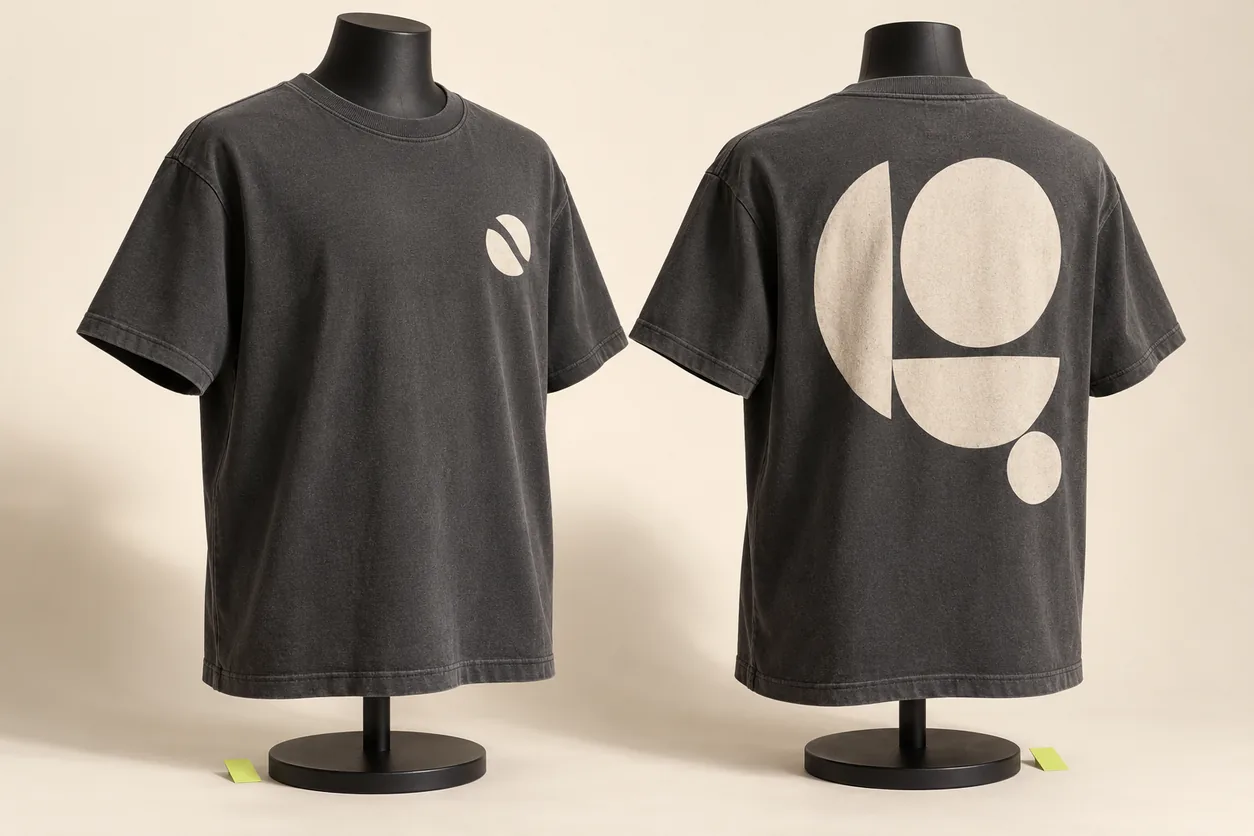
Concept illustration: a short description such as “printed tee” can hide differences in artwork coverage and placement. These are fictional decoration proposals, not a measured print comparison.
Check what the garment amount actually includes
Read the garment specification alongside the commercial reply. For the Loop Tee, check whether the material reference, construction, finished fit, wash or finish, decoration and labels agree with the issued brief. For the Harbor Hoodie, include its hood, pocket, rib and trim decisions. Similar product names do not establish equivalent work.
A materials list helps you ask more precise questions. Techpacker's garment costing guidance includes garment components such as fabrics, trims, labels and packaging in a costing sheet. Use that component-level thinking to check scope; a supplier does not have to disclose every internal production cost for you to ask what the offered amount covers.
For each required item, record one of four clear states:
- Included: the supplier confirms the item is covered in the identified amount.
- Separately charged: a specific additional line and charging basis are stated.
- Excluded: the supplier explicitly says the item is outside the offer.
- Unknown: the reply does not resolve it yet.
“Custom labels available” is a capability statement, not confirmation that your labels are included. “Packing included” still needs the type of packing and its scope. A blank cell should remain unknown until you receive an answer; do not replace it with zero in your comparison.
A comparison sheet you can copy
Put the quote date, revision, currency, validity period and product reference above the sheet. Replace the last two columns with the suppliers' exact written answers and reference the relevant quotation line or attachment.
| Line to compare | Evidence or clarification needed | Supplier A | Supplier B |
|---|---|---|---|
| Garment identity | Same style, specification revision, material, finish and intended fit | Record reference and deviations | Record reference and deviations |
| Quantity and charging unit | Pieces per design; color-size breakdown; components of any bundle | Record exact quantity and unit | Record exact quantity and unit |
| Decoration | Artwork revision, front/back locations, dimensions and application proposal | Included, separate, excluded or unknown | Included, separate, excluded or unknown |
| Labels and packing | Label types, attachment, hangtags, bags and carton or assortment instructions | State the exact included items | State the exact included items |
| Samples and development | What sample is supplied; revisions, delivery and any conditions for a credit | Record scope and conditions | Record scope and conditions |
| Additional order charges | Required setup or other charges not already included | Record line, basis and amount if quoted | Record line, basis and amount if quoted |
| Delivery responsibilities | Named destination or handoff point; freight and other responsibilities | Record stated basis and open items | Record stated basis and open items |
| Timing and payment | Production start conditions, payment stages, validity and unresolved approvals | Record confirmed terms | Record confirmed terms |
Keep the original files beside the sheet. A summary is useful only if you can trace its entries back to the actual reply. If the supplier revises the offer, replace its revision reference and check every affected row instead of changing one total in isolation.
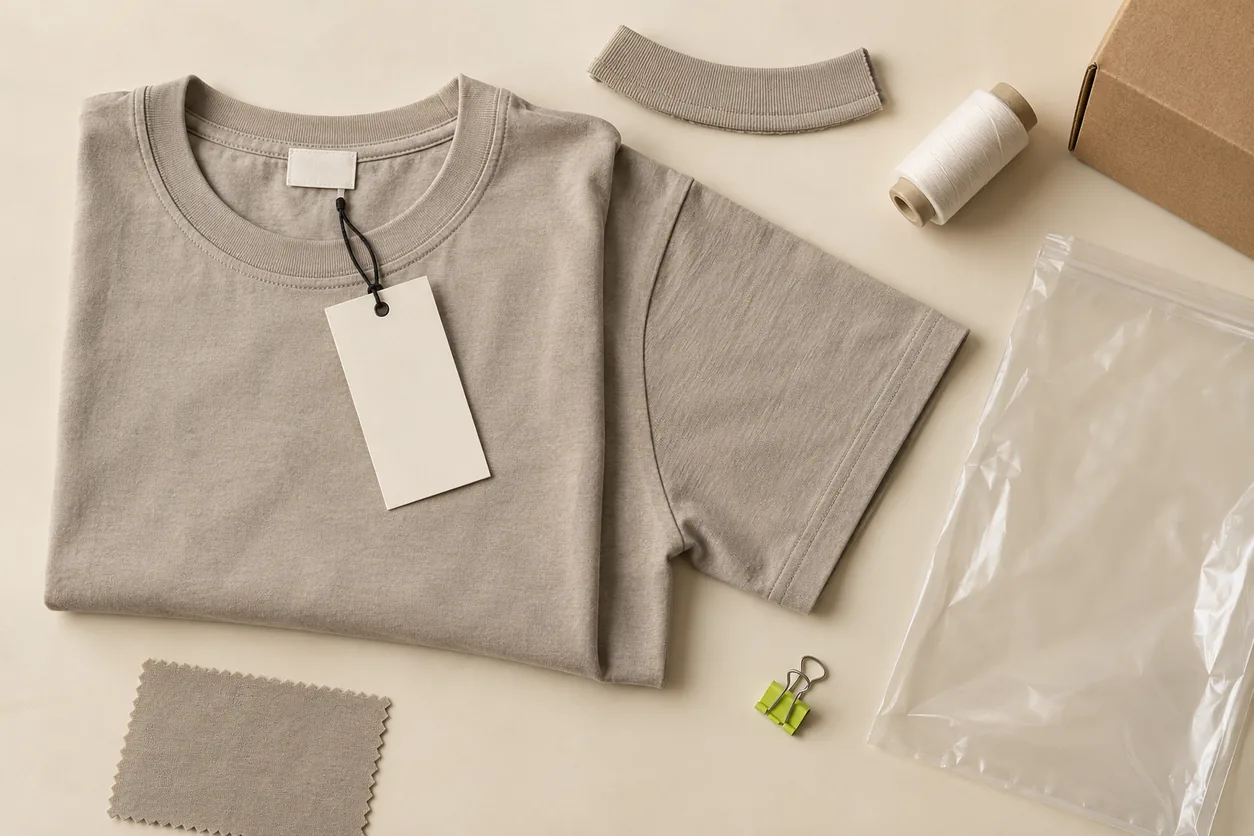
Concept illustration: labels, trims and packing are separate scope questions even when they sit beside the same garment. The objects do not document Athletic Rush's included services.
Resolve differences before you rank the offers
The first decision is whether both replies describe the requested project. The second is whether you prefer an explicitly different proposal. These are separate questions. A material substitution may be acceptable; an unrecorded substitution leaves you comparing an assumption with a specification.
The following examples are fictional. They show how to turn a difference into a useful supplier question without inventing prices or claiming that one option is automatically better.
| Difference you notice | Why the comparison is incomplete | A precise question to send |
|---|---|---|
| One Loop Tee reply names a front graphic; the other includes front and back artwork | The decoration scope differs | “Please quote our attached front-and-back artwork revision LT-02, or identify the front-only version as a separate option.” |
| Both replies say oversized, but one uses a different measurement chart | The finished product may differ | “Confirm the chart and revision used. List any proposed changes to body length, width or sleeve measurements.” |
| A Harbor Hoodie sample is included, but revision coverage is unstated | The development work is unresolved | “Identify the sample stage included, how a requested correction is handled and which further charges require approval.” |
| The offer says custom labels are possible but gives no included label details | Availability does not define the offer | “Confirm whether the specified brand, size and care-information labels and their attachment are included; identify anything separate.” |
| One reply prices a different order quantity | The unit amount relates to another scope | “Please return a quotation for our exact design quantities and allocation, keeping any larger-quantity alternative separate.” |
| A shipping line has no named destination or responsibility detail | You cannot tell where the stated service ends | “Identify the delivery or handoff point, applicable basis and which freight or destination items remain outside the amount.” |
Treat a missing answer as a pending decision, rather than automatically rejecting the supplier or awarding a good score. What matters is whether the supplier resolves the question clearly enough for the next decision. A neat document with unresolved essentials is still incomplete.
If the original requirements exceed what you want to spend, revise the product deliberately. You might request an alternative decoration area or packing proposal, but do not assume it will produce a particular saving. Ask for a separately identified revised offer and review the effect on the intended garment and brand presentation.
For hoodie-specific decisions, Athletic Rush's guide to the details behind a custom hoodie quotation develops the material, trim and construction questions. This comparison sheet serves a different purpose: reconciling several returned offers for one first-drop brief.
Connect the commercial reply to physical sample evidence
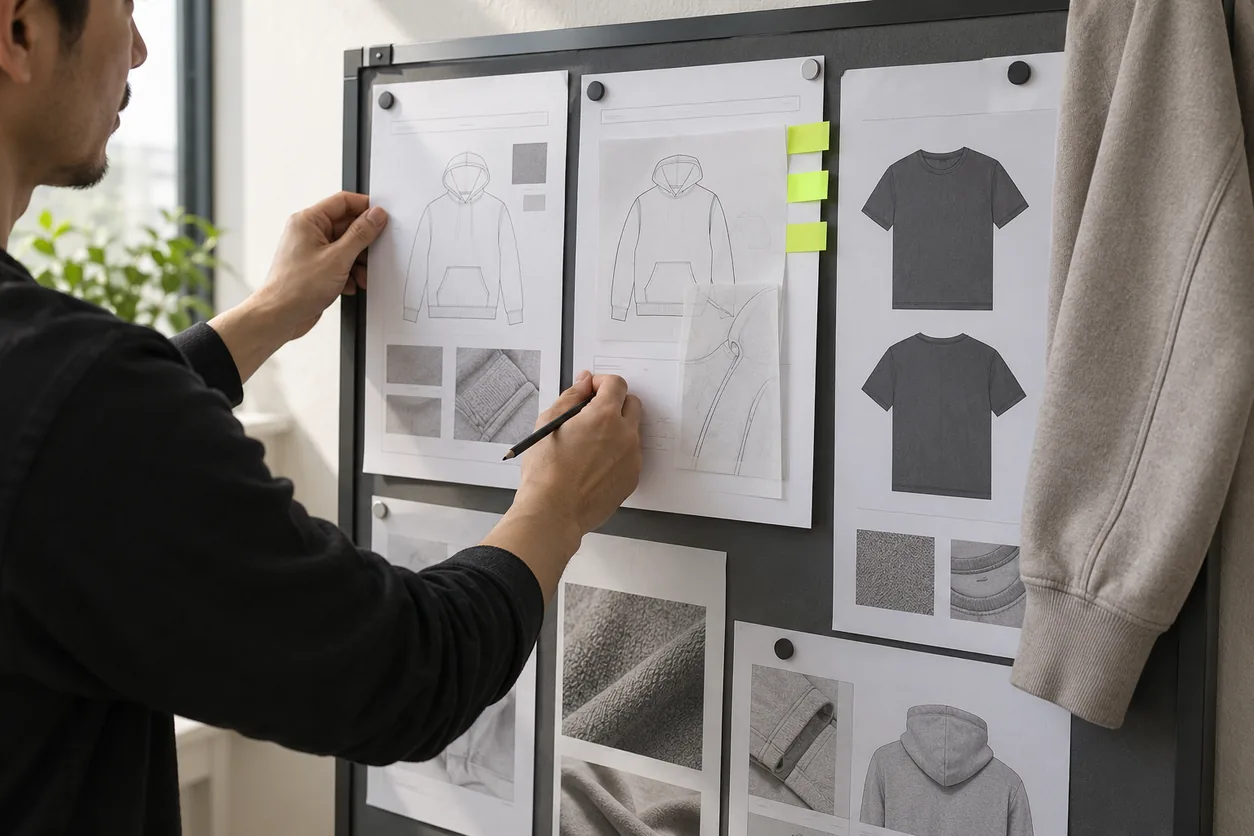
A render or a quotation describes a proposal; it does not establish how the finished garment feels or fits. Before using a sample to support a supplier decision, identify which material, specification and decoration revision it represents. A good-looking sample of another garment is not evidence that your quoted version has been approved.
For the Loop Tee, inspect the intended silhouette, neckline, seams, finish and proposed decoration. For the Harbor Hoodie, include hood shape, pocket construction, rib behavior and the complete worn fit. Record the observation, the reference and what still needs a decision. A different body's fit in a photograph should not be treated as a controlled dimensional comparison.
Ask whether requested changes affect the quoted scope or require another review. For example, changing a hoodie from the reviewed fit to a shorter body should update the specification and the corresponding quotation reference. Do not let the confirmed offer point to one version while the sample comments describe another.
Keep the technical record connected: Read Athletic Rush's streetwear tech-pack and sampling-brief guide for the drawings, materials, measurement references and revision control that support this review. The comparison sheet is not a substitute for that packet.
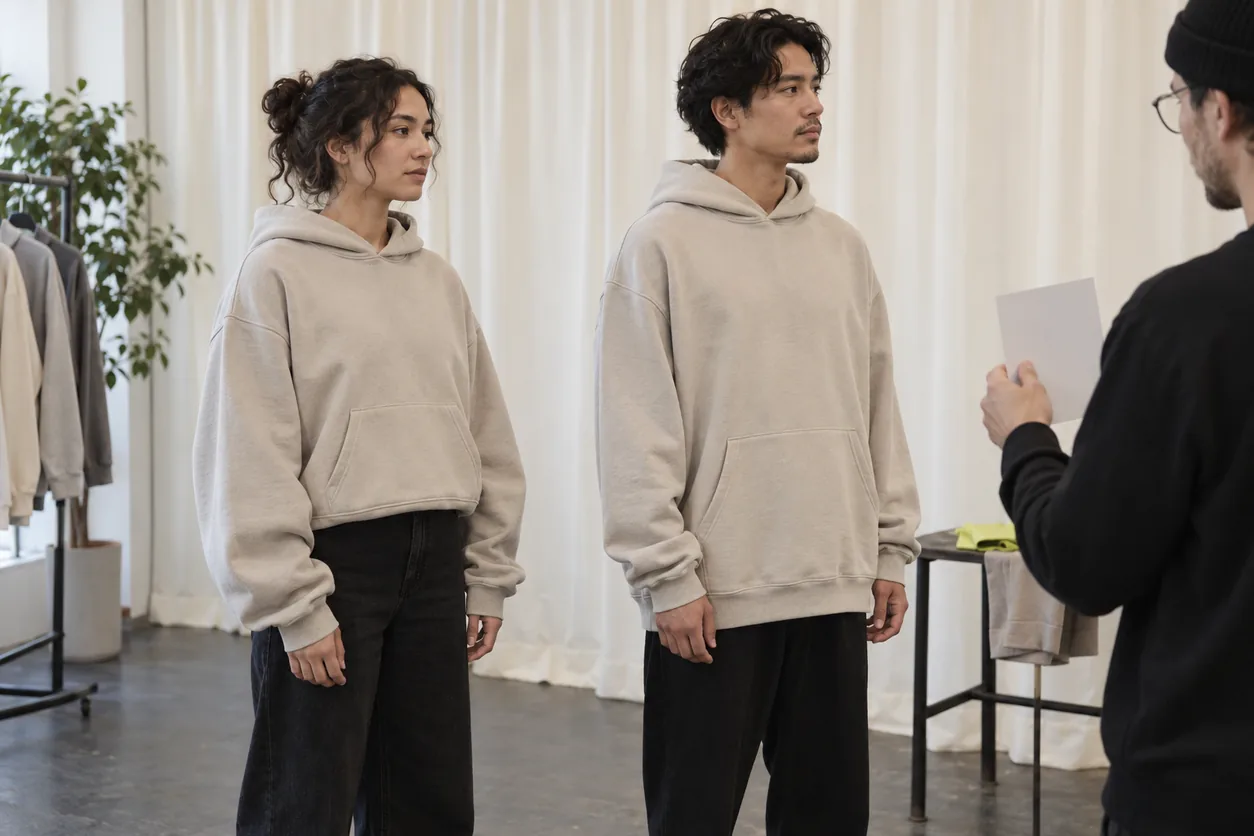
Concept illustration: establish which proposal a sample represents before connecting its review to a quotation. Different wearers and garments do not establish measured fit results.
Separate the manufacturing subtotal from delivery and payment
Once the product scope matches, build a comparison using the suppliers' actual quoted figures. Keep the currency, quantity and charging unit visible. Add mandatory charges only when they are not already included; show optional extras separately. A sample credit should appear only under the conditions the supplier has actually confirmed.
A confirmed comparison subtotal consists of the identified garment line totals plus confirmed required charges that are not already included. If a required item is still unknown, label the comparison incomplete. Do not present that subtotal as a complete delivered cost while freight or destination charges remain unresolved.
Avoid counting a deposit as an additional production charge when it is a payment toward the agreed amount. Put payment stages on a separate schedule and reconcile them with the stated total. Ask about fees, deductions, credits or other conditions rather than assuming they work the same way across suppliers. This is a document check, not a recommended payment percentage or an assurance about a supplier.
For a U.S. delivery, state the intended receiving location or ZIP code and ask where each quoted service ends. Confirm responsibility for transport, insurance where relevant, clearance and any duties, taxes or destination charges with the supplier and appropriate shipping or customs professionals. No duty rate or shipping price is supplied here.
The U.S. International Trade Administration's Incoterms overview explains how the rules allocate tasks, costs and risks between buyer and seller. If a quotation uses one, identify the rule, named place or port and version. The overview also notes that these rules do not themselves establish the goods' price or payment timing. Three letters therefore cannot replace a complete garment description and commercial agreement.
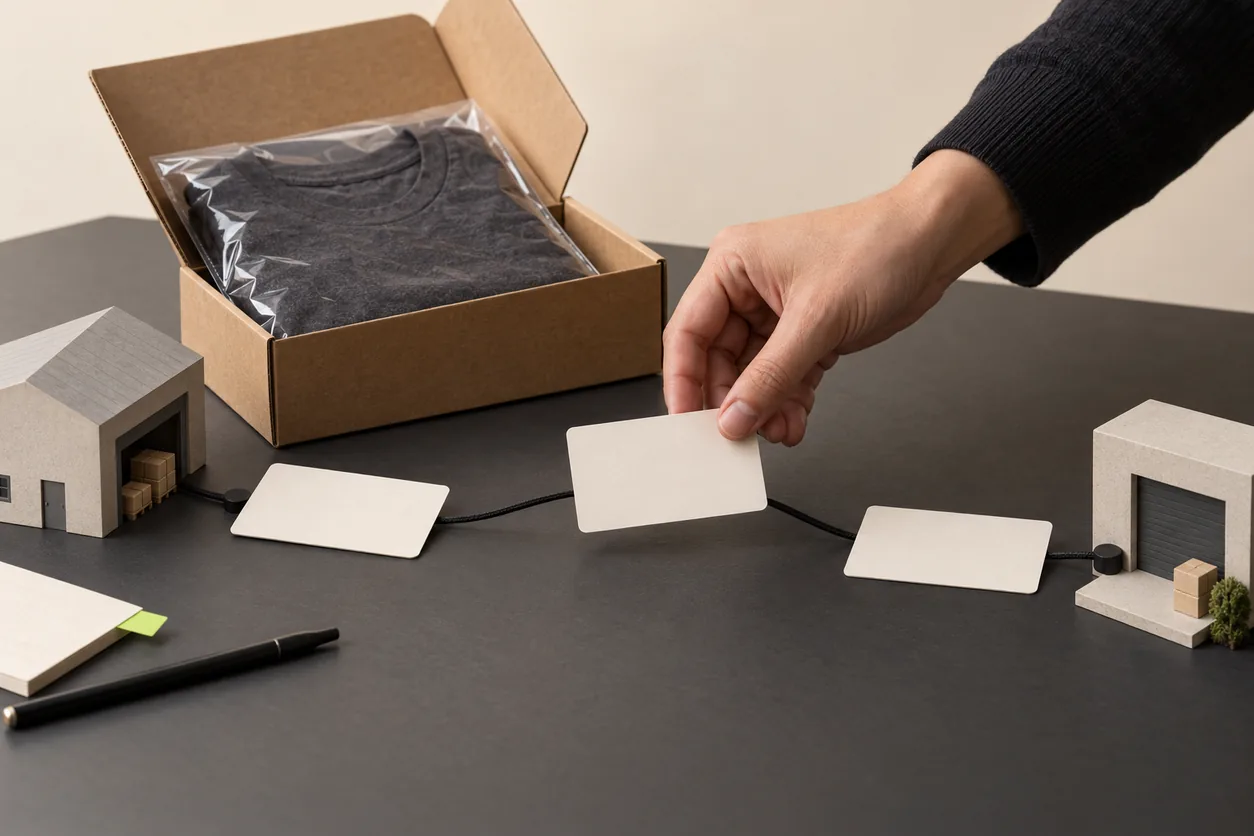
Concept illustration: identify the delivery and responsibility handoffs. The props do not define an Incoterms rule, an actual route or a completed shipment.
Check dates against the actual approval sequence
Ask what starts the quoted production period: an agreed approval, availability of identified materials, a payment stage or another confirmed condition. Keep sample development, revisions, bulk production and shipping visible as separate stages. A dispatch estimate is not an arrival commitment.
Athletic Rush's owner-confirmed sample production is 4–6 working days. Bulk production is 8–10 working days for orders up to 100 pieces; larger-order timing depends on quantity. Shipping time is separate. Ask how these terms apply to the final project and any revisions before fixing a launch date. Manufacturing is in Sialkot, Pakistan, serving U.S. brand enquiries.
For a creator-led drop, a planned announcement or follower response does not settle manufacturing readiness. If the product, quotation or delivery assumptions remain open, keep the launch plan conditional rather than presenting the earliest possible date as a confirmed customer arrival date.
Send one clarification message, then request a revised offer
Collect the unresolved items into a short, dated reply. A useful message names the original request and asks for differences to be resolved in one revised document, instead of scattering decisions across messages and screenshots.
Please revise quotation [reference/date] against our first-drop brief [revision]. Confirm the exact design quantities, material and measurement references, front/back decoration, labels, packing and sample scope. Mark each required item as included, separately charged or excluded, and identify anything still unresolved. Keep alternative garments or quantities separate. State the currency, validity, payment stages, production start conditions, named delivery basis and destination responsibilities. Return the revised quotation with its revision reference so we can compare it with the attached brief.
Replace the bracketed fields with your actual references and add the specific discrepancies from your sheet. Do not send an empty template and assume it defines the garment. Keep the revised quotation, relevant specification and sample-review decisions together.
The International Trade Administration notes that a pro forma invoice can provide a quotation to a prospective foreign buyer. Whatever the document is called, check its contents and ask which identified version and terms govern the proposed order; the title alone does not resolve missing scope.
Concept illustration: connect the revised commercial reply to the same garment references. No real quotation, signature or approval record is shown.
Questions first-time clothing brands ask
Should I automatically choose the lowest unit amount?
First confirm that the offers describe the same product, quantities and included services. Then review the known total, open items, relevant sample evidence and confirmed terms. A lower unit amount by itself does not establish a better or worse supplier.
Can I request an estimate before every design detail is finished?
You can ask for an initial discussion, but identify the open decisions and the assumptions behind the response. Ask what could change and what information is needed for a more specific offer. Keep an assumption-based estimate separate from a quotation for the final identified specification.
Does 30 pieces per design include every color and size separately?
Athletic Rush allows one to three colors and mixed sizes within the same 30-piece design minimum. Each different design requires its own 30 pieces. Confirm the actual grouping and any project-specific constraints in the quotation; do not invent a 30-piece minimum for each matrix cell.
What if a supplier changes the offer after the sample review?
Ask which specification, quantity, service or term changed and obtain a revised quotation. Compare the affected lines with the reviewed garment and your previous version. Resolve the difference before treating the quotation and sample as a matched approval.
Bring a comparable brief to Athletic Rush
Request an Athletic Rush streetwear manufacturing quotation with your product-reference link or tech pack, proposed pieces per design, color-size allocation, decoration files, label and packing requirements, U.S. destination and target arrival window. State which points are decided and which need a proposal.
For your first enquiry, a clear product reference and honest open questions are more useful than an unexplained target amount. Email kamran@athleticrush.co or discuss the brief with Athletic Rush on WhatsApp. Ask for a written response that identifies the garment, the included scope and the next sample or quotation decision.