 Sialkot, Pakistan
A garment measurement tolerance is the agreed amount a particular finished-garment measurement may fall below or above its target. Agree it for each relevant point of measure, with the measurement method, units, garment condition and decision rule written beside it. A single “plus or minus” note for the whole collection leaves too many questions unresolved.
For a U.S. clothing brand developing custom T-shirts or hoodies, the practical question is: how much variation can this design accept while keeping the intended fit and size relationships? The answer needs a conversation about the actual garment and a repeatable inspection. It cannot be selected from a universal internet chart.
This guide uses a fictional charcoal Grid Tee, intended to look boxy, and a stone Edge Hoodie, intended to finish near the waistband. They are teaching examples, not available inventory or Athletic Rush production specifications. Every numerical example below is hypothetical arithmetic, not a recommended tolerance.

Original AI concept illustration. The people, samples and documents demonstrate a development discussion; they are not an actual customer order or verified factory record.
Settle the measurement before debating its tolerance
Two people can disagree about a sample because they measured different things. One may record a flat width while the other records circumference. One may include a rib band in body length while the other stops at its joining seam. A smaller tolerance will not resolve an undefined method.
A point of measure, often abbreviated POM, identifies the dimension to inspect. Give each important POM a code, a plain description and a diagram showing its start, finish and route. Define whether the garment is closed, laid flat, relaxed or measured under a separately specified stretch condition. Do not silently pull a knit until the tape reaches the expected value.
For the Grid Tee, a chest-width row should identify the exact side-to-side landmarks and measuring position. “Chest” alone is incomplete. For the Edge Hoodie, explain whether the finished lower rib is included in the length and how the hood is kept out of the measuring route.
Techpacker's garment spec-sheet guide explains that measurement tables communicate garment dimensions and tolerances, supported by diagrams. Use that document structure, then define the points appropriate to your design. Its example figures are not a ready-made tolerance policy for your collection.
Before discussing numbers, settle these five fields:
- Identity: style, sample identifier, size and specification revision.
- Dimension: POM code, endpoints, route and whether the value is width, circumference or another dimension.
- Units: one controlling unit system throughout the measurement sheet.
- Condition: the agreed stage and state of the garment when measured.
- Recording: the measuring tool, recording precision, rounding rule and way to resolve a disputed result.
U.S. buyers may brief in inches or centimetres; the supplier must know which sheet controls. Avoid separately rounding converted figures and treating both versions as equally authoritative. Keep one controlled specification and mark any conversion as a reference.
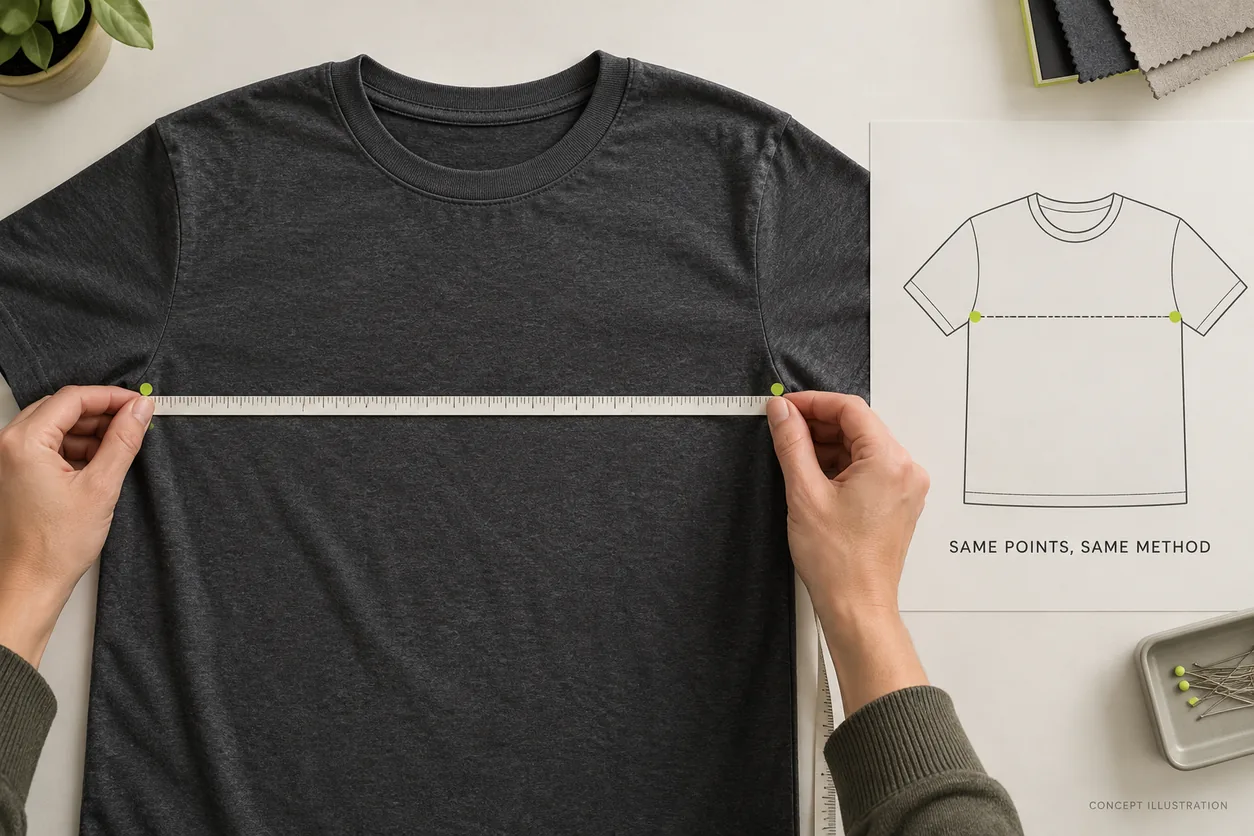
Concept illustration of repeatable landmarks. Tape marks and garment proportions are not readable test results or a substitute for an agreed measurement diagram.
Write the target and both limits explicitly
The target describes the intended finished dimension. The tolerance describes the accepted departure from that target for a defined inspection. Keep the target as the production aim; the existence of an allowed range is not an instruction to manufacture everything at one edge of it.
A symmetric tolerance allows the same departure in both directions. An asymmetric tolerance allows different departures below and above the target. If a supplier proposes the latter, ask what garment decision it protects and whether it is achievable. Do not assume the smaller or larger direction is automatically harmless.
For example, the Edge Hoodie's intended hem position might make a shorter result undesirable. That observation does not establish a suitable numerical limit. Review the physical proposal, worn fit and measurement method before agreeing the allowed variation.
Illustrative calculation only: the table uses centimetres and assumes the stated lower and upper boundaries are included in the permitted interval. These values are invented for teaching; they do not describe a real Athletic Rush sample.
| Fictional measurement row | Target and hypothetical tolerance | Calculated permitted interval | Recorded example and dimensional decision |
|---|---|---|---|
| Grid Tee flat chest width | Target 55.0 cm; minus 1.0 / plus 1.0 cm | 54.0–56.0 cm | 55.7 cm is within this row's interval |
| Grid Tee finished body length | Target 68.0 cm; minus 1.0 / plus 1.0 cm | 67.0–69.0 cm | 69.2 cm is outside this row's interval |
| Edge Hoodie relaxed hem width | Target 52.0 cm; minus 0.5 / plus 1.0 cm | 51.5–53.0 cm | 51.3 cm is outside this row's interval |
Calculate the lower boundary by subtracting the allowed negative departure from the target. Calculate the upper boundary by adding the allowed positive departure. Record the observed difference as actual measurement minus target, preserving its sign.
A number at a boundary needs the previously agreed precision and decision rule. Do not choose a new rounding method after seeing an inconvenient result. If the measurement itself is disputed, resolve the method and recheck before making a dimensional decision.
Also distinguish a development proposal from an approved limit. A supplier's suggested tolerance can be marked “proposed” until the brand and supplier settle it. A blank cell should remain an open decision, not be interpreted as zero variation or unrestricted variation.
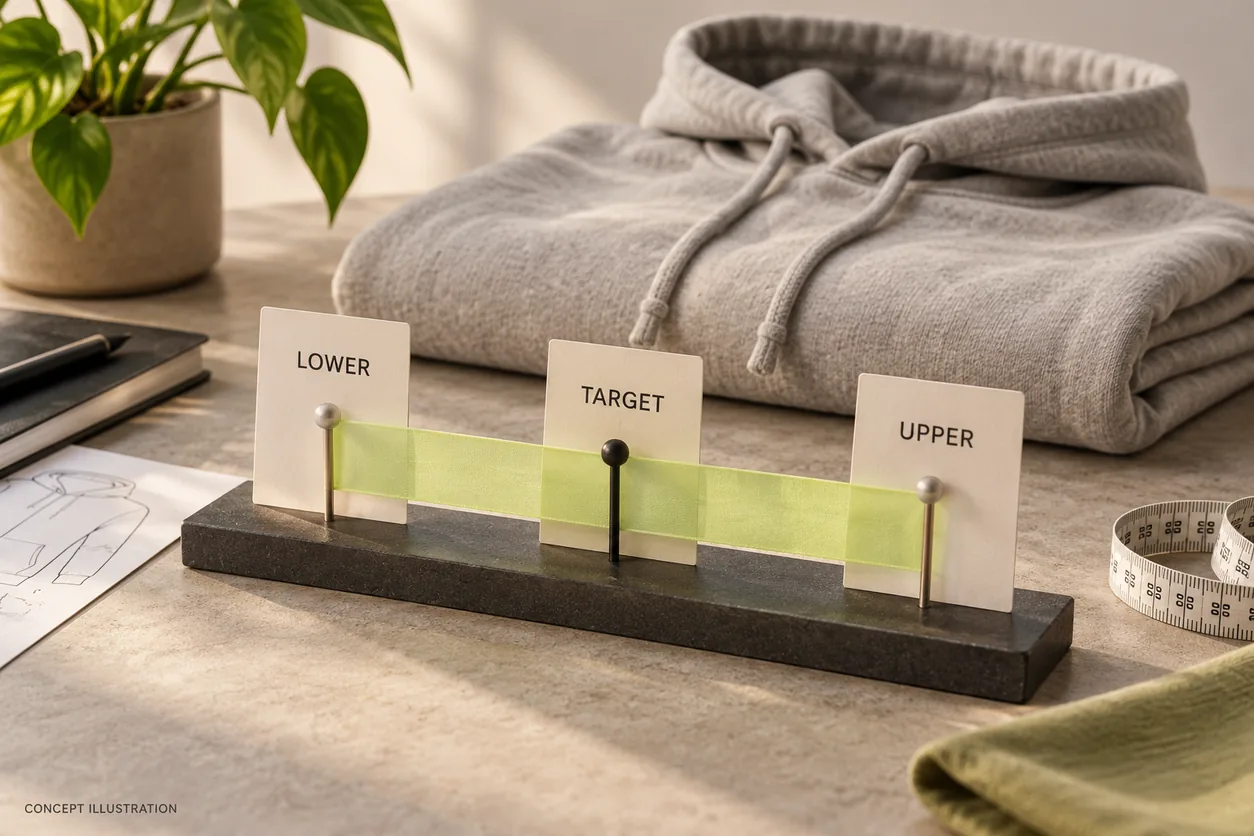
Conceptual range model, without numerical limits. The spacing is illustrative and does not specify an actual garment tolerance.
Choose limits around the garment's important relationships
Start with what a change could do to the design. Then ask the supplier to review the proposed limits against the identified fabric, construction, finishing route and measuring method. An extremely narrow number is not a useful quality promise if no one has established how it will be measured or controlled.
For the Grid Tee, chest width, body length, shoulder position and sleeve dimensions work together to create the boxy silhouette. A wider body and a longer body may each sit within their separate intervals while their combination changes the intended proportions. Review the combination on the sample as well as each line in the chart.
For the Edge Hoodie, the relationship between finished body length, rib band and waistband is central. Check where the hem sits standing and moving, with the intended underlayer. A dimensionally acceptable hoodie may still expose more of that layer than the brand wants.
Small components also need their own decisions. A pocket opening, neck opening or rib detail should not automatically inherit the same allowance as the overall body width. Explain the relevant function: access, appearance, pairing with another component or the intended opening action.
The useful tradeoff is between a clearly protected design outcome and a limit the proposed garment can support. Ask for evidence from the identified sample or development work. Do not infer capability from a tolerance printed in a quotation.
Check adjacent sizes and combined extremes
Grading changes the target dimensions between sizes. Tolerance permits agreed variation around a target. They serve different purposes.
Here is another deliberately hypothetical example. If one size targets a 54 cm flat chest and the next targets 56 cm, giving both a plus-or-minus 1 cm interval means their permitted intervals touch at 55 cm. That is an arithmetic observation about this one dimension. It does not prove the two complete sizes fit identically, but it gives the buyer a reason to review the grade relationship.
Also consider a garment with its width near one accepted extreme and its length near the opposite extreme. Would that combination still express the intended shape? Record any combined checks you need instead of assuming that every possible combination of individually accepted measurements is equally suitable.
Use the T-shirt size-chart guide for building the size framework. This article addresses the narrower decision of permitted variation within that framework.

Conceptual fitting consultation. The scene demonstrates a separate worn review; it does not establish a measured fit result or an accepted production limit.
Keep pre-care dimensions and after-care evidence separate
A production measurement tolerance and dimensional change after laundering answer different questions. The first compares a measurement with an agreed target at a specified stage. The second compares dimensions across defined care conditions.
State whether the specification applies before a care check, after an agreed garment finish, or after a particular care procedure. “Finished garment” can still leave uncertainty if the supplier and buyer mean different stages.
For formal care-related evidence, AATCC TM150's public summary describes assessing garment length and width changes after home laundering. It also notes that the method may not apply to some stretch fabrics. That summary identifies a scope; it does not supply your product's pass limits or the full procedure.
In a practical development review, link the original measurement record to the same identified piece after the agreed care sequence. Record the actual washing and drying conditions and measuring state. Keep a retained comparison sample separately identified; do not accidentally compare one piece's baseline with another piece's after-care result.
Do not subtract an expected shrinkage percentage from a tolerance allowance, or add one allowance to another, unless the specification explicitly defines that calculation and its purpose. A supplier's “within tolerance” answer is incomplete when the buyer does not know which target and stage were used.
The after-wash colour and fit guide covers the wider care review. Retain that separate evidence rather than turning this measurement worksheet into an undocumented laundry test.
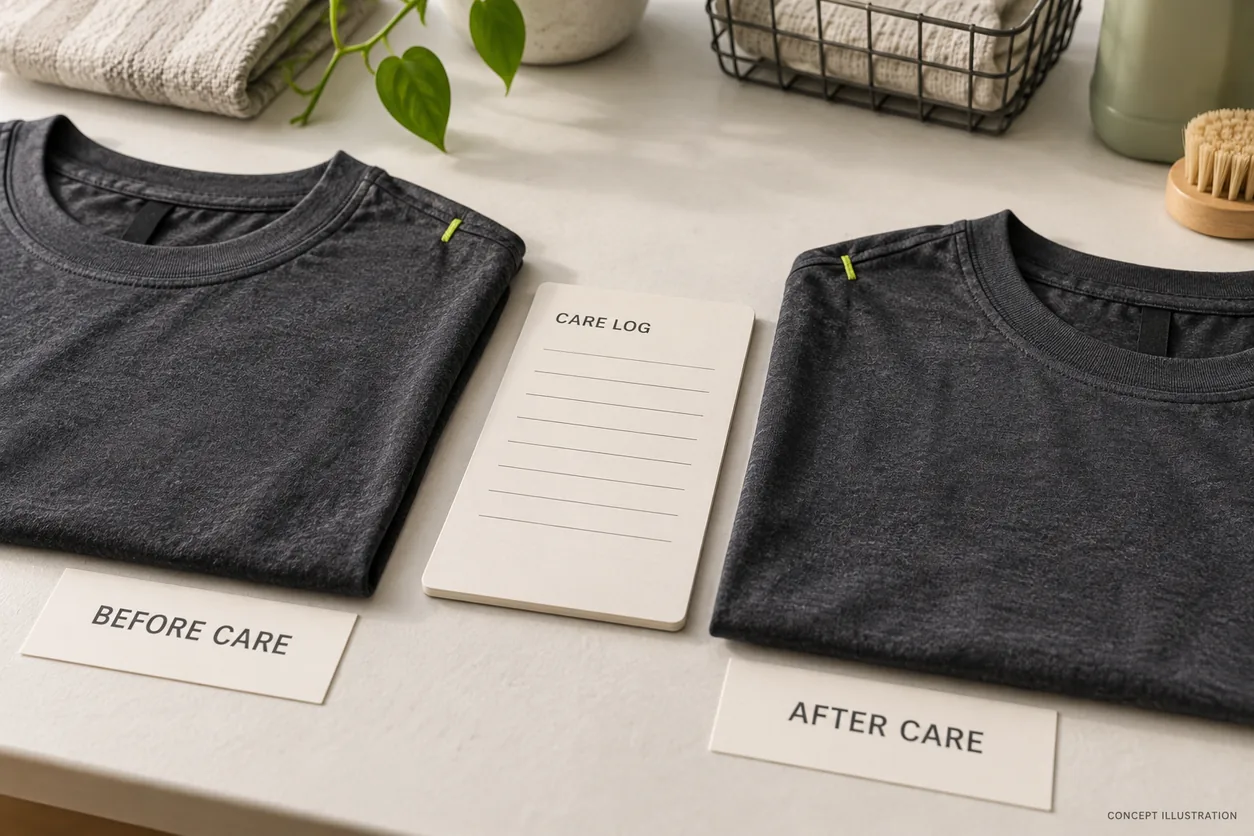
AI concept of a comparison record. Two illustrated references do not prove a dimensional change, a completed care test or identical performance between garments.
Read a sample result before changing the specification
The following is a proposed buyer review workflow. It is not a substitute for a laboratory method or an agreed inspection plan.
First confirm the sample's style, size, revision and measurement stage. Compare against the current sheet, not an old attachment or an informal chat figure. Verify that the stated measurement route and units were actually used.
Next record the actual values rather than writing only “pass” or “fail.” Include the difference from target and the applicable lower and upper limits. Photograph the measurement setup when a result needs discussion, while keeping the tape route and garment identity visible.
Then separate three questions:
- Is the measurement repeatable under the agreed method?
- Is the confirmed result within the agreed dimensional limits?
- Does the complete sample satisfy the separate fit, construction and appearance decisions?
A satisfactory answer to the second question does not answer the third. Equally, a good-looking fit photograph does not justify ignoring a confirmed out-of-limit result.
| What the buyer observes | Useful next action | What the evidence does not yet establish |
|---|---|---|
| Buyer and supplier report different values for the same piece | Compare units, landmarks, garment condition and tape route; remeasure using one agreed method | Which party has identified a manufacturing defect |
| A repeated result is outside its approved interval | Record the actual value, affected POM and intended correction; hold that dimensional approval | The cause of the variation or the status of an entire order |
| Every listed measurement is within its interval but the hoodie hem sits incorrectly when worn | Review the target dimensions and their relationships as a fit-development issue | That the current target expresses the brand's desired fit |
| Several checked pieces sit consistently near one boundary | Discuss the repeated direction and review production evidence while retaining the approved limits | Whether every unmeasured piece has the same condition |
| Measurement rows are acceptable but a seam, print or opening has a separate problem | Record and resolve that specific construction or appearance issue | Whole-garment approval from dimensional results alone |
Do not average away a piece that is outside a limit when the agreed requirement applies to individual pieces. If an inspection plan uses sampling or different acceptance rules, document those rules separately. One development sample cannot establish the dimensional consistency of a whole bulk order.
Also avoid widening a tolerance simply to relabel a failed sample as acceptable. If the brand genuinely changes the target or acceptance range after a new fit decision, issue a dated revision, explain the reason and identify what must be rechecked. Keep the previous result and decision traceable.
Send a correction that can be acted on
A useful correction identifies the object, the observation, the required outcome and the next check. It does not guess the technical cause from one photograph.
For the hypothetical Grid Tee, a dimensional comment could read:
Grid Tee, sample M-02, measurement-sheet revision B: body-length POM L1 rechecked under the agreed flat method is 69.2 cm against the illustrative 68.0 cm target and 67.0–69.0 cm interval. Please propose a correction to return this row to the approved specification. Keep the approved chest target unchanged and identify any linked dimensions that would be affected.
Those figures refer only to the teaching table above. An actual correction must use your own agreed specification and verified record.
For an Edge Hoodie that meets the current dimensions but looks too long in wear, use a different comment:
Edge Hoodie, sample EH-03: the listed dimensions meet revision C, but the hem covers more of the intended waistband than the approved fit direction. Please propose a revised length/rib relationship and identify the measurement-sheet changes. Review the next sample standing and with the agreed movement sequence before replacing the current fit reference.
The first asks for compliance with the existing dimensional decision. The second asks to develop a different target. Keeping those routes separate helps the supplier understand whether to correct execution or propose a design revision.
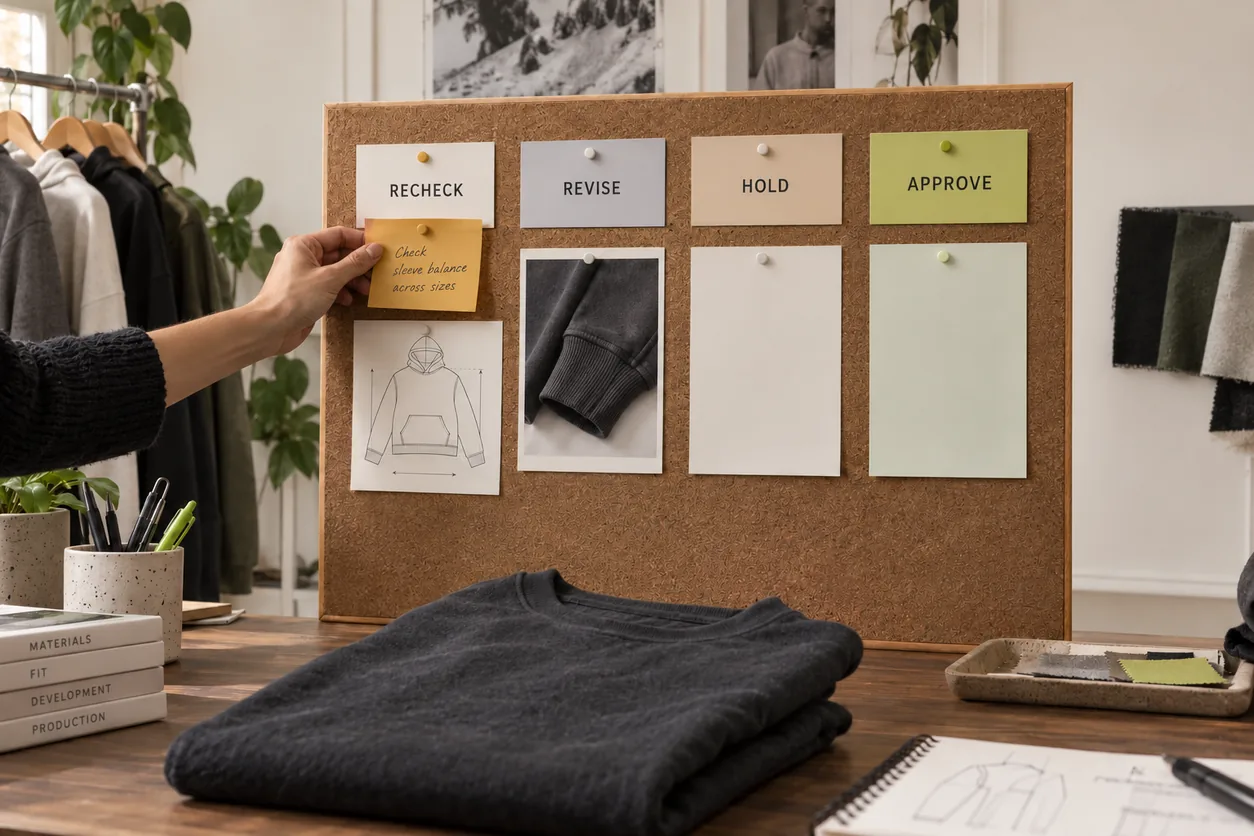
Original concept illustration. The board demonstrates review routes and does not record an actual customer approval, inspection result or corrective action.
Freeze a complete measurement agreement
Before authorising production, keep one accessible record containing the approved measurement sheet and its revision, POM diagrams, units, garment stage, target and lower/upper allowance for each relevant row, recording rules and the reference sample identity.
Include the separate fit decision, unresolved issues, responsible decision maker and applicable bulk inspection arrangement. Ask how the supplier will identify and report a departure rather than assuming an approved development sample settles every later inspection.
Link this record from the streetwear tech pack. Keep measurement revisions consistent with construction drawings and size tables. A change to body length should not remain only in an email while the production sheet retains the previous target.
For a first development enquiry, send the garment description, current measurement draft, intended sizes and the important fit relationships. Mark proposed tolerances as proposals. Invite the manufacturer to identify missing measurement definitions and explain which limits need sample review.
Athletic Rush manufactures in Sialkot, Pakistan, and handles enquiries from U.S. clothing brands. The owner-confirmed minimum is 30 pieces per design, with one to three colours and mixed sizes within that same design; another design requires its own 30 pieces. Samples take 4–6 working days. Bulk production takes 8–10 working days for orders up to 100 pieces; larger quantities require quantity-specific timing. Shipping time is separate. Confirm the order-specific scope, revision sequence and production start conditions in the quotation.
Buyer FAQs
What tolerance should I use for every T-shirt measurement?
Do not adopt one value for every row. Define the measurement method and garment stage, then agree limits appropriate to each dimension and its effect on the design. The figures in this guide are arithmetic examples, not an Athletic Rush tolerance chart.
Is a measurement tolerance the same as a grading rule?
No. A grading rule changes the target between sizes. A tolerance defines permitted variation around a target under agreed conditions. Review both together so their combined ranges do not create an unintended size relationship.
Can a sample pass measurements but fail the fit review?
Yes. The chosen targets may not express the desired silhouette, or several dimensions may combine poorly. Keep dimensional compliance and worn-fit approval as separate records, and revise the target openly when the design decision changes.
Does an approved sample mean every bulk piece will meet the chart?
No. It records the decision for the identified sample and revision. Agree how bulk pieces will be checked, what evidence will be recorded and how departures will be handled. Do not infer a whole-order inspection from one accepted development sample.
Bring the measurement sheet and the actual buyer question to your next discussion. Explore Athletic Rush streetwear, email kamran@athleticrush.co, or discuss your sample on WhatsApp. The useful starting point is a clearly identified garment and a repeatable measurement agreement.