 Sialkot, Pakistan
How many hoodie designs should a small clothing brand develop for its next drop? Start with a clear role for each style, count every colour and size combination, and keep only the products you can sample, explain and support properly. There is no universal number that makes a collection commercially successful. A compact range with distinct reasons to buy is a more useful development brief than a long list of similar hoodies.
The key question is not simply “How many designs look good together?” It is “What does each hoodie add, and what must be approved before we can sell it?” A relaxed pullover, a full-zip layer and a cropped hoodie can belong to the same collection, but each introduces decisions beyond the artwork on the chest.
This guide helps brand owners turn those ideas into a controlled sampling plan. It uses hypothetical examples, not a sales forecast, a recommended order quantity or an Athletic Rush minimum-order promise.
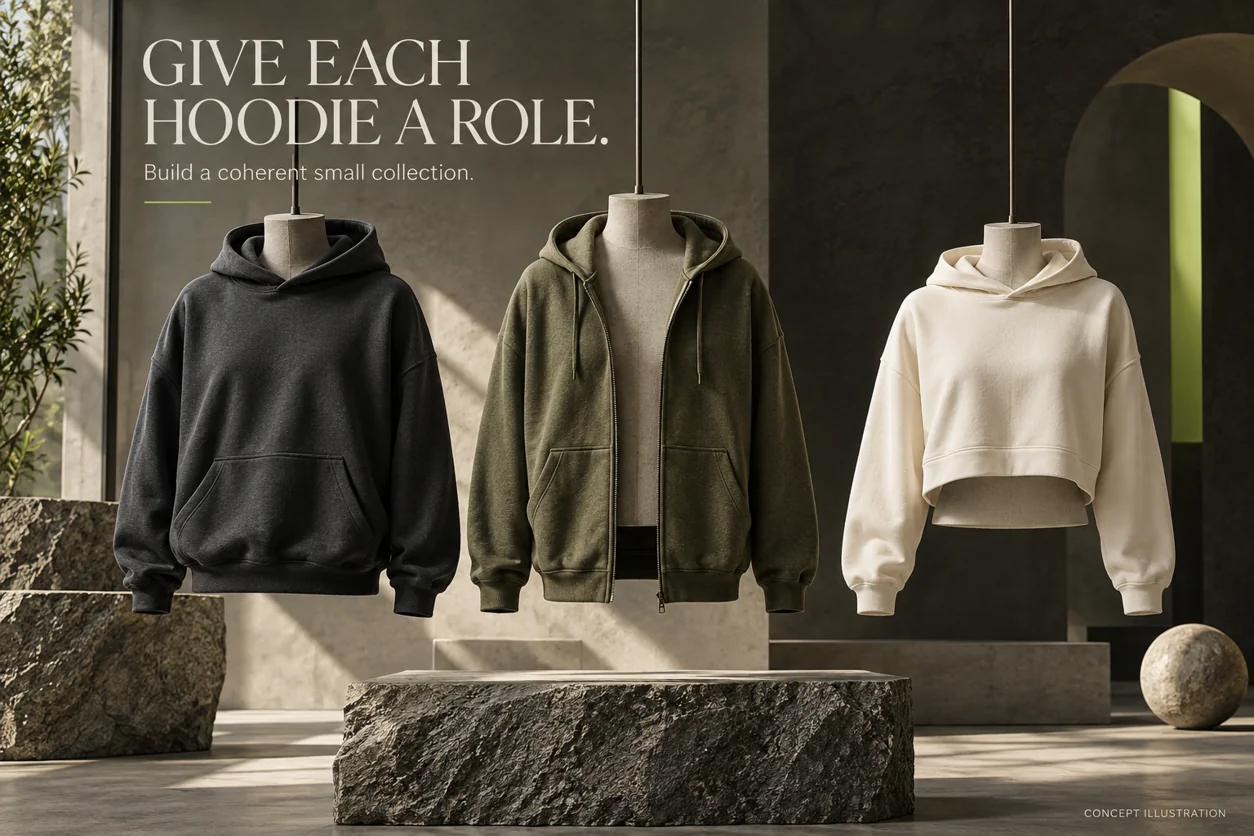
All images are original conceptual illustrations, not photographs of available Athletic Rush stock, actual customer collections or production approvals.
1. Give every hoodie a job in the collection
Write a short description of the intended customer and wearing routine before picking trims or graphics. For example: “A compact everyday streetwear range for customers who layer hoodies with relaxed trousers and want clearly different pullover and open-front options.” That brief gives you a reason to compare two products; “premium hoodies for everyone” does not.
Specify the intended season and sales context in your own brief. Are these indoor layers, outdoor transitional pieces, or part of a coordinated outfit? Will customers mainly buy online, where fit information and photographs must carry the explanation, or try samples in person? Treat those as decisions to investigate, not assumptions that a fabric weight alone can resolve.
Use a role test before adding a style
For each proposed hoodie, finish this sentence: “A customer would choose this instead of the other styles because…” If the only answer is that the logo moved a little, decide whether it is a separate style, a decoration option, or an idea to hold for later.
Three possible roles are shown below. They are examples, not a required three-product formula.
| Proposed style | Distinct customer reason | Development question to settle |
|---|---|---|
| Relaxed pullover | A simple closed-front silhouette with the intended body volume | Does the physical fit deliver the desired length, shoulder and sleeve balance? |
| Full-zip hoodie | An open-front layering option | Are opening, zipper choice, pocket arrangement and artwork placement right together? |
| Cropped hoodie | A shorter proportion intended to work with a specific trouser rise | Where should the hem sit during standing and ordinary movement? |
The purpose of the table is to expose decisions. It does not rank one style as better or more profitable. If your audience has a clear need for only one of these roles, you do not need to manufacture the other two to make the range look complete.

Keep a common identity without making identical products
Choose a small set of shared visual references: a restrained colour family, a consistent artwork language, a label treatment, or a recognizable proportion. Then decide which differences are intentional. The shared identity should be explainable without making every hoodie the same garment in a different photograph.
For example, a charcoal pullover and an olive zip hoodie might share a quiet decoration approach while offering different ways to layer. A cream cropped hoodie could join them only if its shorter shape answers a real brief. Do not add it merely because a third colour looks attractive in a mood board.
Review the styles together as complete outfits. Put the proposed trousers and base layers beside them, or describe those references clearly. A collection photograph can look coherent while the actual garments serve conflicting fit expectations. Naming the wearing context early makes the fitting discussion more concrete.
Our pullover versus zip hoodie guide develops the opening and artwork tradeoffs. For a shorter silhouette, use the cropped hoodie proportion guide before treating a cropped option as a simple length reduction.
Remove overlap before the sample request
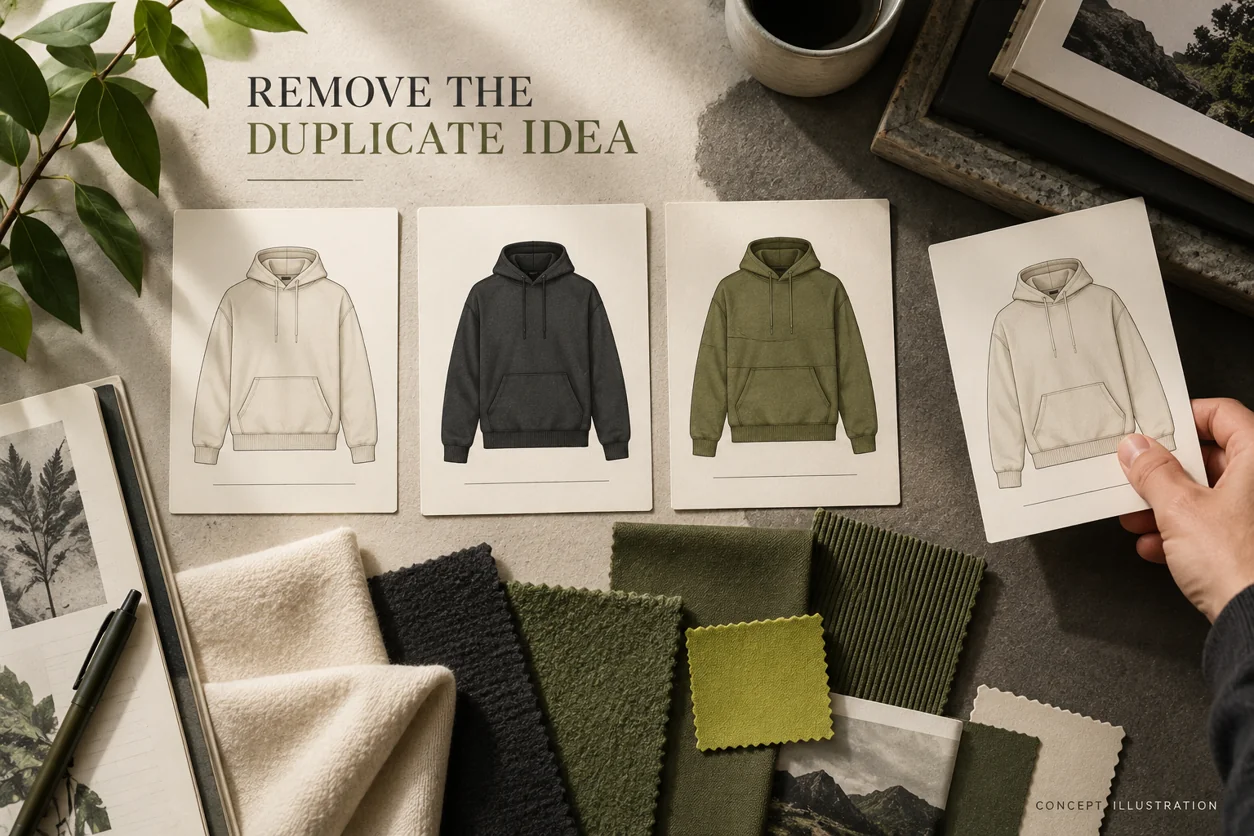
Lay out one card per proposed style. Each card should contain the role, silhouette, material direction, colours, decoration and unresolved questions. Compare adjacent cards. If two have the same role and differ only in an unimportant detail, combine them or postpone one.
Keep a separate “later ideas” list so editing the first range does not feel like discarding creative work. The current collection should show the decisions you are ready to develop, while the later list preserves options that need more customer feedback or material research.
2. Count the combinations, then test the production brief
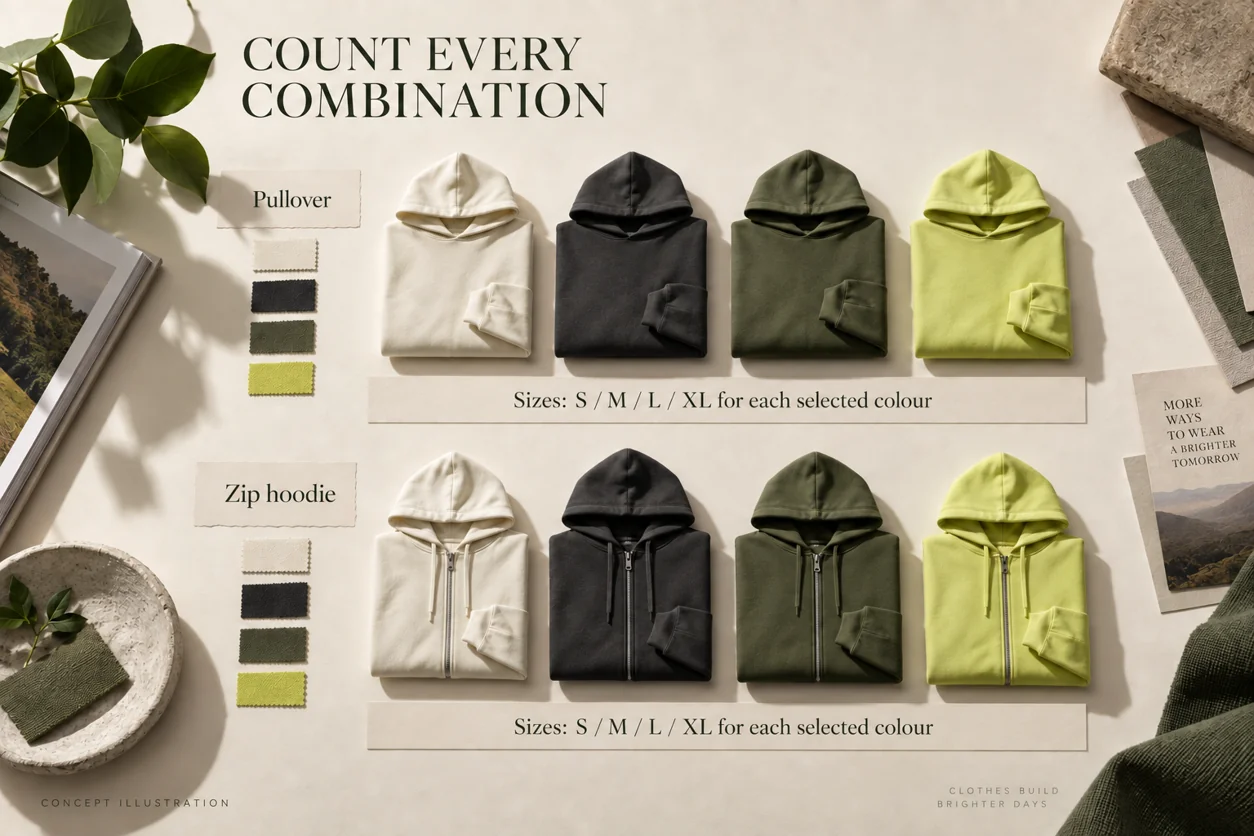
Style count and inventory complexity are different things. One hoodie offered in several colours and sizes creates several distinct combinations to describe, allocate and track. Shopify's product variant documentation defines variants through combinations of option values such as size and colour. That distinction is useful for planning even when your store uses another platform.
Write out the actual combinations you intend to offer. Do not multiply every option together if some combinations will deliberately not exist. Also distinguish a decoration that is fixed for the style from a decoration choice the customer can select; the latter can expand the assortment further.
A worked example with unequal colour counts
Suppose a hypothetical range contains a relaxed pullover in two colours and a zip hoodie in one colour. Both are offered in four sizes. The pullover contributes eight combinations; the zip hoodie contributes four. The collection therefore contains twelve style-colour-size combinations, not just “two hoodies.”
If a cropped hoodie is added in two colours and the same four sizes, it adds eight more combinations, bringing the total to twenty. This arithmetic describes the proposed assortment only. It does not tell you which sizes will sell, how many units to order, or which minimums a manufacturer will accept.
An illustration-only order of 240 garments spread equally across twelve combinations would average 20 per combination. Spread equally across twenty, it would average 12. Neither allocation is a recommendation. Equal division is especially easy to mistake for a demand plan when it is only arithmetic.
Build the quantity proposal from the evidence you actually have: relevant previous orders, clearly recorded customer enquiries, fit feedback, or other direct information about the intended audience. State where evidence is missing. Keep stock availability and stockouts in mind when interpreting earlier sales; a size that was unavailable cannot be compared fairly with one that stayed in stock throughout the selling period.
Ask how minimums apply, rather than assuming one total
Send the supplier the style-colour-size matrix and ask how any minimum quantities apply to it. Confirm whether requirements are stated by style, colour, material, decoration or another grouping. A total collection quantity by itself may leave those details unresolved.
Ask what changes if you remove a colour, share an approved material, or postpone a style. Request a revised written scope when the range changes. Do not assume that using the same colour name or visual theme makes separate garments one production group.
Your enquiry should also distinguish development quantities from the proposed bulk order. Ask what sample stages are needed, what each stage covers, and which charges and lead times apply to your exact brief. Avoid building the launch date around a generic estimate that has not accounted for the unresolved details in your range.
Compare complete quotations against the same range
Keep a versioned assortment sheet with every quotation. Record included fabrics, trims, decoration, labels, packing, sample scope and the delivery basis. If one offer covers two styles and another includes a third, the totals do not describe the same job.
Ask for clarification where wording is vague. “Custom hoodie” does not identify the fit reference, hood construction or artwork. A well-defined brief gives the supplier a practical basis for discussing the project and gives you a record of what was actually quoted.
Do not select a collection purely by chasing a lower headline unit price. First check whether the garment described is the one you intend to sell. Commercial terms should be reviewed for your circumstances; this guide does not set a target margin or promise a profitable quantity.
3. Share useful references, but approve each garment
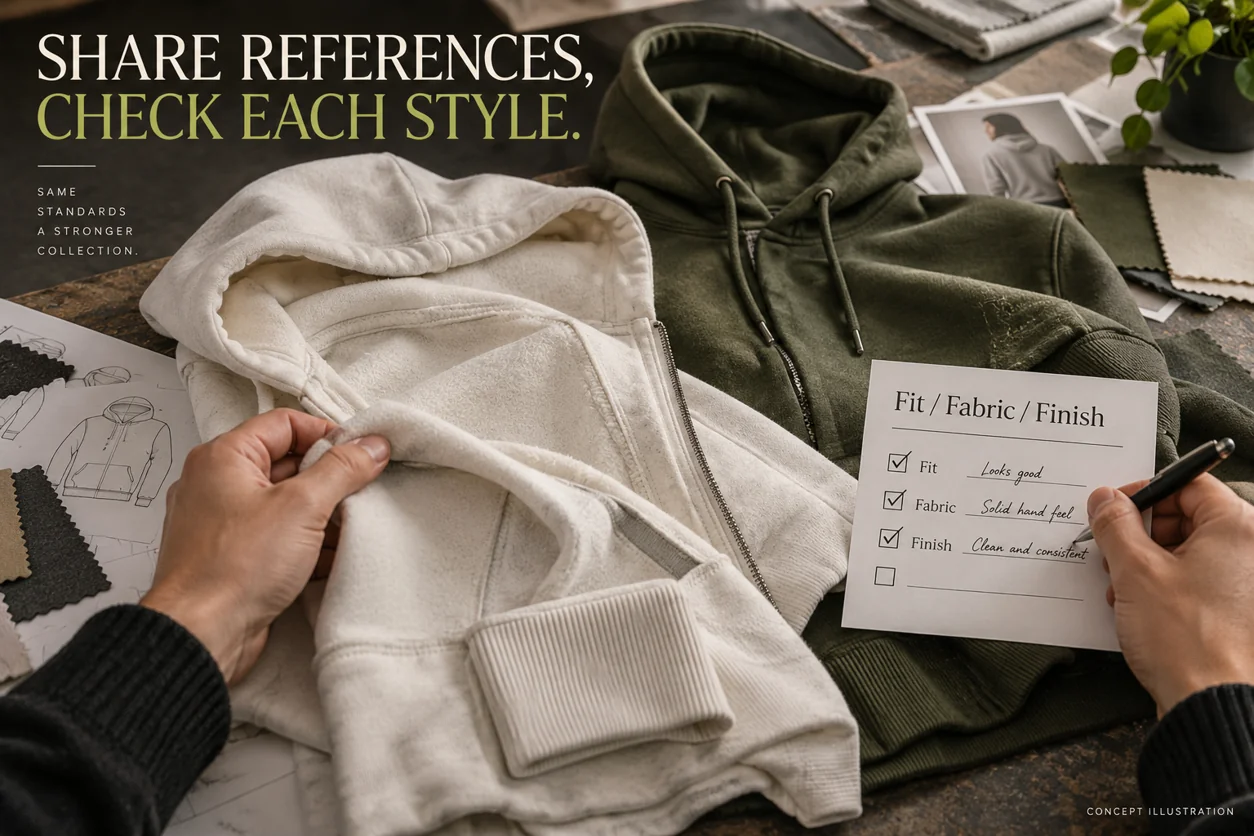
You can organize a coherent collection around shared references without treating every component as interchangeable. Mark the decisions that are common to the range and the ones that belong to a specific style.
A shared colour target, for example, is a communication reference. It is not automatic approval of how the body fabric, rib and zipper tape look together. Review the physical combinations; our guide to matching hoodie-set colours explains how to organize component comparisons.
Similarly, a shared artwork file is not approval of every placement. Record the finished dimensions and intended position on each hoodie. A full zipper, different pocket or shorter body can change the area available for a graphic. Confirm the finished sample rather than approve an entire collection from one attractive mockup.
Use a common-versus-specific approval sheet
| Decision | Possible common reference | What still needs checking by style |
|---|---|---|
| Brand identity | Artwork master and label information | Placement, scale and the complete visual result |
| Colour direction | Identified physical target or agreed reference | Actual materials and adjacent components together |
| Fit language | Description of the intended customer experience | Measurements, proportions, movement and size range |
| Material direction | Proposed material specification | The complete garment's appearance, feel and agreed care observations |
| Packing information | Shared information format | Correct style, colour, size and item identification |
Avoid a blanket note such as “all styles approved as sample.” Identify the sample for each style and record the scope of the decision. If one garment is ready while another needs work, make their status different in the sheet.
Sequence samples around unresolved questions
Begin with the questions most likely to change the garment brief. If the body shape is undecided, resolve that before finalizing artwork placement photographs. If a zipper or pocket arrangement remains open, put it in the relevant sample review rather than assuming it can be added without another look.
For each style, ask the supplier to propose a sampling sequence appropriate to the project. The buyer's record should show the sample identifier, version, question being reviewed, correction requested and next deliverable. Do not apply a fixed number of rounds to every project or promise a completion date before those steps are agreed.
On the returned garment, review the intended fit with suitable wearers and compare measurements using the agreed methods. Inspect hood shape, pocket access, cuff feel, decoration and inside finishing. Include the care review agreed for that product. The collection plan should point to these records rather than replace them with a single visual sign-off.
Decide what happens if one style is late
Choose a rule before announcing the drop. You might require the complete range to be approved together, or decide that independently ready styles can launch first. Either choice needs accurate product information and a realistic explanation of availability.
Do not quietly substitute a different material, trim or unapproved sample to preserve a date. Record the proposed change and review its effect on the garment and collection. If the remaining styles no longer tell a coherent story, revisit the range presentation rather than pretend the original plan is unchanged.
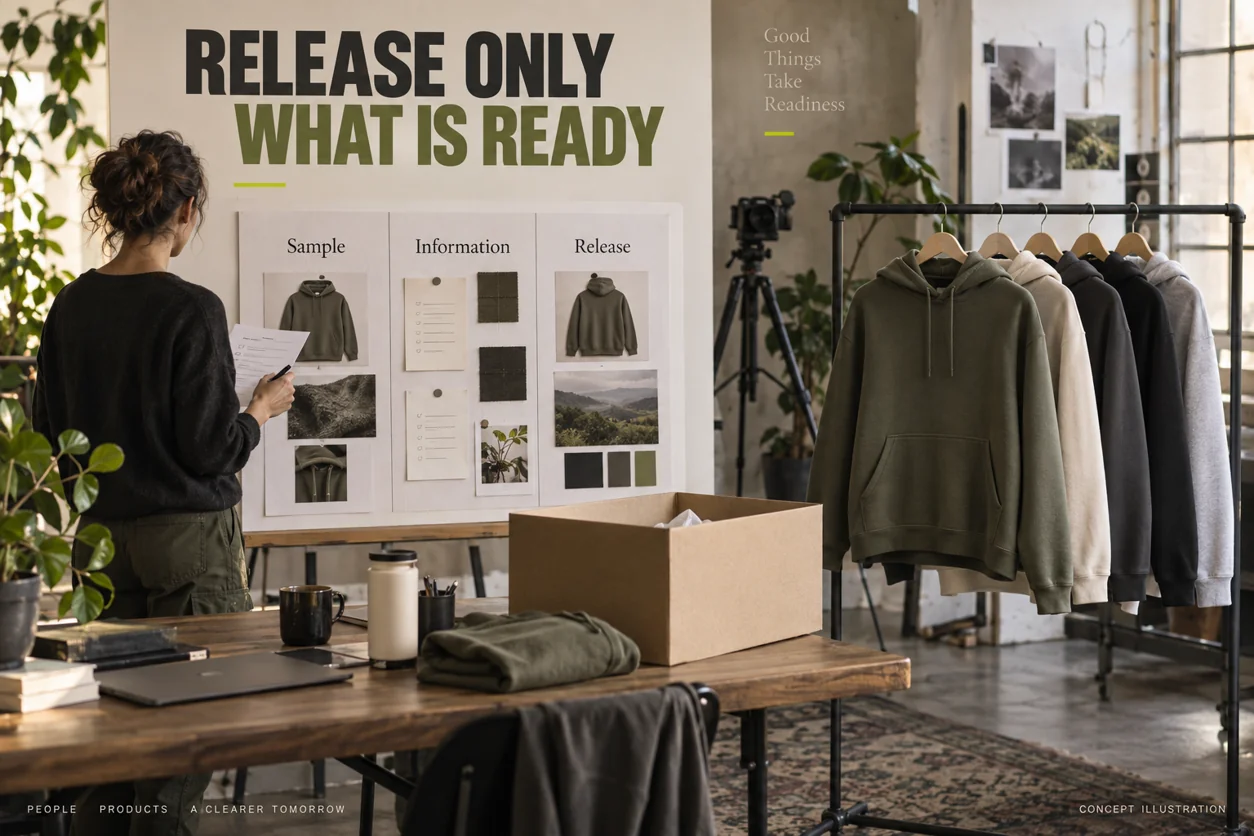
A collection should be ready to explain as well as manufacture
Before release, compare the product information against the approved physical garments. Check the named style, colour options, size guidance, composition and care information supplied for that product. Use accurate images of what customers will receive when preparing the actual selling page; concept illustrations belong in development or clearly labelled educational contexts.
Plan which photographs demonstrate each style's reason to exist. The zip hoodie needs a clear view of the opening as well as its closed appearance. A cropped hoodie needs a useful proportion reference. The pullover should show the intended volume rather than depend on a carefully hidden hem or sleeve.
Create a final release checklist with an owner for each task: sample approval, confirmed order scope, product information, packing identification and delivery arrangements. A blank box should have a named next action. “Nearly finished” is not a useful status when it hides an unresolved fit correction or an unconfirmed colour.
After the collection is sold, record feedback by the actual style and variant. Separate fit comments, material preferences, decoration concerns and availability issues. Use that evidence to decide what belongs in the next drop, rather than automatically adding another silhouette or colour.
Questions before your first hoodie capsule
Is one hoodie style enough for a collection launch?
It can be a deliberate starting scope if it answers your customer brief and the colour and size offer is clear. The useful test is whether each additional style adds a distinct role you can develop and explain. There is no required style count in this guide.
Should every style come in every colour?
Only if those combinations belong in your intended assortment. Write out the combinations you want and discuss feasibility with the supplier. Do not let a mood board silently become a promise to manufacture every possible variation.
Can I approve one sample for all hoodie styles?
A shared reference can help communicate a colour or artwork direction, but it does not close every garment decision. Identify what each physical sample approves and keep a separate status for each style, including unresolved fit and component checks.
Should I split quantities equally across sizes?
Equal division is a calculation, not evidence of demand. Use relevant customer information and document assumptions, then confirm the proposed size allocation and applicable minimums with the supplier. Do not present an illustrative example as a recommended order.
Turn the range into a clear enquiry
A useful small hoodie collection brief contains the customer and wearing routine, a role for each style, the exact colour-size combinations, proposed quantities, shared references and the unresolved sampling questions. It also says who will approve the samples and what must be complete before release.
To discuss development with Athletic Rush, send that brief with your silhouette references and artwork. Explore our hoodie development options, email kamran@athleticrush.co, or message us on WhatsApp. The next step is to confirm the scope and sample plan for your specific range.