 Sialkot, Pakistan
Your first streetwear order is ready to pack, but “fold neatly and use branded bags” still leaves the factory guessing. Which side faces out? Where does the hangtag sit? Can sizes share a carton? Give the manufacturer one packing specification that connects the folded garment, its individual identification, the grouping inside each carton and a carton-by-carton contents list. Review a complete physical packing proposal, open it again, and reconcile the contents before releasing that packing version. A correct total of garments does not prove the right sizes are in the right boxes.
This guide is for new U.S. clothing brands and creators preparing a first streetwear drop. It helps you turn a preferred presentation into instructions a supplier and the receiving team can both use. Start with Athletic Rush's streetwear development and manufacturing hub, then Athletic Rush's private-label packaging service. That service page includes labels, hangtags, bags and retail or ecommerce packing; confirm the exact materials and work in your quotation.
The Signal Tee and Harbor Hoodie below are fictional teaching garments. The 48-piece example is an arithmetic demonstration, not a customer order, a recommended size split or a tested carton capacity. All six images are original AI concept illustrations. They do not show Athletic Rush staff, actual shipments, approved packing materials or transport-test results.

Concept illustration: agree what one packed garment should look like before repeating the presentation. The people, products and materials are illustrative.
Tell the factory who will open the shipment first
Packing for your own studio is different from packing for a third-party warehouse or a wholesale recipient. Identify the first receiving location and its instructions before selecting the final arrangement. An attractive individual pack can still be inconvenient if the recipient cannot identify its contents without opening every bag.
If your own team will receive the bulk order, decide how you will count, store and later pick the garments. If a fulfillment warehouse will receive it, obtain its current written requirements for product identity, unit labels, carton labels, assortments and receiving documents. If a retailer is the recipient, ask for that account's actual routing and ticketing instructions. Do not substitute a screenshot from another business for the requirements of your receiver.
Separate the factory-to-receiver shipment from a later customer parcel. Manufacturing packing does not automatically include direct shipping to your followers, individual customer addresses, gift messages or returns processing. A creator's presentation box for a campaign may also be a separate packing version from the ordinary saleable unit. Name that difference and quote its scope instead of letting one sample imply both services.
Shopify's packing-slip guidance describes item records such as SKUs, quantities and product details in customer shipments. That illustrates why the receiving person needs identifiable contents. It is not a factory packing standard or a requirement to use Shopify. Your bulk carton list should answer the equivalent practical question: what exactly is inside this identified carton?
For a range that combines tees, hoodies and accessories, use Athletic Rush's collection-development service to discuss the coordinated presentation. Keep separate packing instructions wherever the garments, destinations or handling needs differ.
Describe the fold with a physical reference and a few precise views
“Retail fold” is a preference, not a complete instruction. Identify the exact garment revision, size and decoration, then show the proposed sequence and finished presentation. State which side faces out, the orientation of the neckline and artwork, the sleeve position and the intended folded dimensions with units. Leave an unresolved dimension marked for confirmation rather than inventing it from a website image.
For the fictional Signal Tee, the buyer might want the front graphic visible when an individual pack is opened. Ask the supplier to propose the fold using that actual decorated sample. Photograph the garment before folding, the important intermediate positions and the finished pack. The purpose is to explain the decision, not to require a photograph of every hand movement.
Athletic Rush product reference: the live Relaxed Midweight T-Shirt — True Black Tonal Mineral Wash provides front and back views of a real website design reference. Link that page if it is your development starting point, then identify your own garment, artwork and packing proposal. The page does not establish your finished fold dimensions, physical fabric behavior, available stock or an approved packed sample. Signal Tee remains a separate fictional example. Athletic Rush's T-shirt development category is the broader route if the tee itself is still being selected.
The fictional Harbor Hoodie needs its own review. Ask where the hood, cuffs, cords and any zipper or dimensional decoration sit within the fold. A thicker assembly may produce a different packed shape even if its displayed front looks similar to the tee. Use Athletic Rush's hoodie development page for that garment discussion; do not copy the tee's packaging dimensions into the hoodie specification without a physical check.
Check the proposed fold on the relevant size range. An arrangement that works on one medium sample does not establish that the smallest and largest garments fit the same pack as intended. Agree which additional size or construction cases need review. Record the accepted result by reference, rather than letting “same as sample” refer to an unidentified garment.
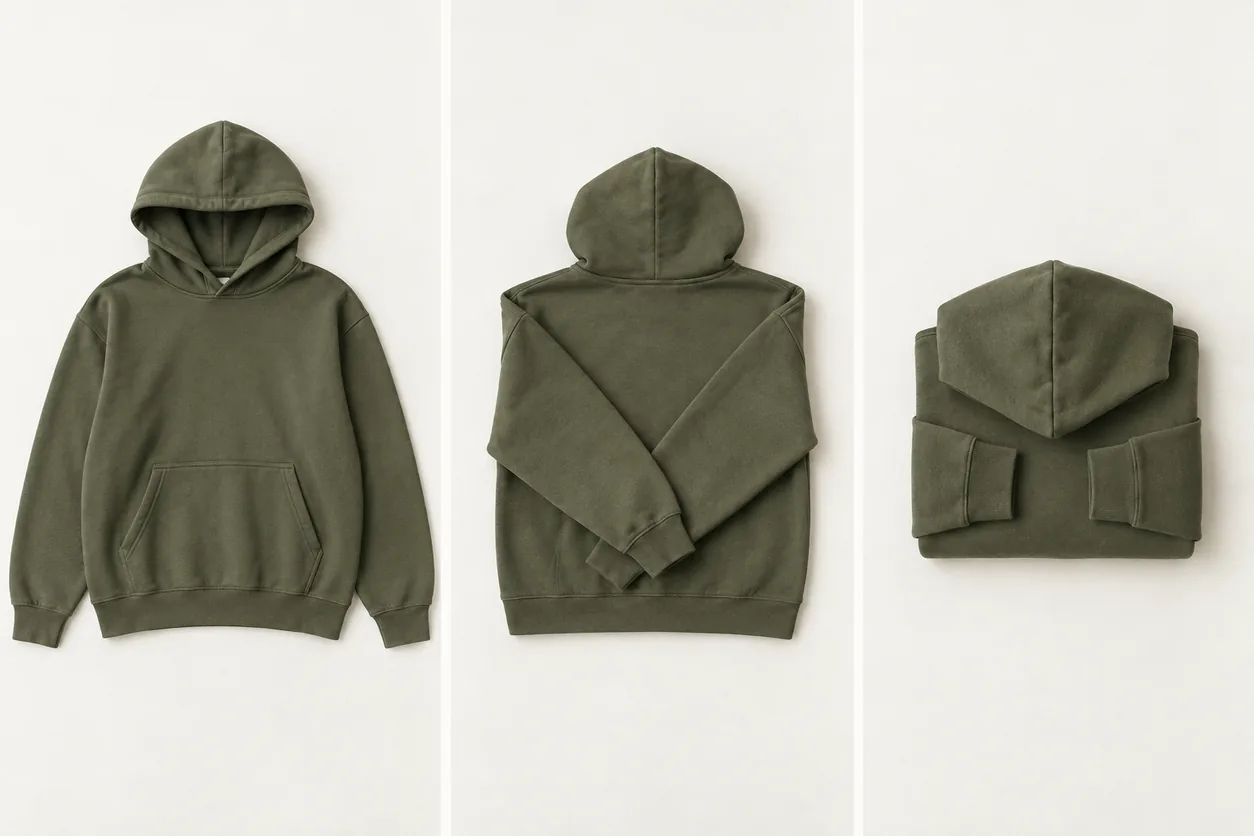
Concept illustration: a folding reference can show the garment's orientation and component positions. These proposed views are not a universal hoodie folding method or a measured size specification.
Approve the complete individual pack, including the garment inside
List the proposed bag, wrap, sleeve or other individual presentation by its actual reference. Record its dimensions, closure and artwork version where relevant, together with any insert, size sticker or removable tag. Distinguish the garment's own labels from information added to its outer pack. A package marked medium must contain the corresponding medium garment; matching the sticker to another sticker is not enough.
Choose materials around the actual garment and receiving route. A transparent proposal may make some garment information visible; an opaque proposal may require a clearer outside identity. A branded wrap may give the presentation you want, while creating another opening and repacking step for your warehouse. These are tradeoffs to review, not proof that one material is universally better, more protective or environmentally preferable.
Ask the supplier and intended receiver to confirm any applicable material, closure, printed-information or warning requirements before the packing materials are released. Do not assume one stock bag is suitable for every channel. Environmental or material claims need their own evidence; the appearance of a kraft box or pale tissue establishes neither composition nor certification.
Place the hangtag, string, sticker and inserts in the actual proposal, then reopen it. Look at where they contact the garment and decoration, whether they obscure identification, and whether the pack opens without an unintended snag or mark. If an interleaf or another separation material is proposed, identify that material and review the complete combination. This guide does not prescribe a universal tissue, adhesive or protective insert.
For raised artwork, embroidery, hardware or a large graphic, show the relevant contact points and fold lines. Ask for a revised arrangement if the proposed pack visibly distorts the presentation or places an unwanted crease through an important feature. A photograph of an unopened bag cannot answer all of those questions. The Athletic Rush hangtag information and proof guide covers the separate tag-content and variant-data decisions.
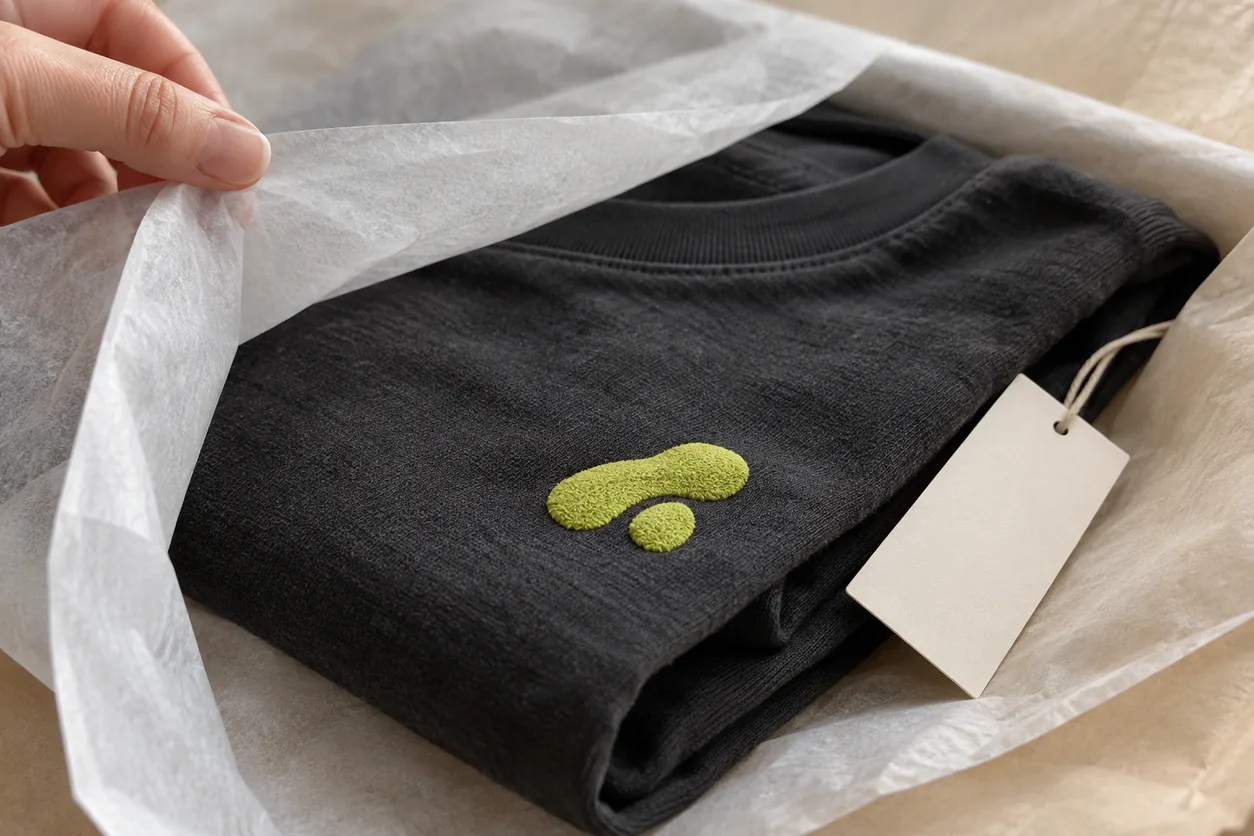
Concept illustration: examine decoration, paper and tag placement together. This is not evidence that the illustrated materials prevent marking or are suitable for your product.
Choose the carton grouping around receiving and picking
Decide what may share a carton: one style-color-size combination, several sizes of one color, or a documented mix of products. There is no single arrangement established here for every first drop. Compare the convenience for the receiving team with the actual packing proposal and its quotation implications.
| Grouping proposal | Useful reason to consider it | Instruction that must stay explicit |
|---|---|---|
| One style, color and size per carton | Contents are simple to identify and count | How partly filled cartons and the final remainder are handled |
| One style and color, with several sizes | Related variants remain together | The exact size quantities and how the size groups are separated |
| Several styles or colors in one carton | May suit an agreed assortment or receiving plan | Every included variant, quantity and internal grouping; no undocumented substitutions |
Do not force an attractive round number of garments into each carton before the actual packed assembly is reviewed. The carton count, outer dimensions and packed weight need to work together. A proposed quantity per carton is not a measured capacity or a shipping quotation.
Also define what you are counting. One individual bag might contain one garment, or an explicitly identified multi-piece pack. State garments per pack and packs per carton where relevant. A bag count, set count and physical garment count must not quietly exchange meanings halfway through the list.
A fictional 48-piece Signal Tee carton map
Suppose the authorized garment allocation is 24 charcoal tees and 24 stone tees. For this teaching example only, assume a two-carton arrangement has been proposed, with one color in each carton. The numbers below explain the records; they do not prescribe carton dimensions, loading or a recommended assortment.
| Carton ID | Signal Tee color | S | M | L | Garment total |
|---|---|---|---|---|---|
| C01 | Charcoal | 4 | 12 | 8 | 24 |
| C02 | Stone | 6 | 10 | 8 | 24 |
| Shipment total | Both colors | 10 | 22 | 16 | 48 |
The garment total is 48, but the detail still matters. If C02 actually contains six smalls, eight mediums and ten larges, it still holds 24 stone tees. The overall shipment can still total 48 while containing two fewer stone mediums and two extra stone larges than the approved breakdown. A label saying “24 pieces” will not reveal that difference.
Use the Athletic Rush size-and-color order breakdown guide to establish the authorized garment matrix. The carton list then records where those actual garments are packed. Do not silently revise the production allocation to make a carton list look correct. Resolve the discrepancy and identify the current instruction before sealing the affected carton.
For this example, one color has 24 pieces, but that is not a separate color minimum. Athletic Rush's confirmed minimum is 30 pieces per design, allowing one to three colors and mixed sizes within the same design. Each different design requires its own 30 pieces. Confirm design grouping and actual packing scope in your quotation.
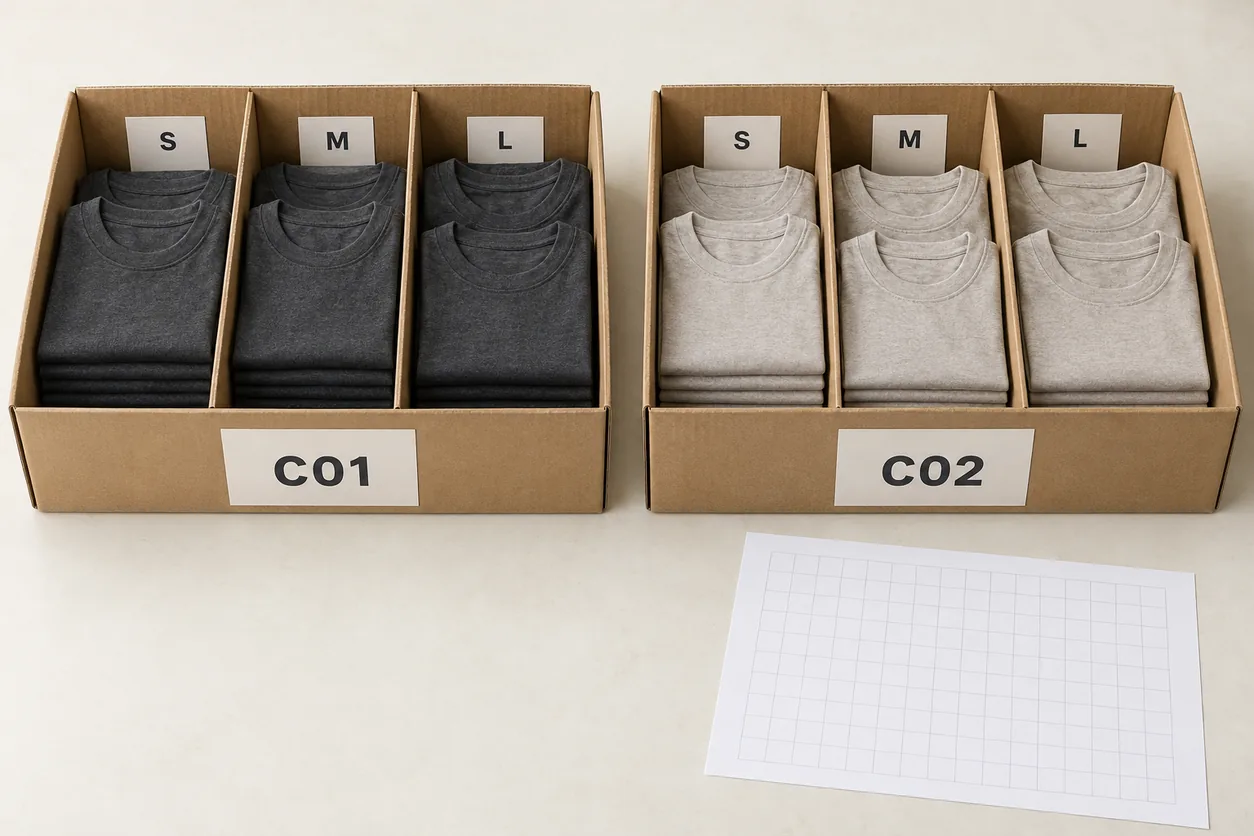
Concept illustration: connect carton identity to its color-size groups. The pictured stacks and dividers do not represent the table's quantities or a required packing construction; the accurate worked counts are in the table.
Make labels and documents describe the actual contents
Give each carton an identity that matches one record on the carton list. In the example, C01 and C02 are internal teaching identifiers, not shipping tracking numbers or issued logistics codes. Agree the actual identifier format, label position and recipient-required fields with the supplier and receiver. Show the proposed label at a readable scale before applying it across the order.
Keep garment identity, internal carton identity and the carrier's shipment label distinguishable. If a warehouse or retailer requires its own barcode or label format, obtain its current template and data instructions. Do not create a decorative imitation or assume that a garment barcode also identifies the entire carton.
A useful carton list connects the order and packing revision to each carton, its included style-color-size quantities, and its actual packed measurements and weight where required. Specify units. Separate a planned packing arrangement from the final as-packed list so the receiving team can tell what was proposed and what was actually dispatched.
Shopify's packing-slip variable reference distinguishes the quantity ordered from the quantity fulfilled in a particular shipment. Apply that same discipline to your own records: a carton containing part of a style is not the complete style order, and a partial dispatch must not be documented as though everything shipped. This is a recordkeeping principle, not a claim that your factory uses that software.
Measure and weigh the completed shipping assembly rather than estimating from an empty box or a single folded tee. UPS's package dimensions and weight guidance explains package measurement and the distinction between actual and dimensional weight. Confirm the applicable carrier, service and quotation basis for your own shipment. Obtain a shipping quotation for that actual service and packed order; this article supplies no freight rate or universal carton limit.
If a carton is repacked, its identifier, contents record, label and measurements may need revision. Ask who updates the final list and which version the receiver will use. Do not preserve an old outside label after the contents have changed simply because the original total was correct.
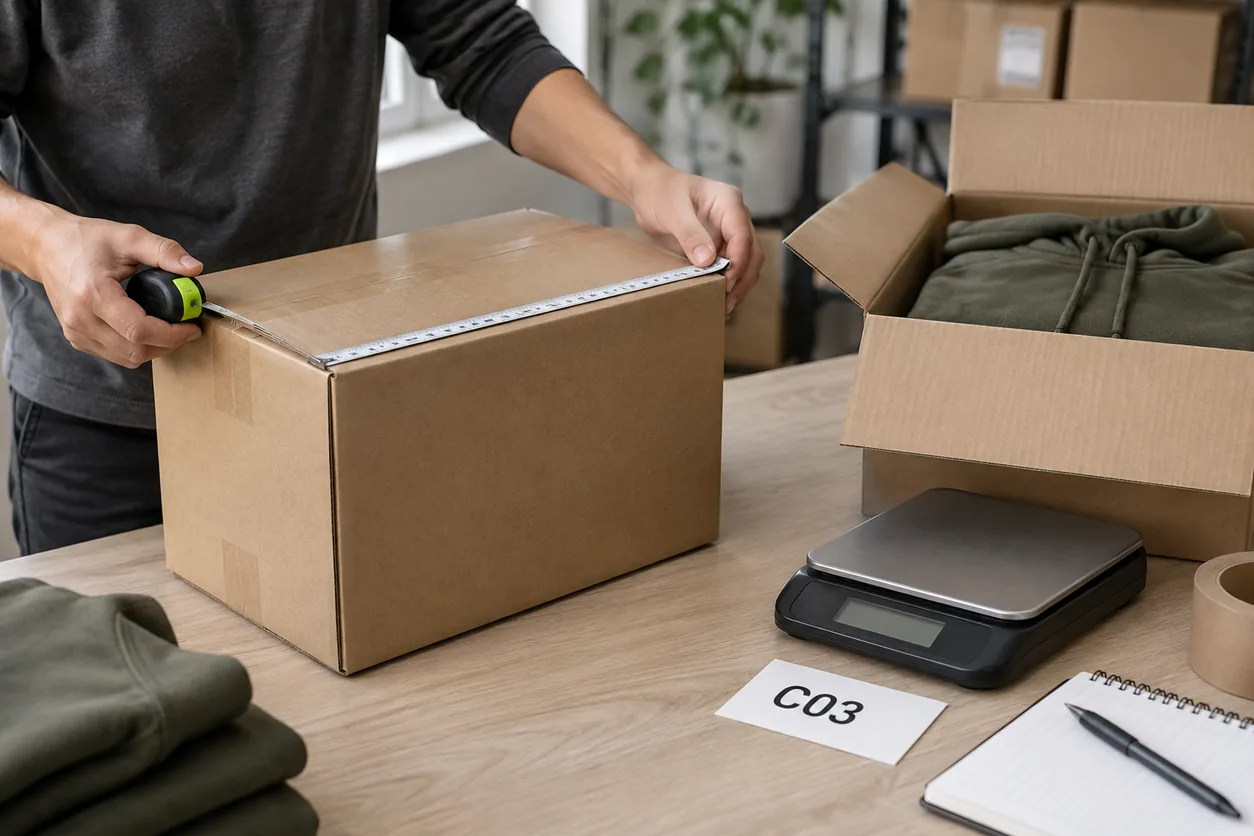
Concept illustration: obtain measurements and weight from the actual completed pack. The image provides no usable dimension, weight, freight quote or tested capacity.
Open the trial pack and turn observations into revisions
Review the identified garment inside its proposed individual pack, then its grouping in the proposed outer carton. Agree which size, artwork, material or packing cases the trial represents. An approval should name that scope; one simple tee does not establish the result for a decorated hoodie elsewhere in the collection.
Follow the receiver's intended opening sequence. Can the carton be identified before it is opened? Can the person find the intended variant without guessing? Does the folded garment present the chosen side, and does the physical label match the outer identity? Compare the trial with the packing sheet rather than relying on whether it looks tidy overall.
When a check fails, write the narrow revision. For example: “Move the size sticker to the agreed visible position on the individual pack; retain the confirmed garment fold and update the packing-photo reference.” Or: “C02's label matches the proposed color but does not list the approved size quantities; return a revised label and contents record before packing release.” Do not ask the supplier to change every material when the observed problem is a missing field.
Photographs can document orientation, visible information and an agreed arrangement. They do not independently prove every packed garment's identity, count, condition or performance through transport. A packing trial is also not a completed shipment inspection or a formal package test. Agree any additional evidence or checks that the actual garment and transport route require.

Concept illustration: reconcile a physical garment with its carton record. This is not a real receiving report, a passed inspection or proof of the illustrative 48-piece order.
Send a packing brief that the supplier can return with a clear reply
Use one dated packing revision alongside the current garment order. The following is a copyable starting point; fill unknown fields with to be confirmed and ask for a proposal rather than leaving the factory to invent a preference.
Packing brief: order and garment references; current size-color allocation; first receiver and its written requirements; individual-pack material, dimensions, closure and artwork references; fold sequence and finished views; garment, hangtag, insert and sticker positions; product identity and any required code data; allowed carton grouping and quantities; carton identifier and label template; carton-by-carton contents list and measurement units; physical trial scope; open decisions; requested reply date; and the person authorized to release this packing revision.
For Signal Tee, a useful accompanying message is: “Please review packing brief ST-P02 against allocation ST-Q03. Propose the individual fold and materials, return one complete packing trial and identify which size cases it represents. Confirm the C01/C02 contents map and actual carton proposal. List any unresolved receiver requirements, additional work and timing effects before we approve packing.” These references are fictional; use your own consistent identifiers.
Ask the reply to state what is included: packing materials, artwork or label preparation, individual application, grouping, physical trials and final contents records. Use Athletic Rush's manufacturing-quote comparison guide to resolve missing scope. Do not assume all branded packaging, spare materials or repacking work is included in a garment price.
Before release, check that the physical proposal, packing instructions, carton map and quotation describe the same version. Record exceptions and the work that remains on hold. The Athletic Rush sample-to-bulk approval guide covers the wider production authorization; approving a folded sample alone does not authorize every unresolved element of the order.
Questions new U.S. streetwear brands ask about packing
Must every garment have its own plastic bag?
This guide establishes no universal material or individual-bag requirement. Obtain the intended receiver's actual requirements, identify the garment and proposed presentation, and confirm the suitable materials and scope with the supplier. Review the complete pack rather than choosing only from a mockup.
Should every carton contain just one size?
Use the receiving and picking plan to choose the grouping. A single-variant carton is straightforward to identify, while a mixed-size carton needs an explicit size breakdown and agreed internal arrangement. Neither approach removes the need to reconcile the actual contents with the final list.
Can I approve packing from photographs alone?
Photographs answer visible-layout questions. Handling, opening, fit within packaging and other physical concerns may need the actual proposal. Agree the evidence required for each decision and record what the reviewed photos or trial do not establish.
Does confirming 48 garments confirm the size breakdown?
No. A correct grand total can contain the wrong variants. Reconcile each style, color and size within its identified carton against the authorized allocation. The worked example shows a two-medium/two-large substitution that leaves both the carton and shipment totals unchanged.
Bring Athletic Rush a garment brief and a receiving plan
Athletic Rush manufactures in Sialkot, Pakistan, and welcomes enquiries from U.S. clothing brands and creator-led labels. Request an Athletic Rush streetwear packing and sample discussion with your garment-reference link, size-color allocation, proposed presentation, first receiver's requirements and the packing trial you need reviewed.
The confirmed garment minimum is 30 pieces per design, with one to three colors and mixed sizes within that same design; each different design requires its own 30 pieces. Samples take 4–6 working days. Bulk production takes 8–10 working days for orders up to 100 pieces; larger-order timing depends on quantity. Shipping time is separate. Confirm the actual packing materials, extra development work and schedule in your quotation; those garment terms do not establish separate packaging minimums or a U.S. arrival date.
Email kamran@athleticrush.co or send Athletic Rush your garment and packing brief on WhatsApp. The next useful decision is agreement on one complete packing proposal, its contents records and the exact revision to review.