 Sialkot, Pakistan
Your first streetwear drop is almost ready, but the hangtag artwork contains only a logo. What else belongs on it? Give the tag a clear job: present the brand, identify the garment and its variant where needed, and connect the buyer to useful information. Keep shared artwork separate from size, color and product-code data, then review a physical printed tag on the actual garment before releasing the print run. A polished card with the wrong size or an untested code is still the wrong tag.
This guide helps new U.S. clothing brands and creator-led labels brief a removable hangtag without confusing it with the garment's required labeling. You will build a content map, choose between shared and variant-specific print approaches, and check the proof, string and attachment together. The suggested records and examples are practical planning tools, not a standard hangtag size or a claim that every sales channel requires the same information.
Athletic Rush's website starting points: explore Athletic Rush's streetwear development hub, then review Athletic Rush's private-label packaging service. The packaging page specifically includes hangtags and strings, size stickers, barcodes and garment labels. Confirm the exact materials, print work and application you want in your quotation rather than assuming that every option is included.
The Lane Tee below is a fictional teaching design. Its proposed colors, sizes and tag decisions are examples, not Athletic Rush inventory or an actual customer order. All six original images are AI concept illustrations. The pictured cards, blank labels and code placeholders are not approved artwork, compliant label specimens or tested barcodes.
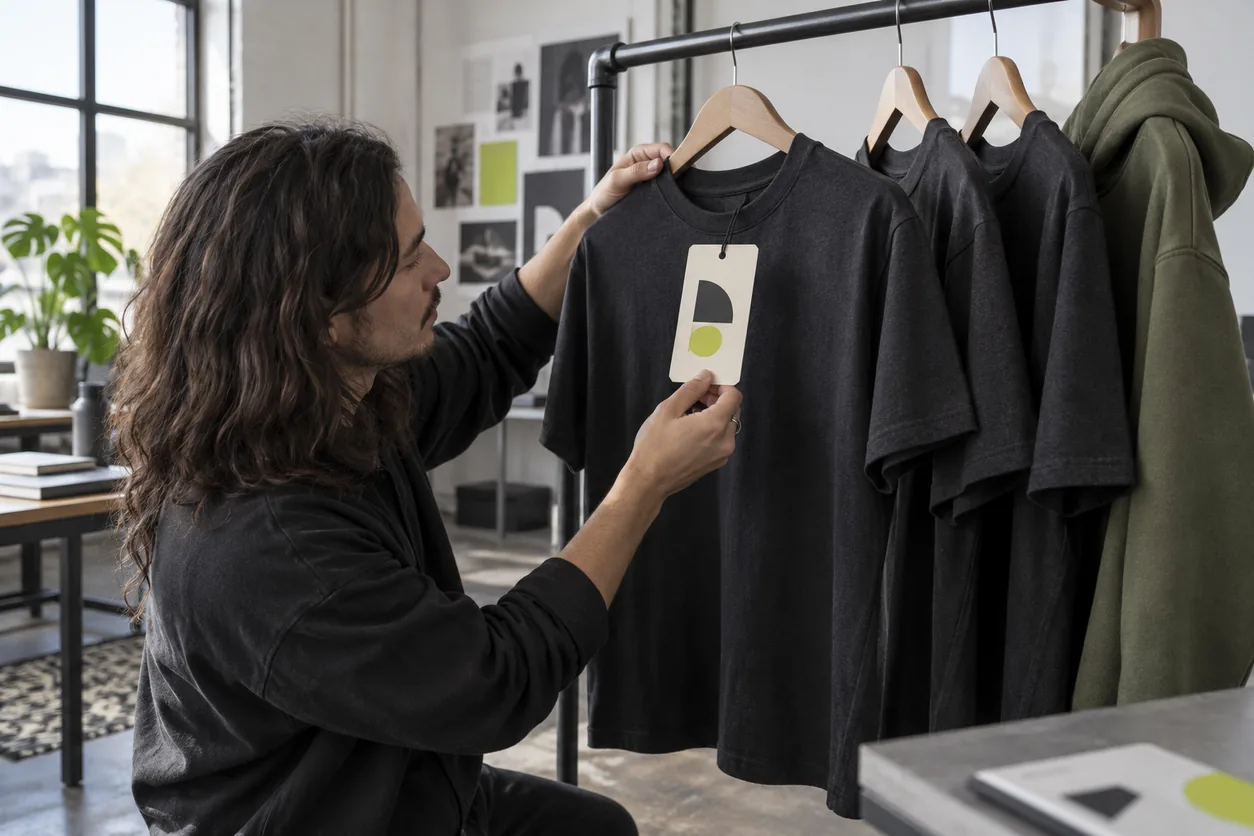
Concept illustration: review the card in relation to the garment. Its scale and appearance are proposals, not a prescribed tag dimension or an actual production approval.
Start with the job of the removable card
A hangtag can introduce the brand and help the person handling the garment identify what it is. That person might be your customer, a retail employee or the team matching products to orders. Decide whose question the tag must answer before adding more decoration.
For a direct-to-consumer first drop, a short brand message, clear garment identity and an optional useful website destination may be enough for the marketing role. A wholesale partner might also provide product-code, price or ticketing requirements. Obtain those requirements from the intended channel before the layout is finalized. Do not turn someone else's retail tag into a universal checklist for your own collection.
Separate the tag from the sewn brand label, the garment's size system and the required product information. They may share a visual language, but one attractive logo card does not resolve all of those decisions. Use Athletic Rush's woven-label approval guide for the different questions involved in an attached fabric label.
Keep U.S. garment-label decisions in their own review
The FTC's textile and wool labeling guide says most covered products need fiber content, country of origin and the responsible business's identity. It also explains conditions for hangtags that highlight a fiber without giving the full composition. Review that guidance before adding a cotton or other fiber claim; do not let a marketing card contradict the garment information.
The FTC's separate care-labeling guidance generally requires permanent, legible care labels for covered clothing and describes exceptions. It also addresses additional care information when packaging conceals the label. A removable brand card or website link does not automatically settle those requirements. Identify the applicable label content and placement separately from this hangtag design brief.
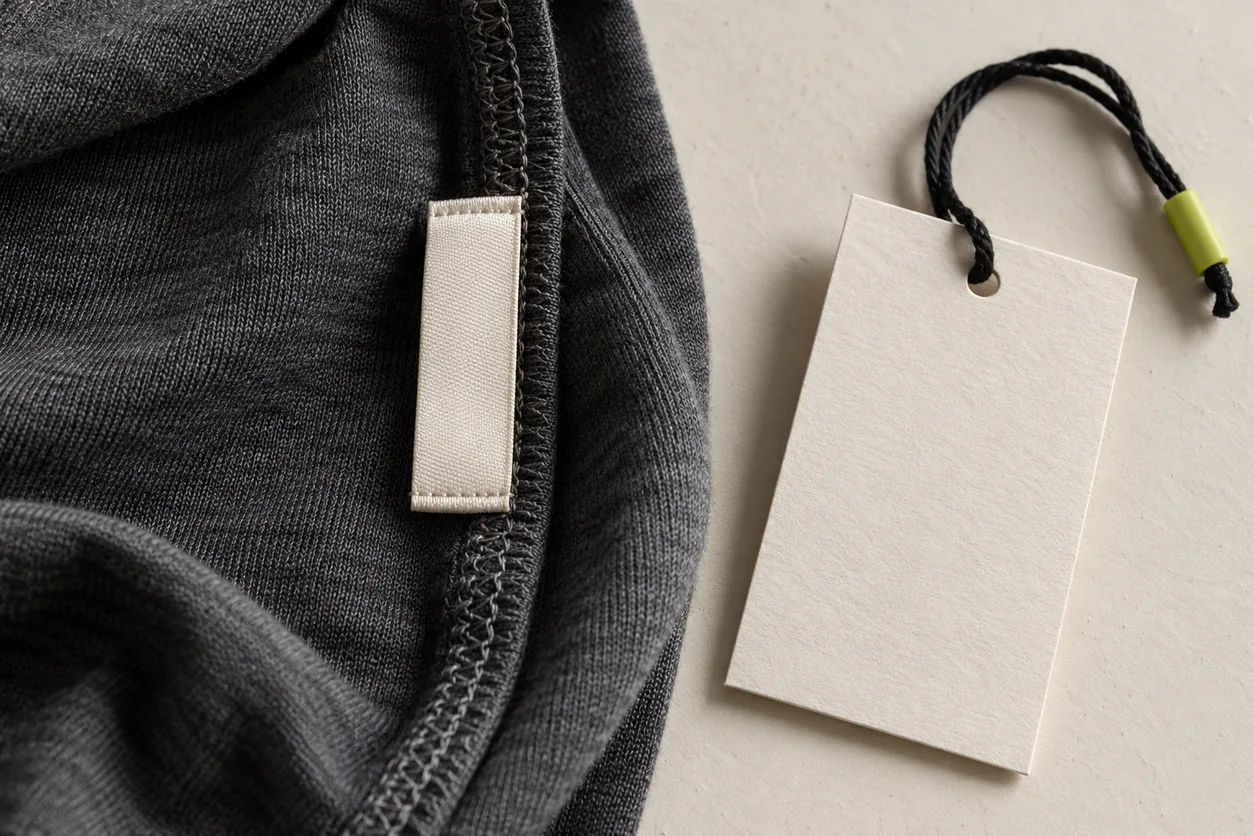
Concept illustration: an attached fabric label and a detachable card have different physical roles. Both are blank; neither demonstrates required wording or legal compliance.
Build a content map before choosing the finish
Write the actual words and data before deciding on foil, embossing, unusual shapes or an extra card. A beautiful layout can become crowded when the final style name, size, URL and channel information are added. Test the intended content rather than approving a mockup filled with short placeholder lines.
Use two categories: shared content, which stays the same across the intended range, and variable content, which must match a particular garment or sales-channel version. This is a planning distinction, not a requirement to print two separate tags.
| Tag element | Decision to make | What to verify before print release |
|---|---|---|
| Brand name and mark | The exact approved identity and artwork revision | Spelling, proportions, color and permission to use the artwork |
| Garment or collection name | Whether it describes one design or a broader range | The name matches the product record and does not imply a different garment |
| Color and size | Which fields change by variant and who supplies the data | Wording matches the actual garment and agreed size/color records |
| Product identifier | Which identifier and code, if any, the channel needs | Correct assignment, encoded value, readable text and intended system result |
| Price or channel-specific information | Whether it belongs on this version or a separate ticket | Current channel instructions, currency and the authorized value |
| Optional story or website link | One useful message or destination | Truthful wording, working destination and a sensible reason to follow it |
| Product claims | Which statements have an identified evidence basis | No invented composition, origin, performance or certification claims |
Keep information you have not confirmed out of the final print file. A phrase such as “details to follow” may be acceptable in a working brief, but it should not accidentally become the production copy. Give the person approving the proof a list of the remaining decisions, not a card that appears finished while important fields are still guesses.
For a creator-led label, your community story can be part of the front or back. Keep it concise enough that the garment identity and any operational information remain usable. Social engagement is not evidence for a material or product-performance statement, and a campaign slogan should not overwrite the correct size or color.
Use a real Athletic Rush product reference precisely
Athletic Rush product reference: Relaxed Midweight T-Shirt — True Black Tonal Mineral Wash. The live page offers a concrete tee direction with front and back views. In a development enquiry, identify that reference and explain your own proposed garment and tag direction. It does not supply your brand's tag artwork, retail price, size data or approved physical sample.
If the intended garment itself is not settled, Athletic Rush's T-shirt development page helps frame that product discussion. If the tag must work across several different products, Athletic Rush's collection-development service is the relevant place to discuss what should stay consistent across the range.
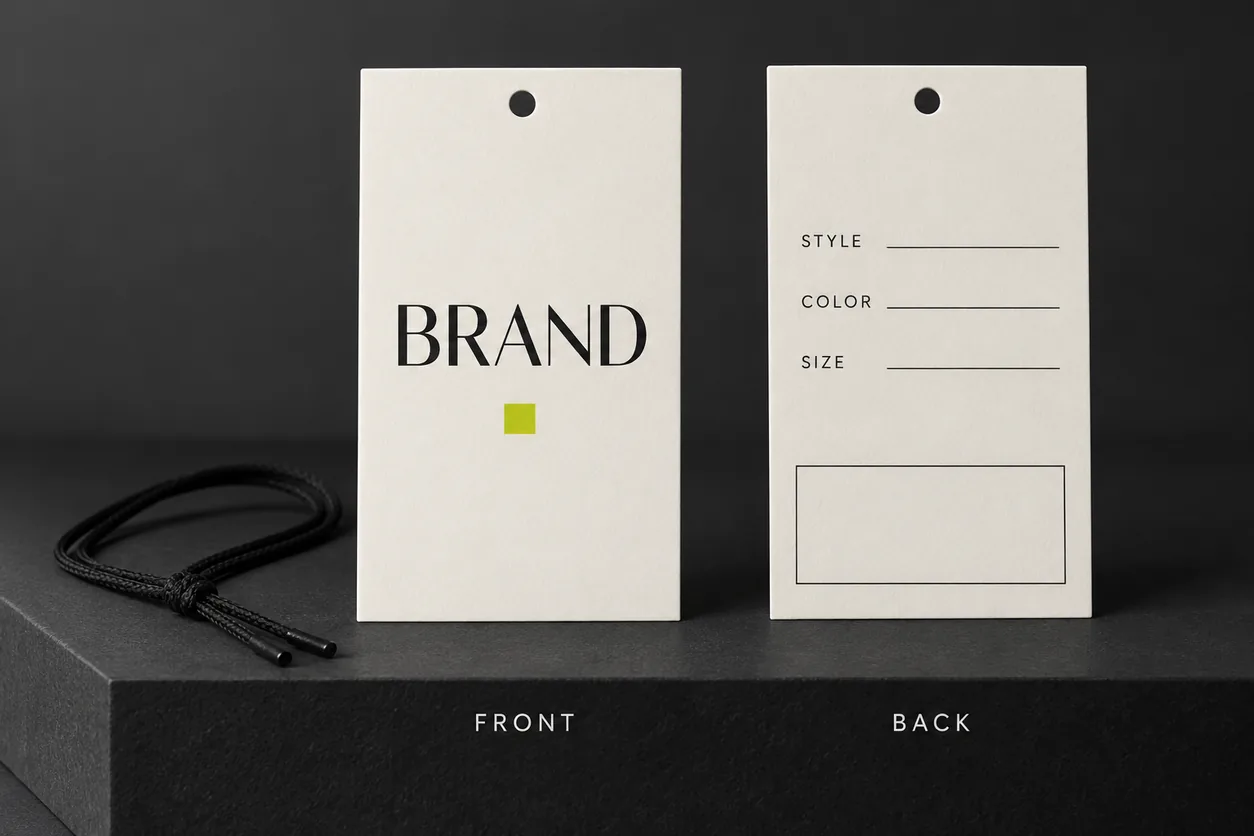
Concept illustration: shared brand presentation and garment fields can be planned separately. “BRAND” and the empty fields are placeholders; the blank rectangle is not a usable code.
One design can need several tag data records
Imagine the fictional Lane Tee is offered in charcoal and stone, each in S, M and L. That creates six proposed color-size combinations. This is an illustration of product identification, not a demand forecast, size recommendation or proposed order quantity.
The front artwork could remain the same for all six, while the back information identifies the actual variant. A charcoal medium and a stone medium may share a size name, but they still need to remain distinguishable in the product records and in whatever identification method your channel uses.
GS1 US's apparel product-identification guidance explains assigning distinct GTINs to product variants such as color and size. If your channel uses that system, obtain and manage the correct identifiers for the actual variants. Your internal style or SKU reference and a channel's required identifier are separate decisions; do not invent retail codes in the artwork or assume a random code generator supplies the required product identity.
For the Lane Tee example, the practical question is how the shared card becomes the right ticket for each garment. Compare these approaches with your supplier:
| Approach | Useful reason to consider it | Tradeoff and sample check |
|---|---|---|
| Shared brand card with a separately applied variable label | The common artwork stays consistent while variant data changes | Agree label stock, position and appearance; check it does not obscure other information or the code's required clear area |
| Fully printed variant-specific card | The data can be integrated into one finished layout | Control every version and match the print quantities to the authorized garment variants |
| Shared card with no variable fields | The hangtag is only a brand presentation item | Confirm where the correct size/color and required operational identification will instead be available |
None is automatically the cheapest or best solution. Ask about the actual print setup, data preparation, application work and revision implications. A shared card reduces artwork versions only if the variable data and the garment-matching process are still controlled.
Keep a simple tag-to-garment map: design reference, color name, size, approved product identifier where applicable, tag artwork revision and variable-data source. Include a reviewed example for each different data/layout case, then agree how all records will be checked. One correct charcoal-medium proof does not prove the other five records are correct.
Use Athletic Rush's size-and-color order breakdown guide for the garment allocation that the tag quantities must follow. Separately authorize any spare tags you want; do not assume a standard overage or let tag counts silently change the garment order.
Six variant records do not mean six different garment designs for minimum-order purposes. Athletic Rush's confirmed minimum is 30 pieces per design, with one to three colors and mixed sizes within that same design. Each different design requires its own 30 pieces. Confirm the actual design grouping and tag/print scope in the quotation rather than applying a garment minimum as if it were a separately confirmed tag-printing minimum.
Choose the physical card around its actual use
Compare material proposals with the printed content and garment in front of you. Ask for the card reference, finished dimensions, shape, finish, hole and string details. A screen render cannot establish how a card feels, how its edge looks or how the assembly sits on the garment.
A thicker-looking card may suit one presentation, while a smaller or lighter proposal may be more appropriate for another. Do not treat visual thickness as proof of durability or overall product quality. Handle the proposed samples and decide which characteristics matter for your route: readable information, practical scale, suitable stiffness, an acceptable surface and a workable attachment.
If you want embossing, foil or another effect, review its relationship to small type, code areas and the final finish. Ask the printer which artwork and clearances are needed. Use its current production template for trim, bleed, safe area, hole and any finishing layers; this guide does not prescribe universal millimeter allowances.
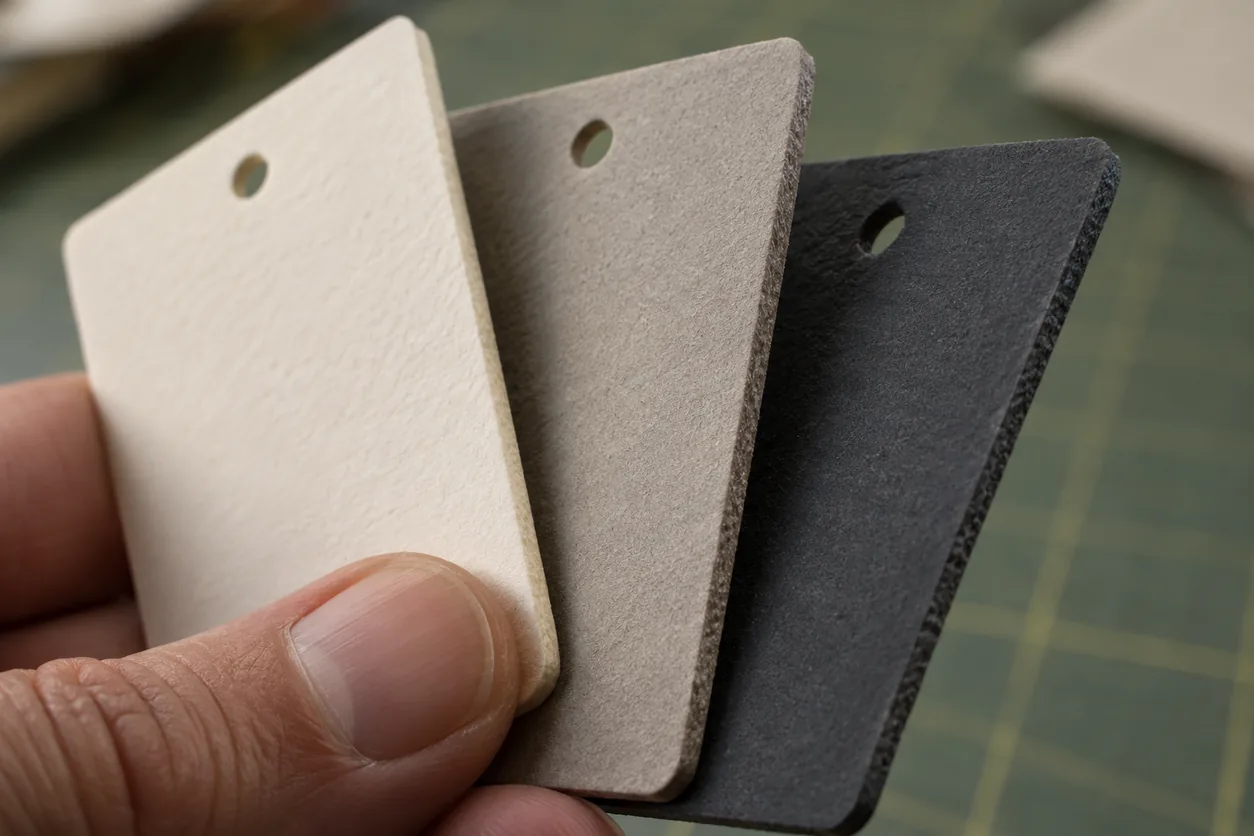
Concept illustration: physical samples let you discuss edges, surface and handling. No paper weight, composition, certification or durability result is established by this image.
Check dimensions and hierarchy at final scale
Review a final-size proof rather than judging a zoomed screen image. Can a person identify the garment information without hunting for it? Is the small type readable in the intended presentation? Does the string hole compete with the logo or leave important content too close to the cut edge?
For the Lane Tee, print a proof with a real-length proposed product name and the actual variant fields. Compare it against the intended tee instead of approving a short generic “T-Shirt” placeholder. The content may need a different line break, a clearer hierarchy or a revised card size. Resolve that in the current artwork rather than asking the production printer to improvise.
Review front and back orientation together. Mark the hole position and the way the card should face when attached. If a separate variable label is used, show its final placement on the proof. A perfect front proof does not confirm the reverse, the hole or the sticker layout.
Treat code readability and correct data as separate checks
A barcode can carry the wrong product identity even when it is readable. A correctly assigned value can also be printed poorly. Check both the data-to-variant match and the physical symbol's suitability for the intended scanning environment.
GS1 US's barcode placement and printing guidance addresses artwork, color, size and clear space. It identifies black bars on a white background as the preferred combination, calls for the relevant unprinted quiet zones and warns against casually resizing barcode artwork. Use the applicable symbol requirements and your printer's correct output, not a decorative imitation squeezed into leftover space.
Keep the hole, string, sticker and decorative finish away from the area the actual code requires. Agree the specific layout with the printer and channel; an empty rectangle in a concept is not a barcode specification. Do not use a generated image as the source of a production barcode.
Ask for a printed proof checked with the intended scanner or workflow and confirm the decoded result against the correct product record. Record the code, the garment variant and what was checked. A single phone scan may answer one practical question, but it is not automatically a formal barcode-quality verification or evidence for every printed ticket.
If you add a marketing QR link, decide what it is for: garment information, a collection page or another useful destination. Test the actual printed code and destination on an ordinary device before print release. A marketing link and the product identifier required by a retailer need not be the same code or serve the same purpose. Confirm the chosen system rather than assuming every QR symbol works at a retail checkout.
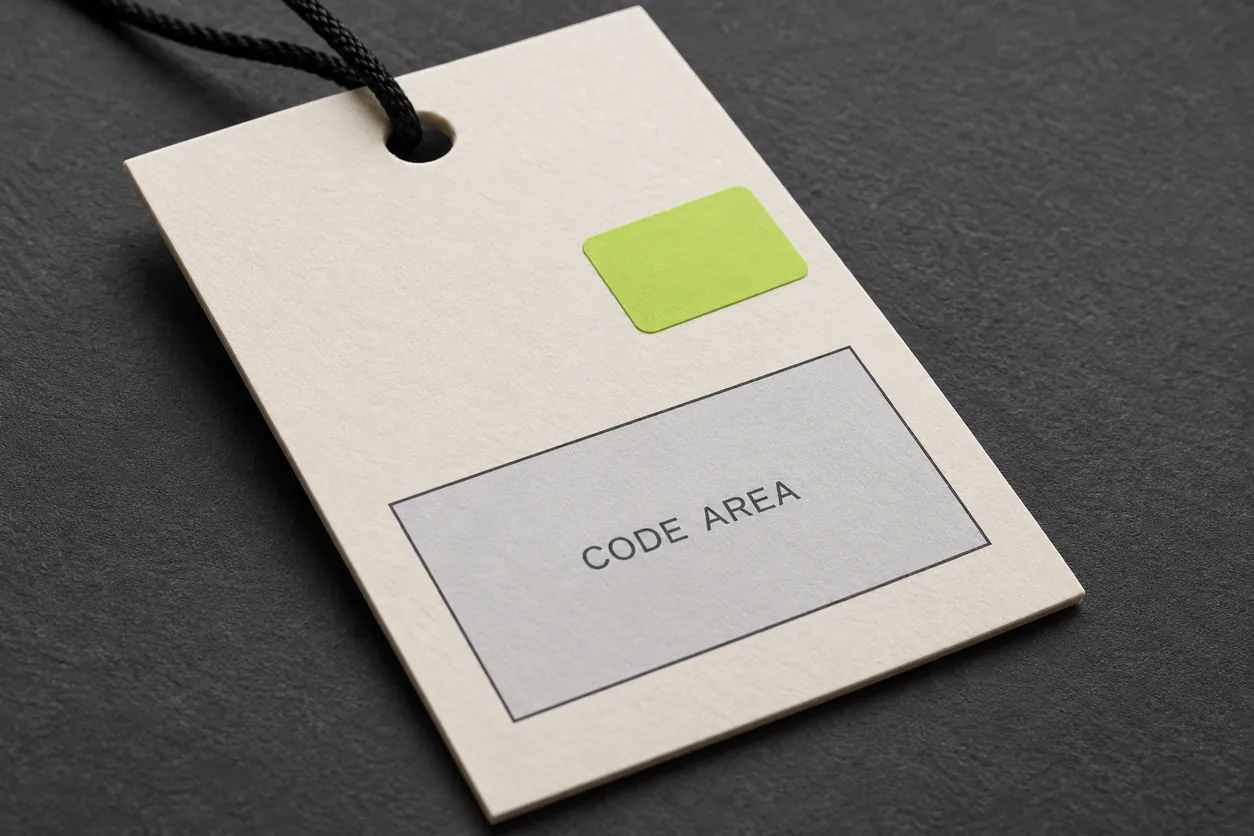
Concept illustration: protect the space needed for the actual code. “CODE AREA” is an empty placeholder, not a barcode, QR code or universal placement standard.
Review the attachment on the complete garment
Specify the string or fastener and the proposed attachment point together. Ask the supplier to demonstrate how it will be attached and removed. Do not assume the same attachment is suitable for every neckline, material or decoration.
Look at whether the tag hangs as intended, whether the string obscures the information, and whether the proposed attachment visibly distorts or marks the garment. Check that the card can be handled without blocking the relevant garment labels. If a sewn brand label is proposed as an attachment point, review that actual construction and ask the supplier to confirm suitability rather than treating the illustration as an instruction.
For creator campaign photography, a deliberately oversized card may be a presentation choice. Review whether that same proposal works for customer handling and the agreed packing route. A styled photograph and an approved production attachment answer different questions.
This article stops at the hangtag assembly and its information. The way a complete order is folded and packed needs its own instructions; do not assume an attractive attached tag establishes the final packing arrangement.
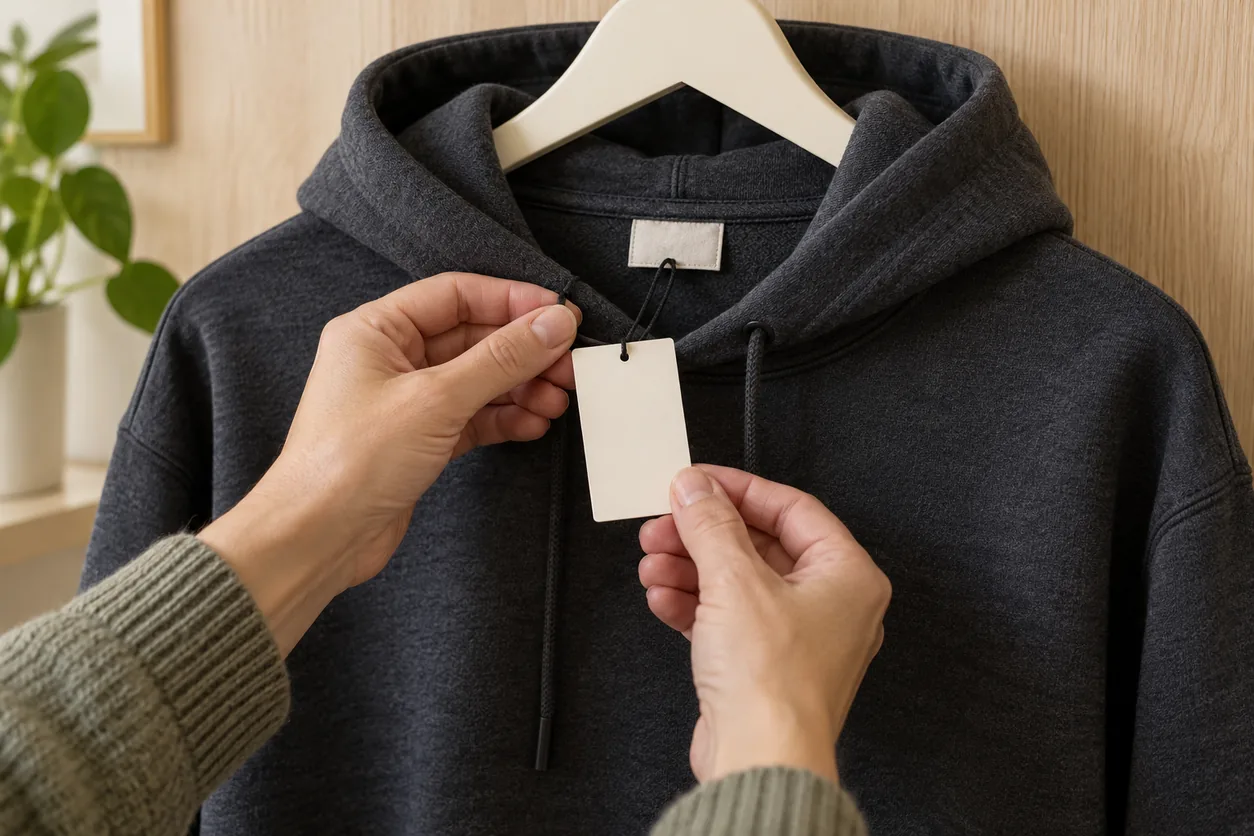
Concept illustration: inspect the proposed attachment on the garment. It does not establish that this attachment point is suitable for every label, fabric or order.
Send one print brief and keep open items visible
Keep the print brief with the garment's current development record. A useful handoff identifies both the visual version and the data version; a file named “hangtag final” is not enough if the style-color-size sheet changed afterward.
Hangtag brief: garment/design reference and intended sales channel; shared front/back artwork revision; exact approved wording; finished card dimensions and material/finish reference; printer's production template; hole, string and attachment proposal; variable fields and current data source; identifier/code requirements where applicable; any separate sticker layout; requested printed proof and checks; quantities by approved version and separately agreed spares; open decisions and the person who may authorize print release.
Ask the supplier to state what is included: artwork preparation, physical proofs, variable printing, strings, application and any relevant extra work. Use Athletic Rush's manufacturing-quote comparison guide to resolve missing scope rather than treating an unanswered item as included.
Before release, work through this short checklist with the actual proof and garment:
- Match the front, back and any sticker to the current artwork and data references.
- Read every printed field and compare each variant's size, color and identifier with its garment record.
- Check final-size legibility, cut position, hole, finish and front/back orientation.
- Review any actual code's printed result and intended system response; retain what was checked.
- Inspect the assembled string and attachment on the identified garment.
- Record unresolved points, authorized quantities and the exact version released for printing.
If a field or attachment remains unresolved, name it and state what must wait. Athletic Rush's streetwear tech-pack guide helps connect the documents, while Athletic Rush's sample-to-bulk approval guide addresses the separate authorization of production work. Approving a logo image does not release every tag version or the complete garment order.
Questions new streetwear brands ask about hangtags
Can every size use the same hangtag?
The shared brand artwork can remain the same, but any size, color or product identifier printed on the ticket must match the garment. Decide where variant information lives and verify the matching process. A shared card is not permission to attach the same incorrect size information to every piece.
Does a removable hangtag replace the care label?
Do not assume it does. Review the FTC care-label rules for the actual product and any applicable exception. Keep the hangtag's marketing role and the required garment-label decisions separately identified in the brief.
Do I need a QR code and a retail barcode?
Only add a code when its purpose and channel requirements are clear. A website QR link and a retail product identifier may serve different jobs. Obtain the intended channel's requirements, agree the correct data and check the actual printed result instead of adding decorative codes for appearance.
Can the supplier copy the size-color information from the order automatically?
Agree the source and responsibility rather than assuming an automatic transfer. Match the current garment allocation, tag data file and proof versions. Ask how revisions and spares will be handled, and check the resulting garment-to-tag match before releasing the work.
Bring Athletic Rush a garment and tag brief that belong together
Athletic Rush manufactures in Sialkot, Pakistan, and welcomes U.S. clothing-brand enquiries. Request an Athletic Rush streetwear hangtag and packaging discussion with your garment-reference link, brand artwork, proposed tag content, variant data, sales-channel requirements and the physical proof you need reviewed.
For garments, the confirmed minimum is 30 pieces per design, with one to three colors and mixed sizes within the same design; each different design requires its own 30 pieces. Samples take 4–6 working days. Bulk production takes 8–10 working days for orders up to 100 pieces, with larger-order timing dependent on quantity. Shipping time is separate. Confirm the actual hangtag scope, print quantities and schedule for your project rather than assuming separate packaging terms from those garment terms.
Email kamran@athleticrush.co or send Athletic Rush your garment and hangtag brief on WhatsApp. A useful next step is agreement on the content map, print/data versions and physical proof before the tag run is released.