 Sialkot, Pakistan
Your first streetwear delivery has arrived. The total looks right, one T-shirt photographs well, and your launch is close. Is that enough to move the whole order into sellable stock? Inspect the delivered garments against the identified approved reference and current specification, record exactly which pieces and characteristics you checked, and separate unresolved goods before release. A correct carton count, an attractive sample and a completed garment inspection answer different questions.
For a new U.S. clothing brand or creator-led label, the useful outcome is a clear decision: which goods can move forward under the agreed requirements, which must stay on hold, and what evidence is still missing. This guide builds that decision around tees and hoodies rather than an unexplained “QC passed” message. It covers a practical buyer review, not a substitute for a professional statistical inspection plan or laboratory test.
Explore Athletic Rush's streetwear development and manufacturing alongside the checks below. Agree your inspection scope before production or dispatch when possible; if the goods are already at your U.S. studio, record the receiving review as its own event rather than rewriting an earlier approval.

All six images in this guide are original AI-generated educational concepts. They show fictional people, garments and review situations, not Athletic Rush staff, inventory, customer orders or measured inspection results.
Start with the approved version, not a remembered sample
Put the current order, style-color-size allocation, measurement sheet, artwork revision, label instructions and physical reference together. Identify the reference by its actual revision and approval record. A photograph of an early development sample may explain a discussion without representing the version that was authorized for production.
Use a fictional Orbit Tee to make the distinction concrete. Its approved reference might be a navy relaxed tee with a cream chest graphic, while the order also contains a stone version. The navy garment does not automatically establish the approved stone shade, graphic contrast or every size. List what each retained reference represents and which requirements need another document or physical comparison.
The Athletic Rush relaxed midweight T-shirt design reference is a real website example of a stated fit and finish direction. It is a different, True Black tonal mineral-wash proposal, not the fictional Orbit Tee or evidence of your delivered goods. Use a website reference to begin development; inspect against the actual specification and reference agreed for your own order.
If the requirement is missing, write “reference needed.” Do not create a tolerance, shade boundary or print-placement rule from memory while judging the delivery. The Athletic Rush streetwear tech-pack guide explains how to connect drawings, components, measurements and revisions before these become inspection questions.
Define what this inspection can actually decide
A receiving count answers what appears to have arrived. A garment review addresses identified product characteristics. An as-received check cannot by itself establish behavior after laundering, and a photo of a seam cannot establish a measured strength result. Keep the scope visible in the record.
For example, a fictional Dock Hoodie needs its own body, sleeve, pocket and hood references. If your actual design has a zipper, include its agreed opening action and assembly checks; do not add zipper requirements to a pullover. Review the Athletic Rush hoodie development information when describing which construction you want to make. The category is a development reference, not a report about a particular finished order.
| Check | Evidence to record | What remains separate |
|---|---|---|
| Receipt and nominal variant count | Carton identities, tags, counted quantities and discrepancies | Whether a tag identifies the garment correctly |
| External and internal appearance | Identified pieces, views, observed differences and reference version | Unseen pieces and untested performance |
| Dimensions | Piece ID, measuring point, method, result and agreed limit | Other dimensions, worn fit and later care changes |
| Practical operation | Which pocket, opening or closure was used and what happened | Standardized strength, durability or safety testing |
| Release decision | Exact goods covered, open points and authorized next action | Goods outside the agreed inspection scope |
Specify whether you are reviewing goods before dispatch at the supplier, after arrival with your receiver, or at both stages. Record who performs each check and who can authorize the next action. A supplier's pre-shipment report and your receiving observations can both be useful, but they should retain their own dates, conditions and scope.
Count the goods, then make the selection traceable
Reconcile each nominal style, color and size with the order rather than stopping at a grand total. Mark unexplained substitutions and separate goods whose identity is uncertain. If a tag says M, that is a label observation; dimensions and construction may still need checking before you treat that identity as resolved.
Give reviewed garments temporary, non-damaging identifiers linked to their source carton and variant. Keep the reference piece separate from delivered units so it does not silently enter the stock count. Record whether a piece was opened, measured, operated, washed or otherwise changed during review before returning it to saleable inventory.
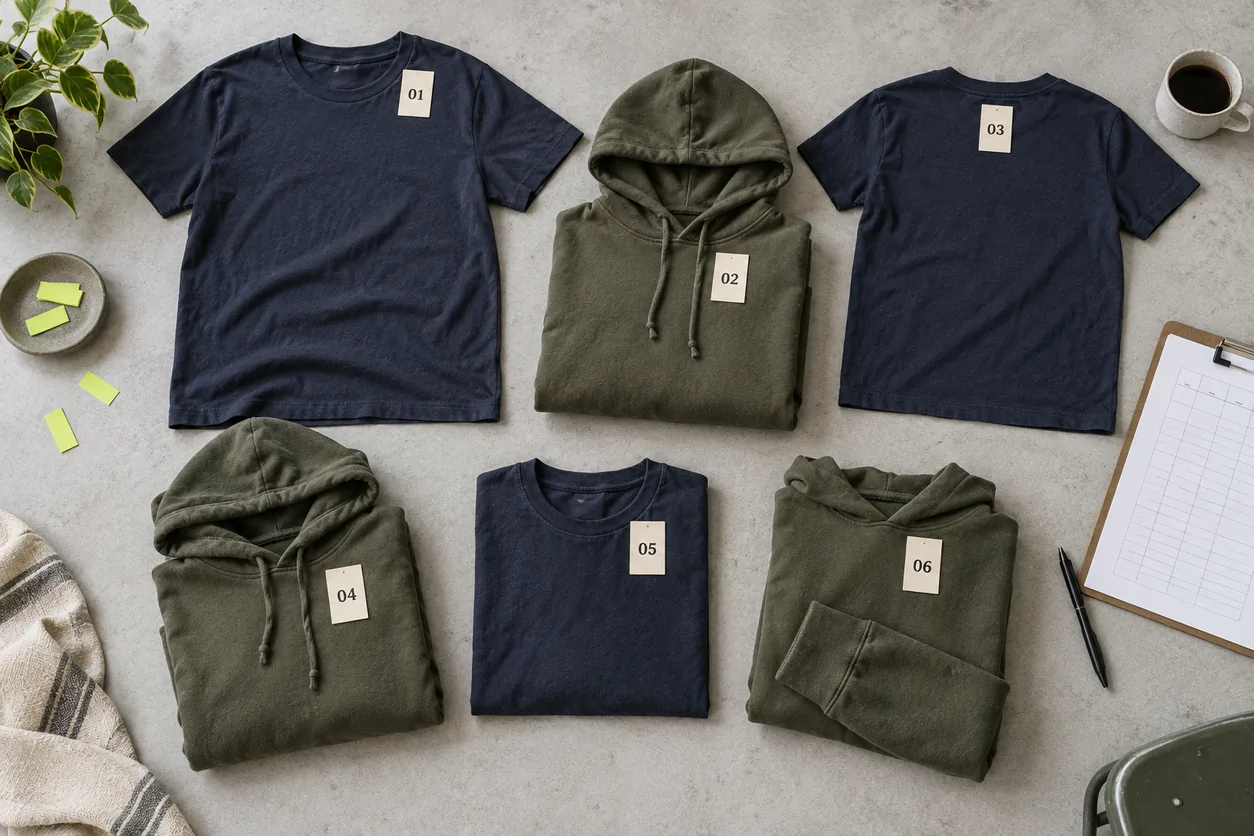
Numbered pieces illustrate traceability. A visually varied selection is not, by itself, a statistical sampling plan.
There are two different choices to discuss with your supplier or inspector. For a small order, you may agree that every garment receives particular non-destructive checks. Alternatively, you may commission a defined acceptance-sampling plan. If every piece is counted but only some are measured, say exactly that; do not describe all characteristics as “100% inspected.”
NIST's introduction to acceptance sampling describes selecting a random sample from a lot to support a decision about that lot. It also distinguishes that decision from estimating the lot's quality. A founder choosing a few accessible pieces from the top of a carton has not demonstrated that procedure.
For a formal plan, obtain the lot definition, applicable standard and edition, selection method, sample sizes, classification rules and acceptance or non-acceptance criteria from the responsible inspector. Do not choose a familiar AQL number and invent the rest. Looking deliberately at a known trouble spot can help investigate a concern, but it must be recorded as that investigation rather than presented as a random acceptance sample.
Measure the same feature the same way
Lay the garment on a suitable surface in the agreed condition, arrange it without pulling it into the target dimension, and use the defined endpoints. Record the unit, measuring method and result next to the piece ID. Confirm which points and limits apply to each size; a size label alone is not a measurement instruction.
For the Orbit Tee, separate flat chest width, body length and sleeve length. A chest measurement across one side of a flat garment is not automatically the same recorded quantity as its full circumference. If one reviewer doubles a figure and another does not, their comparison can create a discrepancy that is actually a method mismatch.
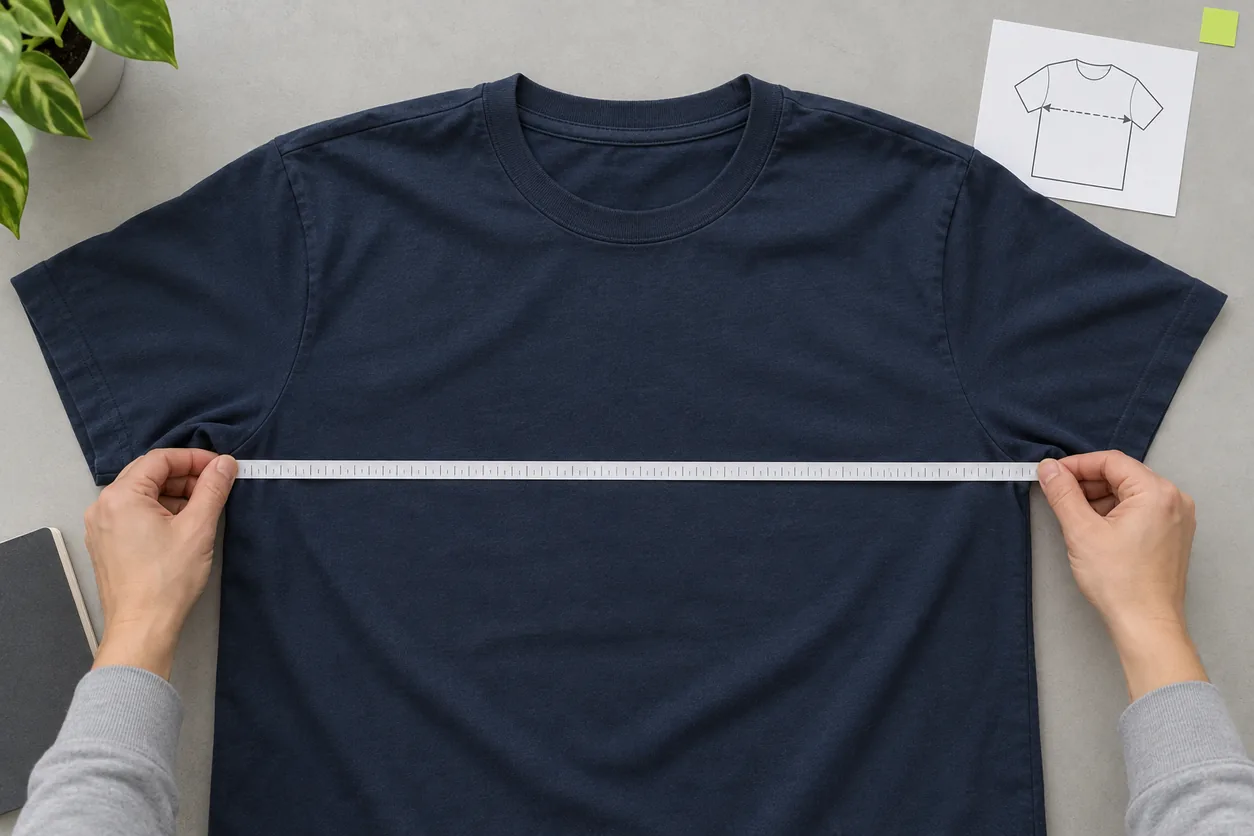
The scene illustrates controlled handling. Your own specification must define the exact endpoints, garment condition, units and permitted limits; the generated tape is not measurement evidence.
Use an explicitly fictional calculation: if one agreed point is 58.0 cm with a permitted difference of plus or minus 1.0 cm, its written interval is 57.0–59.0 cm. A repeatable 59.4 cm observation is outside that example interval by 0.4 cm. Those figures are an arithmetic lesson, not Athletic Rush's standard tolerance or a recommended limit for your tee.
If the reading appears outside the agreement, check the piece ID, correct size row, endpoints and method again before changing the result. Keep the original and repeated observations traceable. Resolve a genuine method disagreement with the supplier instead of stretching the garment or changing the limit after seeing it. The Athletic Rush garment-tolerance guide develops the specification and comparison steps.
Inspect the inside and the working details
Review the garment front, back and inside under consistent, adequate light. Follow seams to their junctions rather than examining only the most visible chest area. Look for observed openings, missed stitches, caught material, stains, unexpected components or other departures from the agreed reference. Describe the location and appearance; do not diagnose an unseen manufacturing cause from one photograph.
For the Dock Hoodie, look at the pocket corners, underarm junctions, hood attachment and cuff joins in addition to the outside silhouette. Check that the intended opening and pocket access work during ordinary handling. An exposed opening at a seam and a loose surface thread are different observations; record what you can actually see before deciding how each should be handled.
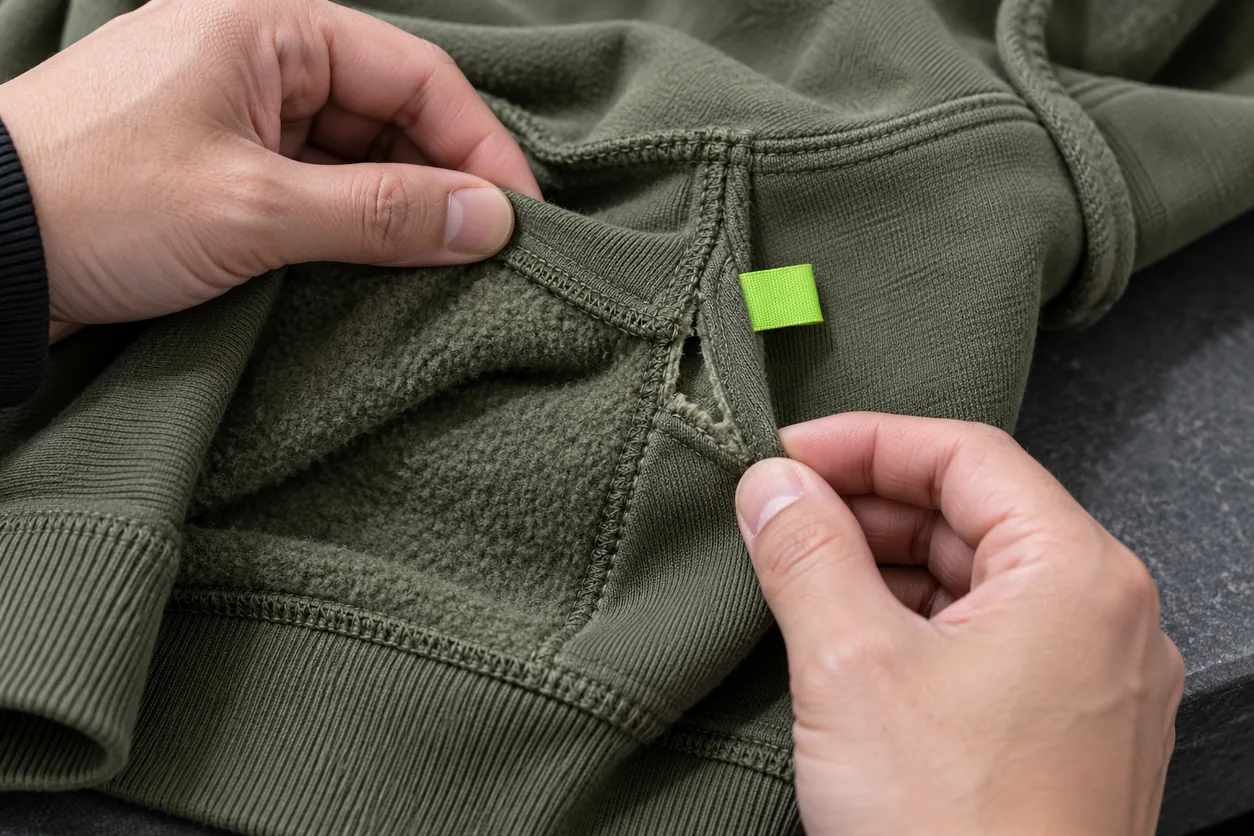
A close view can show an area needing review. This fictional seam image does not establish strength, a production cause or the condition of uninspected garments.
Avoid improvised destructive pulling or repeated stress that changes the evidence without an agreed method. If a concern requires a strength, durability or other specialized assessment, agree the relevant test and sample with a competent provider. Keep those pieces identified. A practical opening check and a test report should not share an ambiguous “passed” label.
Where a finding could affect safe use, keep the affected goods out of release and obtain appropriate qualified assessment. This buyer checklist does not certify product safety or replace product-specific compliance work. Separate the immediate decision to hold a questionable item from an unsupported claim about the cause or the entire order.
Compare the artwork on the actual garment
Match the delivered artwork to the approved version: content, dimensions, orientation and the garment reference points used for placement. Keep the body arranged consistently. A tilted graphic photographed on a twisted shirt is a different observation from a repeatable placement difference on a relaxed garment.
Look at each relevant colorway and size case under the agreed scope. The same graphic can have a different visual relationship to a narrower body, and a cream graphic on navy does not establish its appearance on stone. Check both artwork identity and its relationship to the garment instead of treating an attractive camera image as the sole acceptance condition.
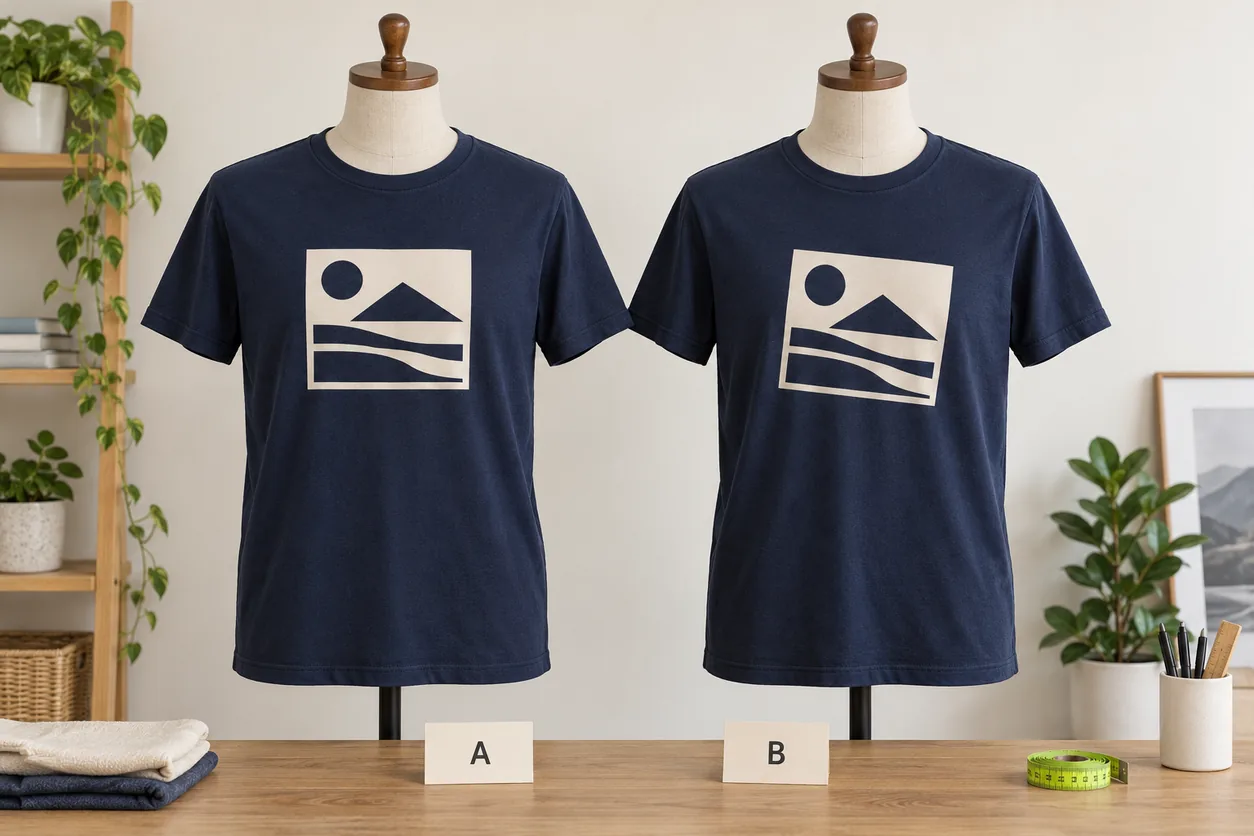
A and B demonstrate an orientation question. They are not measured pass/fail samples or evidence of an actual production defect.
The Athletic Rush printing and embroidery information can help define the decoration proposal. For inspection, use the agreed physical result and method rather than assuming a process name establishes print feel, adhesion or later performance. Visible appearance, tactile observations and any specified performance evidence need their own recorded answers.
Compare shade or finish with the appropriate physical reference under the agreed viewing conditions. Note whether a proposed difference falls within a previously accepted range or needs a decision. Avoid approving a new shade boundary from an edited phone image. Preserve the connection between the observed garment, its variant and the comparison reference.
Worked example: six findings can affect four pieces
Suppose a fictional first drop contains 60 Orbit Tees, split between navy and stone. The receiver reconciles the nominal tag counts and selects 12 identified pieces for a specified visual review and three agreed measurements. This is a teaching example of a buyer-selected review, not a prescribed sample size, a random plan or an AQL calculation. The other 48 pieces have not received those same garment checks.
Within those 12 pieces, the reviewer records the following findings. Each row identifies one physical garment; the two findings on one garment do not create two affected garments.
| Reviewed piece | Recorded findings | Findings on this piece |
|---|---|---|
| Navy M, piece N-M-03 | Open underarm junction and a surface mark | 2 |
| Navy L, piece N-L-02 | Artwork orientation differs from the agreed reference | 1 |
| Stone S, piece S-S-01 | Size identity needs resolution and body length exceeds the applicable agreed interval | 2 |
| Stone M, piece S-M-04 | Missed stitching at the identified hem location | 1 |
| Total | Four distinct pieces with recorded findings | 6 |
The record contains six findings on four of the twelve reviewed pieces. The other eight reviewed pieces had none of these findings under the stated checks. It does not show that six garments are affected, that only four of all sixty garments are affected, or that the remaining forty-eight meet the garment requirements.
ASQ's attribute and variable sampling overview distinguishes characteristic counts from measured data and explains that a sampling plan includes sample sizes and decision criteria. Apply that discipline to your record: identify what is being counted, keep measurement values separately and use the counting rule required by any formal plan you commission. The example table is not an acceptance decision under a standard.
The immediate useful action is to separate those four pieces, preserve their identity and agree the next review of the related goods. Ask whether the same characteristic should be checked across a defined variant, carton group or wider lot. Do not quietly replace the four pieces and call the original review a pass. Record any sorting, replacement or repair as a new action with its own verification.
Turn observations into a controlled release decision
Use clear physical and record statuses so a held garment cannot be picked accidentally. “Release,” “hold” and “further review” are practical working labels; define who can move goods between them and what evidence closes the hold. A colored note without a linked piece or carton identity is easy to lose.
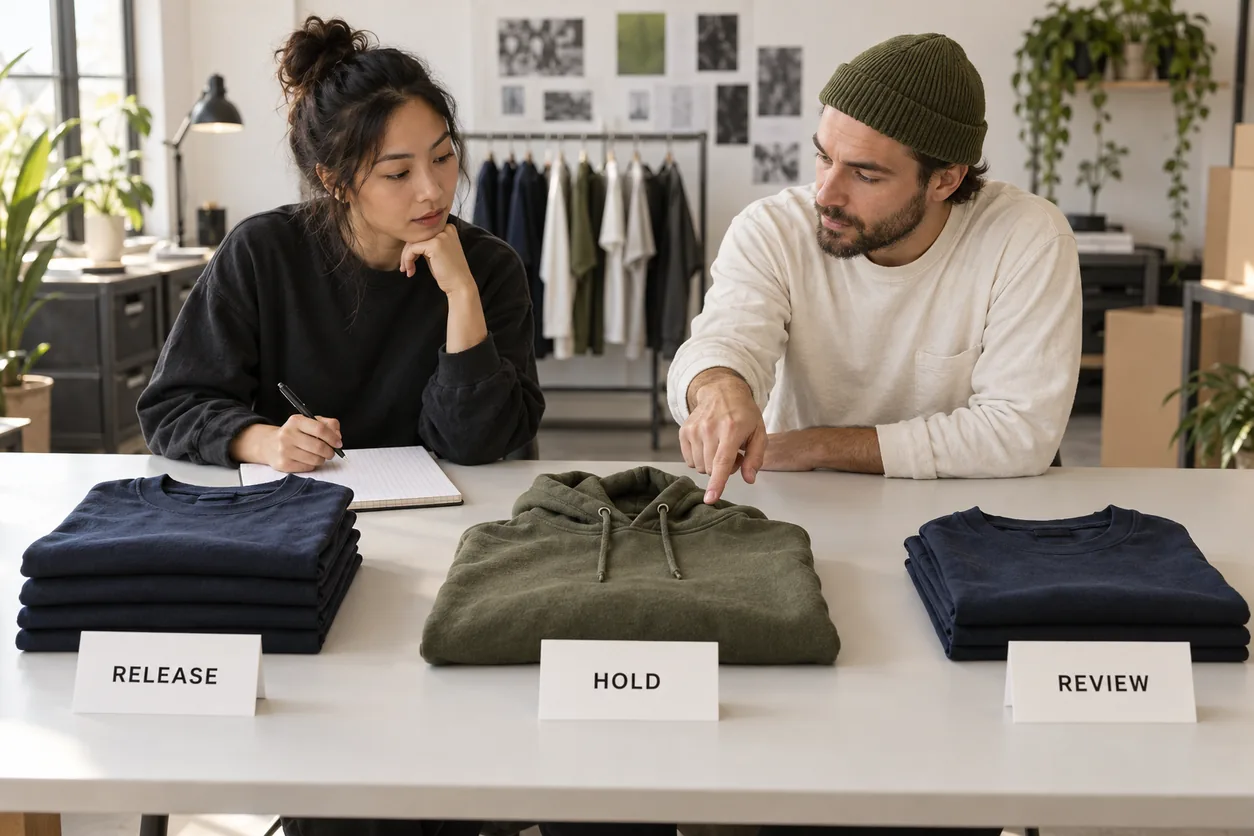
Status groups illustrate a handling decision, not an assertion that any pictured garment has passed inspection.
For the fictional Orbit Tee, a useful message is: “Review OR-I01 covers the twelve listed pieces and the stated checks against specification OR-R04. Keep the four identified pieces separate. Confirm a proposed review scope for the related variants, the disposition of these pieces and evidence required before release. The other forty-eight have not received the same checks.” Use your own references and the actual agreed decision process.
Where a specific requirement is satisfied, record its evidence. Where it is unresolved, name the missing comparison or next check. Where goods are revised, document what changed and inspect the applicable features again before clearing that action. Keep quantity reconciliation current so held and replacement goods do not silently alter the sellable allocation.
A broad message such as “everything looks good except a few issues” hides all three questions: what was inspected, what was found and what is now authorized. Tie the release to exact goods and the agreed scope. For production authorization before the goods exist, use the separate Athletic Rush sample-to-bulk approval guide; a development approval does not replace inspection of finished goods.
Keep care evidence separate from the arrival check
A tee that looks correct on arrival may still have unresolved care questions. Identify whether the actual agreement includes post-care dimensions, appearance or another assessment, which samples represent it and which report is required. Retain the as-received baseline before changing the garment through that work.
AATCC's public laundering-method training overview lists garment dimensional-change and post-laundering appearance methods as distinct subjects. That supports keeping those questions separate; the public overview is not the full test procedure, an acceptable result limit or evidence that this order has been tested.
Use Athletic Rush's color-and-fit-after-washing guide to frame the relevant comparison. Do not wash an unidentified piece, mix it into the retained reference set and later report the resulting dimensions as its arrival condition. Record the method, sample identity and limitations of any evidence used in a release decision.
Copy this finished-order inspection brief
Send the brief before the inspection so the supplier, receiver or appointed inspector can identify missing requirements. It is an enquiry worksheet, not an automatic purchase instruction or a standardized sampling plan.
- Order and review stage: order reference, location, review date and pre-dispatch or receiving scope.
- Goods covered: style, color, size, quantity, lot/carton identities and the population the decision concerns.
- Approved references: current specification, retained garment, artwork, shade/finish range and label versions.
- Checks: visual areas, measuring points and limits, ordinary operation, required tests and evidence not yet available.
- Selection: every-piece checks versus selected-piece checks; selection method and exact piece identifiers; professional plan details where commissioned.
- Reporting: actual results, nonconformity counting rule, affected-piece count, photographs and unresolved references.
- Disposition: separate held goods, responsible decision-maker, proposed corrective action and required reinspection.
- Release record: goods and scope authorized, exceptions remaining and final allocation after any changes.
Ask for the proposed inspection work and exclusions to be stated in the quotation. Do not assume every measurement, test, full-order sort or third-party report is included in a garment price. If the sampling or development brief is still incomplete, discuss those requirements through Athletic Rush's collection-development service before calling a later inspection complete.
Questions new clothing brands ask about order inspection
Does a 30-piece order need a formal AQL inspection?
There is no universal rule supplied by this guide. Agree the checks, scope and decision method appropriate to the actual order. If you commission a formal sampling plan, obtain the full plan from the responsible inspector. A small quantity does not make an unexplained sample or invented threshold a valid statistical plan.
Can I call the delivery checked after looking at one piece per size?
Describe exactly what you checked and how pieces were selected. One identified piece per size can answer limited observations about those pieces; it does not, by itself, establish every characteristic of every delivered garment. Keep unresolved scope visible and agree the next inspection decision.
Should two issues on one T-shirt count as two defective T-shirts?
No. Keep the number of findings and the number of affected physical pieces distinct. For a formal plan, follow its specified definitions and counting rules. The worked example records six findings on four pieces and deliberately does not turn that into a whole-order defect percentage.
Does a factory inspection report replace my receiving check?
Read its actual scope, stage, selected goods, results and exceptions first. A receiving review can reconcile the delivered goods and document their arrival condition. Keep both records identified rather than assuming one covers every question at the other stage.
Plan your first drop with a review you can explain
For a U.S. launch, leave room in your own plan for receiving, inspection decisions and any necessary follow-up before promising availability. Production timing and shipping are separate from your receiving work. Explore Athletic Rush's T-shirt development information, choose the garment proposal you actually want, and identify the checks you need to agree before ordering.
Athletic Rush manufactures in Sialkot, Pakistan, serving U.S. clothing-brand enquiries. The confirmed minimum is 30 pieces per design, with one to three colors and mixed sizes within that same design; every different design requires its own 30 pieces. Samples take 4–6 working days. Bulk production takes 8–10 working days for orders up to 100 pieces; larger-order timing depends on quantity. Shipping time is separate. Confirm the inspection scope, additional work and actual timeline for your project; these garment terms do not establish a separate inspection service, test package or U.S. arrival promise.
Request an Athletic Rush streetwear sample and inspection-scope discussion with your proposed product, intended U.S. destination, quantity, current specification and the release questions you need answered. Email kamran@athleticrush.co or send Athletic Rush your garment brief on WhatsApp. The next useful step is agreement on the garment reference, inspection scope and evidence required for the first production decision.