 Sialkot, Pakistan
Your first T-shirt sample is close, but the sleeves feel wrong and the neckline is not what you pictured. What should you send the manufacturer? Write one numbered comment for each issue, connect it to an identified sample and photo, separate what you observed from what you want changed, and state how the next submission will be checked. A message saying “make it more premium” leaves the factory to invent the decision you have not made.
For a new U.S. clothing brand or an influencer developing a first streetwear drop, useful feedback makes the next conversation specific. This guide shows how to build that feedback, handle a measured difference without accidentally changing your design, and keep a comment open until the right evidence is reviewed. It is a practical communication framework, not an industry-mandated form or a promise about the number of sampling rounds.
Start with Athletic Rush's own garment routes: explore Athletic Rush's streetwear development and manufacturing hub, then identify the product direction you are actually developing. If several ideas are still competing, Athletic Rush's collection-development service is the relevant discussion before you issue conflicting corrections to one sample.
The Crest Tee and Drift Hoodie below are fictional teaching examples. Their identifiers, measurements, decisions and sample history are invented to explain the method. All six original images are AI concept illustrations; they do not show Athletic Rush employees, customer garments, measured results or completed corrections.
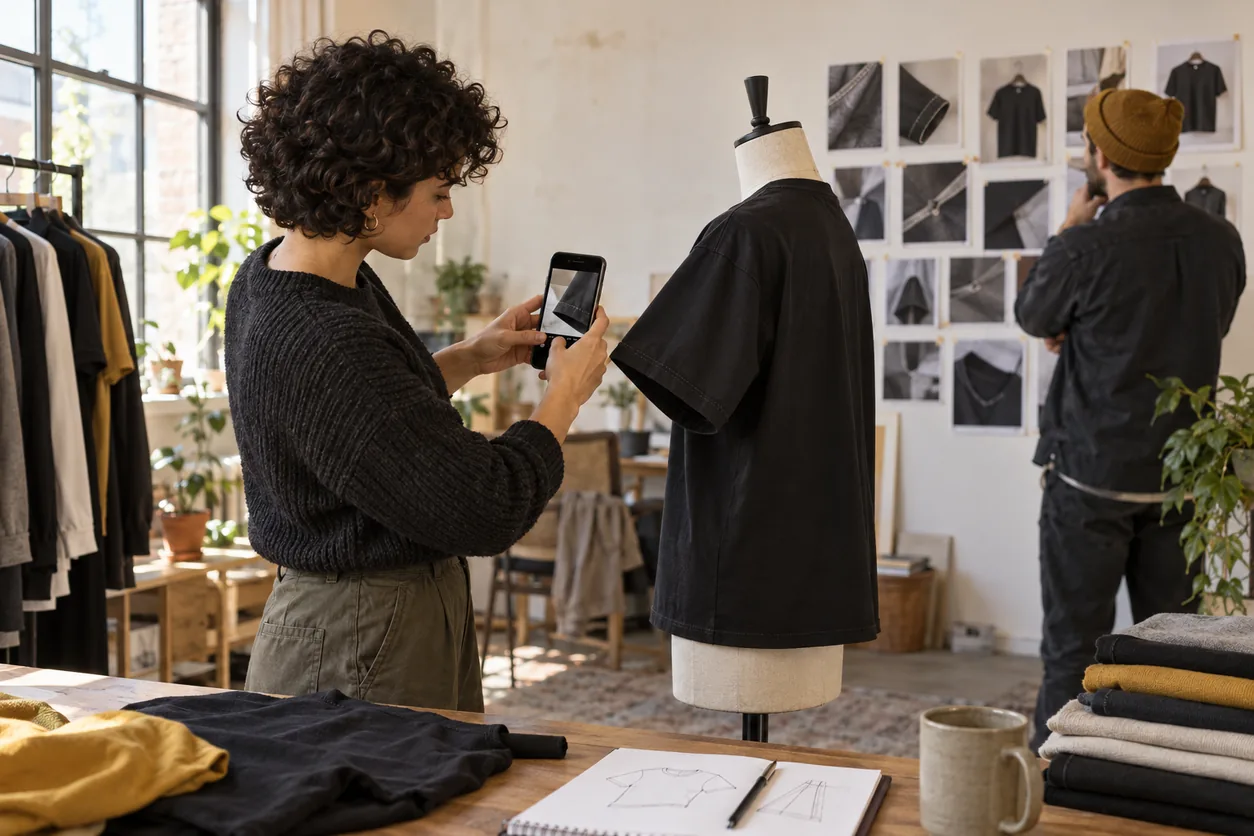
Concept illustration: gather evidence about a specific garment area. A photograph collection still needs sample identities and written decisions; this is not an actual customer review.
Decide what kind of comment you are making
Before asking anyone to change a pattern, decide whether you are reporting a difference from the current specification, requesting a new design direction, or asking for investigation. These require different replies. A supplier cannot tell which you mean from “shorten the body.”
| What you know | Type of request | What the supplier needs next |
|---|---|---|
| A comparable measurement is outside the agreed limit | Correct to the existing specification | Current target, method, actual reading and agreed limit |
| The garment matches the current target, but you now want a different proportion | Proposed design change | Revised target or a clearly defined proposal to develop |
| The wearer reports restriction, but the cause is not established | Investigate before choosing a correction | Wearing conditions, location, views and the observed action |
| A visible construction detail differs from an identified drawing | Clarify or correct that detail | Drawing revision, contextual photo and affected area |
| Fabric or another component differs from the intended submission | Resolve the material basis | Sample identity, actual component reference and intended reference |
| Reviewers disagree about the look they want | Resolve the buyer's brief first | One consolidated decision from the brand |
These are suggested decision categories. Agree the terminology and response process with your manufacturer. Do not label an uncertain cause as a confirmed manufacturing error, and do not hide a fresh design change inside a request to correct the old specification.
Techpacker's garment fitting and fit sign-off guide connects the identified sample, technical brief, measurement review and fitting comments. That supports keeping those references together. Its wider workflow is not a requirement that every Athletic Rush project uses the same sample stages or review sequence.
Connect a website reference to the feature you mean
Athletic Rush product reference: Relaxed Midweight T-Shirt — True Black Tonal Mineral Wash. The page gives a concrete relaxed-tee direction with front and back views. In an enquiry, identify the feature you want to discuss, such as the overall silhouette or neckline appearance, rather than writing “make it like your black tee.”
The website reference is a starting point for your own development; it is not an approved physical sample, a measurement chart or evidence that your proposed garment will reproduce that appearance. Link it alongside your actual sample and specification, and state which details you want to preserve or develop. Athletic Rush's T-shirt development page is useful if the garment route itself is still being selected.
Give every observation a location and a reference
Create a review header before the individual comments. Record the design code, physical sample ID, round, size, color, specification revision and date. Note the actual materials and any known substitutions. If you reviewed the garment after washing, pressing or another treatment, record the condition; do not silently compare that result with a different condition.
For the fictional Crest Tee, a header could identify CT-01 / sample S1 / size M / charcoal / specification R2. Put that same identity on the photo set and comment sheet. A file called “black tee latest” becomes unreliable as soon as another version arrives. Use identities the buyer and supplier can both match to the physical garment.
Give each issue a short code, such as CT-01-C01. Keep that code when the supplier replies and when a new sample is reviewed. It makes a change traceable through the conversation without treating every new email as a completely new problem. The particular code format is optional; the connection is what matters.
Photograph the complete garment area before the close-up. Show enough context to identify which sleeve, neckline section or inside join is being discussed. Specify left and right from the wearer's perspective, or agree another explicit convention. An isolated seam photograph can be detailed yet still leave the recipient guessing where it belongs.
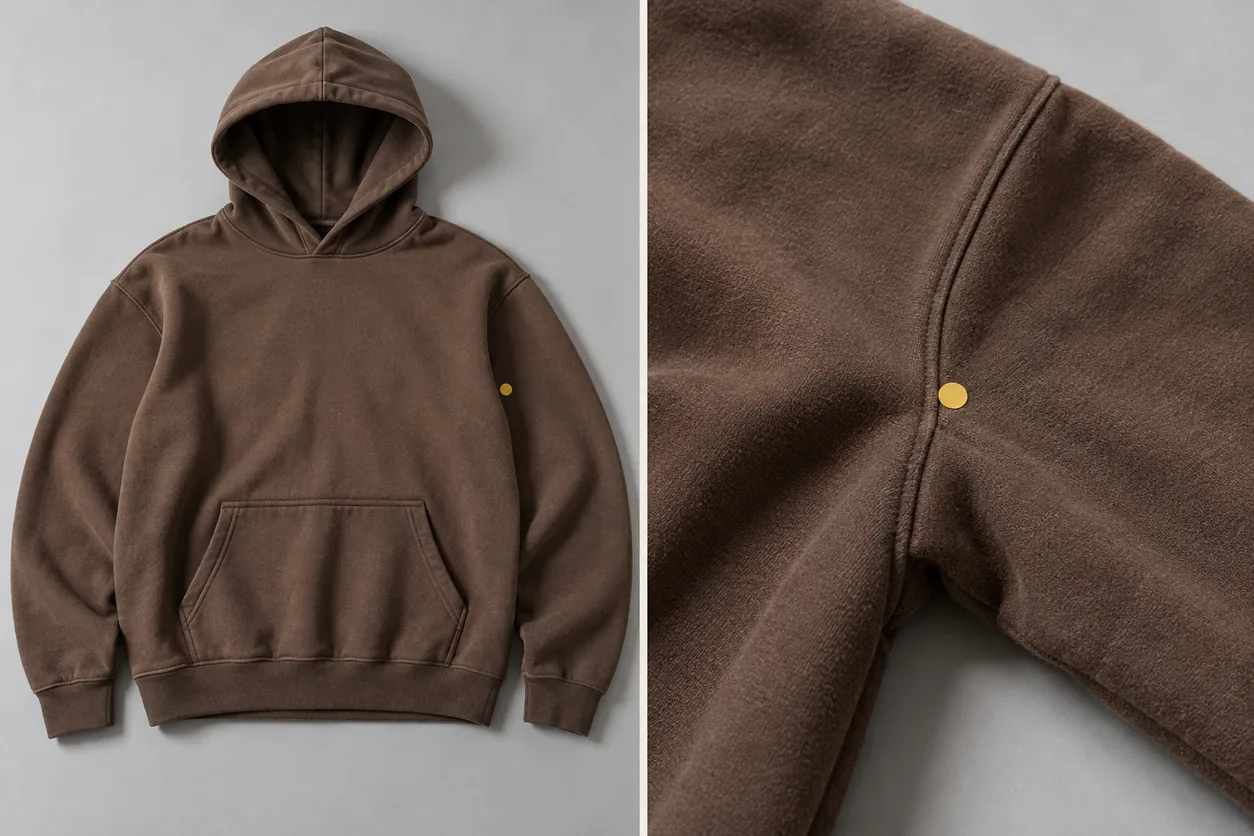
Concept illustration: the overview and close-up connect a location to its detail. The markers identify an area; they do not establish a defect or its cause.
Record the observation before prescribing the fix
“The hem rises when the wearer reaches forward” is an observation. “Lower the armhole” is a proposed construction or pattern change. One does not automatically establish the other. Describe the movement, the sample and the location, then ask the appropriate technical person to explain the proposed correction and what else it affects.
For the fictional Drift Hoodie, the wearer might report pulling under one arm during a forward reach. Record the size, relevant fit reference, underlayer and movement. Add front, side and detail views where useful. Do not conclude from one image that a particular seam allowance or pattern line is the cause.
Explain the outcome you want in plain language: the intended wearing action should feel acceptable while retaining the agreed body shape, sleeve direction and material basis. If those priorities conflict, ask for a proposal and make the tradeoff explicit. A factory should not have to guess whether you prefer more room, a changed silhouette or a different wearing expectation.
Keep the original view alongside any styling reference. Pinning the back, rolling a sleeve or tucking the hem may communicate a visual idea, but it changes what the picture represents. Label the styled view as a proposal. Do not present it as evidence that the unaltered sample already fits.
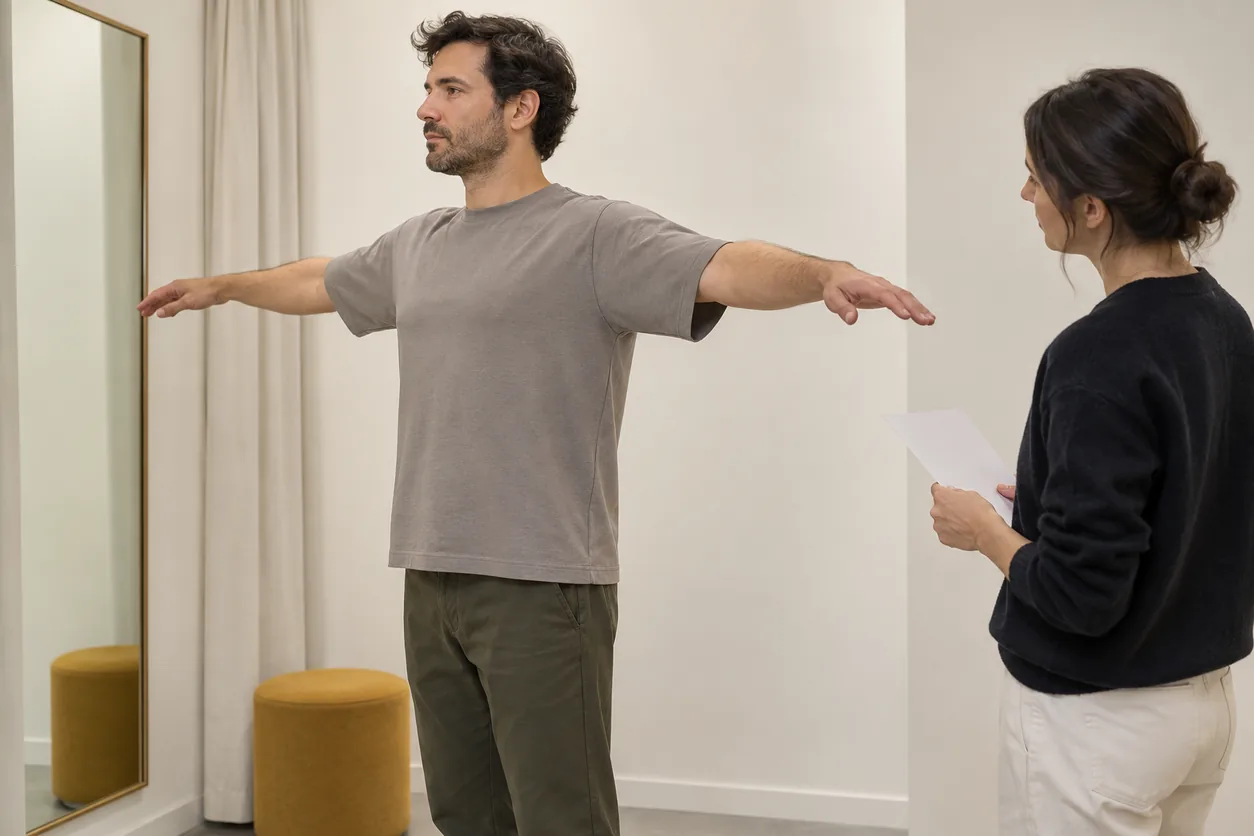
Concept illustration: name the wearing action and observation. This image does not measure movement, diagnose a pattern problem or demonstrate an approved fit.
Keep the old target, actual reading and new decision separate
When a dimension is involved, use the agreed point of measurement, unit and garment condition. Record the current target and tolerance separately from the actual sample reading. Then write the requested action in its own field. This prevents a measured difference from quietly becoming a new target.
Techpacker's sample fit-template documentation distinguishes received measurements, differences, tolerance limits, revised specifications and comments. You can apply that separation in your own document; the software and its color indicators are not required for this worksheet. For the underlying method and limits, use Athletic Rush's garment measurement-tolerance guide.
A fictional Crest Tee correction, with the arithmetic visible
Suppose the agreed body-length target is 72.0 cm, measured using the project's defined high-shoulder-point-to-hem method. The hypothetical allowed deviation is minus 1.0 cm to plus 1.0 cm. The received sample measures 73.5 cm under the same method and condition.
The illustrative acceptable interval is 71.0–73.0 cm. The sample is 1.5 cm above the target, and 0.5 cm beyond the upper limit. Those are different comparisons. If the decision is to correct to the existing specification, the target remains 72.0 cm. Neither 1.5 nor 0.5 automatically becomes an instruction to subtract that amount from the pattern.
Now suppose the brand actually wants a shorter silhouette with a new proposed target of 70.0 cm. That is a design change from the old 72.0 cm target. Identify it as a proposal, agree the affected specification and sample review, and check the related proportions. Do not describe it as merely returning the garment to the original specification.
These numbers are fictional, not Athletic Rush tolerances, measured samples or recommended streetwear dimensions. If the buyer and factory used different start points, clarify and remeasure before deciding that the sample is outside the limit. If you want to use inches, agree and record the unit consistently instead of mixing an inch-based instruction with an unexplained centimeter reading.
Specify what should remain intact
For a neckline comment, “a smaller opening” is incomplete if the supplier might also change the rib width, visible shape or shoulder relationship. Identify the desired outcome, retain the relevant existing references and ask which associated changes are needed. Do not demand that every connected feature remain fixed if the technical proposal shows that the combination is impractical.
For example: “Develop a less open neckline for CT-01; retain the agreed rib appearance and body silhouette as the starting priorities. Propose the revised neckline measurements and any affected construction changes before making the next sample.” Once those decisions are agreed, put them into the actual specification. A preference photograph alone does not supply the missing dimensions.
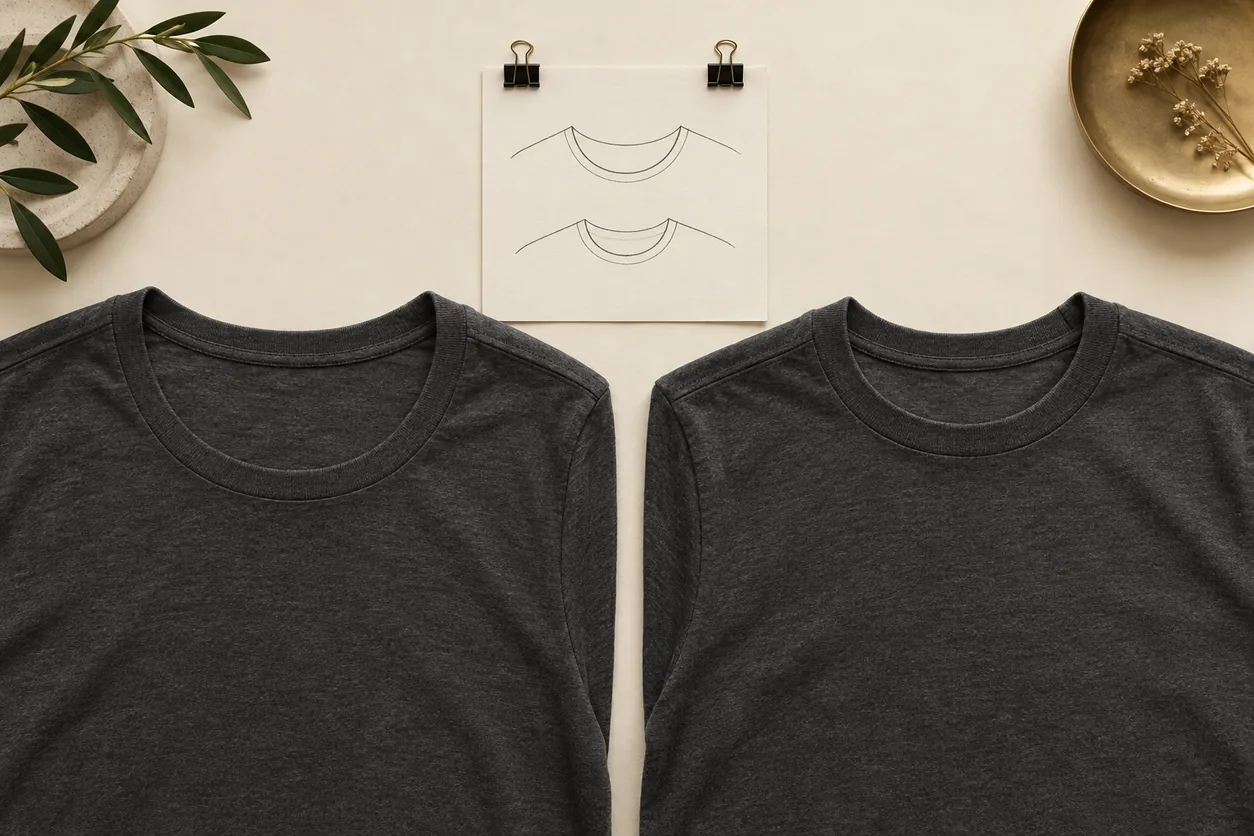
Concept illustration: compare the feature being discussed. The two proposals have no measured dimensions and do not show a verified before-and-after correction.
Use a correction sheet that ends with a check
Keep the review header once per identified sample, then repeat the following block for each issue. It is deliberately more specific than a list of complaints. Fill unknown decisions with to be confirmed rather than inventing a target to make the form look complete.
Sample review: design / sample ID / round / size / color; current specification and artwork revisions; actual materials and substitutions; review date and garment condition; reviewer and relevant wearer or form reference.
Comment ID and location: one issue, named area and point of measurement if relevant.
Evidence: overview/detail photo names; actual observation; measurement method, unit, current target, allowed deviation and actual reading where applicable.
Requested decision: correct to existing specification / proposed design change / investigate before deciding. State the intended outcome and references to retain.
Supplier response required: interpretation, proposed change, affected components or files, evidence or sample needed, and any quotation or timing effect.
Next review: who decides, what will be checked, which sample or document revision is required, and the agreed response date. Record the result and closure evidence against this same comment ID.
Avoid combining “body too long, neck too wide, print too low” in one numbered item. Those concerns need different evidence and may have different responses. Separate them, then review their interaction before issuing the consolidated instruction. A shorter body and unchanged artwork position, for example, still need to make sense together on the intended garment.
If the concern involves visible stitching, describe its location and appearance and include the inside view where useful. A close-up can identify a question, but it does not by itself establish seam strength or the correct machine setting. Ask for the maker's investigation and the evidence relevant to the proposed solution. Athletic Rush's hoodie development page is the correct garment route for hood, pocket, cuff and body questions.
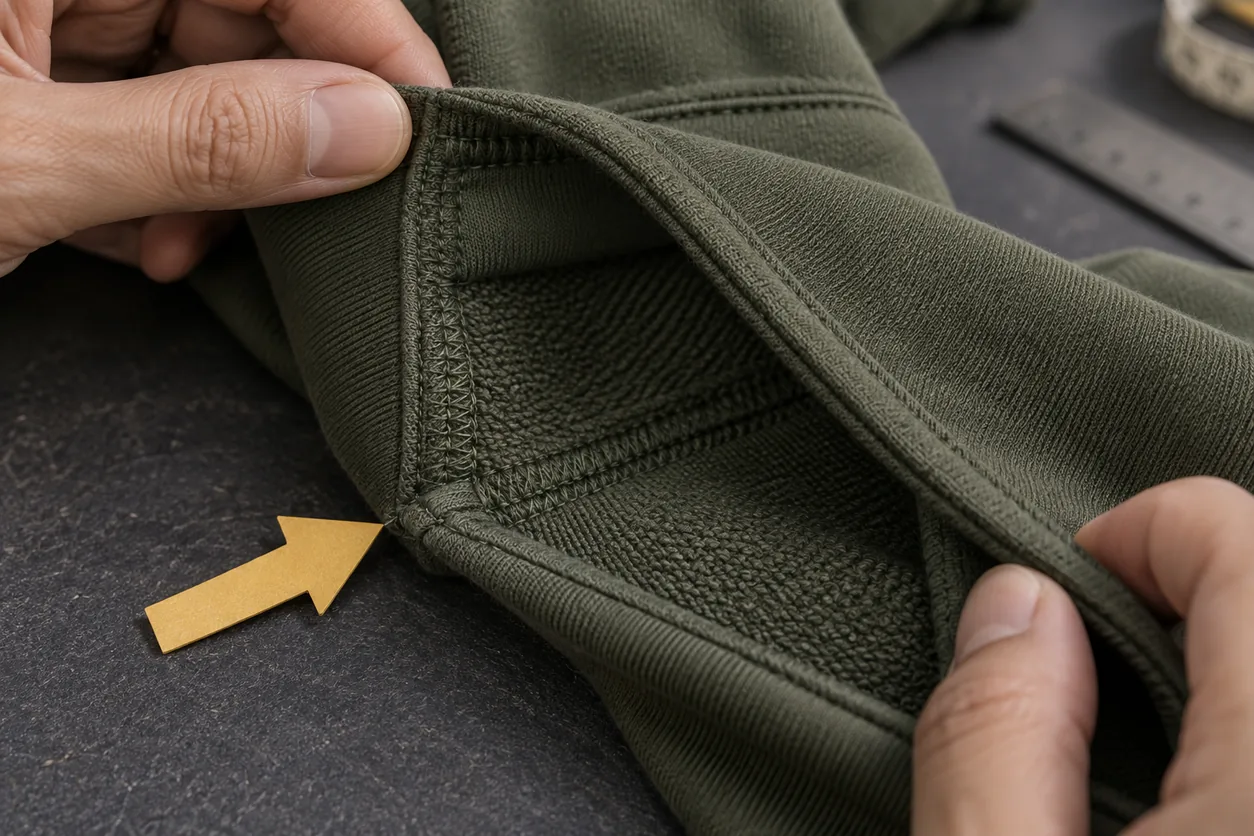
Concept illustration: connect the inside detail to a specific comment. This is not an actual defect report, strength test or proof of a completed repair.
Make the supplier's reply useful
Ask for a reply against the same comment IDs. “Noted” confirms receipt; it does not explain the interpretation, proposed correction or unresolved decision. A useful reply identifies what the supplier believes you requested and which reference will govern the next submission.
For CT-01-C01, a meaningful response might state that the existing 72.0 cm target is retained, name the specification issue to be used and identify the sample evidence the supplier proposes to submit. It should not quietly adopt a 70.0 cm body because a separate chat mentioned “more cropped.” For the Drift Hoodie movement concern, the response may instead propose an investigation before a revision is defined.
If a correction affects materials, decoration, construction, sample work or timing, ask whether the agreed quotation needs revision. Do not presume that every additional development round is included or free. Athletic Rush's manufacturing-quote comparison guide helps keep that commercial scope explicit.
Photograph, consolidate and issue one current instruction
Use a readable overview, a detail view and a concise note instead of a heavily marked image that hides the garment. Keep the original photograph; export a separate annotated copy. Connect the annotation to its comment ID so the text and image tell the same story.
If you work in a PDF, Adobe's drawing-markup guidance explains adding arrows, shapes and an associated comment. That is an optional way to communicate location, not a required app or evidence that an arrow defines a manufacturing correction. A clear photograph and numbered note can serve the same practical purpose.
For a creator-led brand, gather the founder's aesthetic preferences and the technical review before sending the final list. Follower reactions and campaign photographs can suggest a direction; they do not identify the exact physical sample or the construction change needed. Name one person to resolve contradictory comments and issue the consolidated version.
If a late decision changes the list, issue an identified revision and state which prior instruction it replaces. Do not leave an old PDF and a newer voice message competing as active instructions. Keep the same change visible in the drawings, measurement chart, artwork or material list it affects. Athletic Rush's streetwear tech-pack and sampling-brief guide covers that wider document packet.
Close the issue against the next evidence
When the next sample arrives, match it to the supplier's response and the current specification before calling it improved. Review each old comment separately. A better-looking whole garment can still leave one requested change unresolved, and a corrected issue can coexist with a new concern elsewhere.
| Response or new evidence | What it establishes | Useful next decision |
|---|---|---|
| Supplier says the instruction was received | Receipt of the message | Keep the issue open until interpretation and next evidence are clear |
| Revised drawing or measurement chart is agreed | A document decision | Identify which physical checks still remain |
| A new comparable measurement addresses the old dimension | Evidence about that point under the stated method | Record the reading and whether the agreed requirement is met |
| A new photo shows the requested visible detail | Evidence about the visible feature and view | Keep comfort, hidden construction or other unshown questions separate |
| A physical sample is reviewed for the affected wearing action | Evidence for that sample and review scope | Close, revise or investigate that specific issue |
| The supplier changed the fabric during revision | The reviewed basis has changed | Identify which previous decisions need another review |
These are evidence distinctions, not automatic approval rules. Agree which evidence is sufficient for your actual issue. Do not require a full new garment for every corrected file, and do not use a file correction to close a question that depends on handling or wearing the garment.
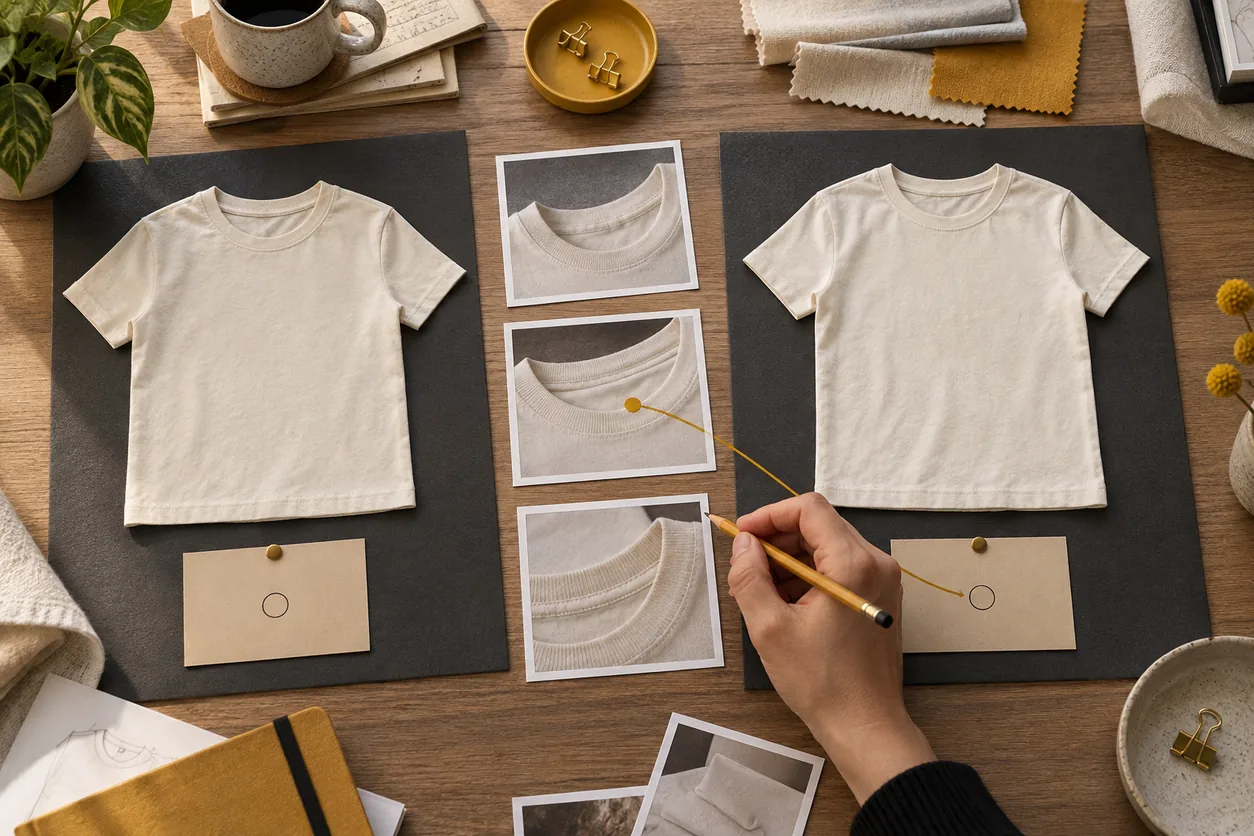
Concept illustration: compare the recorded feature across identified submissions. The scene does not demonstrate a successful correction or approval of either garment.
Record the sample revision, evidence, reviewer and decision when a comment is closed. If another feature changed unexpectedly, open a separate issue instead of silently accepting it. Retain the earlier reference so you can explain the difference without relying on memory.
Closing sample comments does not by itself authorize an entire production order. Once the product decisions are ready, use Athletic Rush's sample-to-bulk approval guide to identify the work that may proceed. Keep that production release separate from the detailed correction history.
Questions first-time streetwear founders ask
What if I know the fit feels wrong but cannot specify the technical correction?
Describe the identified sample, wearer or form reference, action and location. Show what you observed and the intended result, then ask for a technical proposal. Keep the change open until its interpretation and review method are agreed; you do not need to invent a pattern adjustment.
Should a sample outside tolerance become the new specification?
No automatic change follows from the reading. Separate the existing target, agreed limit and actual result from the decision. Correct to the existing specification if that remains the intended design, or explicitly agree a new design target and the affected review.
Can one corrected sample settle every size and color?
Record the scope actually represented. A review of one size, material and color does not supply evidence for every other combination. Agree which additional checks are needed, particularly when a revision affects the proposed size range or material basis.
How many revision rounds should I plan for?
There is no fixed count established by this guide. Ask the supplier which work and submissions are included, what unresolved decisions may add a round, and how revisions affect cost and timing. A clearer comment sheet helps define the next action but cannot establish its duration in advance.
Send Athletic Rush a sample review that can move forward
Athletic Rush manufactures in Sialkot, Pakistan, and welcomes U.S. clothing-brand enquiries. Request an Athletic Rush sample-development discussion with your product-reference link, current tech pack, identified sample photographs and consolidated correction sheet. State what you want to retain, what needs a proposal and which decision you need next.
The confirmed minimum is 30 pieces per design, with one to three colors and mixed sizes within that same design; every different design requires its own 30 pieces. Samples take 4–6 working days. Bulk production takes 8–10 working days for orders up to 100 pieces; larger-order timing depends on quantity. Shipping time is separate. Ask how your revision scope affects the applicable quotation and schedule; these production terms do not establish a U.S. arrival date for an unfinished sample.
Email kamran@athleticrush.co or send Athletic Rush your identified sample-feedback brief on WhatsApp. The next useful step is agreement on the specific correction or investigation and the evidence needed to review it.