 Sialkot, Pakistan
You have chosen a launch date for your first U.S. streetwear drop, but the sample is still being revised. Can you work backward from the advertised production time and assume the goods will arrive in time? Build the calendar around completed decisions and separate sampling, buyer review, production, shipping, receiving inspection and release for sale. A production estimate is one part of the plan; it is not a complete delivery promise.
The practical aim is a calendar you can update when a decision changes. Give each stage a responsible person, a start condition, a realistic planning allowance and evidence that it has finished. Record target dates separately from actual dates. If the sample is not ready for production, a date entered beside “bulk start” does not make that approval complete.
This guide is for U.S. startup clothing brands and creator-led drops. The Signal Tee, Afterhours Hoodie and numerical planning example below are fictional. They are not Athletic Rush order records, carrier quotations or agreed delivery schedules. All six images are AI-generated concepts.

AI-generated planning concept. The studio, people and calendar do not represent an actual order, staff meeting or confirmed delivery plan.
Define what must happen on launch day
A launch might mean opening a product page, taking orders, handing stock to a fulfillment partner or shipping customer parcels. Those are different milestones. State which one you mean. For an in-stock drop, the useful readiness point is normally after the received garments have been checked and the goods intended for sale have been released. Receiving a carton is not the same as having every advertised variant ready to fulfill.
Write the target in plain language: “The Signal Tee needs to be received, inspected and available for our own fulfillment before we open the in-stock release.” Add the destination and responsible receiving person. A creator gifting date, photo shoot and pop-up event may require earlier quantities, but do not assume those pieces can leave the order before the production and inspection plan allows it.
Use the Athletic Rush streetwear development hub to identify the garment scope. If a hoodie and tee launch together, plan their material, artwork and sample decisions separately before combining their release dates. The collection-development page is a relevant starting point for coordinating those connected products.
Ask whether the launch date is fixed or preferred. An external event can create a hard constraint; a date chosen for a social post may be more flexible. Record that distinction before asking the supplier to evaluate feasibility. An announcement does not create time in the sample room, and it does not resolve an open fabric choice.
Build a chain of decisions rather than one countdown
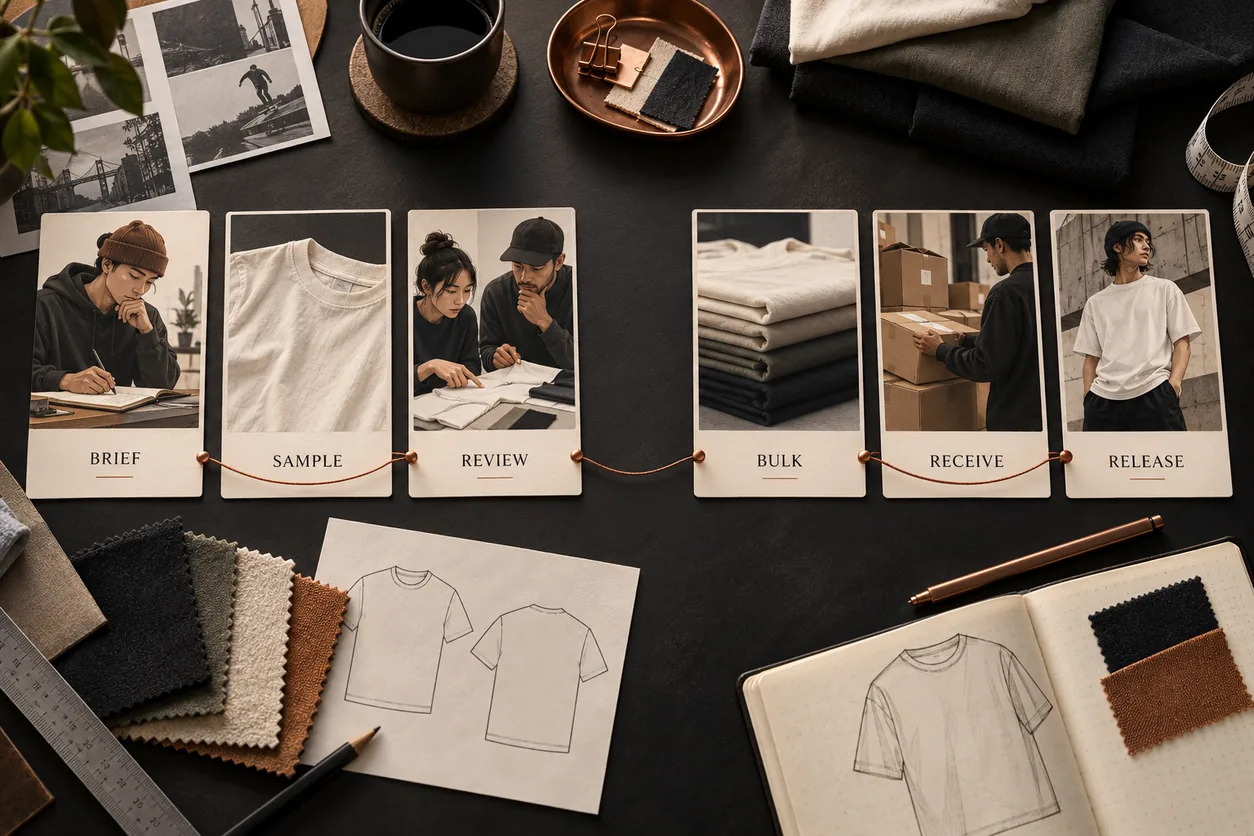
AI-generated dependency illustration. The cards explain stage relationships, not an actual factory schedule or standard number of days.
Start from the required release point and identify what must finish before it. Then test the sequence forward from the current state. This catches a common error: a calendar that looks possible backward but assumes the next stage can start before its inputs exist.
| Milestone | What must be available before it starts | Evidence to record at completion | Who needs to respond |
|---|---|---|---|
| Sampling brief ready | Identified garment, material direction and open questions | Versioned brief and agreed sample scope | Brand and supplier |
| Sample made and delivered for review | Confirmed sample inputs and making route | Sample identity, dispatch and receipt information | Supplier and receiver |
| Sample review complete | Actual sample and relevant inspection conditions | Approved details, revisions and unresolved decisions | Brand decision owner |
| Production release agreed | Final instructions, quantities and agreed start requirements | Identified release version and confirmed production basis | Brand and supplier |
| Shipment ready and dispatched | Completed agreed production and dispatch checks | Packing information and actual carrier handover | Supplier and shipping provider |
| Received goods released for sale | Actual receipt and defined receiving inspection | What was checked, unresolved holds and sellable quantities | Brand or fulfillment partner |
Techpacker's time-and-action report guidance describes planned and actual stage dates in apparel development reporting. The useful idea here is to preserve both what was intended and what happened. You can use a simple worksheet; this guide does not require that software or imply Athletic Rush uses it.
For the sampling inputs, use the streetwear tech-pack and sampling-brief guide. The calendar should refer to that identified version rather than repeat several inconsistent instructions in separate messages. A date and a file name are useful only if everyone understands which garment and revision they describe.
Give buyer review its own time
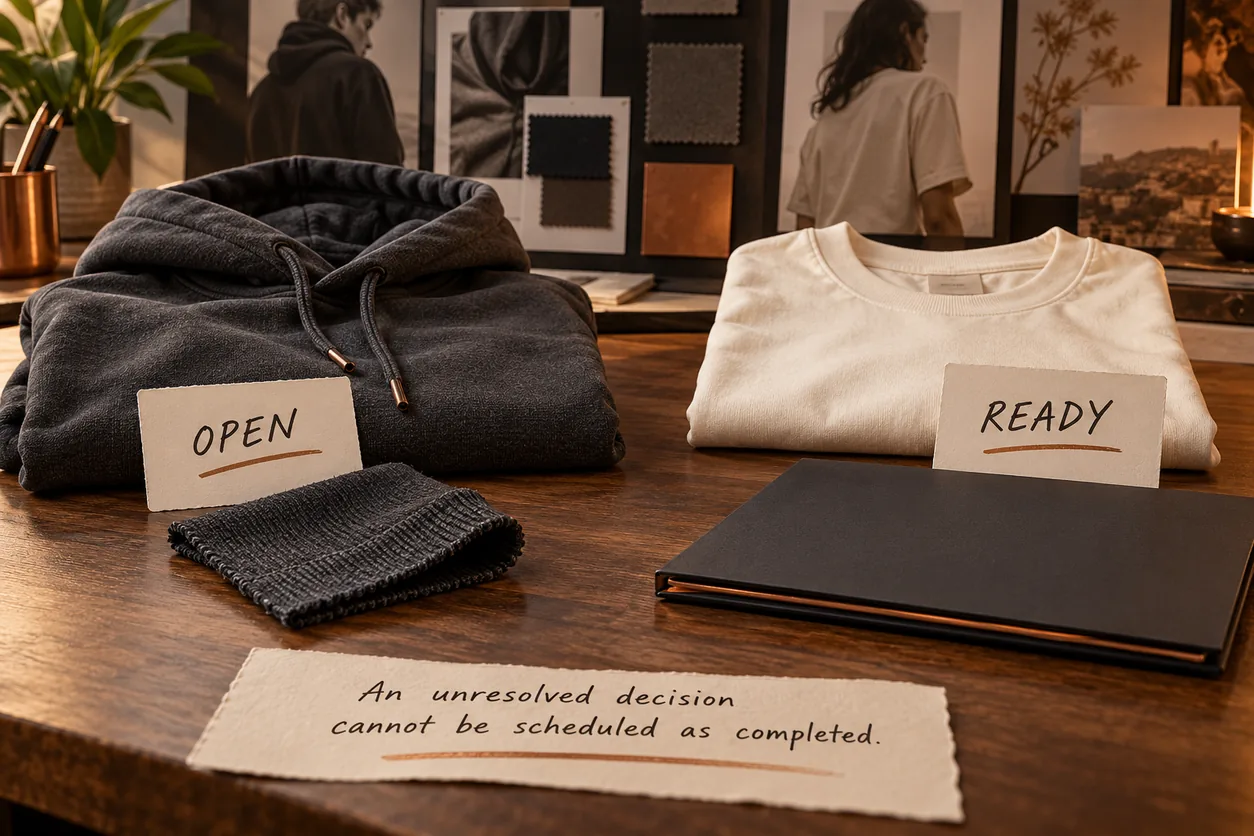
AI-generated concept of open and ready review states. The labels are explanatory, not approvals, measured results or evidence that a production stage is complete.
The fictional Signal Tee may be ready for a placement decision while the Afterhours Hoodie still needs a cuff proposal. Mark those states separately. “Samples received” should not automatically become “samples approved,” and a photograph of one color should not close every color or size decision.
Name the person who can approve each detail and the person who covers their absence. Plan time to receive the sample, wear or inspect it under the agreed conditions, consolidate comments and get a response. If the sample needs a revision, record which observations the new submission must answer. Do not make the supplier infer one instruction from conflicting feedback by several founders.
Use Athletic Rush's sample-correction guide to create clear comments. The sample-to-bulk approval guide helps separate an attractive prototype from a complete production release. This article is about scheduling those decisions; those supporting guides explain the actual approval content.
Some checks require a physical garment rather than an image. A revised hem, a zipper opening or the feel of a printed area may need another submission. Agree what evidence will answer the question, how it will reach the reviewer and what happens if it fails the intended check. Otherwise the calendar can hide a whole review round behind a single word such as “confirm.”
Work that does not depend on the unresolved detail may be prepared in parallel by agreement. For example, the brand can draft its enquiry brief while reviewing range references. That does not authorize producing unapproved garments or treating an unconfirmed artwork version as final. State the specific parallel work and the boundary around it.
Keep three different clocks separate
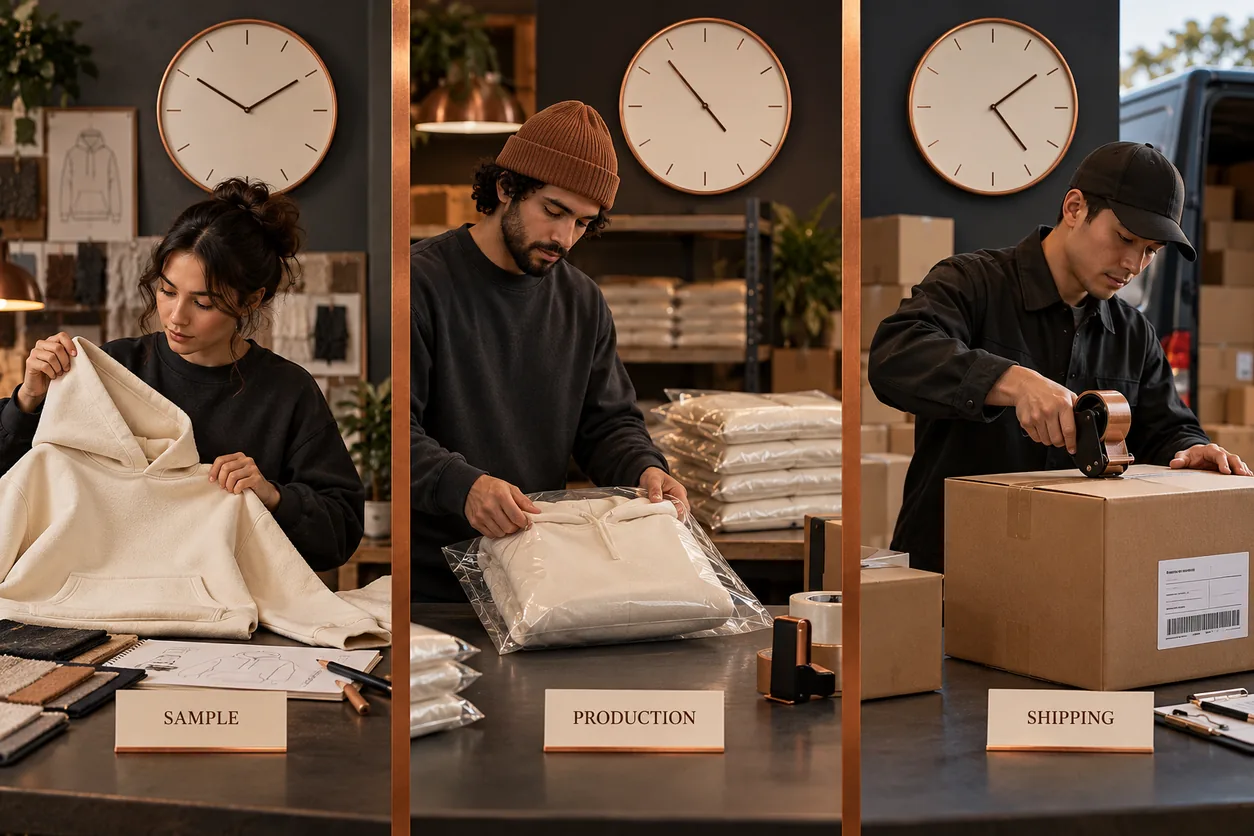
AI-generated illustration. The clocks and scenes are symbolic; they do not show Athletic Rush staff, an actual shipment or universal turnaround times.
Athletic Rush's current sample timing is 4–6 working days. Bulk production is 8–10 working days for orders up to 100 pieces, while larger orders depend on quantity. Shipping time is separate. Ask what makes the agreed clock start for your specific order, which calendar defines a working day and what is included in the quoted stage. Do not add a headline sample figure and a headline bulk figure and call the result a delivery date.
Sampling can involve preparation and review outside the making period. A revision can create a new task with a new start condition. Material availability, agreed payments or other confirmed order requirements can affect when work is actually ready to start; ask the supplier which apply rather than inventing a universal policy. Keep those unresolved conditions visible in the plan.
For transportation, request an estimate for the actual origin, destination, parcel characteristics, contents and service. FedEx's international shipping FAQs explain that transit calculations depend on the commodity, destination and chosen service. This supports getting a shipment-specific estimate; it is not a quotation for your streetwear order, a recommendation of one carrier or a confirmed delivery date.
Use the correct unit when comparing dates. A supplier's working-day calendar, a carrier's business-day estimate and your own seven-day launch calendar may differ. Confirm weekends, holidays and cutoffs with the parties involved. Do not silently count Saturday as a manufacturing day or assume a parcel collected after a service cutoff began moving that morning.
A fictional feasibility check
Suppose a founder has 12 planning days between an assumed completed production approval and the date goods must be ready for sale. For arithmetic only, the founder puts all stages onto the same invented five-day planning calendar and assumes no overlap: 10 days for bulk production, 5 for transportation and 2 for receiving inspection and preparation.
The required allowance is 10 + 5 + 2 = 17 planning days. Against 12 available, the plan is short by 5 days before any additional contingency. The shipping and receiving allowances are fictional, and the common calendar is a teaching simplification. They are not real service timings. The example begins after assumed production approval, so it does not include any remaining sample work or sample delivery.
If approval is actually still open, the start condition is missing as well as the five-day shortfall. The useful response is to ask for a feasible plan, adjust the release or review the scope. It is not to erase the inspection line or describe a speculative faster service as booked. Recalculate using confirmed dates, calendars and stage boundaries for the real order.
Update the plan when a decision changes
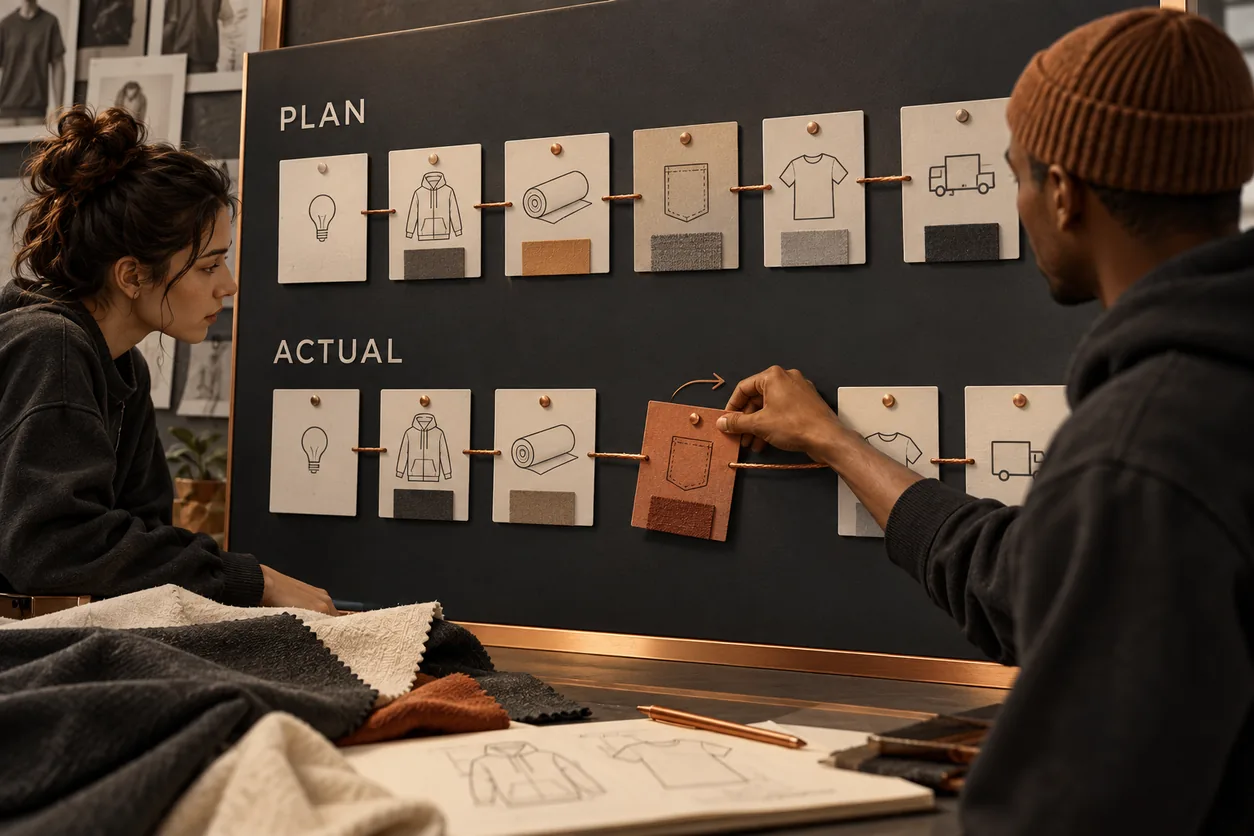
AI-generated revision-planning board. The cards and arrows illustrate a dependency, not a project record, measured delay or completion forecast.
Keep three fields: the original target, the current agreed plan and the actual result when known. Write the reason for a change and who confirmed it. That makes a useful record of what moved without treating an old promise as current or rewriting the history of the original target.
Techpacker's time-tracking documentation describes planned dates, actual dates and a log of date changes. That is a recordkeeping model, not a formula that predicts completion. The dates in your own plan still need confirmation by the people responsible for the work.
| Change or new information | What to ask before moving dates | Calendar action |
|---|---|---|
| Hoodie material proposal changes | Does this require a new sample, revised decoration review or other linked decision? | Reopen the affected stages and their dependencies |
| Brand comments arrive later than planned | Which instructions are now complete and when can the next task begin? | Record actual response date and get a revised next-stage plan |
| Additional size or color is proposed | Is it covered by the approved references and current quantities? | Update the scope before assuming the same release date |
| Shipping estimate changes | Is the service, shipment or destination different, and what is confirmed? | Replace the old transport assumption and reassess receiving readiness |
| Delivered pieces are held for review | Which variants are actually available for sale? | Keep the held goods separate and revise the sellable release scope |
Ask for an update that names the next decision, not simply “still on track.” A useful reply could identify the sample revision awaiting review and when the reviewer will receive the evidence. An overall progress percentage cannot substitute for a specific open decision that prevents production release.
If the launch must move, update the customer-facing plan consistently. This guide does not decide your sales or preorder policy. It helps you avoid presenting unverified readiness as a fact. Keep internal manufacturing estimates separate from any commitment you make to shoppers, creators or an event organizer.
Leave room to receive and inspect the actual goods

AI-generated receiving concept. The cartons and bins are illustrative, not actual inventory, inspection results or proof that goods were released.
A tracking status does not show whether the received garments match the required color-size allocation or whether unresolved pieces need to be held. Name who receives the shipment and where they can inspect it. Confirm how the packing information will identify variants and how concerns will be documented without losing the original piece identity.
The streetwear packing-instructions guide connects garments, variant information and cartons. The finished-order inspection guide explains how to record what was checked before releasing goods for sale. Put those activities on the calendar rather than leaving them as invisible work after delivery.
For a small hoodie-and-tee drop, decide whether both garments must be ready for one coordinated launch. Releasing only the tee may change outfit photography, bundles or the product story. Treat that as a brand decision with updated quantities and communication, not an automatic response to a late hoodie.
Copy this launch-planning enquiry
Streetwear launch calendar brief
Brand and destination: [U.S. delivery city/postal area and receiving arrangement].
Release target: [date, local time zone and exactly what must be ready].
Date status: [fixed event, preferred date or not yet announced].
Garments and quantities: [design-by-design scope, size-color breakdown and any separate creator pieces].
Current evidence: [brief version, samples received, approved details and unresolved decisions].
Requested plan: [sample making, delivery for review, buyer response, revisions, production, dispatch, transit and receiving separately].
Start conditions: [ask the supplier to confirm the applicable requirements and working-day calendar].
Review owner: [one decision maker and backup].
Open risks: [materials, artwork, missing quantities or unconfirmed shipping assumptions].
Update rule: [who confirms a changed date and when the next review occurs].
Bring this brief to the Athletic Rush quotation and development enquiry. For garment-specific scope, compare Athletic Rush's hoodie development page and the actual Oversized Zip Hoodie — True Black Stone Wash reference. The latter is a catalogue starting point, not the fictional Afterhours Hoodie, current stock or a confirmed production schedule.
Common launch-calendar questions
Is a production estimate the same as the date stock reaches my U.S. address?
No. Define the production stage and its start conditions, then plan dispatch, shipment-specific transit, receipt and receiving inspection separately. A transport estimate also needs the actual service and shipment details. Do not use a general turnaround headline as the whole calendar.
Can I announce the launch before the sample is approved?
That is a brand decision, but the unresolved approval should stay visible in the plan. A sample revision may affect later stages. Establish what is confirmed before making a customer-facing commitment, and do not describe an assumed production start as an actual one.
How much buffer should every streetwear order have?
No universal buffer fits every launch. Identify the uncertainty in your actual material, sample, review, production and receiving plan. Agree appropriate allowances with the parties involved and revisit them when scope changes. A blank contingency line is not a substitute for resolving missing information.
What should change first when the plan no longer fits?
Recheck the current garment state and missing inputs, then evaluate the release date and scope with the supplier. Do not skip required sample or goods checks merely to preserve an old date. Record the revised decision and the effect on the next stages.
Ask for a feasible plan before announcing the date
Athletic Rush develops and manufactures apparel in Sialkot, Pakistan, serving U.S. clothing-brand enquiries. The current minimum is 30 pieces per design, allowing one to three colors and mixed sizes within that same design. Each different design requires its own 30 pieces. Confirm the actual design count and quantities before asking whether the calendar fits.
Send your garment scope, current sample status and target receiving date through the Athletic Rush development enquiry, email kamran@athleticrush.co, or message Athletic Rush on WhatsApp. Ask for the start conditions and the separate stage timings. Your next useful answer is a plan tied to real decisions, with shipping and launch readiness clearly distinguished from manufacturing time.