 Sialkot, Pakistan
Your first streetwear drop has sold, but the feedback points in different directions: one customer wants a longer tee, another loves the crop, and a creator poll asks for a new color. What should change in the next collection? Connect each comment to the actual garment and wearing situation, separate product faults from preferences, and turn the strongest unresolved question into a controlled sample trial. Keep the features buyers value while you investigate the detail that needs work.
For a new U.S. clothing brand, customer feedback is useful when it produces a clear development decision. A pile of messages, a star average or a popular color poll cannot tell a pattern maker what to revise. Start with the garment, identify the evidence, choose a narrow change and state how the next sample will be reviewed.
This guide uses a fictional forest-green Moss Box Tee and cream Studio Pullover. The comments, counts and proposals are invented teaching examples, not Athletic Rush customer results, production specifications or a demand forecast. All six images are AI-generated concepts.
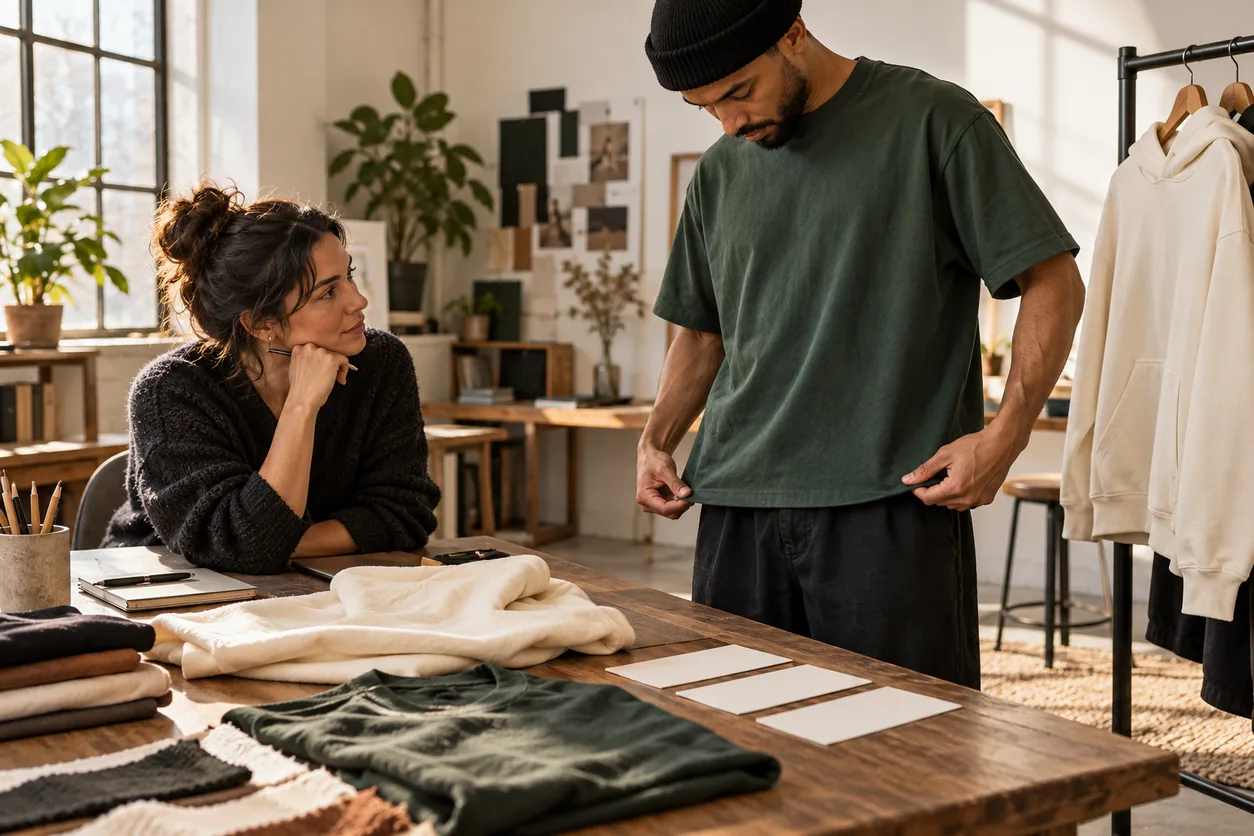
AI-generated concept: a garment gives the conversation a useful reference. The people and studio do not represent actual customers, staff or a recorded fit session.
Start with the decision, not the loudest comment
Ask what you are deciding before collecting more answers. “How can we improve our clothes?” is too broad for one sample round. Better questions include whether the Moss Box Tee needs more body length while retaining its width, or whether the Studio Pullover needs a different pocket opening for its intended wearing routine.
Write one short decision statement: Keep the relaxed shoulder and body width; investigate seated hem coverage in the existing size range. This protects the design identity while leaving room to learn. A buyer who likes longline tees may be describing a different product, rather than a defect in your intentionally cropped one.
Use the Athletic Rush streetwear development hub to identify the relevant garment family, then discuss the specific construction rather than requesting a generic “better quality” version. The Athletic Rush collection-development page provides context when feedback affects the relationship between several pieces in a drop.
There are three useful outcomes: preserve a feature, investigate a question, or develop a defined revision. You can also defer an idea. Recording why you are not changing something is part of controlling the next collection, especially when an audience contains several competing fit preferences.
Separate people who wore it from people who want it
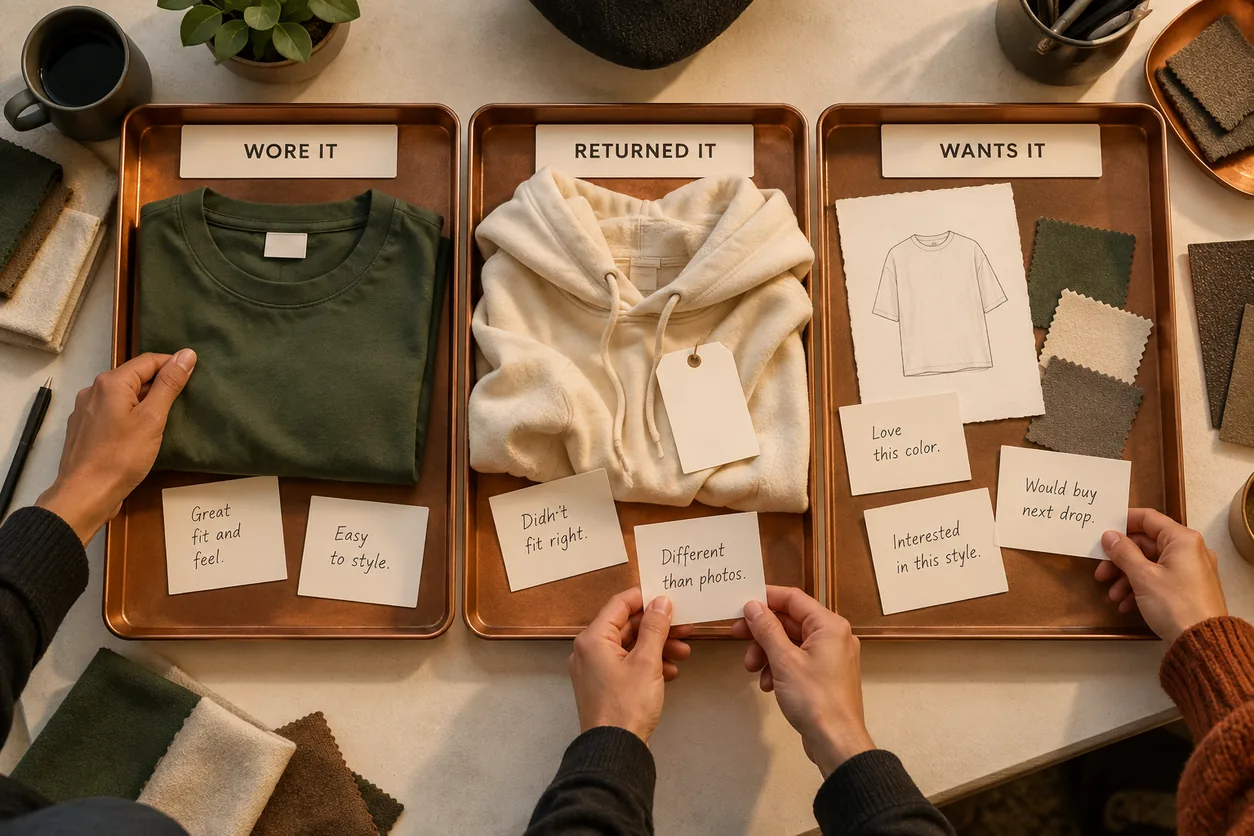
AI-generated evidence-sorting concept. The anonymous notes are fictional examples, not testimonials, sales records or measured research findings.
A purchaser who wore a garment, a person returning it, a gifted creator and a follower viewing a mockup provide different kinds of information. Preserve those differences. A creator may offer detailed wearing observations, but a free sample does not establish willingness to pay. A purchaser may return an unworn garment because the photographed fit did not match their expectation.
Build a small evidence record for each useful observation. Include the design and version, color and size, purchase or sample status, when it was received, whether it was worn or cared for, the original wording, the follow-up answer and the evidence still missing. Use anonymous internal reference codes in the development summary. Keep private order and contact information out of the factory brief unless it is genuinely needed and appropriately shared.
| Feedback source | What it can help you understand | What it does not establish | Useful next question |
|---|---|---|---|
| Customer wearing the identified tee | Fit and experience in a described situation | That the whole size range needs the same alteration | Which size, garment condition and movement were involved? |
| Physical return with an identified reason | The reported reason and the garment available for inspection | A confirmed manufacturing cause | Does the returned piece match the approved specification and listing? |
| Gifted creator's wear notes | Detailed observations, if the actual sample and use are known | Paid demand or representative audience preference | What did you experience wearing this exact sample? |
| Public comment or color poll | Language, preferences and ideas worth exploring | Sales, commitments or a reliable order split | Have you tried this silhouette, or are you reacting to the image? |
| Customer who kept and liked it | Features worth preserving and successful use cases | That every nonrespondent agrees | Which detail would you most want us to keep? |
For brands using Shopify, its current sales-report documentation distinguishes physical returned quantities from broader reversals such as cancellations, edits and refunds. Check the actual report definition before treating a negative sales entry as a garment return. A recorded return reason is a starting category, not a confirmed cause. This is a platform-specific example; it does not imply Athletic Rush uses Shopify or that your store has the same reports.
Ask for the wearing story before proposing the fix
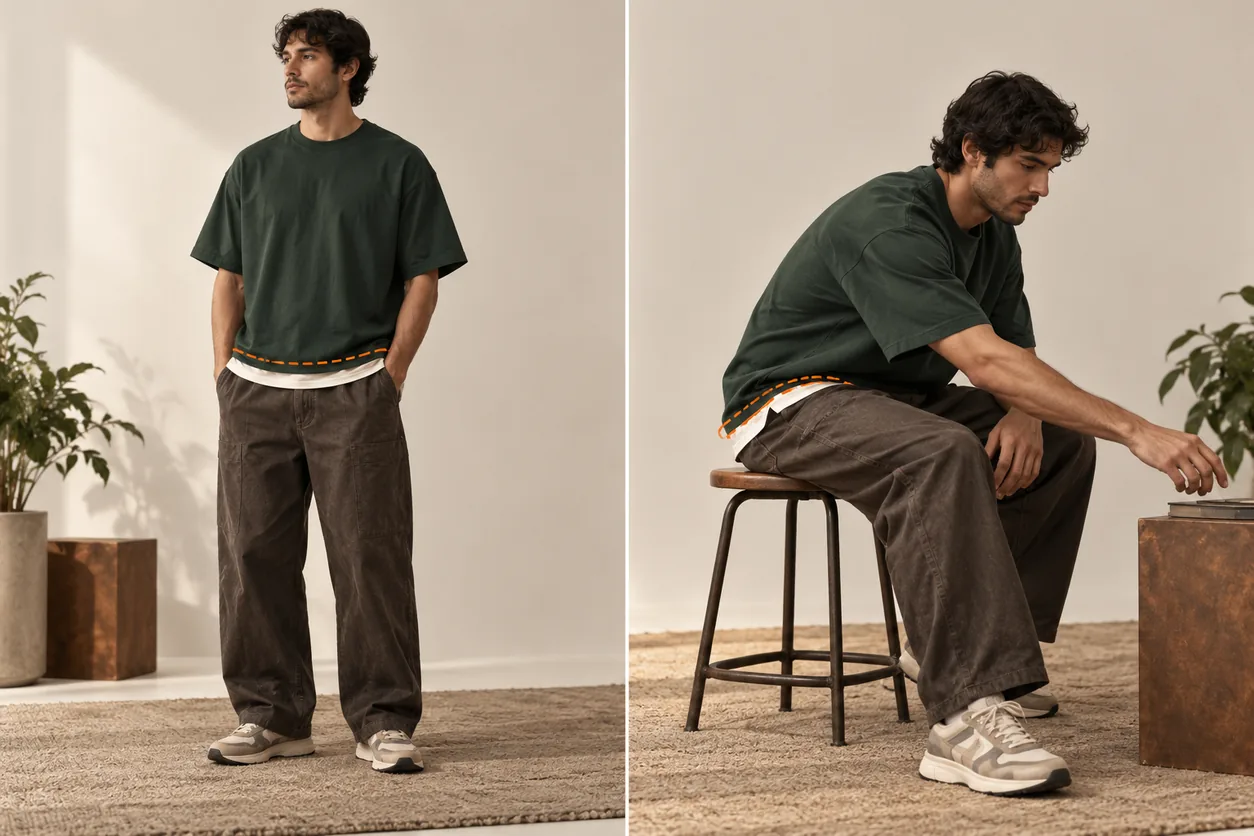
AI-generated illustration of pose and coverage. The guide marks are explanatory, not measurements or proof that this garment passed a wear test.
“Too short” could mean the tee was shorter than the size guide, that the intended crop was not clear, that it changed after care, or simply that the wearer prefers another silhouette. Those possibilities call for different actions. Enlarging the whole pattern before resolving the question could remove the width and shoulder proportions that other buyers liked.
Ask the person to describe what happened first. Then clarify the size, garment identity, wearing situation and care history. Useful prompts include:
- When did you first notice the issue, and what were you doing?
- What size did you select, and what information helped you choose it?
- Where did the hem sit when standing, sitting and reaching?
- Was this before or after care, and what care steps were used?
- What worked well enough that you would want us to keep it?
Avoid opening with “Would adding two inches solve this?” It supplies both a diagnosis and a preferred answer. Start with their experience, then explore a proposal once you understand it. GOV.UK's guidance on in-depth interviews recommends open, neutral questions and specific stories rather than generalities. Here that interviewing principle is adapted to a clothing review; it is not a garment-testing standard or proof that a small interview group represents your market.
For an unclear size selection, review the actual product page and Athletic Rush's guide to building a T-shirt size chart. If a comment concerns a change after washing, the color-and-fit-after-washing review guide helps separate care observations, garment dimensions and worn fit. Do not infer a material or process cause from a photograph alone.
Count the people, then describe the limits

AI-generated deduplication concept: repeated messages associated with one identified person remain linked to one feedback identity. The letters are fictional codes, not customer data.
Keep a count of unique people as well as a count of observations. One customer may send a direct message, complete a survey and leave a review about the same tee. Preserve all three records for context, but do not present them as three independent customers reporting the problem. If you cannot establish whether records belong together, mark that uncertainty rather than inventing a clean total.
Fictional example: a brand sells 60 Moss Box Tees, one per customer, and receives feedback from 24 different purchasers during a stated four-week review window. Six of those 24 mention seated hem coverage. Three of the six also send a follow-up message. There are six identified people raising that theme and nine records about it, not nine independent people.
Six divided by 24 is 25% of the respondents. It is not evidence that 25% of all customers are dissatisfied. Six divided by 60 is 10% of the purchasers in this invented example, but that is only the known share who reported this concern during the window. The other 36 purchasers' experiences are unknown. Neither calculation predicts what the next collection will sell.
Record relevant context beside the count. Were all six comments about one size? Had some garments been cared for while others were new? Did a creator ask followers a leading question before the messages arrived? Did everyone see the same product photos? These details can change what you investigate without making the comments less worth hearing.
Keep different units separate. In a real store, one person can buy multiple items, a return can contain several pieces, and one garment can have several concerns. A person count, garment count, order count and theme count answer different questions. Report which one you used. A small response set is useful for choosing a question to investigate, not for claiming statistically established market demand.
Choose between a product change and a clearer explanation
A concern deserves a route, not an immediate pattern alteration. First check whether it involves an identifiable failure against the agreed requirement, an intended feature that was poorly explained, a preference within the intended audience, or an idea for a different customer. Serious safety concerns require prompt appropriate handling; do not put them into a popularity vote.
For ordinary development decisions, consider impact, credibility of the observation, relevance to the intended wearer and the next practical check. Avoid a numerical priority score that makes incomplete information look precise. Six vague votes should not automatically outrank one well-documented assembly concern, and a costly change should not automatically be rejected if it affects the product's basic usefulness.
| Observation about the fictional garments | First decision to resolve | Practical next step | What should stay controlled |
|---|---|---|---|
| Moss Box Tee feels too cropped when seated | Intended silhouette or unintended coverage problem? | Review the existing tee in that position, then compare a defined length trial | Chest width, shoulder, sleeve and material identity |
| Tee looks longer in the listing than on arrival | Garment mismatch or communication mismatch? | Check the identified piece and size guide; review model and garment information | Original photos, listing version and garment record |
| Studio Pullover pocket is awkward with the intended object | Opening position, space or wearing preference? | Observe access with the agreed object and a complete worn sample | Main body fit and the pocket proposal being compared |
| Several followers ask for muted blue | New color interest, not an order commitment | Record who responded and develop an identified color proposal if it fits the range | Design count, budget and existing successful features |
| One returned tee has an unexplained dimensional difference | Is this an isolated piece or a repeatable concern? | Check its identity, condition and dimensions before proposing a wider revision | Measurement method, reference and actual check coverage |
If a garment does not match the agreed specification, keep the current-order issue and the next-collection proposal as separate records. The finished streetwear inspection guide explains why you should record what was actually checked. Do not silently reclassify an unresolved delivered-goods concern as a new design preference.
Product communication may also need work. A clearer garment measurement diagram, identified worn size or more honest crop description can answer a selection problem. That does not prove the garment needs no improvement; it gives you a separate communication change to evaluate without pretending it is a pattern revision.
Develop one useful trial without erasing the original
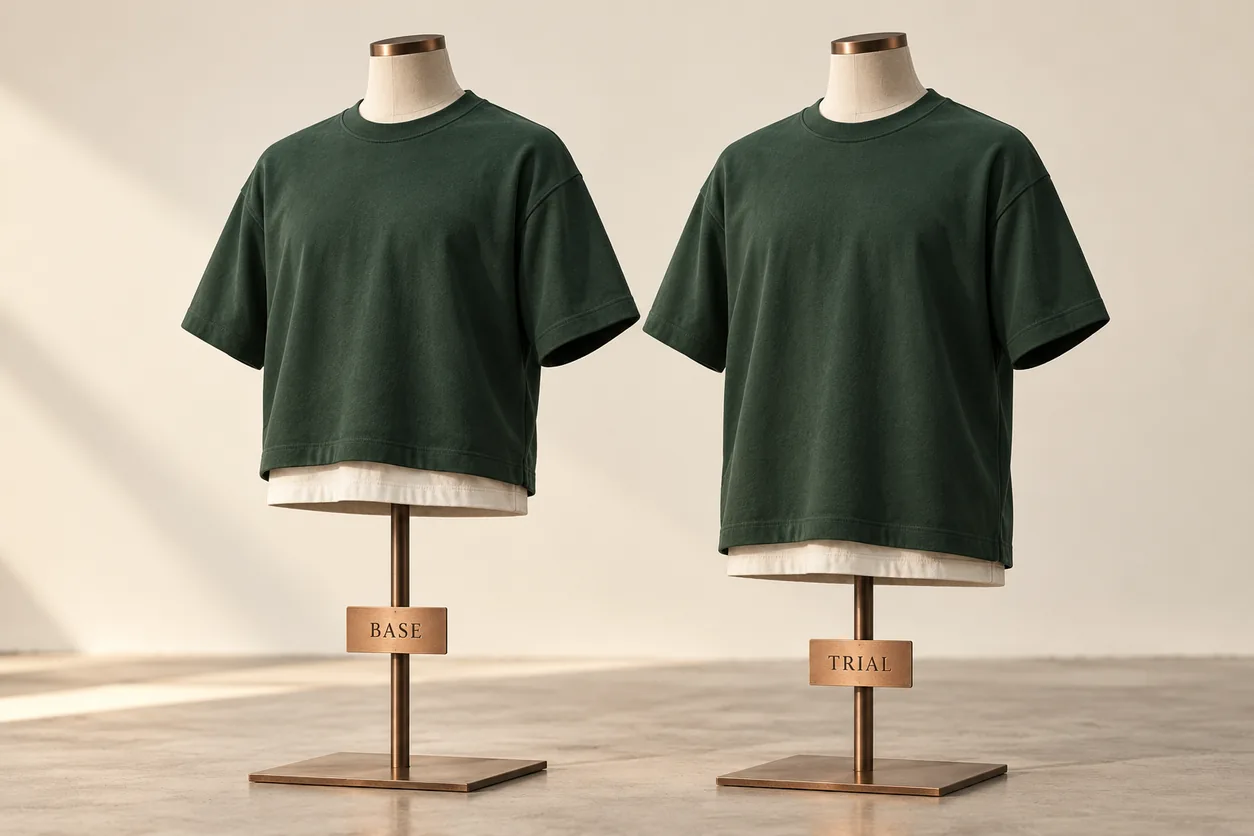
AI-generated sample-comparison concept. The trial illustrates a design direction, not an approved pattern, exact dimensional change or measured experimental result.
For the fictional Moss Box Tee, write the proposal as a change from an identified baseline: retain the relaxed body width, dropped shoulder, sleeve and neckline; ask the supplier to propose a body-length revision for the stated coverage goal. Agree the actual target, measuring point, size and garment condition before the sample is made. “Make it longer but keep the fit” leaves too much open.
As a real visual reference, Athletic Rush's Boxy Cropped T-Shirt — True White Clean Reactive Solid describes a wide shoulder, high-hip crop and straight hem. It helps distinguish the proportions being discussed. It is a catalogue reference, not the fictional green Moss Box Tee, a stock promise, or proof of a measured sample. You can also compare the range on the Athletic Rush T-shirt development page. Use the enquiry route for the proposed changes; this guide does not claim the separate design-studio action has been verified as operational.
Keep the original approved reference and identify the trial separately. Compare both under the same relevant conditions where practical: same wearer, size, intended underlayer, pose and care state. If material or another construction detail must also change, disclose that difference. You are then reviewing two garment proposals, not isolating body length alone.
For the Studio Pullover, a pocket trial may affect appearance, opening position and access together. Ask for a drawing identifying the proposal and review the full garment worn with the intended object. An isolated pocket rectangle cannot establish that the finished hoodie will work as intended. Confirm any changed decoration or trim position that interacts with the pocket.
Use the streetwear sample-correction worksheet when converting the decision into supplier instructions. Keep the evidence and change history connected to the current tech-pack and sampling brief. Techpacker's documentation on creating tech packs describes saving versions at development stages and handoffs. The useful principle here is to preserve which instructions were reviewed; no particular software subscription is required.
Turn the learning into a focused collection brief
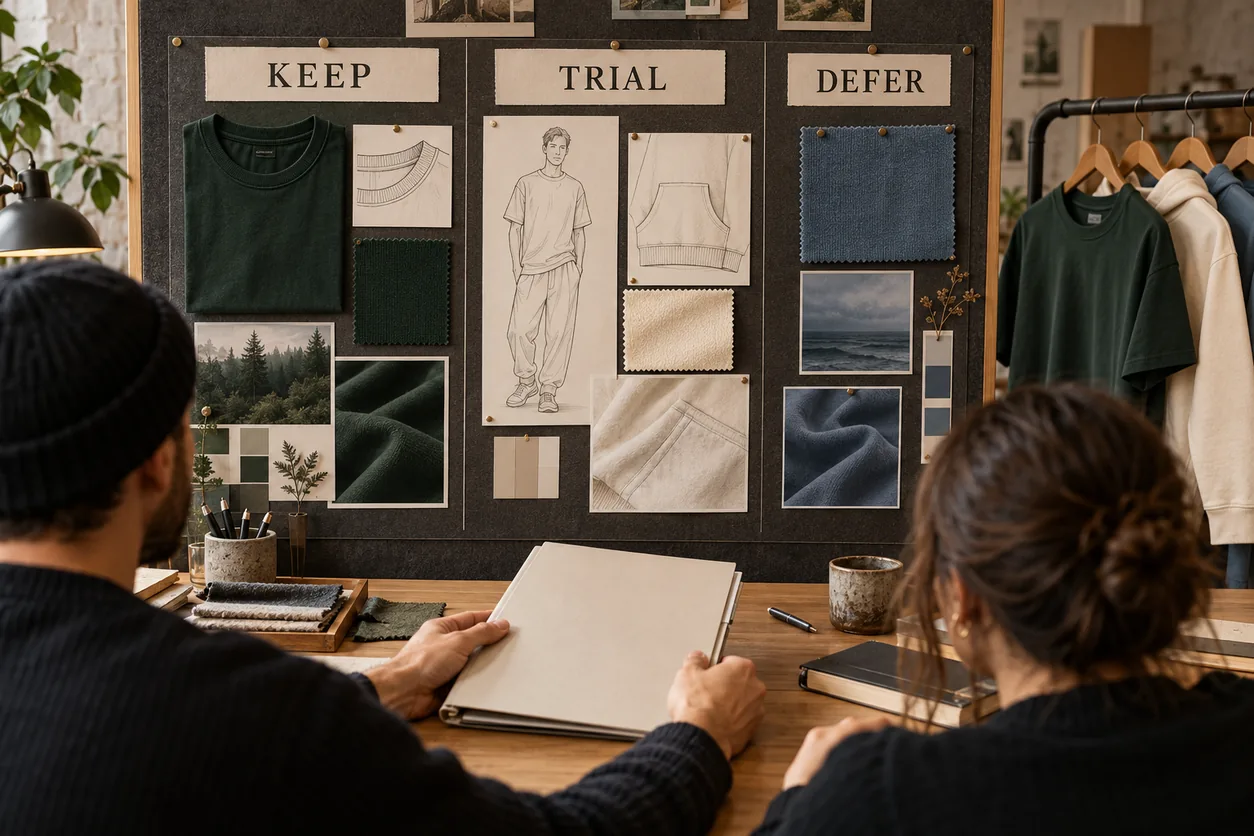
AI-generated planning concept. The sketches and swatches illustrate decision categories, not actual customer research, working patterns or approved production instructions.
Give each proposed change a place in the range. Keep the Moss Box Tee unchanged, develop a length trial, or offer a separately defined silhouette if the audience genuinely needs another fit. Those are different choices. Adding a second fit can expand sampling work, sizing information and order requirements; replacing the original can disappoint people who valued it. Ask what evidence would justify each route before multiplying styles.
Do not convert a preference poll directly into a size-color order matrix. A stated preference does not establish purchase quantity, and a sellout can reflect the initial stock allocation as well as interest. Use your own available commercial records and separate confirmed commitments from assumptions. The streetwear size-and-color breakdown guide explains how to make the eventual order quantities add up once the design decisions are settled.
Use this copyable brief for a development discussion:
Next-collection feedback brief
Brand and intended U.S. wearer: [audience, wearing context and product role].
Existing garment: [design, version, color, size range and retained reference].
Evidence window and sources: [dates, unique people, actual garment experience and important gaps].
Observation: [what was reported, in the person's words where appropriate, without private identifiers].
Decision: [keep, investigate, trial, communicate differently or defer].
Features to preserve: [fit, fabric identity, decoration and construction].
Proposed change: [one clearly identified direction; request supplier feasibility and exact targets].
Next sample review: [size, wearer/context, care state, comparison and required observations].
Open commercial questions: [confirmed design count, quantity assumptions, sample scope, production and shipping separately].
Decision owner and next review: [who records the result and which revision will be reviewed].
After reviewing the trial, record whether the original concern improved, which valued features remained and what new compromises appeared. A longer tee may cover more but change the balance with a high-waisted bottom. A different pocket opening may improve access while changing the front appearance. If the proposed fix misses the goal, keep the learning and revise the question rather than calling the trial approved because it looks newer.
The next customer review should identify which version people actually received. Keep the time window and evidence definitions clear when comparing later feedback. A lower complaint count after a smaller release, a different audience or a shorter review period does not by itself demonstrate an improved product.
Questions founders ask after a first drop
How many comments are enough to change a streetwear design?
There is no universal comment threshold. Check the nature of the concern, the garment evidence and the intended wearer. A small number of specific observations can justify investigating a sample; it does not establish the proportion of your market that wants a change. Preserve uncertainty and define the next check.
Should I redesign a cropped tee because some buyers want more length?
First establish whether the delivered tee matches the intended design and whether that design was clearly communicated. Then compare a controlled length proposal if it fits your audience. Keep the original crop if it serves a distinct role, or develop another silhouette deliberately rather than changing every size automatically.
Can influencer feedback decide my next bulk order?
It can identify questions and product details, particularly when the creator wore the actual garment. Separate gifted experience, audience preference, paid purchases and confirmed commitments. None of those categories automatically supplies a reliable quantity forecast or a complete size-color allocation.
What should I send the manufacturer instead of a folder of screenshots?
Send an identified garment baseline, a short anonymous evidence summary, the decision you want to investigate, the features to preserve and a clear sample-review plan. Include relevant images with permission and context. Ask the supplier to flag feasibility, linked changes and missing instructions before making assumptions.
Discuss the next sample with Athletic Rush
Bring the garment you want to preserve and the specific question you need the next sample to answer. Athletic Rush develops and manufactures apparel in Sialkot, Pakistan, serving U.S. clothing-brand enquiries. Send the brief through Athletic Rush's quotation and development enquiry, email kamran@athleticrush.co, or discuss it on Athletic Rush WhatsApp.
The current minimum is 30 pieces per design, with one to three colors and mixed sizes within that same design. Each different design requires its own 30 pieces; confirm how revised and additional proposals will be counted before allocating an order. Samples take 4–6 working days. Bulk production takes 8–10 working days for orders up to 100 pieces; larger orders depend on quantity. Shipping time is separate. Confirm the agreed sample scope, approvals and production start basis before setting a launch date.
Your next step is a focused development question, not a promise to change everything: which feature should stay, which observation needs investigation, and what evidence will make the next sample decision clearer?