 Sialkot, Pakistan
You want a first streetwear drop with your own identity, but the enquiry offers three starting points: decorate a finished blank, adapt a base design or develop a new pattern. Which one should a new U.S. clothing brand choose? Start with the garment features that must be yours. If an identified physical blank already meets those requirements, assess its decoration and availability. If the fit or construction must change, define a development and sampling route rather than assuming a catalogue image is a finished garment waiting in stock.
The right starting point is the one that can deliver the product you have actually specified and checked. “Custom” does not describe the scope on its own. A logo change, a new body proportion and a different fabric assembly are different tasks. Ask what stays fixed, what the supplier will propose and what the sample must establish before comparing offers.
This guide uses a fictional cream Marker Tee for a creator-led graphic drop and a teal Contour Box Tee for a brand developing its own silhouette. These examples are not Athletic Rush products, customer orders, prices or tested results. All six images are AI-generated concepts; the simplified pattern shapes are not working production patterns.
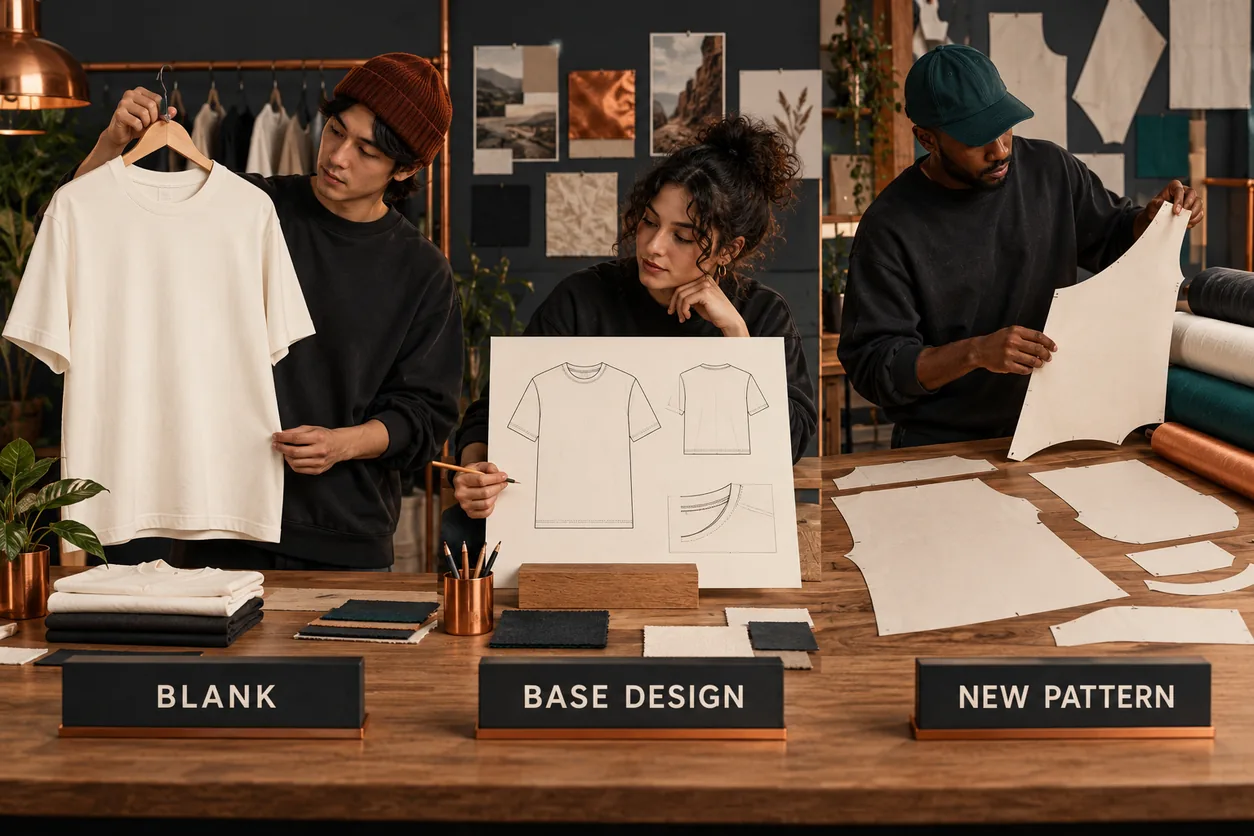
AI-generated comparison. The people and garment stations illustrate different starting points, not actual stock, staff, customer work or a production service already confirmed for an order.
Define the difference before requesting a quote
A physical blank is an existing undecorated garment you can identify and inspect. A base design in a digital catalogue can be a visual or specification starting point for development. A new-pattern proposal requires the garment shape and assembly to be developed or revised against your agreed requirements. Ask the supplier which meaning applies to the reference you selected.
These routes can overlap. A base design may eventually use an existing pattern, a revised one or newly developed pattern pieces. A product described as cut and sewn can still use a provider's established shape. Do not decide the underlying development scope from the marketing label alone.
| Starting point | Useful when | What may remain fixed | What to establish before proceeding |
|---|---|---|---|
| Identified physical blank | The actual garment already suits the intended fit and use | Existing shape, seams and offered material or color options | Exact blank identity, current availability, decoration compatibility and sample result |
| Digital base design | A visible silhouette helps communicate a starting direction | Only the features the supplier confirms are part of the proposal | Whether a physical sample or pattern exists, which specifications are defined and what changes need development |
| New or revised pattern | Required proportions or construction are not met by the existing proposal | The requirements and references you explicitly decide to preserve | Measurement map, material and assembly proposals, pattern scope, size development and sample review |
The Athletic Rush streetwear hub provides routes for original development, an existing tech pack and customizing a base. Use that navigation to choose a conversation, then confirm the actual scope. The Athletic Rush collection-development page is relevant when the tee must fit into a coordinated range rather than stand alone as a graphic item.
There is no automatic quality ranking between these starting points. A well-chosen blank can suit a defined product, while a new pattern can still need several decisions resolved. Conversely, an attractive existing garment may not give your brand the proportions it needs. Evaluate the actual proposal and evidence rather than treating “from scratch” as a quality certificate.
Check a blank as a garment, not an empty print area
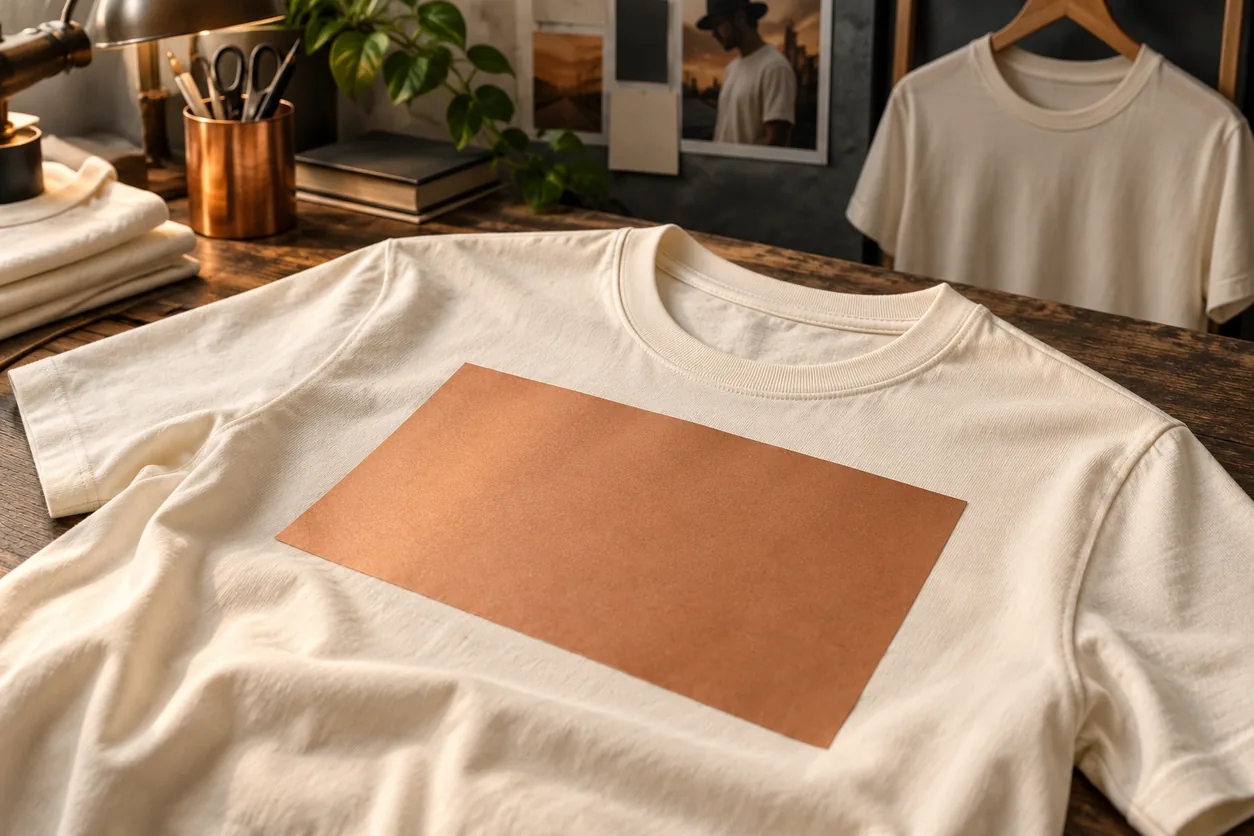
AI-generated decoration-planning concept. The copper rectangle is a visual placeholder, not a measured print area, approved artwork or tested decoration limit.
The fictional Marker Tee is intended to carry one graphic on a shape the founder already likes. If a specific physical blank meets that brief, first record its supplier reference, size, material information and condition. Inspect the neckline, shoulder, sleeve, body length, seams, drape and coverage before treating it as a suitable base. Do not let the intended graphic hide a fit problem.
Ask which colors and sizes are currently available and how that availability will be confirmed at the relevant order stage. A displayed color selection does not establish the quantity available for your order. If the proposed blank changes between the sample and production, ask for the difference to be identified and reviewed rather than silently accepting it as an equivalent.
Then review the decoration on the actual proposed garment. Artwork appearance, placement and interaction with seams need a defined submission. A print that looks appropriate on a regular-length tee may sit differently on a cropped body or across the offered sizes. Use the large T-shirt print-placement guide when specifying that relationship.
An established garment can reduce some design decisions if you accept its existing specification. It does not remove the need for sample checks, traceable instructions or an accurate order breakdown. Nor does this route automatically establish a lower price or faster confirmed schedule. Compare the actual included work and confirmed availability, not a general assumption about blanks.
Treat a digital base as an identified proposal
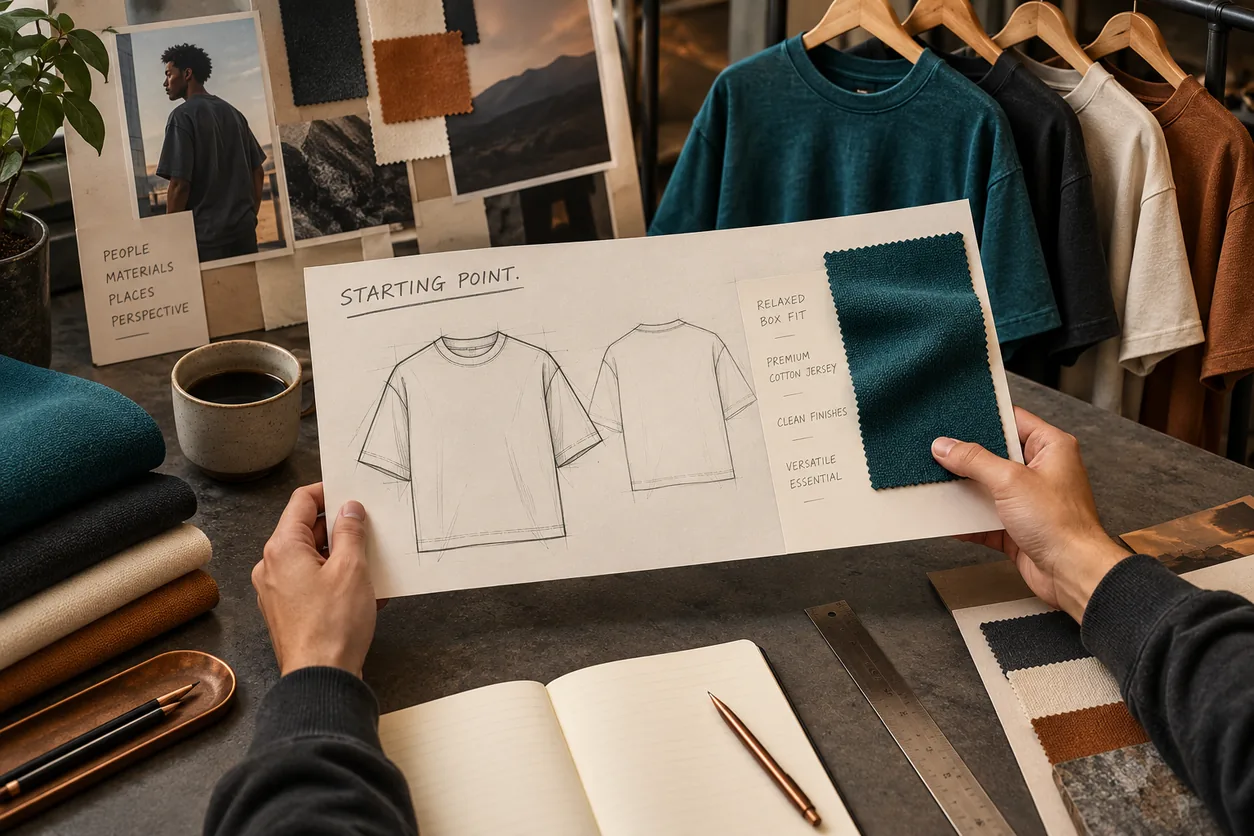
AI-generated starting-point illustration. Any descriptive notes on the sheet belong to the fictional concept; they do not verify fiber content, fabric mass, fit or inventory for an Athletic Rush garment.
A digital base can help a new founder explain the desired outline, graphic position or color direction. Record the exact page or design reference so that “the boxy white one” does not become an instruction that several different garments could satisfy. Then list which visual details you intend to keep and which are only a starting suggestion.
For a real website reference, the Athletic Rush Boxy Cropped T-Shirt — True White Clean Reactive Solid describes a wide shoulder, high-hip crop and straight hem. Those are useful talking points for a silhouette discussion. The page is a catalogue reference, not the fictional teal Contour Box Tee, proof of stock or evidence that a finished sample has been measured.
Compare the relevant silhouettes on the Athletic Rush T-shirt development page, then send the selected reference with your requested changes through the enquiry route. Do not assume an online preview establishes the final material, construction or approved fit. Ask which of those inputs are already defined and which require a supplier proposal.
For example, “use this outline but make the body longer” still needs an identified target and measurement method. Ask whether the supplier proposes adapting an existing pattern or developing a different one. If you also change the fabric and sleeve, record those linked changes. You are no longer asking the sample to demonstrate body length alone.
Use pattern development when the required shape needs it
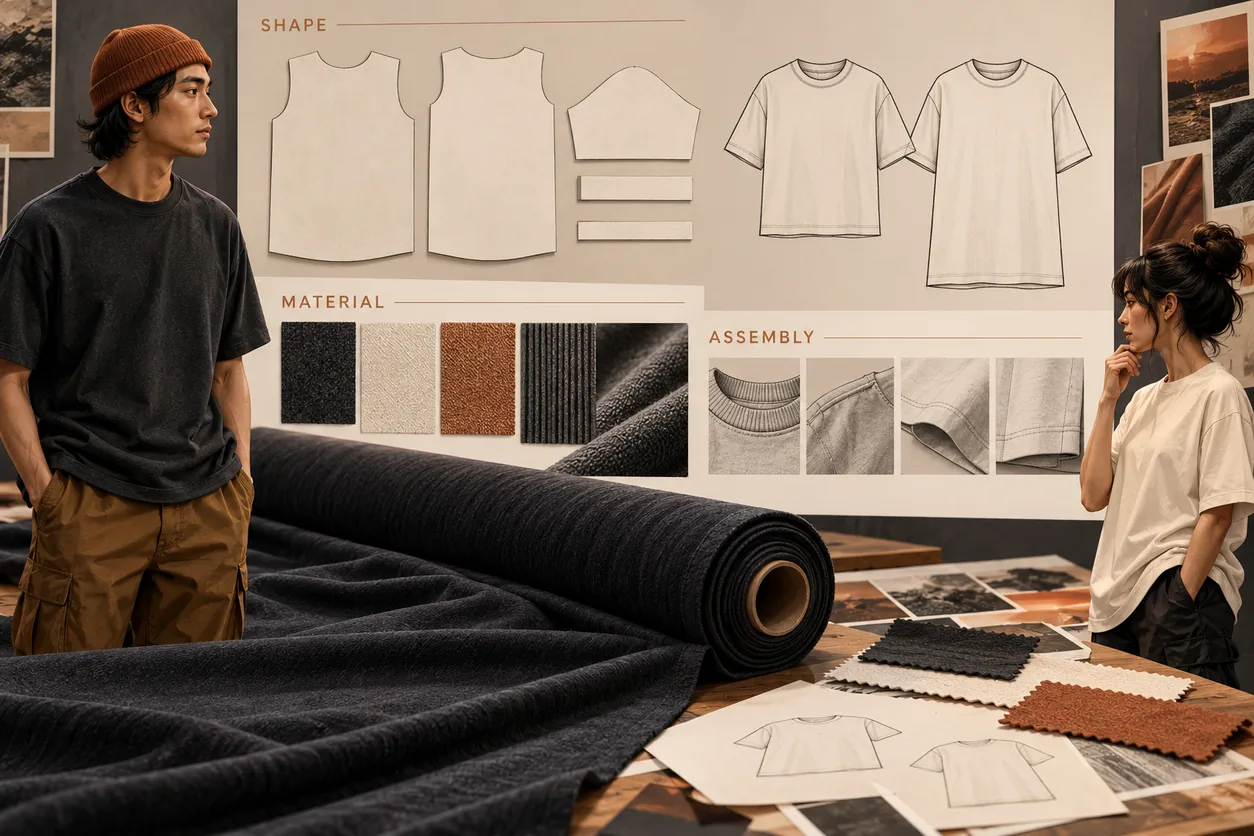
AI-generated construction-planning concept. The paper pieces and sketches illustrate linked decisions; they are not graded patterns, accurate cutting templates or approved technical files.
The fictional Contour Box Tee needs a specific body-to-sleeve relationship, high neckline and intended hem position. If the identified existing proposal does not meet that requirement, write what should change and what should stay. A broad adjective such as “oversized” cannot settle all those relationships for the sample room.
Build a clear front-and-back drawing, measurement map and construction description. Identify the fabric proposal and relevant components, such as the neck rib. Where a detail is unresolved, ask for a proposal rather than presenting a guessed value as an approved instruction. The streetwear tech-pack and sampling-brief guide provides a practical way to organize those inputs.
Techpacker's garment specification-sheet guidance explains the use of measurement instructions, size information and tolerances in a garment specification. Apply that principle to the actual design: identify where a measurement starts and ends, its unit and the garment condition. The source does not provide a universal measurement chart or pass limit for your tee.
Ask how the sample-size review connects to the intended size range. Accepting one body length in one size does not establish the full grade or the relationship between every sleeve and body size. Refer to the T-shirt size-chart guide when distinguishing garment dimensions, wearer information and customer-facing size guidance.
Pattern scope also needs a written commercial discussion. Confirm what files or reference materials will be delivered or retained, which revisions are included, who can use them and how future changes will be handled. Do not assume exclusivity, ownership or file access from the words “custom pattern.” This guide does not set those terms for Athletic Rush; ask for the applicable arrangement for the actual project.
Cut and sewn does not automatically mean your own exclusive pattern
As a specific industry example, Printful's explanation of all-over-print products describes artwork printed onto fabric before the product is cut and sewn. That demonstrates a process sequence; it does not establish that the buyer commissioned an exclusive new silhouette. The example is limited to that provider's described process and does not imply Athletic Rush uses Printful or offers the same service, pricing or turnaround.
Ask the actual supplier what the phrase means in their proposal. Is the garment being made using a defined existing shape, adapting a base, or developing a new pattern against your specification? Those questions are more useful than assuming a process name tells you the degree of design control.
Compare complete proposals without mixing the variables
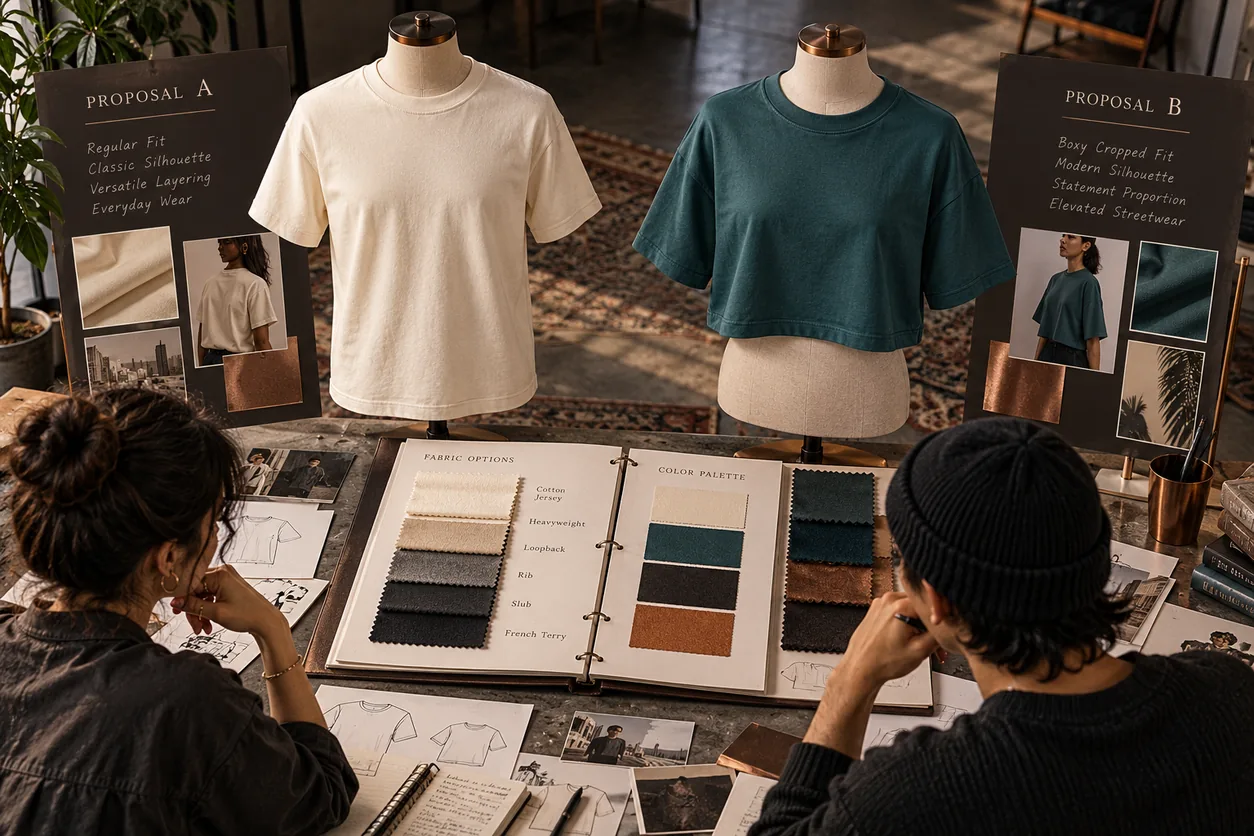
AI-generated proposal comparison. The silhouettes, swatches and display notes are fictional design directions, not measured performance results, quality scores or approved materials.
If a cream regular tee and a teal boxy tee use different fabrics, shapes and construction, evaluate them as two complete proposals. You can decide which better serves the product brief, but you cannot attribute every difference to the starting route. A heavier-feeling sample may also have a different cut or finish; a different hem position may come from the pattern, size or care condition.
Where you need to investigate one variable, hold the relevant others constant when practical, or disclose the differences. If the supplier cannot offer the same material on both proposals, note that limitation. Review the garment worn in its intended context as well as laid flat. A silhouette that photographs strongly may create a different experience during sitting, reaching or layering.
| Buyer requirement | Question for the supplier | Evidence to review |
|---|---|---|
| Keep an existing fit | Which exact blank or approved pattern and size does this reference identify? | Identified physical garment and measurements |
| Change the body proportion | What pattern or specification changes are proposed, and what stays fixed? | Defined drawing, measuring points and revised sample |
| Add a large graphic | Which garment, sizes and decoration route are included in the proposal? | Actual-size artwork and complete decorated sample |
| Change fabric or finish | Which construction and care decisions need to be reopened? | Identified material proposal and appropriate complete-garment checks |
| Build more than one fit | Are these separate designs, and how will the range be sampled and quoted? | Separate design records, samples and confirmed quantities |
For material selection, the oversized T-shirt fabric guide helps connect drape, weight, coverage and construction to the intended shape. If a material or finish changes, the after-wash color-and-fit review guide explains why care observations and worn fit should remain distinct outcomes. Neither a digital preview nor a process label substitutes for that evidence.
Write a handoff with fixed, proposed and check items
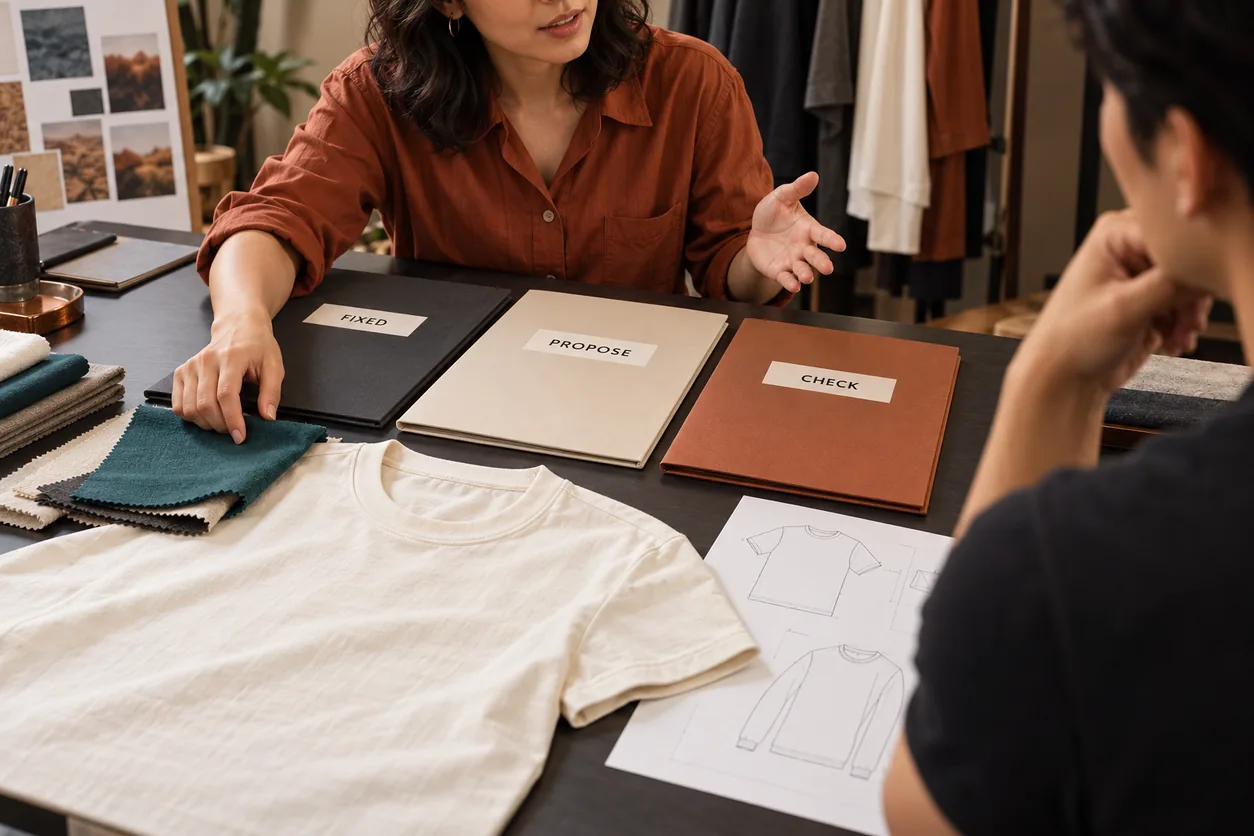
AI-generated handoff concept. The folders and garment details illustrate an enquiry structure, not a signed agreement, real customer project or approval to begin production.
Split the brief into three useful groups. Fixed means a specific requirement or reference you want preserved. Propose means the supplier should identify a feasible option and its implications. Check means the evidence you need before accepting that option. This avoids disguising an open decision as a final instruction.
For the Marker Tee, the fixed item might be an identified existing garment shape. The proposed item could be the decoration route for the final graphic, and the check could be placement and appearance on the actual garment. For the Contour Box Tee, the fixed item might be the intended silhouette relationship, while the supplier needs to propose the exact pattern, material assembly and sample route to achieve it.
Use this copyable enquiry:
Streetwear sampling-route brief
Brand, U.S. wearer and product role: [graphic tee, silhouette-led piece or coordinated drop].
Starting reference: [physical blank identity, exact catalogue page or existing technical brief].
Required garment features: [fit, body and sleeve relationship, neckline, seams and wearing context].
Features to keep: [identified references, material or construction details].
Supplier proposals needed: [blank availability, pattern adaptation, new pattern, fabric, trims or decoration].
Sample evidence requested: [size, garment identity, relevant care state, fit observations and artwork review].
Size and color scope: [offered range and separate design records].
Quantity: [per-design breakdown, distinguishing assumptions from confirmed requirements].
Commercial clarification: [included development, revisions, files, availability, timings and shipping separately].
Next decision: [who reviews which version and what remains open].
Preserve the agreed version when the proposal changes. Techpacker's documentation on creating tech packs recommends version records at development stages and manufacturer handoffs. The useful principle is to retain which instructions were reviewed. A simple controlled document can do that; no software subscription is required by this guide.
Keep route choice separate from design count and quantity
A starting route does not decide the minimum or how many designs the order contains. A single logo applied to two different garment proposals should not automatically be treated as one confirmed manufacturing design. Ask how the actual silhouettes, decoration and other changes will be counted before distributing pieces across them.
At Athletic Rush the current minimum is 30 pieces per design, with one to three colors and mixed sizes within that same design. Every different design requires its own 30 pieces. If two proposed silhouettes are confirmed as two designs, 30 pieces for each means 60 pieces across the pair. That arithmetic is not a quotation or confirmation that a particular change is a new design; the supplier must classify the actual proposals.
The streetwear design-count guide helps separate garment proposals from retail variants. Once the designs are confirmed, use the size-and-color order breakdown guide to make the quantities add up. Do not use an attractive range of mockups as evidence that every combination is available or commercially sensible for the first order.
Questions new brands ask about starting routes
Is a base design the same as a ready-to-ship blank?
No. A catalogue reference may communicate a garment direction without establishing physical stock, complete specifications or a production-ready sample. Ask what exists for that exact reference, which features are defined and what the supplier must develop for your order.
Do I need a new pattern to make my first clothing brand look original?
Not automatically. Decide which garment features matter to your product identity and whether an identified existing proposal meets them. If the required fit or construction is not available, discuss adaptation or new-pattern development. Review the actual result rather than equating originality with one process label.
Can I compare quotes for blanks and custom-pattern garments directly?
Only after identifying the different scope. Compare the garment, material, decoration, sampling, revisions, file arrangements, quantity and delivery basis. A lower amount for a different garment is not an equivalent offer. Use the manufacturing quote-comparison guide to resolve those differences.
What must be approved before choosing a route for bulk production?
Approve an identified complete garment and the instructions relevant to the confirmed scope, including the open fit, material, decoration and size decisions. A route selection is an agreement about how to develop the proposal; it is not by itself a production approval or proof that every size and color has been checked.
Discuss the starting point that fits your actual product
Athletic Rush develops and manufactures apparel in Sialkot, Pakistan, serving U.S. clothing-brand enquiries. Bring the exact reference and the garment features you want to preserve or change through the Athletic Rush quotation and development enquiry, email kamran@athleticrush.co, or message Athletic Rush on WhatsApp.
Samples take 4–6 working days. Bulk production takes 8–10 working days for orders up to 100 pieces; larger orders depend on quantity, and shipping time is separate. Confirm the scope, availability, review requirements and start basis for the actual project. Do not assume a digital starting point removes the development work or that one route carries an automatic price or delivery advantage.
Your next step is to identify the garment requirement, choose the starting reference and ask for a proposal whose sample can answer the remaining questions. That gives the brand and supplier a concrete product to discuss before either relies on the word “custom.”